
 E-mail us
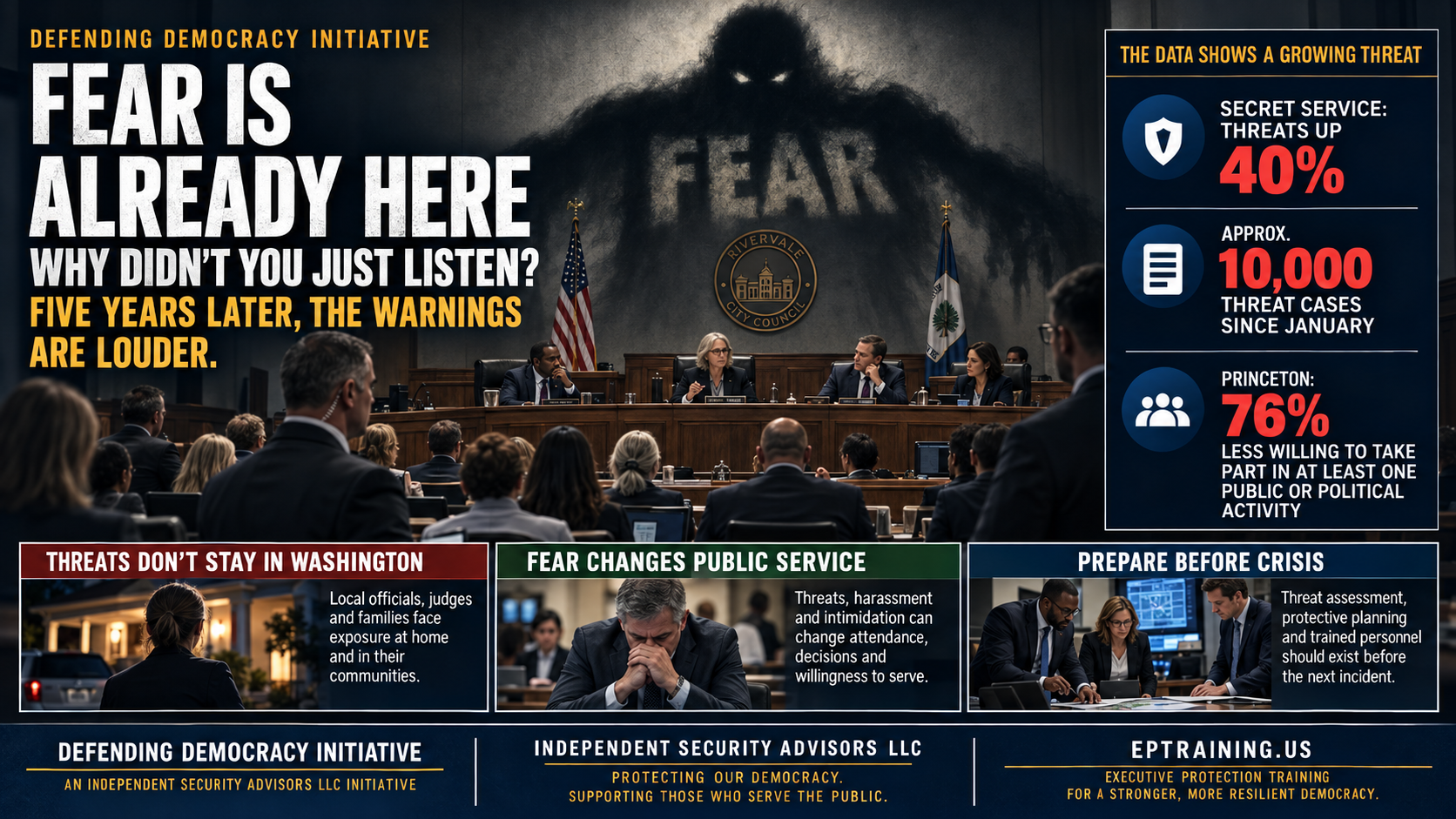
Fear Is Already Here: Why Didn’t You Just Listen? Five Years Later, the Warnings Are Louder.
Threats against elected officials
The Secret Service Reports a 40% Increase in Threats. Princeton Documents How Fear Is Affecting Public Officials.
By Matthew C. Parker
Independent Security Advisors LLC | EPTraining.us
Defending Democracy Initiative | October 18, 2026
Abstract
“Why the focus on elected public officials?” “Why establish the Defending Democracy Initiative?” “There’s no money for training local law enforcement.” “There’s no interest by the private sector in protecting politicians.”
I have heard these questions and comments for years, usually when discussing why Independent Security Advisors spends time helping state and local law enforcement prepare to protect elected and appointed public officials. In 2011, ISA began providing dignitary and executive protection training to law-enforcement personnel, initially at no charge. In 2017, we established the Defending Democracy Initiative to address threats against public officials and the need for trained protective personnel in their communities.
On May 25, 2021, I published an article titled Why Didn’t You Just Listen? We had already witnessed serious attacks against members of Congress, canceled public appearances, threats against officials and their families, and congressional requests for additional security. Those incidents raised questions about the availability of trained protective personnel, particularly when officials returned to their home communities. We had been discussing those problems and recommending solutions for years.
Five years later, the United States Secret Service reports that threats against its full-time protectees have increased by slightly more than 40 percent. Princeton University has separately documented how hostility and fear are affecting the willingness of local elected officials to participate in public events, address controversial issues, and seek reelection.
The new findings bring us back to the questions we were asking in 2017 and again in 2021. How many state and local agencies now have personnel trained to protect their own officials? What plans have they developed for responding to serious threats, and what arrangements exist for obtaining additional personnel when necessary? More importantly, what has actually changed during the five years since I asked why nobody was listening?
Bottom Line Up Front
During an October 11, 2026, interview with CBS’s 60 Minutes, Secret Service Director Sean Curran reported that threats against the agency’s full-time protectees had increased by slightly more than 40 percent compared with the previous year. He also reported approximately 10,000 threat cases involving Secret Service protectees since January. Princeton University’s Bridging Divides Initiative separately reported that 76 percent of surveyed local elected officials had become less willing to participate in at least one important political or civic activity because of concerns about hostility.
These findings measure different things. The Secret Service figures concern its protectees, while Princeton’s survey measures the experiences and reported willingness of local elected officials. Neither establishes a national threat rate for all public officials, but both raise questions about the resources available to protect officials who do not have permanent security details.
Since 2017, ISA’s Defending Democracy Initiative has recommended specialized training for state and local law enforcement, better coordination between agencies, and the use of properly qualified reserve officers and private protective personnel when appropriate. Those recommendations were repeated in our May 2021 article because the same problems continued to appear in congressional security discussions and government reviews.
The question now is not whether threats against public officials deserve attention. It is whether the agencies responsible for protecting them have made measurable improvements in their training, planning, and ability to respond.
Readers’ Navigation
- Why Didn’t You Just Listen? The 2021 Warning
- Five Years Later, the Secret Service Reports More Threats
- Princeton Measures the Effect of Fear
- Congress Was Warned About Protection Outside Washington
- What ISA Recommended and What We Have Done
- Protection Should Allow Public Officials to Serve
- Five Years Later, What Has Changed?
- Frequently Asked Questions
- Related Articles and Sources
- About the Author
- SEO and Publication Information
Why Didn’t You Just Listen? The 2021 Warning
On May 25, 2021, I published Protection for Elected Officials, Part 6: Why Didn’t You Just Listen?.
I opened that article by recalling Lieutenant General Russel L. Honoré, my former brigade commander, and his well-known question during Hurricane Katrina about people being “stuck on stupid.” General Honoré had been assigned to oversee a review of Capitol security following the January 6 attack. I wondered what he must have been thinking as he examined security problems that had already been discussed for years.
At the time, Representative Liz Cheney had publicly reported that members of Congress expressed fear for their personal safety while considering impeachment. According to Cheney, some feared that voting according to their judgment could place them in danger. That was a serious allegation, particularly because it suggested that threats might influence how elected representatives performed one of their most important responsibilities. But after years of attacks and threats against members of Congress, I questioned why anyone was surprised.
On January 8, 2011, Representative Gabrielle Giffords was shot while meeting constituents in Arizona. On June 14, 2017, Representative Steve Scalise was seriously wounded during the attack on congressional baseball practice in Alexandria, Virginia. Other members of Congress had canceled appearances or missed congressional activities because of security concerns. Representative Frederica Wilson remained in her Florida district in October 2017 following threats, while Representative Maxine Waters canceled scheduled appearances in June 2018 after receiving threatening communications.
These were incidents involving elected officials who had publicly described the threats they faced and, in some cases, changed their schedules because of them. Threats were already affecting public appearances and official responsibilities, yet congressional security discussions continued to return to many of the same questions about personnel, funding, and protection outside Washington.
ISA had been preparing state and local law-enforcement personnel for protective assignments since 2011 and publishing articles about the protection of elected officials since 2017. We had contacted elected officials, offered assistance, and discussed protective training with law-enforcement and police training personnel. We also examined how properly trained reserve officers and qualified private protective professionals might support agencies that lacked sufficient personnel to provide regular protective services.
Our concern was not that local police officers lacked the ability or willingness to protect someone. It was that many had never received specialized training in dignitary or executive protection. An experienced patrol officer may be well qualified to investigate crimes, respond to emergencies, and enforce the law but have little training in advance work, protective planning, transportation security, or coordinating a protective detail. When that officer is assigned to protect a mayor, judge, prosecutor, or member of Congress, those responsibilities become part of the assignment whether the officer has received the necessary instruction or not.
By May 2021, ISA had spent ten years developing and providing training intended to address those problems. That history explains my frustration when the Capitol Security Review Task Force and members of Congress were again discussing issues that had been raised years earlier.
Five Years Later, the Secret Service Reports More Threats
On October 11, 2026, Secret Service Director Sean Curran appeared on CBS’s 60 Minutes to discuss the threat environment facing the people his agency protects. Curran reported that threats against its full-time protectees had increased by slightly more than 40 percent compared with the previous year. He also reported approximately 10,000 threat cases since January.
These figures require some explanation because a reported threat is not the same as an attempted assassination or a confirmed plan to commit violence. Threat investigations involve different forms of communications, behavior, and circumstances. Some individuals may lack the intention or ability to carry out an attack, while others may present a serious danger. Investigators must evaluate the available evidence, determine the seriousness of the situation, and decide what action is appropriate.
The reported 40 percent increase also does not establish that threats against every governor, mayor, judge, prosecutor, or county commissioner have risen by the same amount. The Secret Service protects a particular population, and its statistics concern that population. Applying those figures to every public official would be misleading.
My interest is in the officials who do not have comparable protective resources. Consider a county commissioner who receives threatening messages after a controversial vote, a judge whose home address has been published online, or a mayor whose family begins receiving threats. In most communities, local law enforcement will be responsible for evaluating those complaints and deciding whether additional security is necessary.
Depending on the circumstances, the agency may need to conduct an investigation, recommend improvements to residential security, increase patrol attention, or arrange personal protection. If a protective detail becomes necessary, the department must identify qualified personnel, assess the locations the official will visit, prepare transportation arrangements, establish communications, and coordinate with other agencies. Those responsibilities are substantially different from normal patrol duties.
Not every threatening message justifies assigning officers to protect someone. But agencies need procedures for evaluating threats and determining when additional resources are required. If a threat exceeds the department’s capabilities, the responsible personnel should know where qualified assistance is available and how to obtain it.
ISA was asking these questions years before the October 2026 Secret Service interview. The agency’s latest figures do not tell us how prepared local departments are, but they provide another reason to examine whether communities have the resources and training necessary to protect their own officials.
Source: CBS News, 60 Minutes, October 11, 2026
Princeton Measures the Effect of Fear
The Secret Service figures concern threats involving federal protectees. Princeton University’s Bridging Divides Initiative has been examining a different issue: how hostility and threats affect the willingness of local elected officials to perform public duties.
On July 23, 2026, Princeton released findings from a survey of more than 460 local elected officials conducted with CivicPulse during the first quarter of the year. Fifty-four percent of respondents reported experiencing at least one form of hostility during the preceding three months, including insults, harassment, threats, or physical attacks. Seventeen percent specifically reported threats, while one percent reported physical attacks.
The findings concerning participation in public life were particularly troubling.
| Reported effect of concerns about hostility | Percentage |
|---|---|
| Less willing to participate in at least one political or civic activity | 76% |
| Less willing to work on controversial issues | 47% |
| Less willing to seek reelection | 43% |
| Less willing to participate in public events | 37% |
| Less willing to use social media | 64% |
Source: Princeton University, Bridging Divides Initiative, July 23, 2026.
The survey measures what officials reported about their willingness to participate. It does not establish that particular votes were changed, that every reported concern involved a credible threat, or that all respondents subsequently withdrew from those activities. Those limitations are important, but they do not change what the survey tells us about the concerns expressed by local officials.
We elect people to make decisions affecting their communities, and some of those decisions will be controversial. Citizens have every right to disagree with their representatives, criticize their decisions, organize protests, and demand accountability. There is a difference, however, between expressing opposition to a public official and threatening that person or their family in an effort to influence official conduct.
When a county commissioner avoids addressing a controversial issue because of intimidation, the subject may not receive proper consideration. When a mayor becomes reluctant to attend public events, constituents have fewer opportunities to meet their representative. When a qualified individual becomes unwilling to seek reelection because of threats, intimidation may affect who remains in public office.
These concerns are not new to the Defending Democracy Initiative. In November 2017, we published Security for Elected Officials, Revisited, examining the consequences of members of Congress missing votes because of threats. We asked whether intimidation that prevented elected representatives from carrying out their responsibilities was also interfering with the democratic process.
Princeton’s research does not prove that specific legislative outcomes have changed because of threats. It does show that substantial numbers of surveyed local officials report becoming less willing to perform activities associated with public office because of hostility. That is an issue that law-enforcement agencies and public officials need to consider when evaluating threats and deciding what protective measures may be necessary.
Source: Princeton University, Bridging Divides Initiative, July 23, 2026
Congress Was Warned About Protection Outside Washington
One of the issues examined in my May 2021 article concerned security for members of Congress when they returned to their home districts. In January of that year, thirty members of the House of Representatives wrote to congressional leadership requesting additional security resources and greater flexibility to obtain protection, including security at their residences. Their request acknowledged that local law-enforcement agencies were often stretched thin and lacked sufficient personnel or funding to provide regular protection.
The problem sounded familiar because ISA had addressed it in articles published in 2017. In Protection for Elected Officials, Times Are a Changing, published June 28, 2017, I discussed using local and state police, properly trained reserve officers, and qualified private protective personnel to provide security for members of Congress in their home districts. We also addressed the cost of permanent protection and the need to determine security requirements through threat assessment rather than assuming every official required the same level of protection.
In 2021, the Capitol Security Review Task Force overseen by Lieutenant General Honoré examined similar problems. Its review identified limited and inconsistent protection for members of Congress at home, while traveling, and when working in their districts. It also addressed the need for a more consistent approach to providing protective resources based on assessed threats.
The findings were consistent with concerns we had raised in earlier articles. We had recommended preparing local law-enforcement personnel to perform protective assignments and considering the use of qualified private protective personnel where appropriate. Those recommendations recognized that not every community could afford permanent protective units and that some assignments might require assistance from more than one organization.
There was also a separate issue concerning congressional security funding. Members already had authority to use certain official resources for security associated with their duties, but protecting members and their families at private residences raised additional questions about authorized expenses. We examined those distinctions in 2021 because funding, legal authority, and the availability of qualified personnel are separate problems.
An official may have money available for protection but no qualified personnel to hire. A police department may have experienced officers but lack specialized protective training, while another agency may have trained personnel but no established procedure for assisting officials outside its jurisdiction. Resolving those problems requires planning, training, and coordination before an emergency develops.
What ISA Recommended and What We Have Done
In 2011, ISA was invited by Robert Mueck, then director of the University of Maryland Public Safety Academy, to provide dignitary and executive protection training to local and state law-enforcement personnel. The initial training was offered at no charge. In our June 2017 article, I reported that more than 200 officers, deputies, and state troopers, along with approximately twenty federal law-enforcement or security personnel, had attended the early training. By May 2021, ISA reported that more than 300 law-enforcement personnel had attended its dignitary and executive protection training. These are the figures we published at the time, not current enrollment totals.
The training addressed responsibilities that local agencies might encounter when assigned to protect an elected or appointed official. Those responsibilities included advance planning, threat assessment, protective operations, transportation, emergency procedures, and coordination with other personnel. We wanted officers to understand how a protective assignment should be organized and what was required beyond simply accompanying the person being protected.
We also recommended that agencies consider using properly trained reserve or auxiliary officers where permitted by law. In jurisdictions where those resources were unavailable, qualified private protective professionals could provide another source of assistance. Each option requires appropriate training, legal authority, and supervision. Neither a police uniform nor a private security license establishes that someone is prepared to conduct an executive protection assignment.
A small department may not be able to establish a permanent protective unit, but it can identify officers for specialized training, develop procedures for evaluating threats, and determine what resources are available from neighboring departments or state agencies. Regional training programs and state law-enforcement academies can also help by making protective instruction available to personnel who may be assigned these duties.
Federal protective training opportunities exist, including programs offered through the Federal Law Enforcement Training Centers and protective seminars conducted by the Secret Service. These programs provide instruction to eligible state and local personnel, but departments still need to establish their own protective procedures and train officers for assignments involving officials within their jurisdictions. Instruction associated with supporting federal operations does not automatically establish that an agency can independently organize and supervise protection for its mayor, governor, judge, or other official.
 Our Defending Democracy Initiative also shares its purpose with the United States Presidential Service Badge Foundation, which has partnered with ISA to help prepare state and local law enforcement. Both organizations want officers trained to protect elected and appointed officials in their own communities and, when necessary, to support federal protective operations. The investigations following the July 2024 assassination attempt in Butler, Pennsylvania, documented serious failures in communications and coordination between federal, state, and local personnel. Those findings reinforced the need for agencies to understand protective operations, establish clear responsibilities, and coordinate effectively when working together.
The Foundation partnership supports the same work ISA has pursued through the Defending Democracy Initiative since 2017. Our principal objective remains preparing state and local officers to protect the officials who serve their communities.
Some people have questioned why ISA devotes resources to training agencies that may have limited budgets. Our original program began with free instruction because local officers were being assigned protective responsibilities for which they needed additional preparation. We subsequently expanded the curriculum, obtained state training approvals, and continued providing instruction to law-enforcement and private protective personnel.
The requests that led to the original program have not disappeared. Local agencies are still responsible for evaluating threats against public officials and arranging protection when circumstances require it. Many departments continue to face difficult decisions about personnel, training, and available resources, which is why ISA has continued to address these subjects through its training and Defending Democracy articles.
Protection Should Allow Public Officials to Serve
In our June 2017 article following the shooting of Representative Steve Scalise, I addressed objections raised by members of Congress who believed additional security might separate them from their constituents. Some worried that protective personnel would create barriers between elected representatives and the public, while others were concerned about the appearance and behavior of security personnel accompanying them.
I understood those concerns, but I disagreed with the assumption that effective protection required isolating an elected official. A properly trained protective detail should know how to evaluate an event location, coordinate with local authorities, arrange transportation, and prepare emergency procedures while allowing the official to continue meeting the public. The protective team should assist with the official’s activities rather than unnecessarily restrict them.
There will be circumstances when a serious threat justifies changing an event, limiting access, or making other security arrangements. Those decisions should be based on the assessed risk and the measures available to address it. The mere presence of political opposition or an anticipated protest does not establish that a public official needs personal protection.
Princeton’s findings add another consideration to this discussion. If 37 percent of surveyed local elected officials say concerns about hostility have made them less willing to attend public events, then fear may already be limiting public access without any security detail being present. Appropriate protective measures may help an official continue participating in activities that would otherwise raise serious security concerns.
This does not mean every public official requires permanent protection, and it certainly does not mean criticism or lawful protest should be treated as threatening behavior. Public officials must accept that people will disagree with their decisions and express that disagreement. Law-enforcement and protective personnel must distinguish lawful political activity from conduct that presents a genuine security concern.
Political affiliation should have no bearing on whether an official receives an appropriate threat assessment or protective response. The decision should be based on the circumstances, the available evidence, and the level of protection reasonably required to address the risk. The objective is to allow elected and appointed officials to continue performing their duties without unnecessary restrictions or exposure to preventable threats.
Five Years Later, What Has Changed?
When I wrote Why Didn’t You Just Listen? in May 2021, I reviewed attacks against members of Congress, threats that interfered with public activities, requests for additional congressional security, and recommendations from the Capitol Security Review Task Force. ISA had already been training local and state law enforcement for ten years and publishing articles about the protection of elected officials since 2017.
Now, in October 2026, the Secret Service reports a substantial increase in threats against its full-time protectees. Princeton’s research shows that hostility is affecting how local elected officials say they are willing to participate in public life. These findings do not tell us how many state and local agencies have improved their protective capabilities since 2021, nor do they establish that the problems identified in earlier investigations have been resolved.
That is information I would like to see. How many departments have personnel trained in dignitary and executive protection, and how many have established procedures for evaluating threats against elected and appointed officials? Have they identified other agencies or qualified protective personnel who can provide assistance when necessary? Have state law-enforcement training commissions and academies made this training more widely available, and have departments established working arrangements to support protective assignments that exceed local resources?
These questions can be answered by examining agency training records, operating procedures, staffing plans, and mutual-aid agreements. They would tell us considerably more about protective preparedness than another general statement about the importance of public official security.
I do not assume that every department needs a permanent executive protection unit. Many communities could not justify that expense, and the level of protection provided to an official should reflect the circumstances. But when a mayor, judge, prosecutor, or other public official receives a serious threat, the responsible agency should not be trying to determine for the first time how to organize a protective detail.
The department should know which personnel have the necessary training, how the threat will be evaluated, what protective resources are available, and who will supervise the assignment. If additional personnel or expertise are required, the arrangements for obtaining that assistance should already exist.
Those were among the issues ISA was discussing in 2017. They contributed to my frustration in 2021, and they remain relevant in 2026. I would like to believe that in another five years we will have more than additional threat statistics and another series of reports identifying familiar problems.
We cannot prevent every threat or guarantee that a public official will never be attacked. We can, however, evaluate threats, train personnel, identify vulnerabilities, prepare protective operations, and establish working relationships between agencies before an emergency occurs. Those are measurable responsibilities, and we should be able to determine whether agencies are prepared to carry them out.
We have been discussing these problems for years. The Secret Service is reporting more threats, and Princeton is documenting how fear is affecting public officials. What I want to know now is how much better prepared our state and local law-enforcement agencies are to protect the people who serve in public office.
Frequently Asked Questions
What did the Secret Service report in October 2026?
During an October 11, 2026, 60 Minutes interview, Director Sean Curran reported that threats against the agency’s full-time protectees had increased by slightly more than 40 percent compared with the previous year. He also reported approximately 10,000 threat cases involving Secret Service protectees since January. These figures concern people protected by the agency and should not be treated as a national threat rate for all public officials.
Does that mean there were 10,000 assassination attempts?
No. Threat cases can involve different forms of threatening communications and behavior. Some require additional investigation, while others may not present a credible threat of violence. The reported number does not represent 10,000 attempted assassinations or confirmed plans to commit attacks.
What did Princeton University find?
Princeton’s Bridging Divides Initiative surveyed more than 460 local elected officials during the first quarter of 2026. Seventy-six percent reported that concerns about hostility had made them less willing to participate in at least one important political or civic activity. The survey also measured reluctance to work on controversial subjects, attend public events, use social media, and seek reelection.
When did ISA begin training law enforcement to protect public officials?
ISA began providing dignitary and executive protection training to state and local law enforcement in 2011. Its original training effort included free instruction for participating personnel. ISA established the Defending Democracy Initiative in 2017 and has continued advocating specialized training and improved protective capabilities for agencies responsible for protecting public officials.
Should every public official have personal protection?
No. The need for protection should be based on a professional assessment of the circumstances. Some threats may require an investigation or additional security precautions, while others may justify temporary or continuing personal protection. A permanent protective detail is not necessary for every elected or appointed official.
Can private protective personnel support law enforcement?
Yes, where permitted by law and appropriate to the assignment. Private agents must have suitable training, qualifications, and legal authority. Their responsibilities and coordination with law enforcement should be established before they undertake protective duties, particularly when the assignment involves public officials or operations extending across jurisdictions.
What is the purpose of ISA’s partnership with the Presidential Service Badge Foundation?
The partnership supports specialized protective training for state and local law enforcement. Its primary objective is to prepare officers to protect elected and appointed officials within their own communities. The same training can help those officers support federal protective operations when necessary, but the partnership is not a Secret Service training program.
Doesn’t the federal government already provide protective training?
Yes. Federal agencies and the Federal Law Enforcement Training Centers have offered protective-operations training to eligible law-enforcement personnel. Local departments must still determine whether their officers have the training and procedures necessary to protect officials within their own jurisdictions. Supporting a federal protective operation and independently managing a local protective assignment are related but different responsibilities.
What can smaller law-enforcement agencies do if they cannot afford permanent protective units?
Smaller agencies can identify personnel for specialized training, establish threat-assessment and response procedures, and arrange assistance from neighboring departments or state agencies. Properly qualified reserve officers and private protective personnel may also provide support where permitted by law. These arrangements should be established before an emergency requires the agency to provide protection.
Isn’t criticism of elected officials part of democracy?
Yes. Criticism, lawful protest, and political disagreement are essential parts of representative government. They must be distinguished from threats, stalking, unlawful intimidation, and violence. Protective measures should be based on the circumstances and assessed risk, not on an official’s political affiliation or the opinions expressed by critics.
About the Author
Matthew C. Parker is Chief Executive Officer of Independent Security Advisors LLC (ISA) and Director of Training for EPTraining.us. His professional experience includes more than three decades of military service, executive and dignitary protection operations and training, international security advising, and protective program development.
Before retiring from the U.S. Army in 2011, Parker conducted protective operations involving senior U.S. military leaders, trained U.S. and Iraqi protective-security personnel, managed military instructional programs, and taught military science at Virginia Tech.
Since establishing ISA in 2011, he has directed executive protection operations in the United States for international government officials and trade delegations, provided protective services for corporate and private clients, and developed protective programs for financial institutions, insurance companies, and private families.
His international experience includes protective operations and security-advisory assignments in Ukraine, training for Ukrainian police and Judicial Protection Service personnel, and advisory work involving international commerce, diplomatic protection, and democracy-support initiatives.
Through ISA’s Defending Democracy Initiative, established in 2017, Parker has written extensively about threats against elected and appointed officials, the protection of public officials, and preparing state and local law enforcement for protective assignments.
Related Articles and Readers’ Navigation
Protection for Elected Officials, Times Are a Changing — June 28, 2017
ISA’s examination of congressional security following the shooting of Representative Steve Scalise, including local law-enforcement training, reserve officers, and qualified private protective personnel.
Security for Elected Officials, Revisited — November 7, 2017
An examination of how threats against members of Congress can interfere with legislative duties and public representation.
Protection for Elected Officials, Part 6: Why Didn’t You Just Listen? — May 25, 2021
The original article addressing Representative Liz Cheney’s remarks, congressional security concerns, ISA’s previous recommendations, and the Capitol Security Review.
Why Didn’t You Just Listen? A Security Reckoning in Defending Democracy — July 2026
A review of recurring warnings and the need for improved protective preparedness.
Fear Is Already Here: Threats Against Public Officials Are Changing How They Serve — July 2026
An examination of Princeton University’s survey findings concerning threats, hostility, and their effect on local public officials.
A discussion of threats against elected officials and judges, including the effects of intimidation on public duties.
Who Should Protect Elected Officials? Police, Private Security, Reserves, or an Integrated Detail?
An examination of protective resources available to state and local law-enforcement agencies.
Sources and References
- CBS News, 60 Minutes: Secret Service Confronts Rise in Threats to Protectees — October 11, 2026
- Princeton University, Bridging Divides Initiative: Hostility Against Local Officials Is Continuing at Elevated Levels in 2026 — July 23, 2026
- Princeton University: Countering Threats to Local Officials During the 2026 Election Season
- U.S. Senate Homeland Security and Governmental Affairs Committee: Bipartisan Interim Report on Butler — September 25, 2024
- U.S. Department of Homeland Security: Independent Review Panel Report on Butler — October 2024
- U.S. Senate Homeland Security and Governmental Affairs Committee: Final Butler Investigation Report — July 13, 2025
- Federal Law Enforcement Training Centers: Protective Service Operations Training Program
- United States Presidential Service Badge Foundation
- Independent Security Advisors: Protection for Elected Officials, Times Are a Changing — June 28, 2017
- Independent Security Advisors: Security for Elected Officials, Revisited — November 7, 2017
- Independent Security Advisors: Why Didn’t You Just Listen? — May 25, 2021
#DefendingDemocracy #ExecutiveProtection #PublicOfficialSecurity #LawEnforcementTraining #DignitaryProtection #ThreatAssessment #ProtectiveOperations #JudicialSecurity #IndependentSecurityAdvisors #EPTraining