
 E-mail us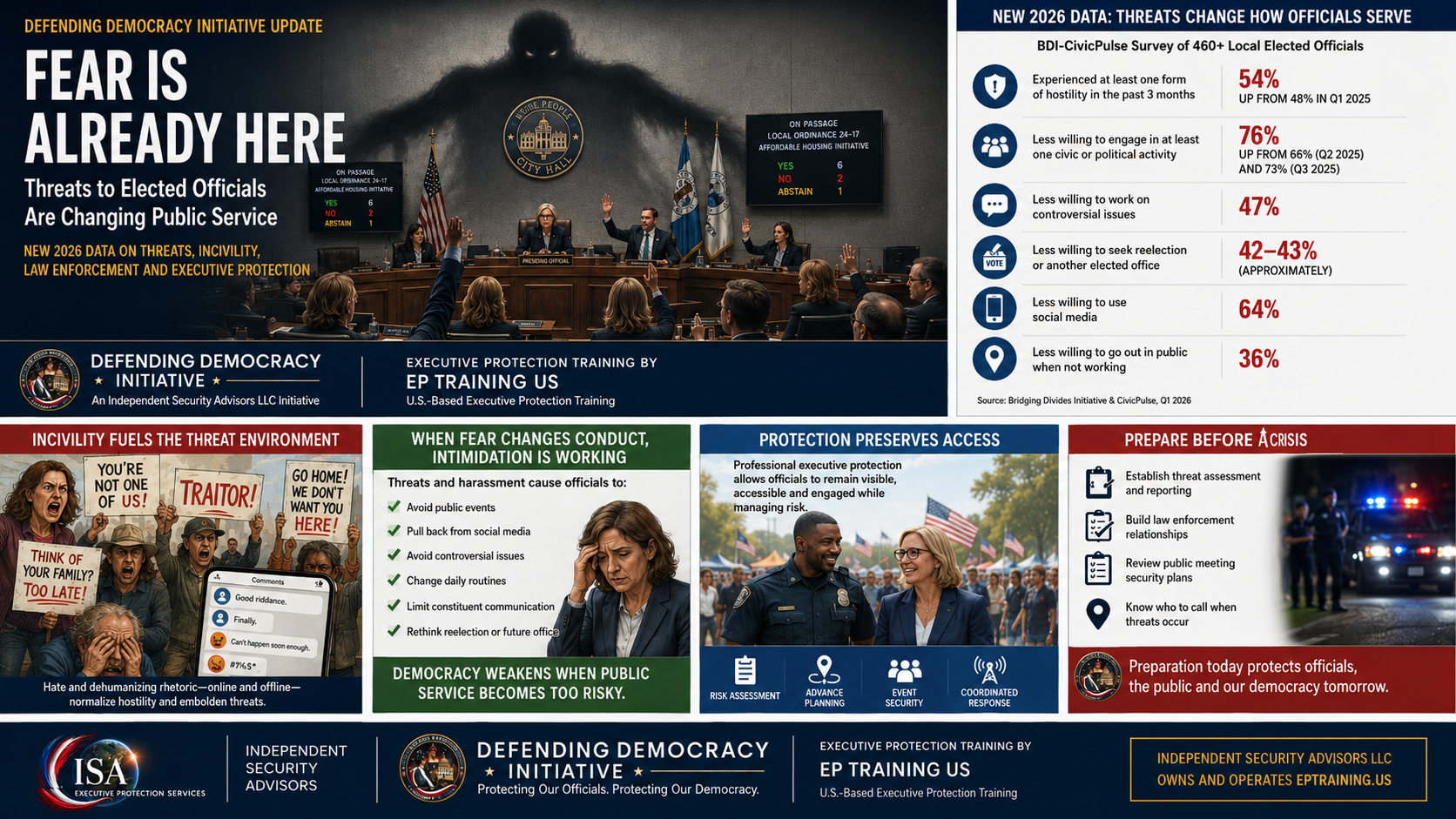
Fear Is Already Here: Threats Are Changing How Public Officials Serve—and How Judges Rule
Threats to elected officials
How Many Times Will We Scream Into the Wind Before We Are Heard?
A Defending Democracy Initiative Update on Threats to Elected Officials, Judges, Political Incivility, Judicial Security and the Need for Protective Preparedness
By Matthew C. Parker
Independent Security Advisors LLC | EP Training US
Updated September 2026
 There are times when new research changes the way we understand a problem. Then there are times when new research confirms what people have been warning about for years and leaves us asking a much more frustrating question: how many times will we scream into the wind before somebody finally listens?
That is where I find myself after reviewing Princeton University’s newest research on threats and harassment against local elected officials and the September 1 Associated Press report on threats against federal judges.
Neither report introduces us to a new problem. What they provide is more evidence, better numbers, and direct testimony showing how far the threat has progressed.
We are no longer talking only about threatening letters, angry social-media posts, criminal investigations, assaults, attempted assassinations or people who ultimately carry out acts of political violence. Increasingly, we are looking at what happens before the violence, when fear itself begins changing how public officials perform the duties entrusted to them.
Princeton’s Bridging Divides Initiative reports that 54 percent of local elected officials surveyed in the first quarter of 2026 experienced at least one form of hostility during the preceding three months. More important for this discussion, 76 percent said concerns about hostility had reduced their willingness to participate in at least one civic or political activity. Forty-seven percent reported becoming less willing to work on controversial subjects, and roughly 42 to 43 percent reported becoming less willing to seek reelection or another elected office. Princeton describes these behavioral effects as accumulating over time. Princeton Bridging Divides Initiative 2026 election-season toolkit
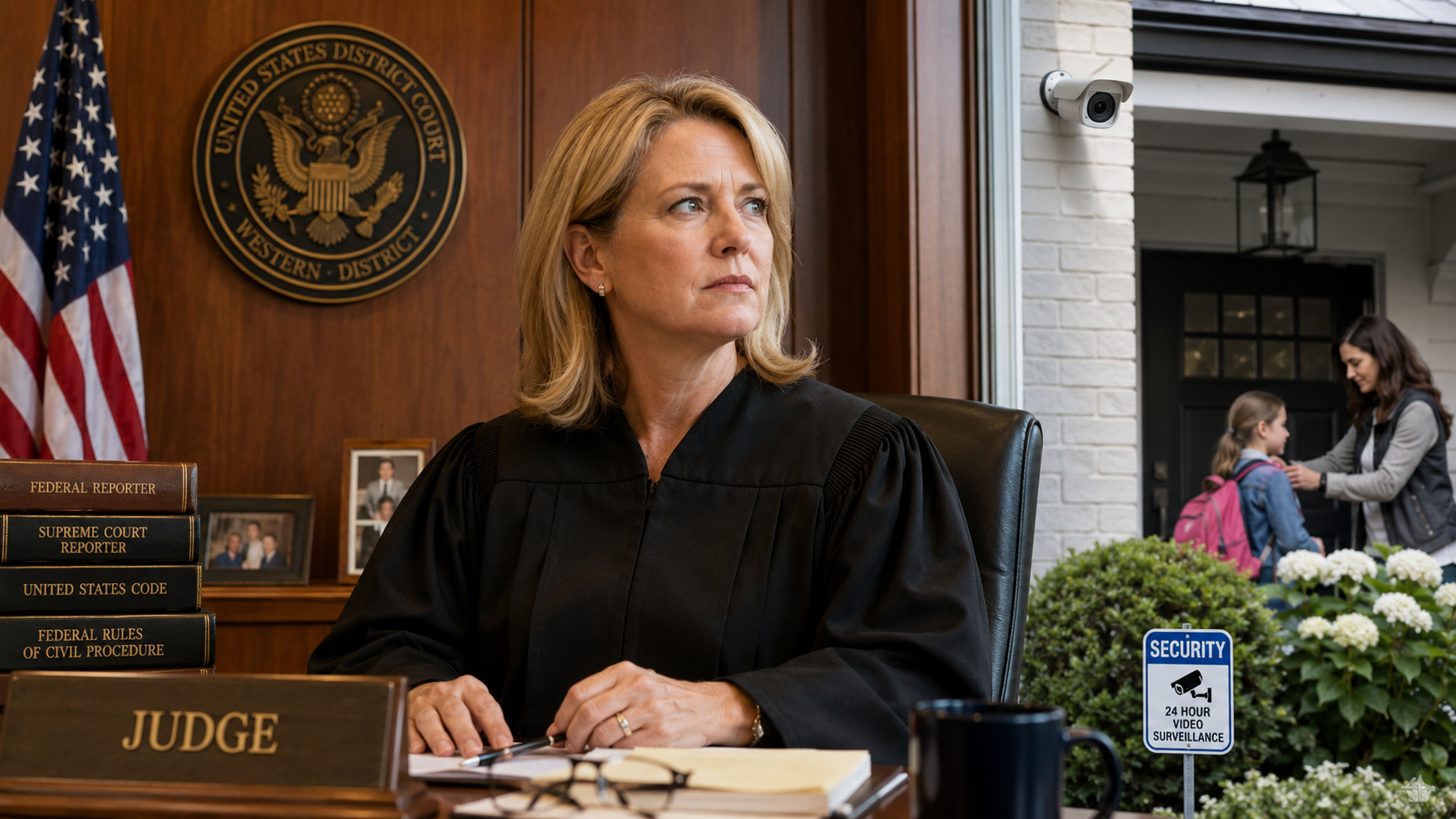 Federal judges are now describing a parallel problem inside the judiciary. Judges interviewed for two recent studies described changing commuting routes, hiring private security, fortifying their homes, installing security cameras and panic buttons, and worrying about the safety of spouses and children. Federal-court security incidents categorized as being of significant concern increased 57 percent during the year ending in September 2025 and were reportedly on pace to increase again in 2026. One judge reported receiving more than 700 threatening telephone calls after information about the judge’s residence became exposed. Associated Press: federal judges describe growing security fears
Most troubling, another federal judge acknowledged considering whether to issue a different ruling because of fear that the legally required decision could place the judge’s family in danger. The judge ultimately followed the law, but only after struggling with the safety implications for nearly an hour.
Think about what that means. An attacker did not have to enter the courthouse, a weapon did not have to pass through courtroom security, and nobody had to physically touch the judge. Fear had already entered the deliberative process.
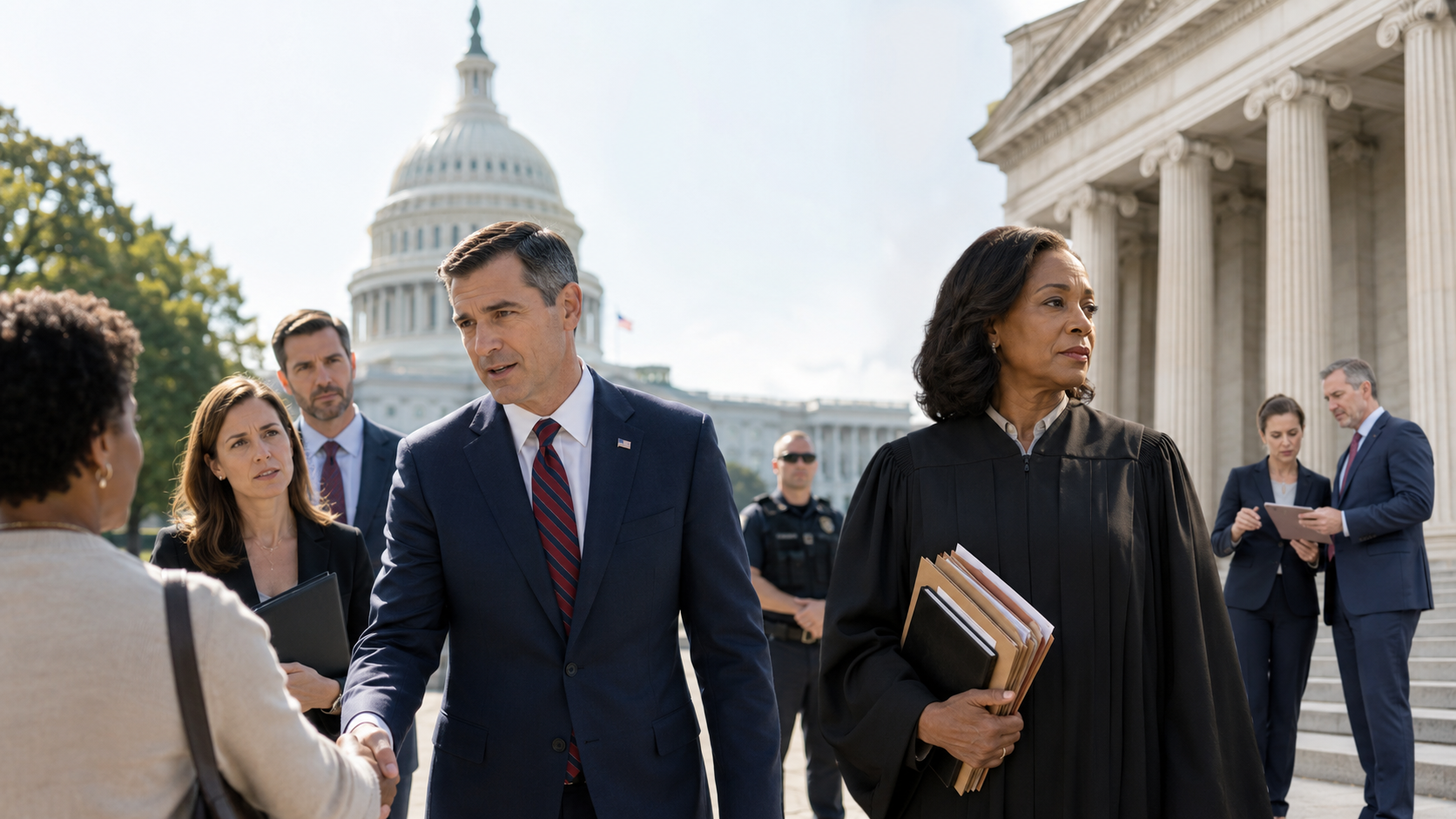
For Independent Security Advisors LLC and our Defending Democracy Initiative, this is precisely the line we have been trying to identify for years. A threat does not have to culminate in an assassination before it damages a democratic institution. When intimidation influences where an official appears, which subjects an elected official is willing to address, whether a candidate remains willing to run, whether a family feels safe at home, or whether a judge has to weigh personal safety while deciding what the law requires, fear has acquired influence it was never entitled to possess.
This is simultaneously a public official security problem and a judicial security problem, but it is larger than either professional discipline. It is about whether threats can interfere with legitimate government functions.
The Numbers Are Not Returning to Normal
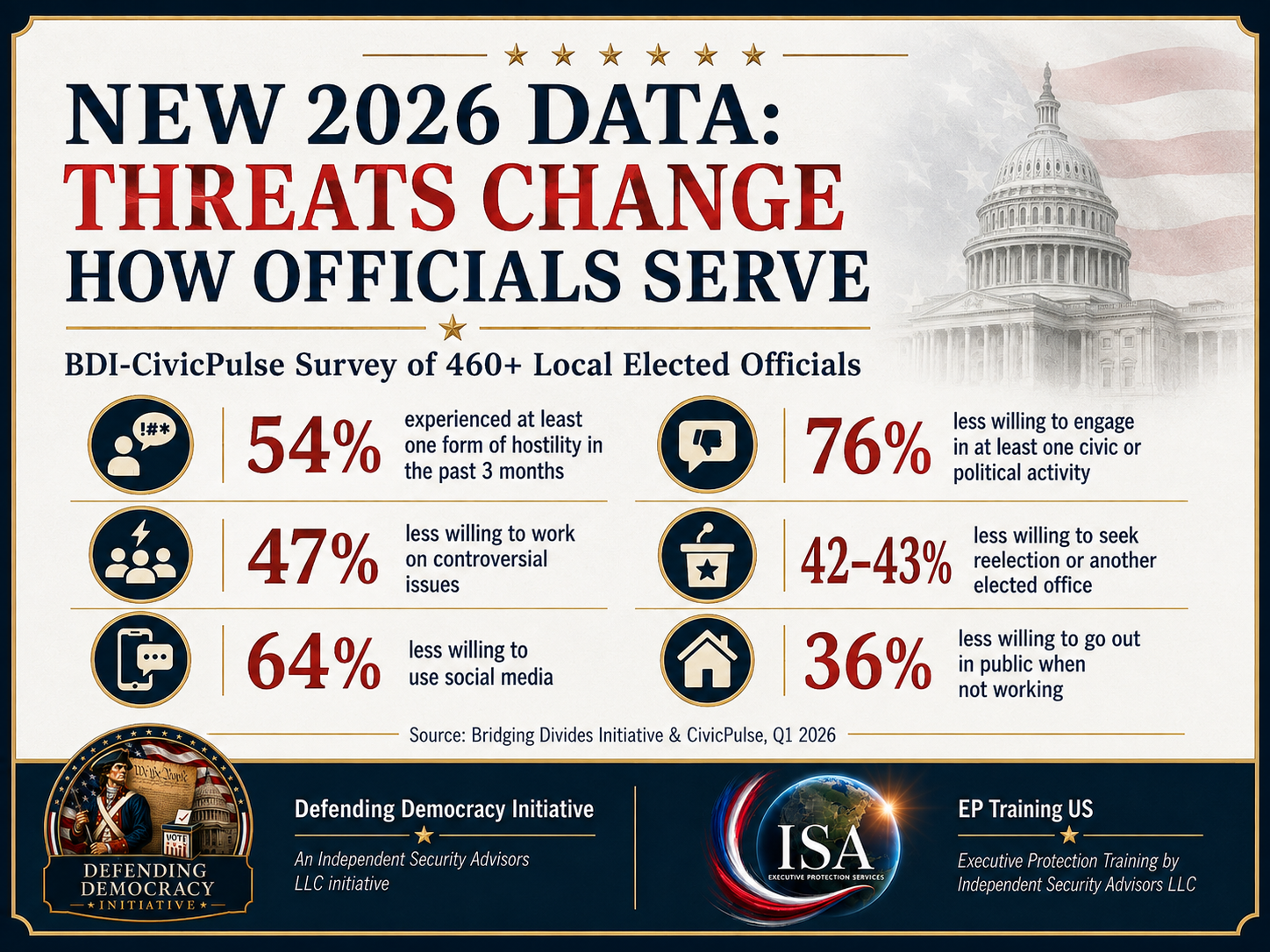 The Princeton findings need to be understood as a trend rather than a single quarterly snapshot. A persistent threat environment does not have to increase at exactly the same rate every quarter to be dangerous. What matters is that officials appear to have been operating inside an abnormally hostile environment long enough for its consequences to become incorporated into their behavior.
We examined that behavioral effect in July in Fear Is Already Here: Threats Against Public Officials Are Changing How They Serve. Princeton’s findings gave us something many earlier discussions lacked: measurable evidence that threats were not merely making public officials uncomfortable. Fear was affecting where they appeared, what issues they were willing to address, how they communicated with constituents and whether they were willing to remain fully engaged in public life.
The federal numbers reinforce the broader trend, although they involve a different population and should not be statistically combined with Princeton’s survey. The United States Capitol Police reported 14,938 concerning statements, behaviors and communications involving Members of Congress, their families, staffs or the Capitol Complex during 2025. The agency has also expanded its relationships with state and local law-enforcement organizations because Members eventually leave Washington and return to communities where those agencies become essential protective partners.
That operational reality is even more important at the state and local level. A mayor, judge, prosecutor, county commissioner, election official, state legislator or school-board member does not generally have a permanent federal protective apparatus following them home. When the threat changes, responsibility frequently falls on a municipal police department, sheriff’s office, state police agency, court-security organization or, where appropriate, qualified private executive-protection personnel.
That responsibility should not arrive as a surprise.
We Did Not Come Late to This Issue
 Every time another official is attacked or another research project confirms elevated threats, the national conversation seems to begin again as though the problem appeared yesterday.
That is not our history.
Independent Security Advisors’ protective-training work reaches back to 2011 and the aftermath of the assassination attempt against Representative Gabrielle Giffords. The operational gap identified then remains familiar today: state and local officers can suddenly be handed responsibility for protecting an elected official, candidate, judge, prosecutor or other public figure even though executive protection is not a routine patrol or investigative function. ISA’s current syllabus still identifies the Giffords attack and the resulting law-enforcement requirement as part of the program’s development history.
By May 2015, ISA was publicly documenting that problem in Executive Protection Training and Defending Democracy. The article described the need to prepare state and local law enforcement for protective assignments involving public officials and candidates, and it became part of a much larger body of ISA writing on the protection of the democratic process. The article remains on EPTraining.us and identifies its original publication date as May 8, 2015.
Then came June 14, 2017, when House Majority Whip Steve Scalise and others were shot during congressional baseball practice in Alexandria, Virginia. Two weeks later, in Protection for Elected Officials, Times Are a Changing, I argued that the country was once again asking questions about congressional security that should already have been addressed.
We rejected the assumption that greater protection necessarily meant separating elected officials from constituents and argued instead that properly designed executive protection for elected officials could help preserve public access. The article was originally published June 28, 2017.
Later that year, threats kept Representative Frederica Wilson away from Washington. In Security for Elected Officials, Revisited, we asked a question that remains central to the Defending Democracy Initiative today: if threats prevent a member of Congress from casting votes and performing legislative duties, are those threats themselves interfering with representative democracy?
By May 2021, my frustration was apparent in the title Protection for Elected Officials, Part 6: Why Didn’t You Just Listen?. Representative Liz Cheney had said that some members of Congress feared for their personal safety when considering impeachment. Once again, the problem was no longer limited to whether somebody might be physically attacked. Fear itself was entering the decision-making environment.
One day later, the discussion explicitly included the judiciary. In Defending Democracy; Dignitary & Executive Protection Training, ISA identified members of the court alongside elected officials, political appointees and others exposed to elevated risk. We addressed protection in depth, threat assessment, risk mitigation, public-event security and emergency planning, while also emphasizing that threats do not conveniently stop at the door of a government facility. The May 26, 2021 article specifically described ISA training for personnel conducting or supporting protection for “elected officials, political appointees, members of the court” and other at-risk principals.
That was five years before the September 2026 federal-judge research.
We did not discover threats against judges after reading this week’s news.
From Repeated Warnings to the Defending Democracy Initiative
The Defending Democracy Initiative developed because repeated incidents demonstrated that individual attacks were part of a larger institutional problem. The question was no longer simply whether a particular official could survive an attack. It was whether threats, intimidation and political violence could change who serves, how they serve and whether government institutions remain able to perform legitimate functions.
After the July 13, 2024 assassination attempt against Donald Trump, I returned to that frustration in Defending Democracy Initiative: Can We Be Serious Now?. The argument was not about prematurely deciding the attacker’s motive. It was about asking why the country continued to act surprised that politicians, candidates, election personnel and other public figures were being targeted after years of attacks, warnings and documented threat growth. The article reiterates that ISA had been writing on protection of public officials since 2015 and formally developed the Defending Democracy Initiative in 2017.
The argument was expanded in The Protection of Public Officials: A Democratic Imperative. Protecting public officials is not about giving political leaders a privilege unavailable to ordinary citizens. Every democratic system depends on human beings performing legislative, judicial, executive and election-administration functions. When credible threats interfere with those duties, public official security becomes inseparable from democratic function.
The progression continued into 2026. Before Princeton released the data now measuring behavioral withdrawal among local officials, we published Fear Is Already Here: Public Officials, Judges, and the Threat ISA Has Warned About Since 2017. That article connected threats against elected officials with threats against judges, family exposure, canceled events, missed duties and the broader question of whether fear was already influencing public service.
Princeton then provided additional measurements, leading to Fear Is Already Here: Threats Against Public Officials Are Changing How They Serve. The survey did not create the warning. It measured what the warning had been describing.
The historical line is clear: operational training beginning in 2011, public writing by 2015, repeated warnings in 2017, explicit inclusion of members of the judiciary by 2021, continued Defending Democracy work through 2024 and 2025, and measurable behavioral consequences documented in 2026.
Political Incivility Is Part of the Environment, but It Is Not the Same as a Threat
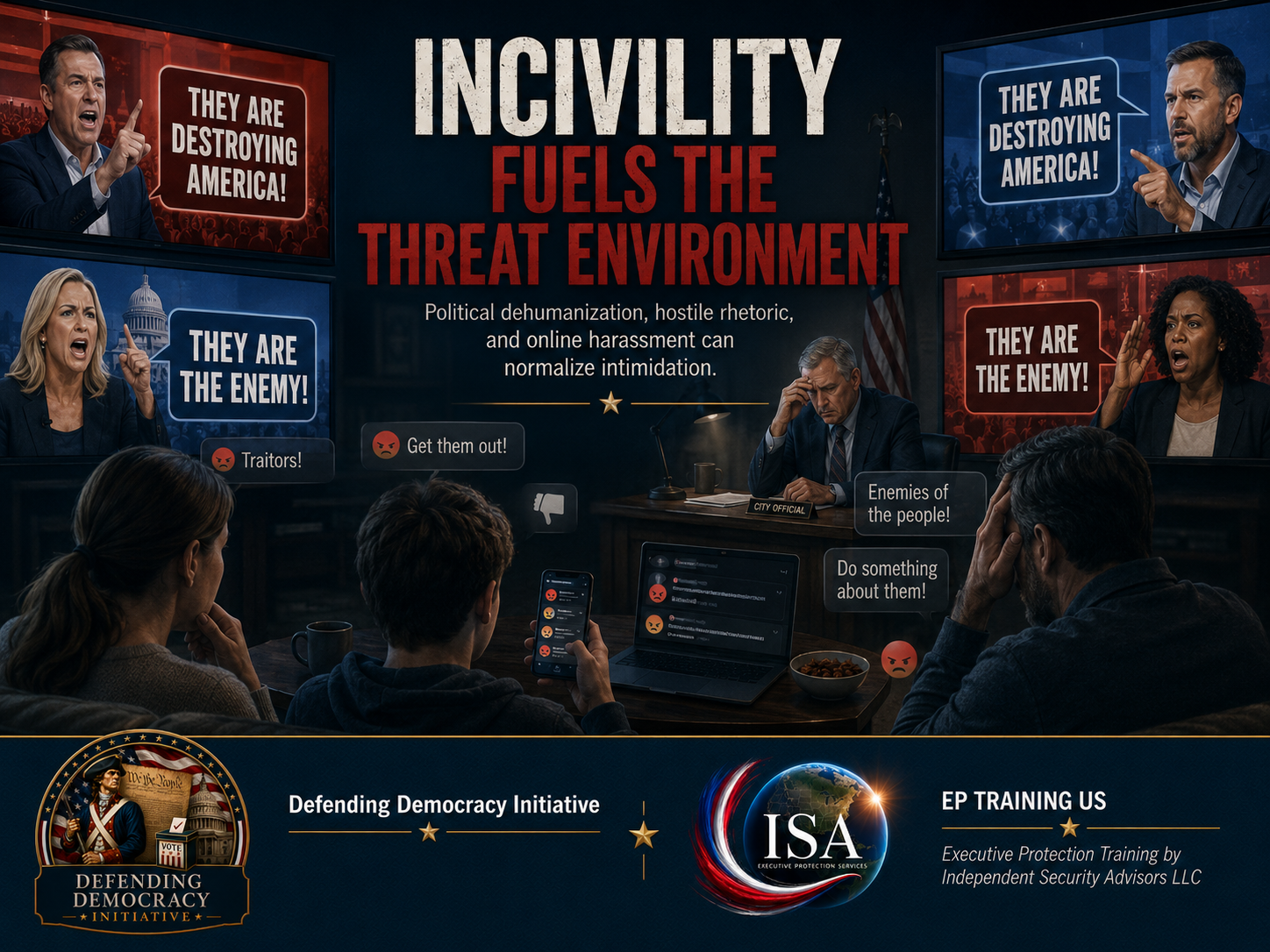 The security discussion cannot be separated entirely from the deterioration of political discourse, but neither should the two be carelessly confused.
In The Threats to Our Democracy: It Starts with Incivility, I argued that we have become increasingly comfortable describing political opponents not merely as wrong, but as enemies, traitors or people whose suffering should be celebrated. The article deliberately treated the problem as nonpartisan because political incivility is not owned exclusively by one ideological camp.
The distinction matters. Political criticism is not a threat. Anger is not automatically dangerous. Protest is not a security incident. Judges should be criticized. Presidents should be criticized. Legislators, governors, prosecutors, mayors, police chiefs and election officials should all expect disagreement. A free society requires that right.
The relationship between political incivility and political violence therefore has to be discussed carefully. Political incivility does not automatically create violence, and harsh political criticism must remain protected. But an environment in which public officials and judges are routinely reduced to enemies, traitors or people deserving retaliation is still an environment protective professionals cannot responsibly ignore.
For the Defending Democracy Initiative, the concern is not whether one offensive statement can be blamed for one attack. The concern is whether sustained political incivility, doxing, personal targeting, grievance, fixation and repeated threats can combine with other factors as an individual moves toward political violence.
That is where threat assessment and protective intelligence become essential. Their purpose is not to investigate everyone who says something offensive. Their purpose is to distinguish protected anger from behavior indicating that an individual may be progressing toward targeted violence.
The Judiciary Is Now Telling Us What Fear Does
The September 2026 research makes the judicial-security problem difficult to dismiss. Judges are reporting altered travel, strengthened residences, cameras, panic buttons, private security and fear for spouses and children. One judge described hundreds of threatening calls after residential information was exposed; another acknowledged that fear for family safety briefly entered the consideration of a judicial ruling.
The modern evidence is best understood alongside the historical record examined in our companion article: The Courthouse Was Not the Perimeter: A Historical Interview with Judge Robert S. Vance
Judge Vance was killed at his Alabama residence in December 1989 when he opened a package bomb. His wife was seriously injured. His assassination remains one of the clearest historical demonstrations of why residential security for judges must be considered part of a larger protective system rather than something separate from courthouse security.
The attacker did not need to defeat courtroom screening, overpower a marshal or enter chambers. He reached the judge through another part of the protective environment: his home, family proximity, mail and the appearance of trust.
That lesson is remarkably current. The newest research shows why threats against judges cannot be treated solely as a courthouse-security problem. Judges are changing routes, strengthening residences and altering family routines. Those are matters of judicial security, but they are more specifically problems involving residential security for judges, family exposure, information protection, transportation and protective intelligence beyond the courtroom.
A judge may be well protected while sitting on the bench and remain vulnerable during predictable travel or at home. Effective executive protection for judges therefore has to consider the entire protective environment rather than simply the government facility.
The same principle applies to elected officials. Capitol security does not protect every congressional district event. A city-hall metal detector does not protect the mayor in the parking lot. Courthouse security does not automatically protect a prosecutor driving home. An officer at a contentious public meeting does not necessarily address doxing, family exposure, hostile surveillance or predictable routines.
The attacker sees a person and a system around that person. Our protective planning has to do the same.
Our Judicial-Security Experience Was Not Academic
Independent Security Advisors’ connection to judicial protection predates the current federal studies. Our training has included law-enforcement personnel with responsibilities related to protecting state’s attorneys and prosecutors, officials who can face many of the same grievance-driven threats confronting judges. Our public-official training has also included practical work involving judges, judicial offices and residential environments.
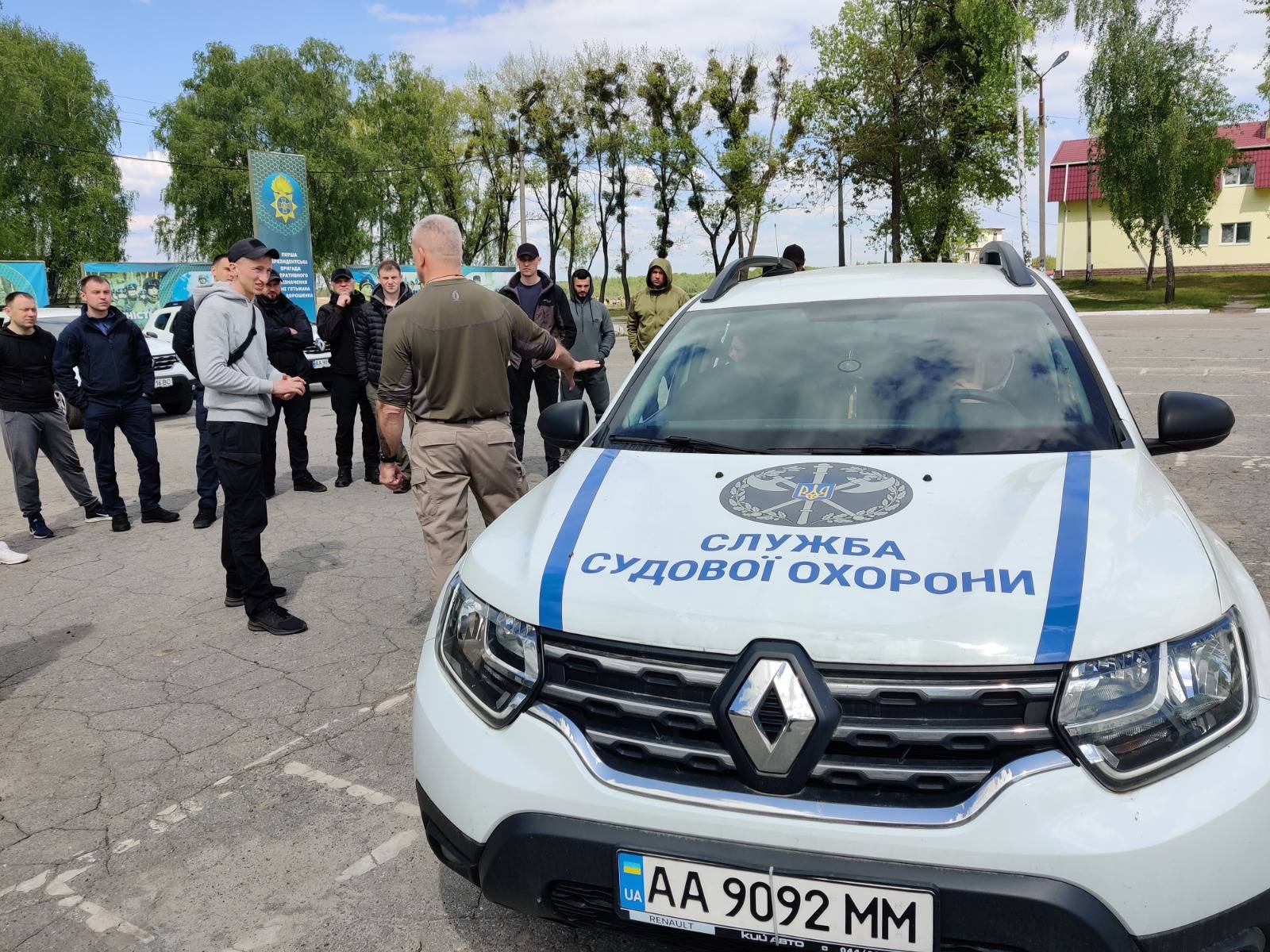 My own experience later extended to Ukraine, where I worked with Ukrainian police and Judicial Protection Service and Court Security personnel supporting judges and court operations.
That work did not occur in an abstract classroom environment. Ukrainian judges were continuing to administer justice while the country was at war, and the personnel responsible for protecting those courts had to think beyond the front door of the courthouse. Judicial security involved people, facilities, movement, information, emergencies and the continued ability of the institution to function.
That experience reinforced something I had already learned in other protective environments: the purpose of protection is not simply to keep the principal alive. The purpose is to allow the legitimate mission to continue.
We protect the judge so justice can continue. We protect the prosecutor so the case can continue. We protect the legislator so representation can continue. We protect the election official so lawful election administration can continue.
If our only security solution is to tell the protected person to remain home, abandon public appearances or change the lawful performance of legitimate duties, then security has begun accomplishing some of the same things intimidation was trying to accomplish.
Protection Is a System, Not a Bodyguard
That philosophy is built directly into the ISA Dignitary and Executive Protection Training Program. The current program prepares law enforcement, public safety, military personnel, corporate security and qualified private-sector personnel to support or conduct protective operations involving public officials, candidates, executives, judges and others designated as being at risk.
The program addresses law enforcement executive protection, executive protection for elected officials, executive protection for judges, threat assessment, protective intelligence, mission planning, advance work, protection in depth, secure movement, public-event security, communications, physical security, emergency-action planning, medical response and practical performance. These subjects are treated as components of one protective system rather than disconnected tactical skills.
The Executive Protection Training Curriculum was developed as a structured instructional program rather than a collection of bodyguard drills. ISA’s curriculum centers instruction around defined learning objectives, regulatory requirements, instructional methodology, practical application and evaluation.
Those lessons are reinforced by the ISA Executive Protection Training Standards. In the absence of one national quantifiable standard governing all state and local law-enforcement close-protection training or civilian executive-protection training, ISA has tied the program to measurable learning objectives and regulatory standards rather than treating course attendance alone as proof of competence. The standards specifically identify threat assessment, risk mitigation, threat intelligence and hostile surveillance as subjects incorporated through the instructional-design process.
This history matters because our recommendation that state and local agencies develop protective capability before a crisis is not marketing language added after a new threat report. It is the problem the program was originally built to address.
Law Enforcement Executive Protection Must Exist Before the Crisis
 Most state and local public officials will never have a permanent federal protective detail. Their safety will ultimately depend on municipal police departments, sheriff’s offices, state police, court-security organizations and other public-safety agencies. That makes law enforcement executive protection an essential part of the response to threats against public officials.
The difficulty is that traditional law-enforcement experience and executive-protection experience are not identical. A highly capable police officer may have years of patrol, investigative, tactical or supervisory experience while never having conducted a protective advance, assessed a judge’s residence, developed principal-specific transportation plans, evaluated family exposure or coordinated a protective arrival and departure.
This is why executive protection for elected officials and executive protection for judges require specialized preparation. Officers need to understand threat assessment, protective intelligence, advance work, residential security, transportation, public-event planning, emergency action, communications and the professional challenge of protecting people without unnecessarily preventing them from performing their duties.
Princeton’s 2026 election-season toolkit makes clear that preparation should occur before an election or incident rather than after it. Threat assessment should already be taking place where circumstances warrant it. Officials receiving threats should already have an established reporting process, relationships with law enforcement should already exist, and public-meeting plans should already have been reviewed. Officials and staff should already understand whom to call, what evidence to preserve and which changes in behavior require immediate attention.
That is not paranoia. It is planning before somebody is standing in the parking lot.
For smaller jurisdictions, the answer does not necessarily require maintaining a permanent full-time protective detail. Regional teams, mutual-aid agreements, trained personnel available for temporary assignments and appropriate public-private cooperation can create scalable capability without attempting to reproduce a federal protection agency at the county level.
Private Executive Protection Can Extend Public Official Security
 Properly trained private executive-protection professionals can also support public official security when government agencies lack the personnel to provide continuous coverage. That role becomes increasingly relevant as judges hire private security and local officials face threats that follow them beyond government facilities.
Private executive protection for elected officials and executive protection for judges should complement rather than replace law enforcement. Private personnel generally do not possess the same law-enforcement authority, criminal-intelligence access or investigative powers as sworn officers, but qualified professionals can extend protective capacity through advance work, protective transportation, open-source protective intelligence, site and residential assessments, family-security planning, event coverage, schedule coordination and continuing protective presence.
Standards matter enormously. Owning a firearm, wearing a suit and driving an SUV does not make someone an executive-protection professional. If a government agency, judge or public official intends to rely on private protection, someone should be asking what training was completed, what standards governed that training, how competence was evaluated, what licensing applies, how information will be shared, what medical capability exists and how responding law enforcement will identify and communicate with protective personnel during an emergency.
We ask those questions of our own students because this profession involves responsibility for keeping another human being alive.
Threat Assessment Is More Than Looking for Explicit Threats
A professional threat assessment process should not begin and end by searching for the words “I am going to kill you.” People progressing toward targeted violence do not always provide a convenient written warning.
Protective professionals should look at behavior in context. Is there persistent unwanted contact? Has a grievance become personalized? Is the individual researching a residence, family member or schedule? Has online hostility moved toward an in-person approach? Is there evidence of fixation, surveillance, target research, acquisition behavior or escalation?
This is where protective intelligence becomes essential. Information has to be collected, evaluated, compared and reassessed as the protective environment changes. One hostile email may mean very little. The same email combined with repeated appearances, residential research, family targeting or developing fixation may mean something very different.
Judge Vance’s case demonstrates another important lesson. Threat professionals cannot become so committed to the first apparent motive that they stop examining contradictory information. The most persuasive narrative is not always the correct one.
That is why professional threat assessment remains an analytical discipline rather than a keyword search.
Residential Security for Judges Cannot Be an Afterthought
The renewed attention to residential security for judges is overdue, but it should not be treated as a separate security problem that begins only when the judge leaves the courthouse parking lot. The residence is part of the same protective environment.
Family members, deliveries, home-address exposure, predictable routines, neighbors, domestic staff, vehicles, mail, online data and everyday habits can all create vulnerabilities that do not exist inside a secured courthouse. The home may also be the place where the judge and family most reasonably expect normalcy, making security more complicated than simply installing another checkpoint.
Judge Vance was killed at home. Judge Esther Salas survived an attack at her residence, but her son Daniel Anderl was killed and her husband wounded. These incidents occurred decades apart and involved different offenders, yet the recurring geography should tell us something important.
A secure courthouse cannot be the complete definition of judicial security.
Protection Should Keep Officials in Public Life
For years, one objection to greater security for elected officials has been that protection creates a “boy in the bubble” and separates officials from constituents.
The Princeton findings should cause us to reverse the question. What if fear is already creating the bubble?
If an official stops attending public events because security cannot be provided, reduces constituent contact because the threat environment has become intolerable, avoids controversial issues or decides against another term because family members have become targets, the absence of an adequate protective system has already reduced democratic access.
Professional executive protection for elected officials should allow a mayor to attend the parade, a legislator to conduct the town hall and a commissioner to enter the contentious public meeting. Professional executive protection for judges should allow a judge to continue administering justice without requiring that judge or family to live permanently behind courthouse walls.
Security should not replace the mission. It should make the mission possible.
That is why public official security and judicial security belong inside the Defending Democracy Initiative. We are not advocating protection because public officials are more valuable than the citizens they serve. We are advocating appropriate protection because intimidation should not decide whether those citizens receive representation, justice, lawful elections or functioning government.
What State and Local Governments Should Be Doing Now
The response does not require building a federal-style protective detail around every public official. It requires systems proportionate to the actual threat and exposure.
 Agencies should establish tiered protective plans that allow security to increase or decrease according to intelligence, identified threats, event conditions, public exposure, family vulnerabilities and other risk factors. Police departments, sheriff’s offices, state agencies and court-security organizations should identify personnel who can be assembled for protective assignments and consider mutual-aid agreements where maintaining a permanent unit is unrealistic.
Threat assessment should be connected directly to protective intelligence rather than operating as a separate administrative process. Information about doxing, stalking, surveillance, grievance, fixation, repeated approaches and family targeting has to reach the people who can evaluate it and change the protective posture when necessary.
Protective planning also has to extend beyond government facilities. Residences, parking areas, routes, offices, hotels, public meetings, campaign events, polling locations, family activities and predictable routines should be assessed according to the threat. Before contentious or high-profile events, agencies should conduct proportionate advance work addressing arrivals and departures, emergency exits, medical response, communications, demonstrations, crowd-management responsibilities, transportation contingencies and evacuation procedures.
Where private protection supplements government resources, identification, command relationships, communications, information-sharing limitations and emergency responsibilities should be established before an incident occurs. Most importantly, the plans should be exercised. A protective plan that has never been tested remains largely theoretical.
The objective is not to transform democratic government into a fortress. It is to replace improvisation with preparation.
How Many Times Do We Need to Learn the Same Lesson?
This is where the historical record becomes difficult to ignore.
We trained for the public-official problem after the Giffords shooting in 2011. We were writing about it publicly by 2015. We argued for better protection after Scalise was shot in 2017 and asked later that year whether threats preventing representatives from voting were interfering with democracy. In 2021, we asked why people still were not listening and explicitly included members of the judiciary in the protective mission. Our training included law-enforcement personnel responsible for prosecutors and state’s attorneys and practical judicial-security problems. My later work included Ukrainian court-security personnel responsible for protecting judges and court functions.
In 2024 we were asking whether the country could finally be serious about a threat environment that was already well documented. In July 2026 we again connected public officials, judges, families, fear and democratic function before the newest judicial studies were published. Princeton then quantified how deeply fear was changing the behavior of local elected officials. Now federal judges are describing how threats are affecting routes, homes, family lives and, in one extraordinary account, what a judge had to consider before issuing a ruling.
Perhaps the question is no longer whether we have been heard. Congress has the threat data. Capitol Police has it. Courts have it. Universities are measuring it. Public officials are describing it. Judges are describing it. Families have already suffered the consequences.
The real question is what we are willing to do with what we know.
We Are Awake. Now Prepare.
The threat is no longer adequately measured by counting assassinations, attempted assassinations, arrests or successful prosecutions. We also have to measure the decisions fear begins to influence: the public meeting that is canceled, the controversial issue that is avoided, the vote that becomes frightening, the qualified candidate who decides not to run, the official who stops appearing publicly, the family forced to change how it lives and the judge who has to consider whether following the law will place a spouse or child in danger.
That is where intimidation begins obtaining power it should never possess.
The Defending Democracy Initiative was never intended to protect politicians from criticism or judges from scrutiny. Democracy requires criticism, protest, disagreement, difficult questions and accountability. Our concern is what happens when harassment, stalking, swatting, doxing, threats and targeted political violence begin exercising an illegitimate veto over legitimate public duties.
The current environment demonstrates why public official security and judicial security cannot be separated from the health of democratic institutions. Threats against judges, threats against elected officials, attacks on family members, political incivility and political violence may involve different offenders and different circumstances, but the institutional consequence can be remarkably similar: fear begins influencing legitimate public duties.
The answer is not to shield public officials from criticism. It is to make sure executive protection for elected officials, executive protection for judges, professional law enforcement executive protection, competent threat assessment, effective protective intelligence and appropriate residential security for judges exist before intimidation succeeds in changing how government functions.
Independent Security Advisors did not come late to that concern, and EP Training US was not created after the latest headline. The protective-training mission grew from a need identified after the 2011 Giffords attack, developed through years of law-enforcement and private-sector training, expanded as threats changed and continued to evolve as real incidents produced new lessons.
Through the Defending Democracy Initiative, Independent Security Advisors will continue making the case that protecting people who perform legitimate democratic functions is part of protecting the process itself. Through EP Training US, Independent Security Advisors LLC will continue preparing law-enforcement, public-safety, military, corporate-security and qualified private-sector professionals to perform those protective missions responsibly.
We have been training for it, writing about it and warning about it for years. The newest research does not introduce us to the threat; it confirms the warning. The question now is whether we finally prepare for it.
Frequently Asked Questions
Why are threats to elected officials a democratic-security issue?
Threats become a democratic-security issue when they affect whether officials attend public events, address controversial subjects, seek reelection, communicate with constituents or otherwise perform legitimate duties. The physical safety of an individual official matters, but the wider concern is whether intimidation begins changing government itself.
What is judicial security?
Judicial security is the protection of judges, court officials, court functions and the environments in which judicial duties are performed. Modern judicial security cannot stop at courthouse screening. It may also involve threat assessment, protective intelligence, transportation, family exposure, information protection and residential security for judges.
What is executive protection for judges?
Executive protection for judges applies professional protective principles to the particular threats and operational requirements facing members of the judiciary. Depending on circumstances, it may include threat assessment, protective intelligence, residential assessment, secure movement, event planning, emergency action and coordination with law enforcement and court-security organizations.
What is law enforcement executive protection?
Law enforcement executive protection is the use of specially trained law-enforcement personnel to conduct or support protective operations for elected officials, judges, dignitaries, candidates and other public figures. It requires skills beyond ordinary patrol or investigative duties, including advance work, movement, threat assessment, transportation planning, communications and protective emergency procedures.
Can private executive protection support public officials and judges?
Yes. Qualified private protective professionals can supplement public resources where appropriate. Private executive protection for elected officials and executive protection for judges can support advance work, transportation, residential assessments, open-source protective intelligence, event coverage and family-security planning. Private protection should complement rather than replace law enforcement, and responsibilities should be coordinated before an incident occurs.
What is the Defending Democracy Initiative?
The Defending Democracy Initiative is an Independent Security Advisors LLC effort addressing threats, intimidation, political violence, political incivility and security vulnerabilities affecting elected officials, judges, prosecutors, election personnel and others whose legitimate public duties are necessary to democratic government.
About the Defending Democracy Initiative
The Defending Democracy Initiative is an effort of Independent Security Advisors LLC addressing threats, intimidation, political violence, political incivility, protective vulnerabilities and other pressures that can interfere with elected officials, judges, prosecutors, candidates, election personnel, public employees and citizens performing legitimate roles in democratic government.
ISA’s public record on public-official protection predates the Initiative itself. The company’s training mission began addressing public-official protection in 2011, its public writing on the issue dates to at least 2015, and the Defending Democracy Initiative developed from the recognition that threats against individuals can ultimately become threats against democratic participation and institutional function.
About EP Training US and Independent Security Advisors LLC
EP Training US is the U.S.-based executive protection training operation of Independent Security Advisors LLC. Independent Security Advisors LLC owns and operates EPTraining.us.
ISA provides training in public official security, judicial security, executive protection for elected officials, executive protection for judges, law enforcement executive protection, protective intelligence, threat assessment, advance work, transportation, physical security, emergency planning, medical response and related protective disciplines.
The program’s history reaches back to 2011 and the need for state and local law enforcement to protect public officials. That mission later expanded to include members of the judiciary, prosecutors, court-security personnel, corporate security and qualified private-sector protection professionals.
About the Author
Matthew C. Parker is CEO of Independent Security Advisors LLC and Director of Training for EP Training US. Parker retired after 22 years of military service, combat veteran, executive-protection practitioner, law-enforcement instructor and curriculum developer.
His protective and training experience includes public officials, law enforcement, state’s attorneys and prosecutorial-security responsibilities, and judicial-security personnel. His later work in Ukraine included training police and Judicial Protection Service and Court Security personnel supporting judges and court operations.
That experience reinforced a principle that runs throughout his approach to executive protection: the objective is not simply to keep a protected person alive. It is to manage risk well enough that the person and the legitimate institution they serve can continue functioning.
#DefendingDemocracy #DefendingDemocracyInitiative #EPTrainingUS #IndependentSecurityAdvisors #ThreatsToElectedOfficials #JudicialSecurity #ProtectingPublicOfficials #ExecutiveProtection #ProtectiveIntelligence #ThreatAssessment #PoliticalViolence #LawEnforcementTraining