
 E-mail us
Miami-Dade Sheriff Withdraws Executive Protection: Is Public Officials’ Security Becoming a Political Tool?
Miami-Dade Executive Protection
A $4.1 Million Protection Program, a Budget Dispute, 33 Correctional Officers, and a Serious Question About Who Should Control the Protection of Elected Officials
By Matthew C. Parker
Chief Executive Officer, Independent Security Advisors LLC (ISA)
Director of Training, EPTraining.us
ISA Defending Democracy Initiative
October 27, 2026
Abstract
Miami-Dade County Sheriff Rosie Cordero-Stutz has announced that her office will discontinue the Sergeant-at-Arms Program on November 9, 2026, removing sheriff’s deputies who provide transportation and personal security for the county mayor and 13 commissioners. The decision follows a disagreement over approximately $42 million in additional funding requested by the sheriff.
Mayor Daniella Levine Cava has responded by proposing that 33 correctional officers, reportedly trained for protective assignments, replace the deputies. Public reporting has not established where those officers received their training, how much training they completed, what qualifications they possess, or how their new assignments will be supervised.
Our review also found that the Sheriff’s Office budget plan reportedly included approximately $3.9 million for the protection program shortly before the sheriff announced its cancellation. That raises questions about what changed and whether the budget dispute influenced the decision.
This article examines the dispute from the standpoint of executive protection, threat assessment, government accountability, training, and the professional responsibilities of those assigned to protect elected officials. It also considers whether Miami-Dade should establish a county-managed protective capability, supported by qualified public and private personnel, so that necessary protection cannot be interrupted by disagreements between elected officials.
Bottom Line Up Front
There are several problems with what is happening in Miami-Dade, and I do not believe they can be resolved simply by transferring 33 correctional officers into new assignments.
First, the sheriff has decided to withdraw deputies assigned to protect elected officials during an ongoing dispute with those same officials over her budget. We have not found direct evidence that the sheriff threatened to withdraw protection unless her budget demands were met. However, the timing, the public statements, and the previous funding allocated to the program raise legitimate questions about why this particular program was selected.
Second, from an executive-protection standpoint, removing an established security detail can create a new vulnerability for the protected individuals. That is true regardless of the sheriff’s motives. The change itself must be evaluated as part of their threat assessments.
Third, we cannot verify where the 33 correctional officers received their protective training. Miami Dade College offers a five-day Dignitary Protection course with 45 scheduled hours. It is a possible training source, but we have no evidence that these particular officers attended it. Even if they did, five days of training would not normally be sufficient by itself to prepare inexperienced personnel for a full protective assignment involving a meaningful threat.
Fourth, using correctional officers introduces additional concerns. Their regular duties must be covered, their legal authority must be established, and their previous contacts with inmates should be considered when assessing their suitability for visible protective assignments.
Finally, the county has options beyond relying entirely on the sheriff or transferring correctional officers into a new unit. Miami-Dade could examine a county-administered protective-services program, with Emergency Management providing coordination and administrative support, qualified protective professionals managing operations, and law enforcement supplying those functions that require police authority.
Our September articles examined how local governments can build and manage protective details using police officers, reserves, auxiliary personnel, and qualified private-sector professionals. Miami-Dade now provides a real example of why that discussion matters.
An Executive Protection Problem We Have Been Discussing for Years
On October 22, 2026, Miami-Dade County Sheriff Rosie Cordero-Stutz notified Mayor Daniella Levine Cava and the county’s 13 commissioners that her office would discontinue the Sergeant-at-Arms Program effective November 9.
The program assigns plainclothes sheriff’s deputies to provide transportation and personal security for county elected officials. According to the sheriff, the program costs approximately $4.1 million annually. She intends to reassign the personnel and resources to other law-enforcement responsibilities.
The decision comes during a disagreement over the sheriff’s budget. The sheriff maintains that approximately $42 million in requested additional funding remains unavailable. The mayor and county commissioners dispute that characterization and point to an adopted Sheriff’s Office budget of approximately $1.234 billion, the largest in the agency’s history.
Then, on October 26, the Miami Herald reported a plan that deserves a closer look. Mayor Levine Cava intends to use correctional officers from the county’s Department of Corrections and Rehabilitation to replace the sheriff’s deputies.
During an event at the Corrections Department, the mayor said the agency was entering a new period of responsibility for protecting elected officials. When she asked how many correctional officers had been trained to serve as sergeants-at-arms, an administrator answered that 33 had received training.
The public reporting has not established what specific protective training those officers completed, whether they possess additional law-enforcement certifications, or how the new detail will operate. These are the same questions we have been asking at ISA for years.
In September 2026, we published two articles addressing these problems:
Who Should Protect Elected Officials: Police, Private Security, Reserves, or an Integrated Detail?
Ten Days to Build the Detail — and What Happens When the Detail Loses the Mission
In those articles, I examined how police chiefs, county administrators, protection supervisors, and private professionals might approach the responsibility of protecting elected officials. We discussed the qualifications of personnel, the use of reserve and auxiliary officers, the cost of assigning sworn police officers, and the need to establish proper command and supervision.
Miami-Dade now gives us an opportunity to examine those issues in an actual government operation. And the more I examine this situation, the more questions I have.
The Sheriff Has a Legitimate Question About Resources
Before discussing the mayor’s proposed replacement program, we need to examine the sheriff’s decision. A sheriff is responsible for providing law-enforcement services to the community. Deputies assigned to executive protection are deputies who cannot simultaneously perform other duties.
In a large metropolitan county, those duties include patrol, investigations, responding to calls for service, and supporting other public-safety operations. So, personnel assigned to protect elected officials represent a real commitment of resources, and the sheriff has stated that the $4.1 million devoted to the Sergeant-at-Arms Program can/should be redirected to other operational needs.
The sheriff has a point. Those deputies could be doing something else, and their time is not free. A permanent executive-protection detail should not exist simply because the county has always maintained one. But the opposite is equally important. A protection detail should not be discontinued solely because its annual cost appears excessive.
The proper questions concern the actual protective mission. Why was the program established? What threats and responsibilities currently justify its staffing? Which protective duties are performed by those deputies, and which are primarily transportation services? What alternatives exist, and what risks would be created by discontinuing the service?
We should also distinguish between reducing expenditure and reassigning personnel. If deputies remain on the sheriff’s payroll and are assigned to other duties, the county has not necessarily saved $4.1 million in cash. It has redirected personnel and operating resources to other work.
Is Executive Protection Becoming a Political Tool in Miami-Dade?
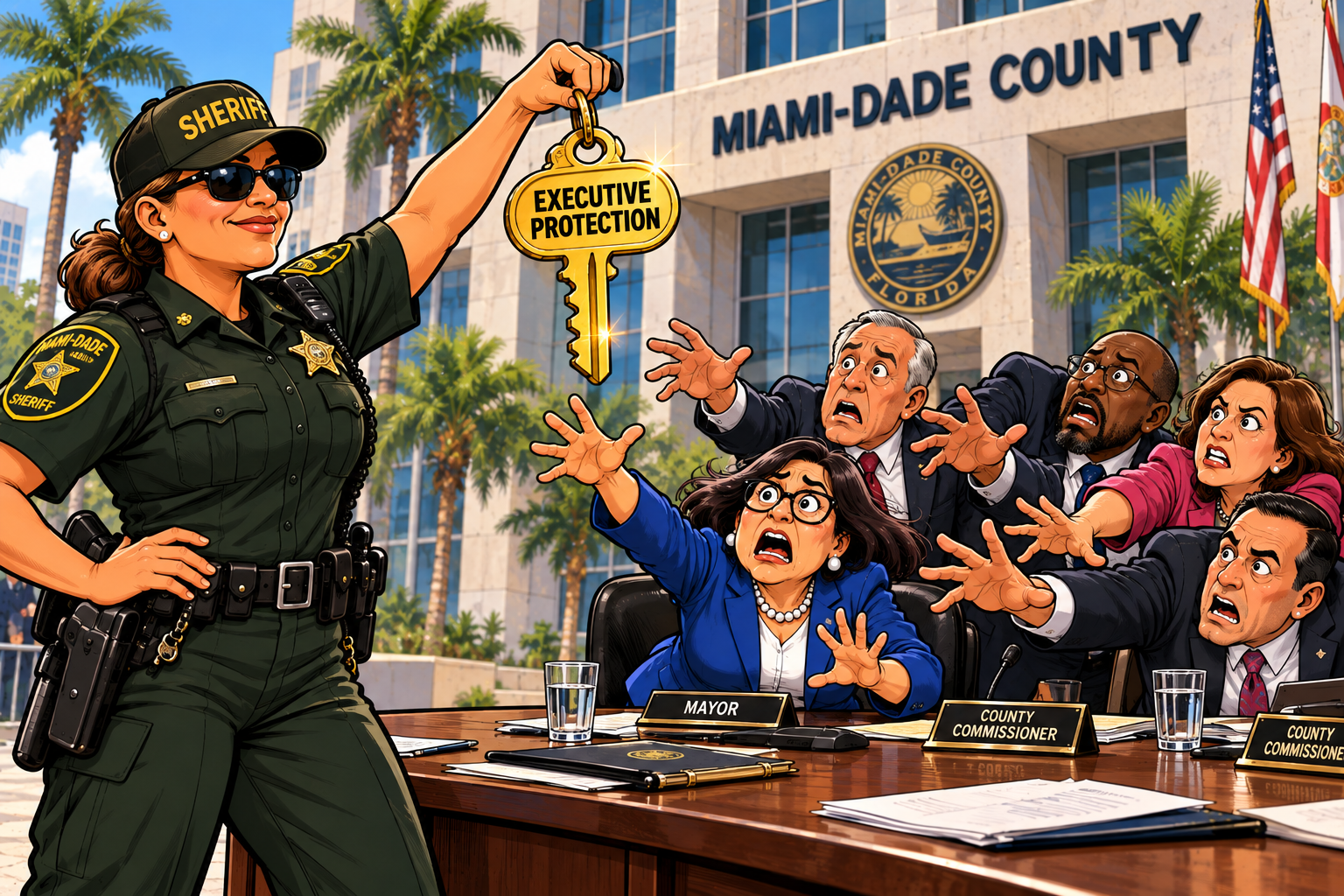 This is where the situation becomes particularly interesting.
The sheriff and county commissioners have been involved in a public disagreement over her budget. The sheriff says approximately $42 million of the additional funding she requested remains unavailable. The county says it approved a record budget that provides funding for the additional positions requested by her office. These are two different explanations of the same budget, and both deserve examination.
On October 9, the Sheriff’s Office issued a formal statement maintaining that the county’s budget figures did not account for costs associated with inherited labor agreements, staffing, facilities, and other operational requirements. The sheriff announced that she would appeal the adopted budget to Florida’s Administration Commission.
The county responded that the adopted budget totaled approximately $1.234 billion and provided funding for all 200 additional positions requested by the sheriff, including 80 sworn and 120 civilian positions.
There is a legitimate budget dispute here. I am not suggesting that the sheriff’s concerns about staffing, compensation, or operational resources should be ignored. But then something happened. The sheriff announced that she was discontinuing a protection program serving the same elected officials involved in making those budget decisions.
That raises an obvious question.
Is the withdrawal of protection simply a legitimate effort to redirect resources, or is the sheriff using the protection of elected officials as a means of applying political pressure during a budget dispute?
The September Budget Included Money for the Same Program
In September 2026, the Miami Herald reported that the Sheriff’s Office’s proposed spending plan included approximately $3.9 million for the Sergeant-at-Arms Program. According to that reporting, the amount was approximately 20 percent higher than the previous year’s allocation. By October 22, the sheriff was announcing that the same program would be discontinued, citing an annual cost of approximately $4.1 million.
What changed?
Was there a new assessment indicating that the mayor and commissioners no longer required the same level of protection? Was there an internal review showing that deputies were being used primarily as chauffeurs rather than protection agents? Did the agency determine that the program was improperly staffed or that it could be performed more efficiently? Or did the decision arise during the budget disagreement because eliminating this particular service would have an immediate effect on the elected officials involved?
These are questions that should be answered with records, not speculation.
A written justification for the decision, any supporting staffing study, and any threat assessments used in the process would help explain what happened. The sheriff may have good operational reasons for her decision. If those reasons exist, the county and the public should be able to understand them without disclosing sensitive protective information. What makes the timing notable is that this is not simply an unpopular program being discontinued during a routine budget review.
This program directly serves the elected officials involved in the budget dispute. That does not prove retaliation. It does make the decision deserving of closer examination.
Has the Sheriff Complained About This Program Before?
In May 2012, Miami Herald columnist Michael Putney published an article titled Baby, You Can’t Drive My Car, questioning the use of Miami-Dade police officers as chauffeurs for county commissioners. Putney examined the practice of commissioners receiving transportation from police officers while also receiving county vehicle allowances. His criticism centered on whether the service was being used for personal convenience rather than legitimate protective needs.
I can understand that criticism. And I have no interest in defending a publicly funded chauffeur service simply because somebody holds elected office. If a commissioner needs transportation to attend meetings, that does not automatically mean the county needs to assign a sworn police officer as a personal driver. On the other hand, if a commissioner faces a credible threat requiring protective transportation, that is a different matter.
The question should always return to the threat assessment and the mission.
County budget records also demonstrate that the program was not an insignificant expense. The adopted FY 2024–25 budget provided approximately $3.055 million for nine sergeants-at-arms serving the Board of County Commissioners. The program’s cost and staffing had therefore been recognized in county budgets well before the October 2026 dispute.
There is also a historical distinction worth making. Miami-Dade’s current elected sheriff took office in January 2025, following a state constitutional change that restored an independently elected sheriff. Before that, county policing operated under the county’s administrative structure for decades.
What Have County Officials Said?
The public statements surrounding the dispute are worth examining. On October 21, during an appearance with Governor Ron DeSantis concerning property-tax policy, Sheriff Cordero-Stutz discussed the need for government to examine longstanding expenditures. She stated: “An expense should never go unquestioned simply because that is what government has always paid for.”
I agree with the principle. Government spending should be examined, and executive protection should not be exempt from that examination. The sheriff has also maintained that her responsibility is to protect the people of Miami-Dade County while addressing the resources needed by her department. The following day, however, she announced the withdrawal of the Sergeant-at-Arms Program.
Mayor Levine Cava and County Commission Chairman Anthony Rodriguez responded by raising concerns about security and the transition. The mayor wrote: “Neither responsibility should be diminished by disagreements between our offices.” That statement goes directly to the problem.
During the September budget debate, Commissioner Oliver Gilbert III had also expressed concern about pressure surrounding the budget negotiations, stating: “I don’t think we should ever be governed by an implied or an expressed threat.” Gilbert was discussing the sheriff’s potential appeal of the budget to state officials, not specifically the protection program. His statement should not be presented as an accusation that the sheriff had threatened to remove his security.
Nevertheless, it shows that concerns about pressure during the budget dispute existed before the October 22 announcement. The sheriff has offered an operational explanation for eliminating the program. The mayor and commissioners have expressed concerns about its effect on security. What remains unanswered is whether the selection and timing of this particular program were based solely on operational needs or were influenced by the dispute with county officials.
From a Protection Agent’s Standpoint, the Withdrawal Creates a New Risk
There is an important distinction between evaluating the sheriff’s intentions and evaluating the effect of her decision on the people receiving protection. As an executive-protection professional, my responsibility is to assess threats and vulnerabilities affecting the person I have been assigned to protect. I do not have to establish that somebody intends to harm my client before recognizing that a decision has increased the client’s exposure.
If I were conducting a threat assessment for Miami-Dade’s mayor or commissioners, I would have to examine the announced withdrawal of their existing security details as a significant change in their protective environment. Those deputies provide an existing capability. They know their assignments, the officials they serve, and the operating procedures used by their department.
The sheriff intends to remove that capability. Unless a suitable replacement is in place, properly trained, supervised, and equipped, the withdrawal could increase the officials’ vulnerability.
From a protective standpoint, the loss of an established security detail is itself a risk factor that must be assessed.
A threat assessment considers more than threatening statements or suspicious individuals. It also examines vulnerabilities, exposure, the capabilities of the protection team, and changes in the environment that could affect the principal’s safety. If an official’s established protection is being withdrawn, the protection professional must determine what capability will be lost and what new vulnerabilities may result.
It does not matter whether that loss resulted from a budget dispute, a staffing shortage, a change in policy, or an administrative decision. The vulnerability is still there. And if a replacement program is being assembled in less than three weeks, I would want to know exactly what that program can do.
The proper response is not to assume that every commissioner requires a permanent bodyguard. It is to assess each official’s present exposure and make sure that any justified protective requirement remains covered during the transition. That is why I find this situation concerning.
The discussion seems to have moved quickly from the sheriff withdrawing deputies to the mayor identifying correctional officers as replacements. What I have not seen publicly established is the threat assessment and operational planning connecting those two decisions.
When a Sheriff Controls the Protection of the Officials Who Control Her Budget
 The Miami-Dade situation exposes a problem that deserves attention well beyond Florida. A sheriff is an elected official. County commissioners are also elected officials. They have different responsibilities, different powers, and different constituencies. Those responsibilities sometimes place them in disagreement over money, personnel, and government policy.
That is normal government.
But there is a potential conflict when one elected official controls a protective capability serving other elected officials involved in disputes with that official. This does not mean a sheriff cannot professionally protect a county commissioner who disagrees with her. It means the system needs safeguards so that legitimate protective requirements are not left vulnerable to unrelated disagreements.
My professional expectation is straightforward: once an agency has lawfully accepted and been assigned a protective mission, the people carrying out that mission should provide the required protection until the mission is properly changed or transferred. The mission should not depend on whether the principal agrees with the sheriff, supports the sheriff’s budget, or shares the sheriff’s political views.
There are legal limits to that principle. Florida law gives sheriffs substantial independent authority over their agencies, and a county commissioner cannot simply order the sheriff to assign a particular deputy indefinitely. But those legal questions should be addressed through established government procedures. They should not leave a protection team uncertain about whether it will exist after the next budget disagreement.
That is why the county should examine whether the present system gives any single agency too much practical control over the continuity of protective services for elected officials. The question is not whether Sheriff Cordero-Stutz has acted improperly. That has not been established. The question is whether the present arrangement contains enough safeguards to prevent a future political or budget dispute from interfering with necessary protection. That is a legitimate administrative and security issue, regardless of which political party controls either office.
Can Correctional Officers Perform Executive Protection?
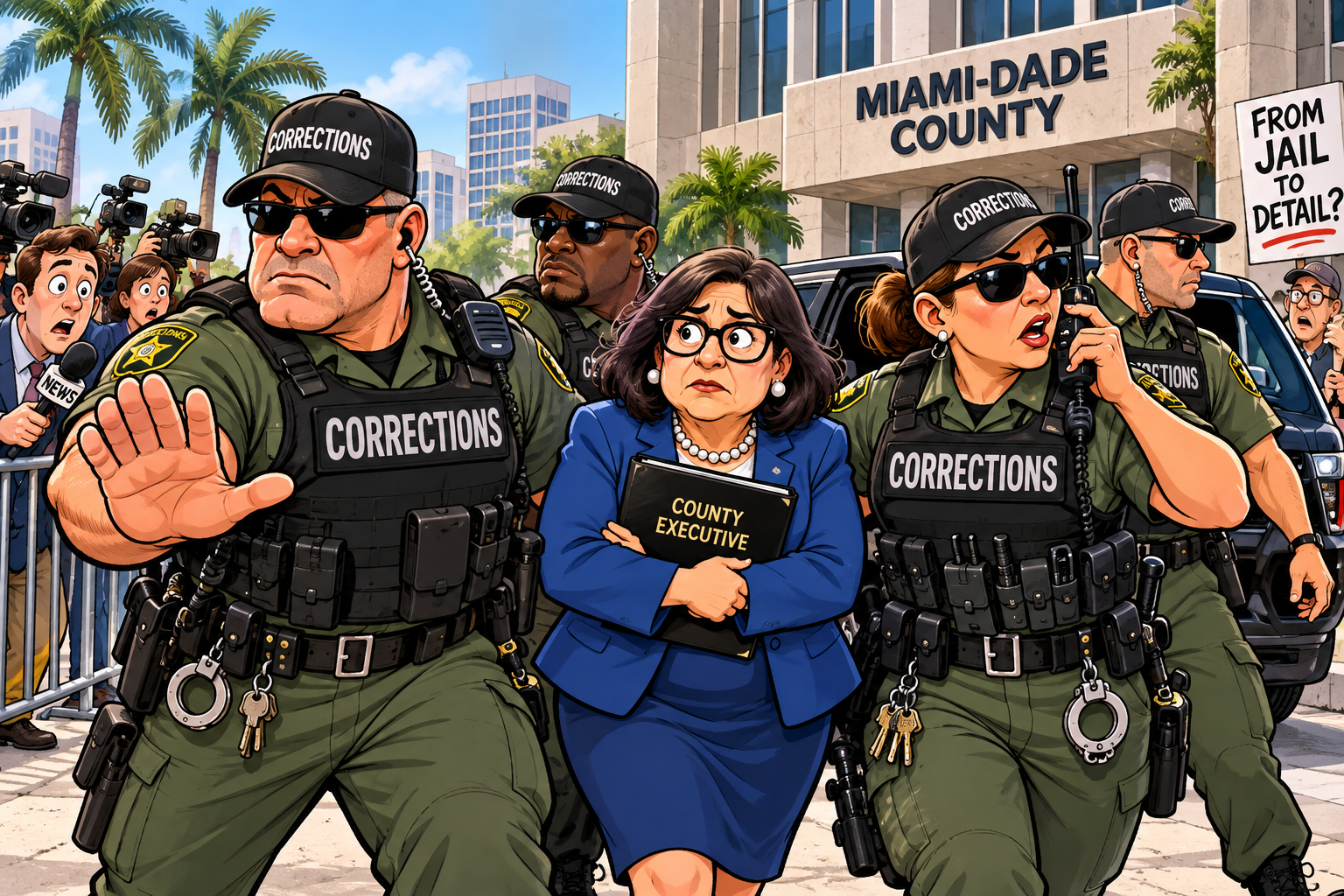 This is where I have some serious questions about training and qualifications.
I have worked with military personnel, police officers, and individuals entering executive protection from different professional backgrounds. The experience they bring can be valuable, but their previous occupation does not automatically establish competence in executive protection. Correctional officers are no exception.
An experienced correctional officer may possess excellent judgment, emergency-response experience, knowledge of defensive tactics, firearms qualifications where applicable, and the ability to manage difficult or confrontational situations. Those are useful skills, and I would certainly not dismiss them. But they are not the same as being trained in executive protection. Executive protection involves additional responsibilities that may be quite different from correctional operations.
An officer assigned to protect a county executive may need to conduct advance work, evaluate event locations, prepare protective transportation, coordinate with local police, recognize possible hostile surveillance, assist in protective movements, and respond to emergencies involving the official. Those responsibilities require appropriate training and practical evaluation. Florida law also distinguishes correctional officers from law-enforcement officers. Under Florida Statute 943.10, the two occupations have different statutory definitions and primary responsibilities.
That distinction does not mean a correctional officer cannot perform protective services. It does mean the county must establish the actual legal authority held by the individuals selected for these assignments. Some correctional officers may possess additional certifications or lawful appointments. Others may not. Those differences cannot be ignored when assigning personnel to a protective detail. If an officer is expected to drive a county official, provide personal protection, and coordinate emergency responses, the county should know precisely what that officer is authorized and trained to do.
The same applies to traffic enforcement, emergency vehicle privileges, criminal investigations, arrests, access to restricted information, and the use of firearms. An agency cannot create additional police authority merely by changing an employee’s assignment or job title. The mayor’s reported statement that 33 correctional officers have received training deserves further examination.
What course did they complete? How many hours were devoted to executive protection? Was protective driving included? Did the students conduct practical protective exercises? Were they evaluated against established performance standards?
I am not suggesting that the officers lack those skills. We simply do not have enough public information to determine whether they possess them. Thirty-three trained correctional officers could represent a useful protective resource. But the number itself tells us very little about their qualifications, available staffing, or ability to replace the existing program.
Correctional Officers Bring Another Risk That Should Not Be Ignored
There is another concern with using correctional officers that has received little attention. Correctional officers work directly with incarcerated people. They supervise inmates, enforce institutional rules, respond to disturbances, and sometimes become involved in confrontational or violent incidents.
That experience can help develop useful skills. It can also create threats that follow the officer beyond the correctional facility. A correctional officer who has supervised, disciplined, restrained, or otherwise dealt with an inmate may later encounter that individual outside the institution. I am not suggesting that every former inmate presents a threat to a correctional officer. Most do not. But correctional officers can become the subjects of threats, grievances, and retaliation connected to their official duties. That is a documented risk.
For example, in a 2015 federal case in Colorado, an inmate was convicted and sentenced for threatening correctional officers and their families. According to the U.S. Department of Justice, the case included an attempt to persuade a former inmate to kill prison staff members. This example does not establish that any of the Miami-Dade officers face such a threat. It demonstrates why the possibility cannot simply be dismissed.
Imagine assigning a correctional officer to a visible protective position accompanying a county commissioner at public meetings, community events, and other locations throughout Miami-Dade. That officer might be recognized by somebody previously incarcerated in a facility where the officer worked. Recognition alone is not a threat. But if the officer had received credible threats connected to a previous inmate interaction, that history could become relevant to the protection detail. The officer could become the target of attention unrelated to the elected official.
That possibility needs to be considered when selecting personnel. I would want to know whether any proposed officers have received documented threats connected to their correctional duties, whether those threats have been investigated, and whether their assignment to a visible protective position would create an additional security concern. That is not a reason to reject correctional officers as a group. It is a reason to conduct proper personnel screening and threat assessments before placing them on the detail.
We spend considerable time examining threats directed toward the protected person. We should also consider whether individual members of the protection team bring known security concerns into the assignment. The selection process should identify those risks and determine whether they can be managed. It would be unfortunate to assemble a protection detail for an elected official and overlook a known threat involving one of the people assigned to provide that protection.
Are We Moving a Staffing Problem From One Agency to Another?
There is another question that deserves attention. According to the Miami Herald, Miami-Dade’s Corrections Department has experienced staffing difficulties and relies on overtime to maintain jail operations. The department operates facilities holding approximately 5,000 people daily.
Commissioner Raquel Regalado expressed concern about the proposal, arguing that correctional officers should remain available for their responsibilities inside the county’s jails. In an interview with the Herald, Regalado stated: “Using correctional officers to drive elected officials is a horrible idea.”
She also reportedly had not been briefed on the plan. That concern should be examined rather than dismissed. If the sheriff believes assigning deputies to executive protection places too much pressure on law-enforcement resources, replacing those deputies with correctional officers may create a similar problem inside the Corrections Department. The county needs to establish how many officers will actually be reassigned, how their regular duties will be covered, whether the new assignments create overtime, and whether other correctional personnel will be required to replace them.
Having 33 officers who attended training does not mean you have 33 officers available to work a protection detail. A roster of qualified personnel is not the same thing as a funded, supervised, and operational protective unit. We should also remember that an official who requires protection during regular working hours may also require it during evening meetings, public appearances, or other activities. A single officer cannot work every shift. There are days off, leave, training, medical absences, and other staffing requirements.
Thirty-three officers may sound like a substantial number, but their actual availability depends on the assignments, schedules, relief staffing, and other responsibilities involved. Before anyone starts moving officers from one department to another, the county should establish what positions are needed and how those positions will be staffed. Otherwise, we may simply be transferring one department’s staffing problem to another.
Who Commands the Protective Detail?
 One of the most important issues in our September article, Ten Days to Build the Detail, concerned the relationship between the protected official and the people providing protection.
A county executive may be the most senior official in county government, but that does not mean the executive should personally control every aspect of a protective detail. When sworn personnel provide protection, their law-enforcement chain of command must remain clear. The protected official can express concerns, explain scheduling requirements, and cooperate with the protection team. Operational decisions, personnel supervision, and professional boundaries must remain with the responsible command structure.
This is particularly important when the protected official also exercises administrative authority over the department furnishing the personnel. Under the proposed arrangement in Miami-Dade, correctional officers would come from a department under the mayor’s administration rather than the independently elected sheriff. Somebody needs to be in charge, and everybody needs to know who that is. Clear supervision and written procedures are essential. Who will supervise the officers when they are assigned to the mayor?
Will the same command structure supervise the personnel assigned to commissioners? Who determines whether an officer is qualified for the assignment, and who handles complaints about the conduct of the detail? What happens when an elected official requests a driver for an activity unrelated to official government business? Who determines whether the activity warrants publicly funded protection? Who has the authority to refuse an inappropriate request?
These are not theoretical problems. Our earlier article examined how protective assignments can gradually lose their intended purpose when officers begin performing personal errands, political work, or other duties unrelated to security. A properly managed executive-protection program requires boundaries that protect the officers, the elected officials, and the public.
A Driver Is Not Necessarily an Executive Protection Agent
 The Miami Herald describes the existing deputies as providing both transportation and personal security. Those are related responsibilities, but they should not automatically be treated as the same job. An official may need transportation without requiring a close-protection agent.
Another official may face a credible threat that requires protective intelligence, advance planning, a trained driver, close protection, and additional police support. The driver may be one member of a broader protective team. If most of the existing Sergeant-at-Arms Program consists of routine transportation, the county should examine whether every position requires a fully sworn deputy sheriff.
If the program includes legitimate protective responsibilities, those functions must remain covered by personnel who are qualified to perform them. This distinction is central to responsible staffing. It also provides an opportunity to examine the private sector.
In our September article, we discussed circumstances in which properly trained and vetted private executive-protection professionals may provide protective transportation, advance work, residential security, or other services without removing sworn police officers from public-safety assignments.
That does not mean private personnel should replace every law-enforcement function. Private agents generally do not possess the same arrest authority, investigative powers, or access to law-enforcement information. But a properly organized operation can use different personnel for different duties. Miami-Dade has options beyond treating the problem as a choice between sheriff’s deputies and correctional officers.
Should Miami-Dade Establish Its Own Protective Services Program?
This brings me to the question I believe Miami-Dade should examine. Why should the county’s elected officials depend entirely on the sheriff’s willingness and ability to maintain a protection program?
If the sheriff believes the Sergeant-at-Arms Program is too expensive or draws deputies away from more important duties, the county should examine another arrangement. That does not mean establishing a new police department. Florida law places important restrictions on county governments creating their own policing agencies. Under Florida Statute 30.15(5), the sheriff holds the principal county policing responsibilities established by law, and counties generally cannot create competing police agencies to perform those functions in unincorporated areas.
Any county-managed protection program must respect those legal limits. But executive protection is not simply another name for police work. Many protective services can be provided by properly trained personnel who do not exercise general police powers. That includes certain protective transportation assignments, advance planning, event-security support, residential security, and other functions permitted by law.
I believe Miami-Dade should examine whether it can establish a dedicated protective-services program under county administration, using appropriately qualified personnel and maintaining formal arrangements with the Sheriff’s Office for functions requiring law-enforcement authority.
The purpose would be to establish continuity of protection and clear accountability, rather than leaving the entire service dependent on the staffing priorities of one agency. This proposal would require legal review, appropriate county authorization, funding, and written operating agreements. It should not be mistaken for a proposal to place another county police department under the mayor.
Why the Office of Emergency Management Deserves Consideration
In our September article, Ten Days to Build the Detail, we discussed the role Emergency Management can play in helping local government maintain protective capabilities.
Emergency Management already deals with planning, coordination, resource management, interagency agreements, and emergency preparedness. In Miami-Dade, the county’s emergency-management functions have operated within the county’s broader public-safety structure, including Fire Rescue and related emergency-management responsibilities. That makes Emergency Management worth examining as an administrative and coordinating office for a county protective-services program.
I am not suggesting that emergency managers should suddenly become executive-protection agents. Nor am I suggesting that Emergency Management should command police officers or conduct criminal investigations. That would misunderstand the purpose of the proposal. Under a properly authorized arrangement, Emergency Management could maintain agreements, qualification records, resource requests, activation procedures, and administrative coordination.
The actual protective operations would have to be directed by a qualified protective-services supervisor with the appropriate authority. The county could establish arrangements with licensed private executive-protection providers, qualified personnel from participating agencies, and other resources legally available for specific duties.
The Sheriff’s Office would remain responsible for its statutory law-enforcement functions and could provide threat information, investigative support, emergency response, or sworn personnel under lawful agreements. This would not eliminate the need for cooperation with the sheriff. It would establish a structure in which the county has more control over the planning, funding, and continuity of protective services that do not require police authority. The details would need to be examined by the county attorney, county administration, Sheriff’s Office, and the agencies expected to participate.
Miami-Dade already has experience coordinating large and complicated public-safety operations. The administrative skills needed to maintain agreements, personnel rosters, equipment records, and readiness procedures are not foreign to county government. The more difficult questions concern legal authority, operational command, and the qualifications of the personnel assigned. Those questions should be answered before a new program begins operating.
The Integrated Protection Model
Independent Security Advisors has long supported examining the full range of legally available personnel and resources when developing protective capabilities for local officials.
Those resources may include municipal police officers, sheriff’s deputies, qualified reserve personnel, correctional or court-security personnel whose authority and training support the work, and experienced private executive-protection professionals. The important consideration is whether each individual has the authority, training, experience, and supervision necessary for the assigned task.
For Miami-Dade, an integrated arrangement could allow qualified personnel from the county’s own departments to provide selected protective services while maintaining an established relationship with the Sheriff’s Office for investigations, threat information, enforcement, and emergency support. Qualified private personnel could also be considered for duties that do not require police authority, subject to appropriate licensing, contracting, vetting, and supervision.
Florida’s Department of Agriculture and Consumer Services regulates private security under Chapter 493, including bodyguard protection. A private provider would need to meet the licensing requirements applicable to its work, including appropriate individual and agency licenses and firearm authorization where required. A state security license does not automatically establish competence in executive protection. I would apply the same professional standards to private protective personnel that I apply to police officers and correctional officers.
What training have they completed? What relevant experience do they have? Can they conduct advance work, protective transportation, emergency procedures, and the other tasks required by the assignment? Have they demonstrated those skills? The private sector should not receive a free pass simply because it offers an alternative to the sheriff.
Such a program would require cooperation between the sheriff, county administration, and other responsible agencies. It would also require a written agreement covering responsibilities, communications, supervision, costs, and operational coordination.
Before anyone starts talking about saving money, I would like to see the actual costs: salaries, overtime, replacement staffing, training, supervision, vehicles, equipment, insurance, and the cost of replacing employees removed from other duties. A mixed team also cannot succeed without a clear person in charge.
Protecting the Government Center Is a Separate Responsibility
The dispute also involves security at the Stephen P. Clark Government Center. Mayor Levine Cava and County Commission Chairman Anthony Rodriguez have raised concerns about the effect of the sheriff’s decision on security at the government complex. The facility houses county offices, serves members of the public, and is connected to public transportation. The sheriff has indicated that law-enforcement coverage will continue during County Commission meetings.
That is important, but personal protection for elected officials and security for an entire government facility are not interchangeable responsibilities.
A protective detail may escort an official to a meeting. Facility security personnel may control access, support emergency procedures, respond to incidents, and protect the many other people using the building. One function does not automatically provide the other. The mayor has requested a transition plan explaining what security coverage will remain, how responsibilities will be coordinated, and how threat assessments and security concerns will be shared. Those are reasonable subjects for a formal transition plan. At the same time, the plan should protect sensitive operational information.
The public is entitled to know how its money is being spent and whether qualified personnel are providing protection. It does not need access to individual movement plans, staffing patterns, or other details that could create security risks.
What Should Happen Before November 9?
As of October 27, the scheduled withdrawal is less than two weeks away. Miami-Dade does not need to reinvent executive protection in the next two weeks. It needs to make sure the people taking over know what they are doing. That begins with an assessment of the existing program and the current security requirements of the officials receiving protection.
The county should establish which officials currently require protection, what services are being provided, and what capabilities would be lost when the existing deputies are reassigned. Where there are documented threats, the transition plan must account for them.
Next, the county must identify the positions that need to be filled. Some may require sworn law-enforcement authority. Others may be performed by qualified correctional officers, reserve officers, or private protective personnel where permitted by law. The county should verify the training and legal authority of the proposed personnel, designate supervisors, establish communication procedures, and ensure that necessary law-enforcement support remains available. There must also be an accounting of the resources involved.
If correctional officers leave jail assignments to provide protection, the county must determine how their previous responsibilities will be covered. The county should also consider any known, credible threats connected to officers’ previous correctional assignments when evaluating their suitability for the new details.
Finally, any replacement program must contain a process for reassessing the need for protection. An elected official may require increased security during a particular period of heightened concern and less security when circumstances change. A responsible protection program must be able to increase and reduce its staffing without losing the ability to respond when new threats emerge.
One additional safeguard deserves consideration. A justified protective assignment should not be discontinued without a documented review of the resulting security needs and an orderly transition. That does not mean protection must continue forever. It means changes should be made for professional reasons and implemented without creating unnecessary vulnerabilities.
Closing Conclusions: Who Controls the Protection, and Who Protects the Protected?
I do not believe every mayor or county commissioner automatically requires a permanent, full-time protective detail. I also do not believe the financial cost of a protective detail should be the only factor in deciding whether it continues.
Public officials have legitimate security needs, but those needs should be examined professionally and supported by actual assessments. The sheriff has raised questions about the use of deputies and the cost of the existing program. Those questions deserve serious consideration. But the timing of the withdrawal deserves equally serious examination.
The program was reportedly included in the sheriff’s earlier budget plan. The county then rejected part of her requested funding increase. The sheriff subsequently announced that the security details serving the officials involved in that decision would be withdrawn.
I cannot establish that this was political retaliation. But I can establish that the decision affects the protective resources available to those officials. As a protection agent, that matters to me far more than which elected official wins the argument about the budget. If I were responsible for assessing the security of these officials, I would regard the announced loss of their established protection as a change in their risk environment that must be addressed.
That does not mean the sheriff herself is a physical threat. It means that her decision may create or increase vulnerabilities if the transition is not properly managed. I would also question the decision to use correctional officers until their training, authority, availability, and any known security concerns associated with their previous assignments have been evaluated. Neither the sheriff’s badge nor the correctional officer’s badge automatically establishes executive-protection competence.
I would apply the same standard to a private security company seeking the assignment. A company license, an impressive résumé, or a claim of extensive experience does not substitute for verifying the qualifications of the people who will actually perform the work.
Miami-Dade has an opportunity to examine whether its current approach to protecting elected officials is properly organized, staffed, and funded. It also has an opportunity to determine whether a different combination of personnel can provide the necessary protection while preserving police and correctional resources. The county should consider a structure in which protective requirements are established through professional assessment, public resources are properly accounted for, and the continuity of necessary protection is not left entirely dependent on the outcome of budget disputes between elected officials.
Emergency Management could potentially provide administrative coordination for such a program, while qualified protective personnel manage operations and the appropriate law-enforcement agencies retain their legal responsibilities.
What I would not want to see is one department’s staffing problem simply transferred to another department without first determining what the protective mission actually requires. Nor would I want to see an elected official’s safety become a bargaining point in a dispute over public money. That was the concern behind our earlier articles, and Miami-Dade has now given us another reason to examine it.
The question is not simply who will drive the mayor and commissioners after November 9. It is who will be responsible for their protection, what those personnel are qualified and authorized to do, and whether the county has a properly managed program that can continue functioning when elected officials disagree.
That is a question every local government should be able to answer before a serious threat or emergency forces the issue. A budget is not a threat assessment. A chauffeur is not necessarily a protection agent. And a disagreement between elected officials should not determine whether legitimate protective needs are addressed.
Frequently Asked Questions
1. Why is the Miami-Dade sheriff discontinuing protection for elected officials?
Sheriff Rosie Cordero-Stutz has stated that the approximately $4.1 million annual program uses personnel and resources that can be redirected to other law-enforcement responsibilities. The decision occurred during a dispute over approximately $42 million in additional funding she requested.
2. Is there evidence that the sheriff is using security to pressure county officials over her budget?
The timing of the announcement and the history of the program raise questions about political pressure. However, the available public evidence does not establish that the sheriff threatened to withdraw protection to obtain additional funding or that political retaliation motivated the decision.
3. Did the sheriff previously object to the Sergeant-at-Arms Program?
We have not identified an earlier public statement by Sheriff Cordero-Stutz specifically calling for the program’s elimination. Historical criticism of the use of police officers as chauffeurs appeared as early as 2012, but that criticism was not an earlier complaint from the current elected sheriff.
4. Does withdrawing a protective detail create a security risk?
It can. Removing an established protective capability may increase a protected person’s exposure unless an adequate replacement is available. The actual level of risk depends on the person’s threat environment, the protection previously provided, and the effectiveness of any replacement arrangements.
5. Can correctional officers legally provide executive protection in Florida?
Correctional officers have a different statutory role from police officers and sheriff’s deputies. They may be able to perform particular protective duties, but their authority, certifications, appointments, and assigned functions must be examined. A correctional officer’s status alone does not provide all the powers of a deputy sheriff.
6. Where did the 33 correctional officers receive their training?
The training provider has not been verified in the public reporting reviewed. Miami Dade College offers a local Dignitary Protection course open to correctional officers, but there is no evidence establishing that the 33 officers attended that course.
7. Is five days of training sufficient for executive protection?
That depends on the officers’ previous experience, the curriculum, demonstrated performance, and the protective mission. A five-day course may provide a useful introduction or refresher, but it would not normally be sufficient by itself to prepare inexperienced personnel for every aspect of a protective assignment involving a meaningful threat.
8. Were public funds used to train the correctional officers?
We have not identified expenditure records specifically documenting payment for the protection training of these 33 officers. That does not establish that there were no costs. Training could have involved existing staff, regional training resources, overtime, equipment, or other expenses not recorded as a separate tuition payment.
9. Could correctional officers bring additional security concerns to a protective detail?
Potentially. Officers who have received credible threats connected to previous correctional assignments may require additional consideration before being placed in visible protective roles. That is an individual screening and threat-assessment issue, not a reason to assume correctional officers generally are unsuitable.
10. Could Miami-Dade use private executive-protection agents?
Yes, subject to applicable Florida licensing, contracting, and legal requirements. Qualified private personnel can perform certain protection and transportation functions, although they do not automatically possess police powers or access to law-enforcement systems.
11. Could Emergency Management oversee a county protective-services program?
Emergency Management could be considered for administrative coordination, resource agreements, qualification records, and readiness planning, subject to proper county authorization. Actual protective operations would require qualified supervisors. The arrangement could not unlawfully transfer policing responsibilities reserved to the sheriff.
12. Does every elected official need a full-time bodyguard?
No. Protective requirements should be based on threat assessments, exposure, public duties, travel, location, and other operational considerations rather than the official’s title alone.
13. Should the sheriff be able to discontinue protection without a replacement plan?
A protective assignment should be evaluated and changed through appropriate legal and operational procedures. Where a current threat assessment justifies continued protection, an orderly transition is important to prevent avoidable vulnerabilities. The legal extent of the sheriff’s authority and the county’s obligations must be addressed under Florida law.
Related EPTraining.us Articles
The following articles provide background for this examination and form part of ISA’s continuing discussion of public-official security, protective training, operational standards, and threats to democratic government.
1. Who Should Protect Elected Officials: Police, Private Security, Reserves, or an Integrated Detail?
September 2026. Examines law-enforcement and private-sector protection, reserve personnel, costs, authority, and integrated protective details. This is one of the two principal companion articles.
2. Ten Days to Build the Detail — and What Happens When the Detail Loses the Mission
September 2026. Two instructional roundtables examining how local governments assemble protective details, use Emergency Management and other resources, and maintain proper supervision, ethics, and accountability.
3. Fear Is Already Here: Why Didn’t You Just Listen? Five Years Later, the Warnings Are Louder
October 2026. Reviews threat reporting from the U.S. Secret Service and Princeton University and the continuing need for protective capabilities at the state and local level.
4. Defending Democracy: Protecting Public Officials in an Era of Escalating Threats
June 2026. Explains why protecting public officials supports the functioning of democratic government and why protection should remain nonpartisan.
5. Executive Protection Competency: Can Agents Do the Job?
Examines the difference between training attendance, professional experience, and demonstrated ability to perform protective duties.
6. When the Voice and Outrage Is Fake: Social Media and Protective Intelligence
September 2026. Examines protective intelligence, information reliability, and how changing public attention can affect the threat environment around officials.
7. When Incivility Becomes a Call to Kill: The New Hampshire Assassination Posts
September 2026. Examines the protective implications of public calls for political violence.
Sources, Documents, and Further Reading
Reporting on the Miami-Dade Dispute
- Miami Herald, October 22, 2026. In Budget Fight, Sheriff Is Ending Top Perk for Miami-Dade Leaders: Police Drivers. Reports the sheriff’s notice, annual program cost, and planned November 9 withdrawal.
- Miami Herald, October 26, 2026. Miami-Dade Mayor Plans to Use Jail Officers to Replace Sheriff’s Security Details. Reports the mayor’s proposed correctional-officer replacement plan, the figure of 33 trained officers, and Commissioner Raquel Regalado’s concerns.
- NBC 6 South Florida, October 22, 2026. Miami-Dade Mayor Pushing Back After Sheriff Announces She’s Ending Sergeant-at-Arms Program. Covers the letters, budget disagreement, and statements by the sheriff and mayor.
- Local 10 News, October 23, 2026. Miami-Dade Budget Battle Escalates as Sheriff Moves to End Commissioners’ Security Detail. Reports the planned discontinuation and concerns surrounding the transition and Government Center security.
- Miami Herald, September 2026, republished by Yahoo. How the Miami-Dade Sheriff’s Office Plans to Spend $1 Billion Next Year. Reports approximately $3.9 million included in the proposed budget for sergeants-at-arms.
- WLRN, September 18, 2026. Miami-Dade Sheriff Budget Battle Could Force Cuts in Parks, Transit. Reports the budget dispute and statements made by Commissioner Oliver Gilbert III.
Official Government Statements and Budget Records
- Miami-Dade Sheriff’s Office, October 9, 2026. Sheriff Reaffirms $42 Million Funding Shortfall and Will Appeal Adopted Budget. The sheriff’s official explanation of the budget disagreement and anticipated staffing consequences.
- Miami-Dade County, October 8, 2026. Miami-Dade Approves Record $1.23 Billion Sheriff’s Office Budget. The county administration’s explanation of the adopted budget, staffing funding, and related appropriations.
- Miami-Dade County. FY 2024–25 Adopted Budget and Multi-Year Capital Plan, Volume 2. Page 38 identifies approximately $3.055 million for nine sergeants-at-arms.
- Miami-Dade County Charter Review Task Force. June 20, 2012 Meeting Agenda Package. Includes Michael Putney’s May 15, 2012 Miami Herald commentary, Baby, You Can’t Drive My Car, addressing police officers used for commissioner transportation.
- Miami-Dade County. Transparency and Open Data Portal. Provides access to county financial information, payment records, and public-records resources.
Training, Legal Authority, and Protective Services
- Miami Dade College, School of Justice, Public Safety and Law Studies. Dignitary Protection Course. Published course description, audience, schedule, training objectives, and instructor background. This is a possible training source, not a confirmed provider for the 33 officers.
- Miami Dade College. Region XIV Training Schedule. Lists scheduled regional training, including an April 2027 Dignitary Protection course.
- Florida Legislature. Florida Statutes, Section 943.10 (2026). Definitions of law-enforcement officers, correctional officers, and related personnel.
- Florida Legislature. Florida Statutes, Section 30.15 (2026). Sheriff’s powers and duties, including restrictions affecting county policing agencies.
- Florida Department of Agriculture and Consumer Services. Private Security Licenses. Licensing and regulatory information for private security and bodyguard services under Chapter 493.
- Miami-Dade County. Fire Rescue Chief Biography and Emergency Management Responsibilities. Describes the county’s emergency-management coordination and resource responsibilities.
Correctional Officer Threats and Personnel Safety
- U.S. Department of Justice, June 19, 2015. Inmate Sentenced for Threatening to Assault and Murder Correctional Officers and Their Families. Documents a federal prosecution involving retaliation threats against correctional personnel.
- Tasca, Melinda; Duke, Misty C.; and Butler, H. Daniel. June 4, 2026. Navigating Authority: Role Responses and Correctional Officer Victimization. Research examining threats and workplace victimization involving correctional officers. The findings concern a studied prison population and do not establish a threat level for Miami-Dade personnel.
Research Limitations: This article is based on information available through October 27, 2026. We have not obtained the individual training records of the 33 correctional officers, the complete proposed replacement operating plan, the individual threat assessments of the protected officials, or internal documents establishing the sheriff’s reasons for selecting this particular program for elimination. No motive of political retaliation has been established. The proposed county-administered protective-services model is a professional policy concept requiring legal and operational review, not a statement that Miami-Dade has already authorized such a program.
About the Author
Matthew C. Parker is Chief Executive Officer of Independent Security Advisors LLC (ISA) and Director of Training for EPTraining.us. His professional experience includes more than three decades of military service, executive and dignitary protection operations and training, international security advising, and protective program development.
Before retiring from the U.S. Army in 2011, Parker conducted protective operations involving senior U.S. military leaders, trained U.S. and Iraqi protective-security personnel, managed military instructional programs, and taught military science at Virginia Tech. His military teaching responsibilities included leadership development, military skills instruction, course management, curriculum development, and the evaluation of training programs.
Since establishing ISA in 2011, he has directed executive protection operations in the United States for international government officials and trade delegations, provided protective services for corporate and private clients, and developed protective programs for financial institutions, insurance companies, and private families. His international experience includes protective operations and security-advisory assignments in Ukraine, training for Ukrainian police and Judicial Protection Service personnel, and advisory work involving international commerce, diplomatic protection, and democracy-support initiatives.
Through ISA’s Defending Democracy Initiative, established in 2017, Parker has advocated improved protective capabilities for state and local law enforcement and closer cooperation with properly qualified private protective professionals. His professional approach emphasizes threat assessment, mission planning, appropriate legal authority, sound operational supervision, and demonstrated competence rather than training attendance or professional titles alone.
Independent Security Advisors LLC operates EPTraining.us, where Parker publishes instructional articles, historical case studies, and research concerning executive protection, public-official security, professional standards, protective intelligence, and related subjects.
#MiamiDade #ExecutiveProtection #PublicOfficialSecurity #DignitaryProtection #ThreatAssessment #Sheriff #CorrectionalOfficers #PrivateSecurity #GovernmentSecurity #DefendingDemocracy #IndependentSecurityAdvisors #EPTrainingUS