
 E-mail us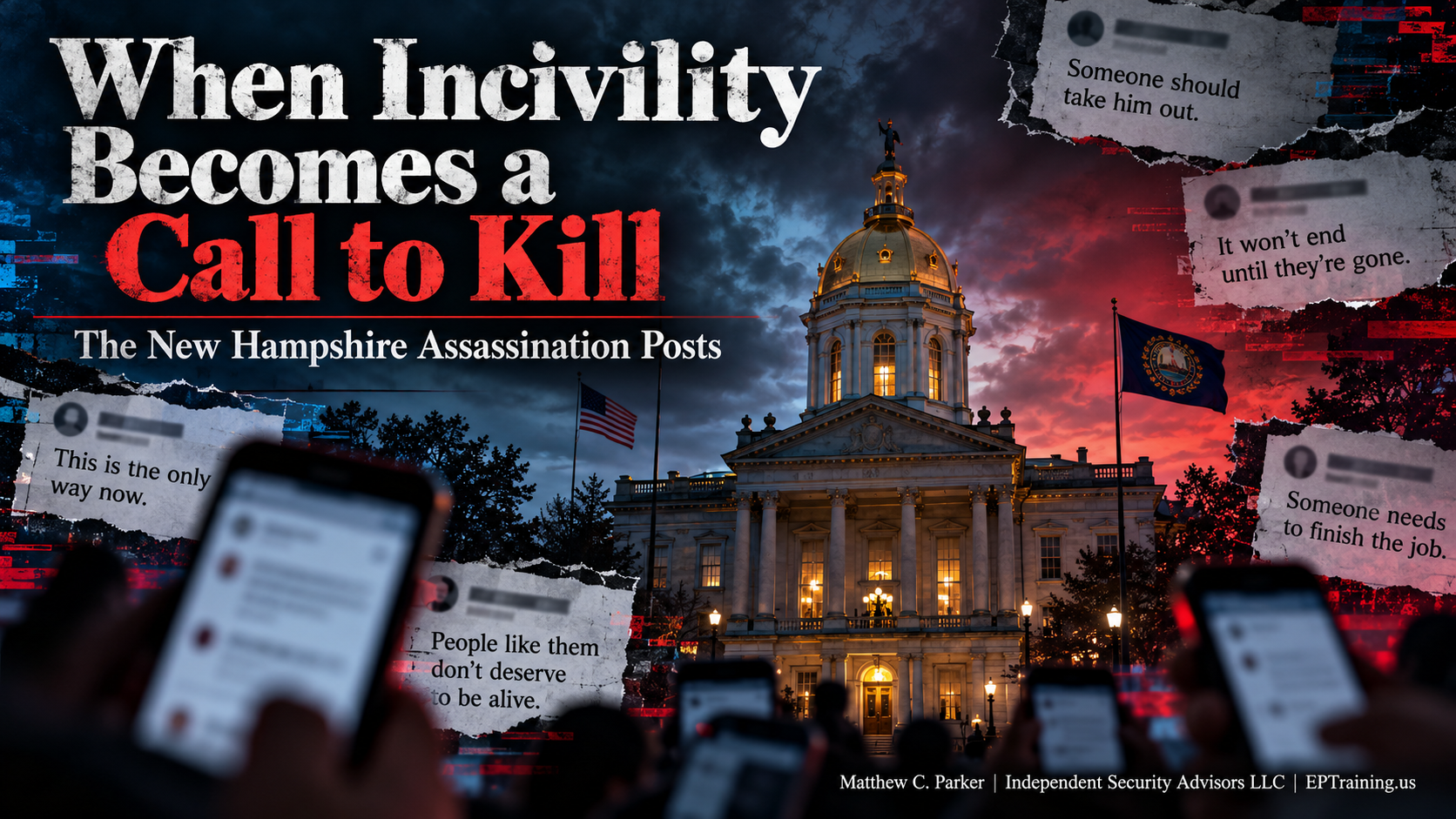
ISA INTEL BLOG
political violence
When Incivility Becomes a Call to Kill: The New Hampshire Assassination Posts
Category: Defending Democracy / Public-Official Security / Political Violence
Date Posted: September 27, 2026
By Matthew C. Parker | CEO & Director of Training, Independent Security Advisors LLC | EPTraining.us | Defending Democracy Initiative
Abstract
There is a difference between angry political speech and publicly calling for people to be killed.
Americans criticize politicians every day. They protest, argue, insult elected officials, attack their policies, and vote them out of office. That is politics. What happened in New Hampshire went well beyond that.
On September 22, 2026, the @LPNH account used by the organization formerly recognized as the Libertarian Party of New Hampshire posted that it supported the assassination of essentially every elected Democrat in the state. Another post encouraged violence against Democrats. Democrats, Republicans, the national Libertarian Party, and the newly recognized Granite State Libertarian Party condemned the statements. New Hampshire Public Radio
The New Hampshire posts are another example of political anger crossing a line. We are no longer talking about people calling politicians names, arguing over policy, or saying they want someone voted out of office. This account openly supported killing elected officials because of their political party, and it was not the first time the same account had used this kind of language.
That is what this article is about: when political anger moves from ugly words to open calls for political violence, and why we should stop pretending that is normal political debate.
What Happened in New Hampshire
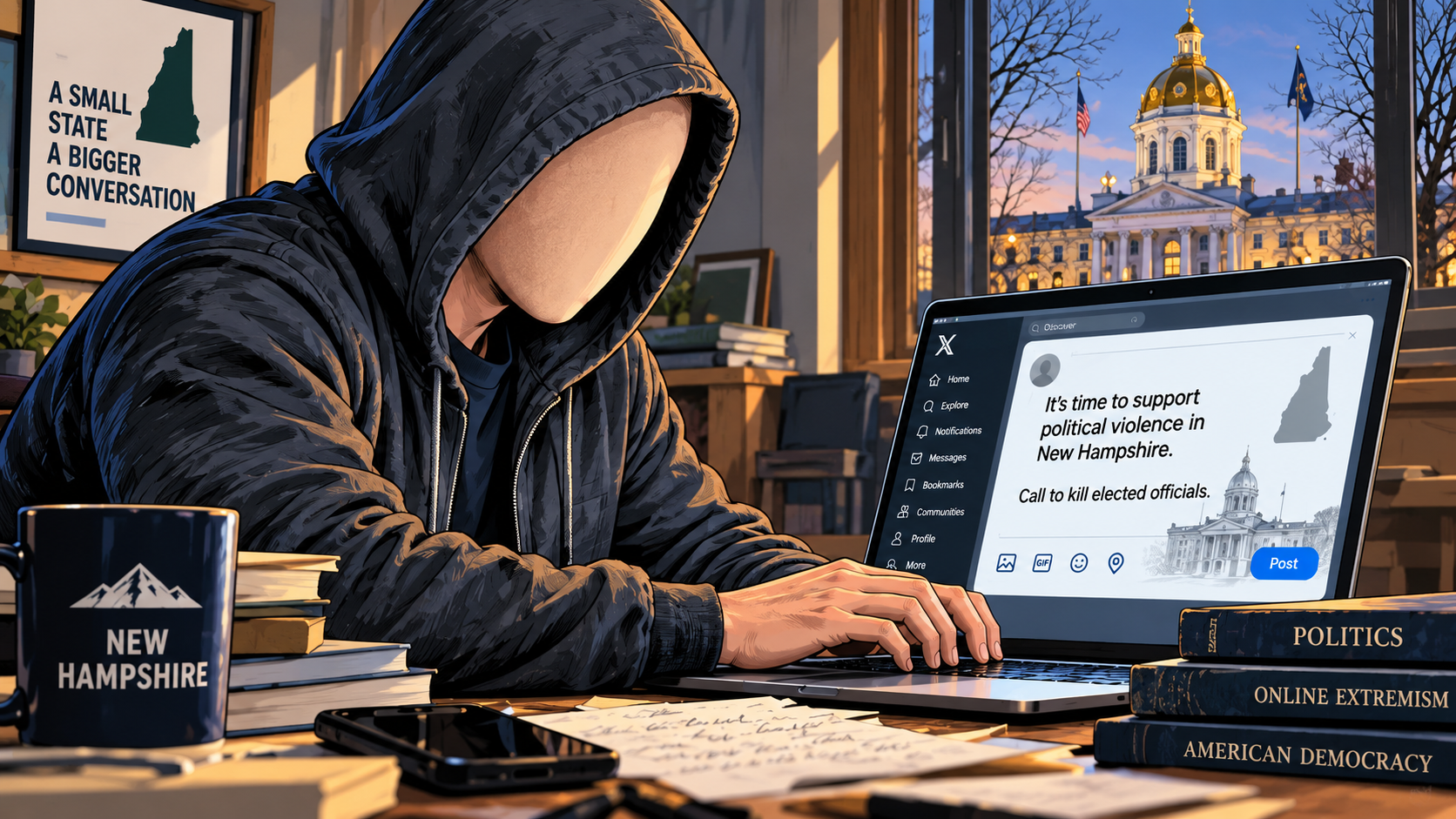 The September 22 post was direct:
“We openly support the assassination of basically every elected Democrat in New Hampshire.”
The account followed that with another post telling people who wanted to set Democrats on fire to do so. New Hampshire Public Radio, WCAX and WMTW documented the posts and the response that followed. New Hampshire Public Radio
The New Hampshire Attorney General’s Office confirmed that the Department of Justice was aware of the posts. House Democratic Leader Alexis Simpson contacted both the Attorney General’s Office and State House security and asked that the matter be monitored and investigated. New Hampshire Public Radio
This was not someone saying Democrats were wrong. It was not a demand that they resign or lose an election. It was an account once associated with a political organization openly supporting their assassination.
This Did Not Start in September
The same account has been here before.
In September 2024, the account posted that anyone who murdered then-Vice President Kamala Harris would be an American hero. Other posts from the account discussed shooting and killing politicians. The response in 2024 also crossed party lines. New Hampshire Republican Party Chairman Chris Ager condemned the posts, as did Democratic Party Chairman Raymond Buckley. The original Harris post was later deleted. New Hampshire Public Radio
Then came former New Hampshire Executive Councilor Andru Volinsky.
In March 2026, Volinsky helped announce a school-funding plan that included an income tax. The @LPNH account responded that under its stated political theory it was “perfectly permissible to kill him.” Volinsky contacted law enforcement, and now we have September 2026 and a statement supporting assassination of essentially every elected Democrat in New Hampshire.
The names and targets changed. The calls for political killing kept coming from the same organizational account.
This Is Not the National Libertarian Party
The group controlling the @LPNH account is no longer the recognized New Hampshire affiliate of the national Libertarian Party.
The Libertarian National Committee removed the organization as its state affiliate in May 2026. After the September posts, the national Libertarian Party condemned the former affiliate’s comments and said it did not condone political violence. The Granite State Libertarian Party also condemned the statements and said it had no association with the group operating @LPNH. Independent Political Report
By September 24, X had temporarily locked the @LPNH account for breaking its rules. The Boston Globe also reported that the national Libertarian Party was reviewing legal options over the former affiliate’s continued control of party assets and branding. BostonGlobe.com
The Response Crossed Party Lines
Republican Gov. Kelly Ayotte called the posts irresponsible and dangerous and said threats should be investigated and prosecuted to the fullest extent of the law. Republican congressional candidate Lily Tang Williams also condemned calls for political assassination as dangerous and unacceptable. BostonGlobe.com
Democratic officials responded as well. Congresswoman Maggie Goodlander called on the New Hampshire Attorney General and federal law enforcement to investigate the posts and hold anyone who broke the law accountable. Congressman Chris Pappas said calls for political assassination have no place in New Hampshire and said citizens should be able to take part in government without intimidation or violence. Congresswoman Maggie Goodlander
The targets were Democrats. The people condemning the calls to kill them included Democrats, Republicans and Libertarians. Political killing should not require a party meeting before we decide whether it is wrong.
From Incivility to Calls to Kill
ISA has written about political incivility for years. The point has never been that rude political speech is the same thing as violence. It is not.
People say terrible things about politicians every day. Some of it is stupid. Some of it is hateful. Some of it is protected political speech that other people find offensive. That does not make every angry person dangerous. But there is a point where the words change. Calling a politician a fool is one thing. Saying the politician should lose an election is politics. Protesting outside an office is politics. Openly supporting the assassination of elected officials is something else.
ISA addressed the first part of this problem in The Threats to Our Democracy: It Starts with Incivility. That article looked at what happens when Americans increasingly treat political opponents as enemies instead of people with whom they disagree. The Threats to Our Democracy: It Starts with Incivility
The Monster Engine went farther into the anger, fear and outrage that keep feeding the political fight. People stop seeing the person and start seeing only the label: Democrat, Republican, socialist, fascist, MAGA, leftist, right-winger. Once the label becomes all that matters, it gets easier to talk about another American as though he or she is no longer a person. The Monster Engine
New Hampshire shows where that kind of language can end up. We went from political disagreement to statements openly supporting killing political opponents.
This Is Not Only a New Hampshire Problem
 The numbers surrounding members of Congress show how large the threat problem has become.
The U.S. Capitol Police reported 14,938 threat-assessment cases in 2025 involving concerning statements, behavior and communications directed at members of Congress, their families, staff and the Capitol complex. USCP said the total increased for the third year in a row. U.S. Capitol Police
The same problem is showing up closer to home. A 2026 Princeton/CivicPulse survey of more than 460 local elected officials found that 54 percent had experienced at least one form of hostility during the first quarter of the year. Thirty-nine percent reported harassment and 17 percent reported threats. Democrats, Republicans and independents reported similar overall levels of hostility during that quarter. Bridging Divides Initiative
This is not one party’s problem.
Social Media Makes the Problem Bigger and Faster
The September post did not stay on one account in New Hampshire. It was copied, reposted, condemned and reported across the country. By September 25, Independent Political Report documented hundreds of comments and reposts, along with national commentators circulating the statement. Independent Political Report
That is simply how political communication works now. A statement made by a relatively small organization can become a national story in hours. Deleting the original post does not pull back the screenshots, news stories and copies that have already moved across social media.
ISA examined that problem in When the Voice and Outrage Is Fake, which looked at how social media can increase political anger, spread information far beyond its starting point and make events appear much larger or different from what happened on the ground. When the Voice and Outrage Is Fake: Social Media and Protective Intelligence
The point here is simpler. Once somebody publishes a call to kill political opponents, those words can go much farther than the person who first posted them.
The Bottom Line
The New Hampshire story is not one bad social-media post.
In 2024, the same organizational account endorsed the killing of Kamala Harris. In March 2026, it said killing Andru Volinsky was permissible under its stated political theory. In September, it publicly supported assassinating essentially every elected Democrat in New Hampshire. New Hampshire Public Radio
The national Libertarian Party had already removed the organization as its New Hampshire affiliate and condemned the latest posts. Republicans and Democrats in New Hampshire condemned them too. State officials confirmed that the Attorney General’s Office was aware of the latest statements, and State House security was contacted. New Hampshire Public Radio
People are going to continue saying ugly things about politicians. That comes with public life. But open calls to kill political opponents should never become just another part of the noise. We do not need to agree on politics to agree on that.
About the Author
Matthew C. Parker is CEO and Director of Training for Independent Security Advisors LLC and EPTraining.us. A retired U.S. Army professional with more than 20 years of military service, Parker’s work has included advisory, executive and dignitary protection, democracy programs internationally, anti-terrorism, and protective/security program management in the United States and overseas.
Through Independent Security Advisors, Parker develops and teaches executive-protection and security programs for law enforcement, military, private security, and others responsible for protecting executives, elected officials, judges, prosecutors, and other at-risk individuals.
He is also the author of ISA’s Defending Democracy Initiative, which has addressed threats against public officials, political violence, public access, and the security of elected officials since 2017.
Related ISA / EPTraining.us Reading
The Threats to Our Democracy: It Starts with Incivility
Fear Is Already Here: Threats Are Changing How Public Officials Serve—and How Judges Rule
The Monster Engine
When the Voice and Outrage Is Fake
Protection for Elected Officials, Times Are a Changing — 2017
Sources and Current Updates
The principal reporting for the September posts comes from New Hampshire Public Radio, WCAX, WMTW, the Boston Globe and Independent Political Report. NHPR also provides the strongest reporting on the 2024 Harris posts and the March 2026 Volinsky incident. The current public statements from Reps. Maggie Goodlander and Chris Pappas provide the officials’ own words rather than secondhand summaries. New Hampshire Public Radio
NHPR — September 2026 assassination posts
WCAX — Bipartisan response in New Hampshire
NHPR — 2024 Kamala Harris posts
NHPR — March 2026 Andru Volinsky posts
Princeton/CivicPulse — 2026 local-official survey
U.S. Capitol Police — 2025 threat-assessment cases