
 E-mail us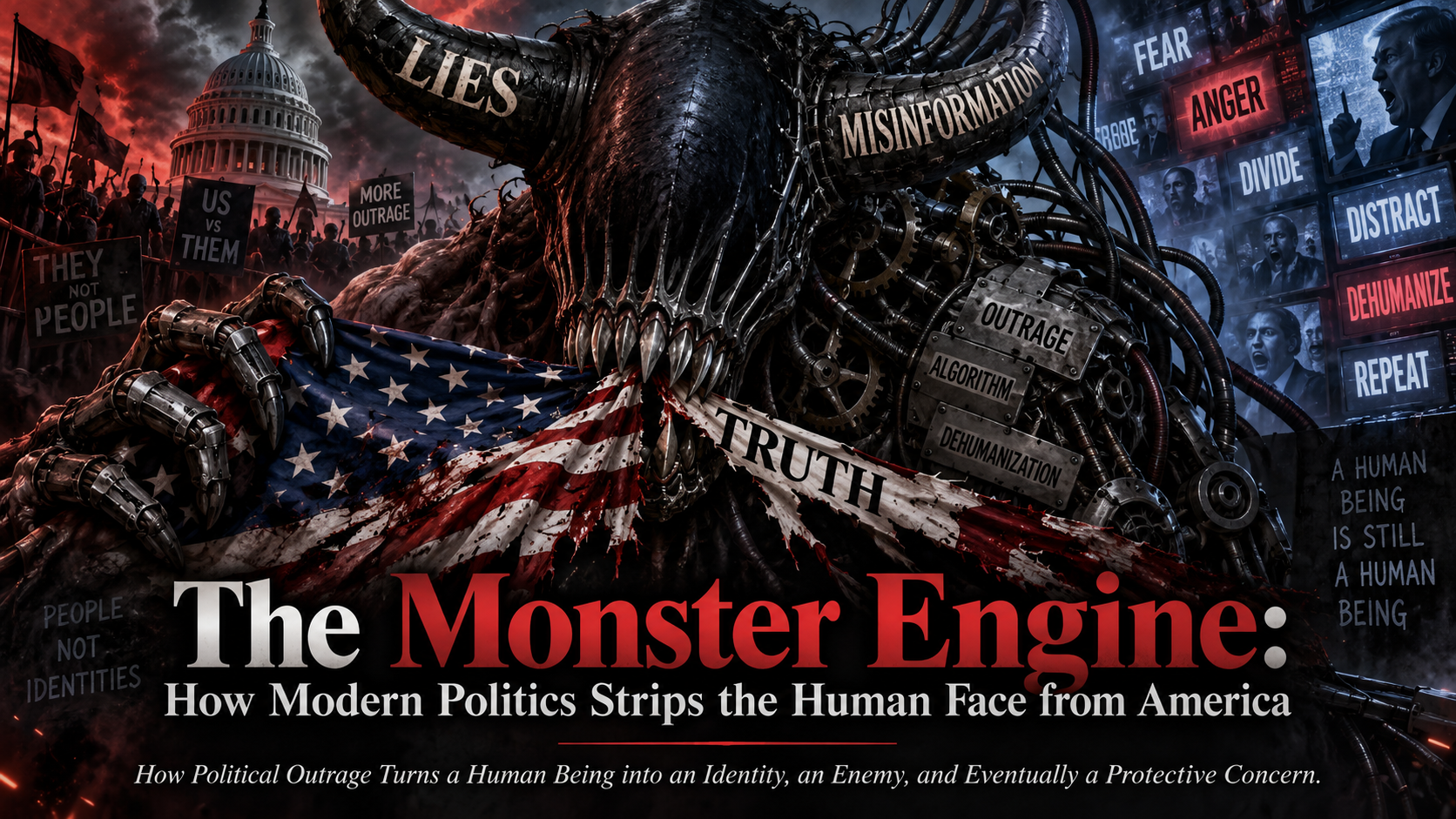
The Monster Engine: How Modern Politics Strips the Human Face from America
How Political Outrage Turns a Human Being into an Identity, an Enemy, and Eventually a Protective Concern
By Matthew C. Parker
CEO, Independent Security Advisors LLC | Director of Training, EPTraining.us
ISA Defending Democracy Initiative
September 2026
The Monster Engine is a living political machine fed by fear, misinformation, partisan media, political power, money, and our willingness to stop seeing one another as human beings. Matthew C. Parker examines how the monster gains power, how online anger reaches real people and places, and how citizens can weaken it through truth, education, skepticism, debate, and respect for democracy.
Abstract
Every day, millions of Americans experience politics through a screen. Too often, what reaches that screen is not a complete speech, a full interview, a policy paper, or enough information to understand what actually happened.
It is a fragment: four seconds of video, an awkward photograph, a facial expression, a sentence removed from everything around it, or an accusation repeated so often that eventually nobody remembers where it started. Eventually, people stop asking questions because they are buried in the sheer onslaught of false information.
That process is what I call the Monster Engine.
Bottom Line Up Front
To combat the monster, the answer is not silence or less political disagreement. Democracy requires disagreement. A democracy depends on our ability to oppose another person’s ideas without having to manufacture an evil identity for the person holding them.
Where the monster wins and takes over is when political disagreement becomes character assassination. The consequences extend beyond hurt feelings or ugly social media. False accusations can become permanent reputations. Compromise begins to look like betrayal.
Cooperation with the other party can be portrayed as collaboration with an enemy. Legitimate criticism gets buried beneath fabricated allegations, and political opponents begin to be treated not as people to defeat in elections but as people whose continued presence is itself the problem.
Reader Navigation
- The Monster Engine Explained — What the Monster Engine is, what feeds it and why people themselves keep it alive.
- The Four Pillars That Hold Up the Monster — Political power, social media, partisan media and money give the creature purpose, reach, voice and fuel.
- The Monster Engine — How fragments, false narratives and amplification turn ordinary human moments into political identities.
- The Most Dangerous Part Is What the Monster Leaves Behind — The result of the machine: a human being reduced to a political identity, category or enemy.
- The Person Disappears First — How labels cover the individual one layer at a time until the person disappears behind the identity.
- The Monster Is Half Machine for a Reason — Technology gives fear, lies and outrage reach, speed and repetition.
- It Looks Like It Is Eating the Flag, but It Is Really Eating the Soul of Our Country — What happens when Americans lose the common ground that lets political opponents remain fellow citizens.
- Lies and Misinformation Created the Horns — How false information makes existing grievances worse and gives anger a target.
- The Monster Has Operating Instructions — Fear, anger, division, distraction and dehumanization keep the creature moving.
- When the Monster Gives Anger a Face — A broad grievance becomes attached to a real person, family and physical place.
- Defending Democracy: When the Sky Begins to Darken — What changes in the environment around a protectee when online anger moves into the physical world.
- How Citizens Starve the Monster — Verification, education, skepticism, listening, debate, compromise and civic responsibility take away its fuel.
- Bottom Line — The monster survives only as long as we continue giving it breath.
The Monster Engine Explained
The Monster Engine is not one politician, one political party, one television network or one social-media company. It is a living political machine that feeds on fear, anger, grievance and our willingness to believe the worst about one another. Political power gives it purpose. Social media gives it speed and reach. Partisan media keeps the anger alive. Money rewards those who keep feeding it.
The monster survives because we participate. We click, share, repeat and sometimes believe before we verify. We allow political labels to replace human beings and let our desire for change become fear that somebody else can manipulate. But what we feed, we can also starve. Truth, education, skepticism, debate, compromise, civic knowledge and respect for democracy take power away from the monster.
The Four Pillars That Hold Up the Monster
The monster does not stand by itself. Four pillars hold it up: political power, social media, partisan media and money. Remove one and the creature becomes weaker. Feed all four and the monster has almost everything it needs to keep breathing.
Political power
gives the monster a reason to exist. Fear can move voters, anger can raise money, grievance can build loyalty and division can make compromise look like surrender. The monster benefits when political success depends less on convincing people and more on making them afraid of what will happen if the other side wins.
Social Media
Political power alone cannot keep the creature alive. It needs a way to reach people constantly, and social media gives it that ability. A political accusation that once might have reached a few thousand people through a speech or newspaper can now move through millions of phones, be repeated by strangers, copied by fake accounts and returned to the same person again and again.
This is not just a metaphor. In 2026, Nature Human Behaviour looked at deceptive online networks active during the 2020 U.S. election. They reached at least 37 million Facebook users and 3 million Instagram users. Some wanted political influence. Others appeared to use politics to make money. Ordinary users helped carry the material farther by resharing it. That last part matters: the machine did not do all the work. People did.
Partisan Media
Then comes partisan media. The monster needs voices that keep telling an audience that its fears are justified and that the people on the other side are responsible. That does not belong exclusively to the political right or left; political commentary and openly ideological media exist across the political spectrum.
For purposes of this article, partisan media does not mean that every report produced by an organization is false. It means political media in which commentary, ideology, advocacy or an identifiable political viewpoint plays a substantial role alongside reporting or discussion. That distinction matters because the monster does not require everything a source says to be false. It needs an audience that stops looking outside the sources it already trusts.
These organizations are not identical, but their reporting, standards, audiences or political positions are interchangeable. The common concern is what happens when any audience stops testing what it hears against competing information and begins using media primarily to confirm what it already believes.
The personalities can change, the networks can change and the political party can change. The monster does not care. It wants an audience that keeps coming back angry. One audience can spend every day hearing why the left is destroying America, while another can spend every day hearing why the right is destroying America.
The names are different, the politics are different and the audiences are different, but fear still feeds the monster, anger still feeds it and division still feeds it.
Money
The fourth pillar is money, because outrage can be profitable. Advertising, subscriptions, donations, fundraising and audience growth all create incentives to keep people watching, clicking and returning. Research published in Nature found that misinformation websites in its study were heavily supported by advertising and that digital advertising platforms could amplify that financing.
Money does not automatically make political speech dishonest, and disagreement does not make media dangerous. The problem begins when keeping people frightened, furious and divided becomes more valuable than slowing down long enough to determine whether what they are being told is true.
The four pillars reinforce one another. Political power needs attention. Social media delivers it. Partisan media keeps the audience emotionally involved. Money rewards whoever can keep that audience watching. And underneath all four pillars are all of us. Without people willing to feed it, the monster has nothing to eat.
The Monster Engine
The monster is frightening because it is not entirely alive and not entirely machine. Part of it is flesh, part of it is machinery, and neither part works alone. The horns are marked LIES and MISINFORMATION, but those are only what power the creature. Inside the body are gears, cables, screens and an OUTRAGE ALGORITHM, suggesting something more disturbing than a single dishonest person or a single false story. The monster is unleashed to cause anger, spread lies and corrupt our democratic system.
But the monster is alive. It breathes because we breathe life into it. It feeds on our fears, then stokes those same fears and feeds them back to us. It takes resentment, anger and distrust, gives them something to blame and then waits for us to give the creature another meal.
The machine does not care who started it; it will serve any master who gives it life. It only needs fuel. The monster does not care whether that fuel comes from the political right or left, a foreign adversary, political organization, activist, opportunist, or someone simply trying to make money from keeping people angry. Feed the monster, and it grows.
The process can begin with almost anything: an anonymous account, a partisan commentator, a misleading headline, an edited photograph, a foreign influence operation, or an ordinary person sharing something because it confirms what he already believes.
U.S. intelligence and law-enforcement agencies have documented foreign actors using false personas, fabricated stories, manufactured video, fake websites, and coordinated campaigns to exploit existing American divisions. Those operations do not have to invent a disagreement when amplifying a real disagreement can be more effective.
All the process needs is a spark—a few seconds of video, an awkward gesture, a photograph caught at the right moment, or a sentence that can be separated from everything said before and after it. The sequence is familiar: a raw human moment loses its context, someone assigns a motive, outrage amplifies the interpretation, repetition turns the interpretation into a narrative, and the narrative becomes part of the person’s identity.
The byproduct of using the machine is crowds holding signs that reduce people to categories: US VS. THEM and THEY — NOT PEOPLE.
The machine sends out to the willing the emotional commands that keep the monster running: FEAR, ANGER, DIVIDE, DISTRACT, DEHUMANIZE, REPEAT. Here sits the monster, taking political disagreement and turning it into something personal.
The Most Dangerous Part Is What the Monster Leaves Behind
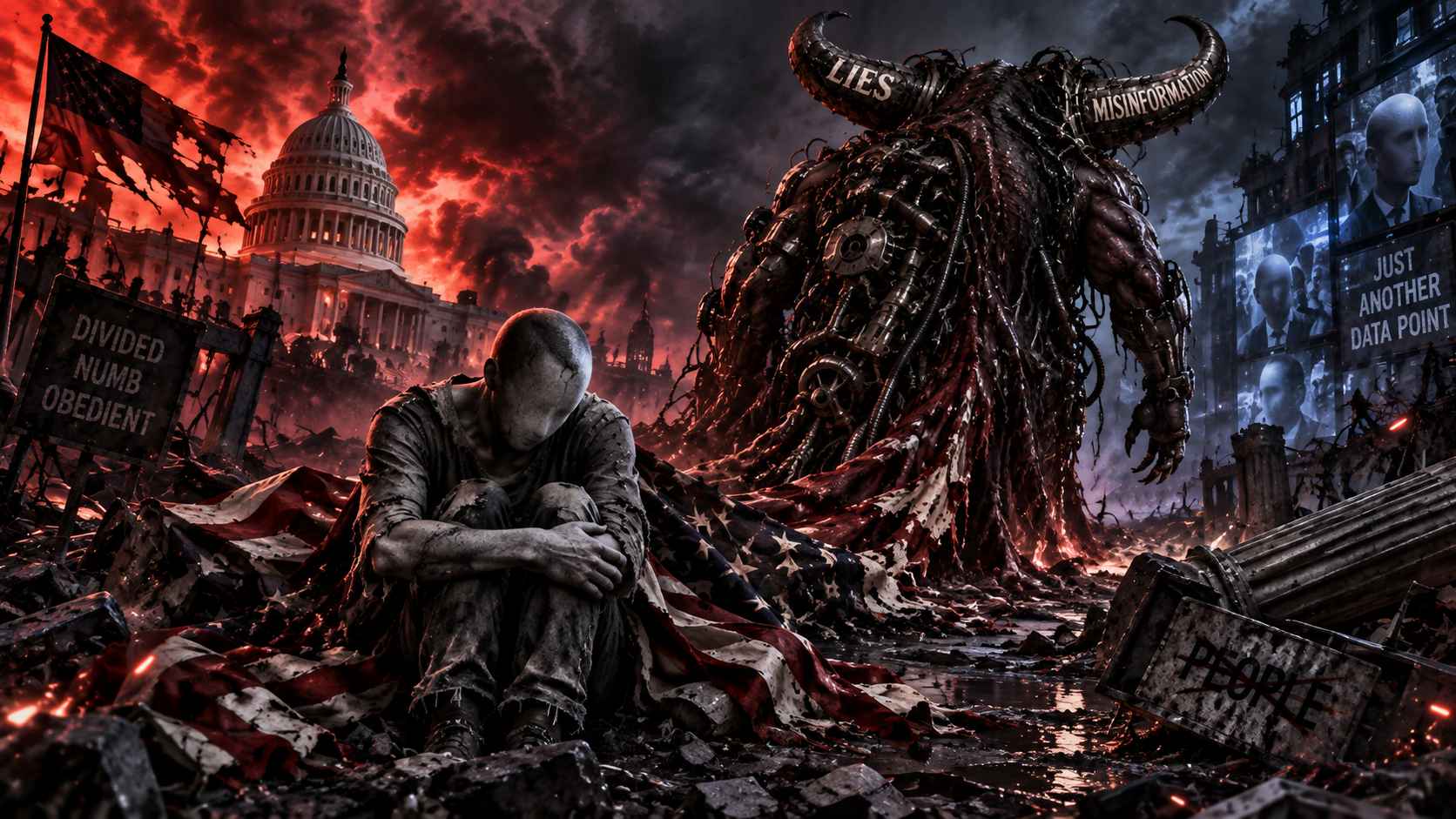
After the lies, fear, repetition and outrage have done their work, the human being on the other side of the argument is still standing there, but the monster has stripped away everything that made that person an individual. What remains is the result of the machine’s work: a political identity, a category or an enemy.
That is when the monster has accomplished more than spreading misinformation. It has changed how one human being sees another. The disagreement is no longer about what somebody believes, what decision somebody made or what policy somebody supports. The person becomes the problem.
The monster benefits every time this happens because a faceless enemy is easier to hate than a human being. It is harder to hate a father, mother, neighbor, police officer, judge, election worker or the person standing beside you in a grocery store. It becomes easier when the monster removes those things and leaves only the label.
The monster does not win because everybody believes the same lie. It wins when enough people stop seeing the human being standing behind the political identity. Once that happens, the distance between disagreement and personal hatred becomes much shorter. The monster has now done something more dangerous than make somebody angry. It has given the anger a human face.
The Person Disappears First
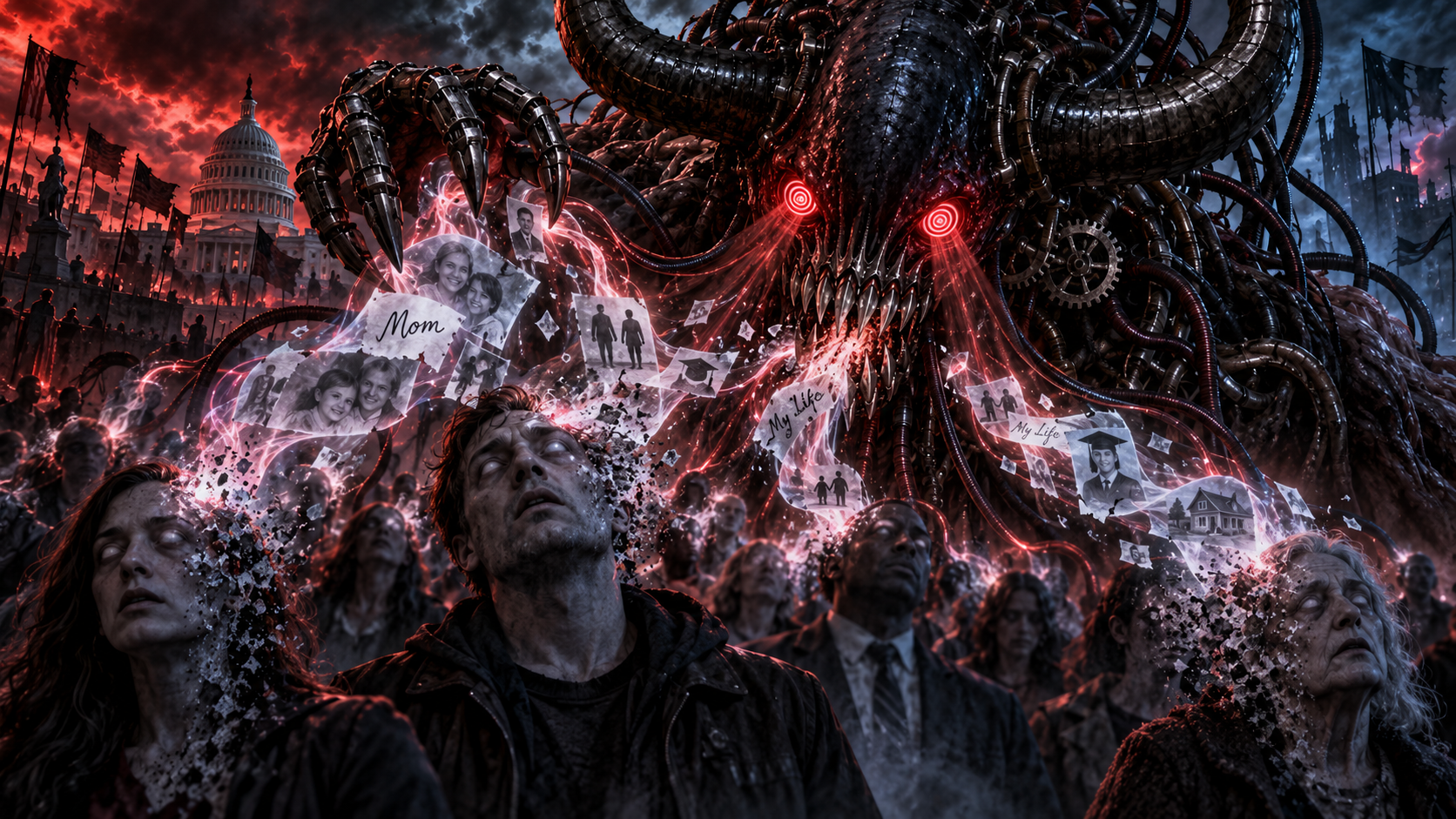
The face does not disappear all at once. The monster covers it one label at a time. A face belongs to a father, mother, neighbor, police officer, protester, elected official, judge, voter or person standing beside you in a grocery store. Once the face disappears, the individual becomes easier to replace with an identity.
Republican. Democrat. Liberal. Conservative. Immigrant. Government official. Activist. Police officer. Journalist. Judge. Protester. Rich. Poor. Urban. Rural. The monster uses labels to tell us something about a person, but to divide us, it never tells us everything.
We stop debating an idea and begin assigning moral guilt to everyone who appears to belong to a group we disagree with. The person is no longer judged for what he did. He begins carrying the guilt assigned to everyone who shares the same label.
The human being is still standing there, but nobody is looking at him anymore. The face has disappeared behind the label, and the monster has won.
The Monster Is Half Machine for a Reason
The creature is part mechanical so it can use those systems to generate modern outrage and produce lies, fear and misinformation that multiply and are delivered at a scale no angry crowd standing on a street corner could ever achieve.
The machinery does not create human emotion from nothing. It finds emotion, feeds it, organizes it and keeps turning the gears. It can do that because the monster is partly alive. It knows how to manipulate human beings into believing its message. It can speak in human terms and drive humans to become angry.
Another post appears, another video follows and another accusation is repeated. Another comment tells everybody to agree, to submit to the liars and to fear what they are being told to fear. The monster does not need the first message to convince you because it knows another one is coming behind it.
The monster pushes another headline telling those who pray at its feet that the other side is worse than they thought. It repeats the same claim and triggers the social-media machinery, knowing that anger keeps people watching, reading and believing.
The monster and the machine need one another. The machinery gives the creature reach. The monster gives the machinery something human beings will react to. We give both of them the final ingredient when we feed our fear, anger and resentment back into the creature.
It Looks Like It Is Eating the Flag, but It Is Really Eating the Soul of Our Country
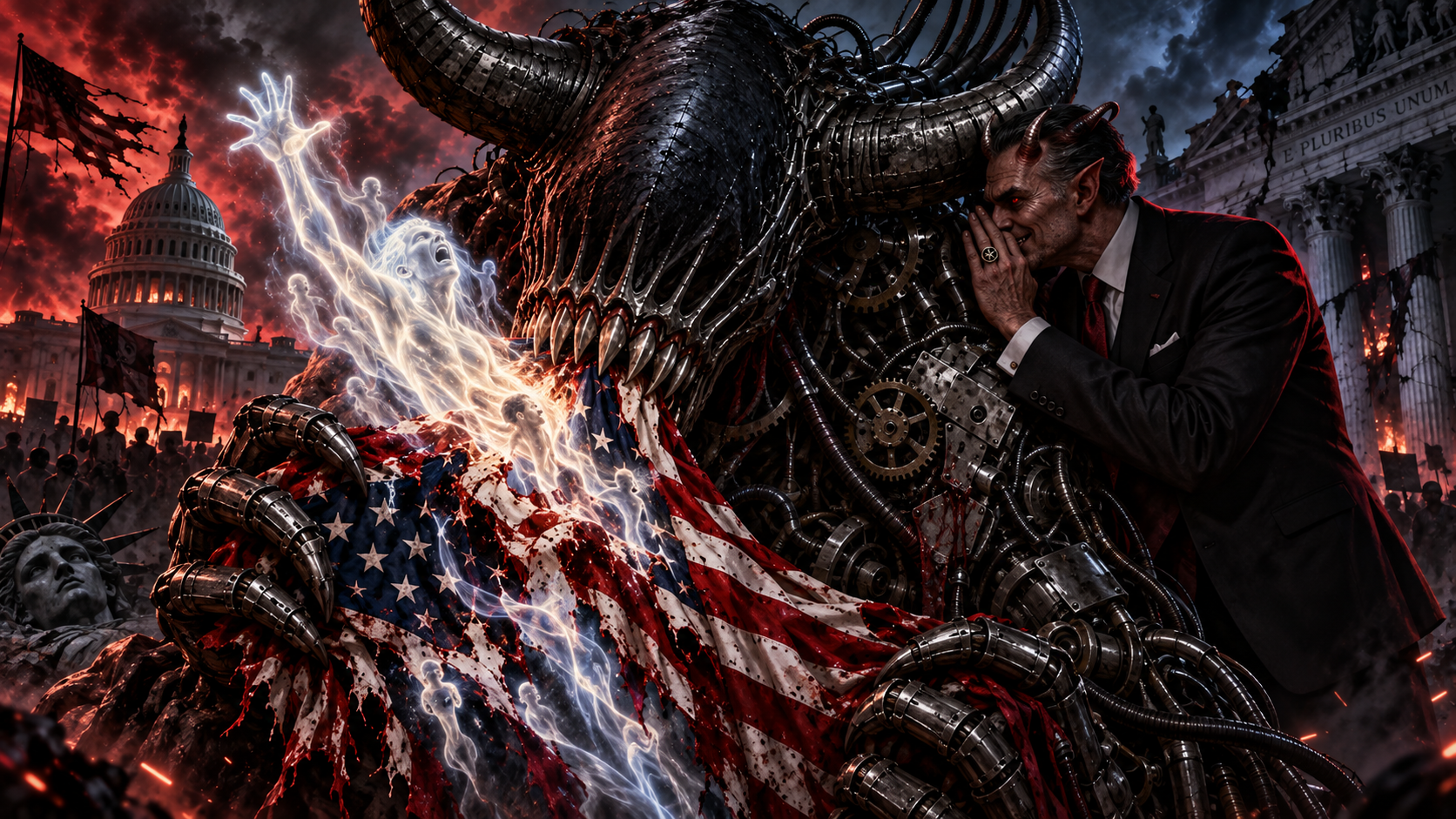 The American flag in the monster’s mouth is not clean or ceremonial. It is being pulled apart, like our people. We are pulled into camps and factions, led by liars and those who claim to be public servants while feeding the same creature that benefits from keeping Americans angry with one another.
The monster is not simply biting a piece of cloth. It is chewing through the thing that allows Americans who disagree with one another to remain part of the same country: some common belief that facts matter, that opponents remain human beings and that losing an argument does not make the other person an enemy who must be destroyed.
Before we unleashed the monster, a person could oppose a mayor, governor, president, judge, prosecutor, police chief or political candidate and still recognize that person as a human being. A protester could be angry without becoming violent. A voter could believe an official made a terrible decision without believing that official’s family deserves punishment.
But the monster feeds and survives by destroying those truths. It wants disagreement to become condemnation, condemnation to become hatred and hatred to become something personal. Every time that happens, the monster gets stronger.
Lies and Misinformation Created the Horns
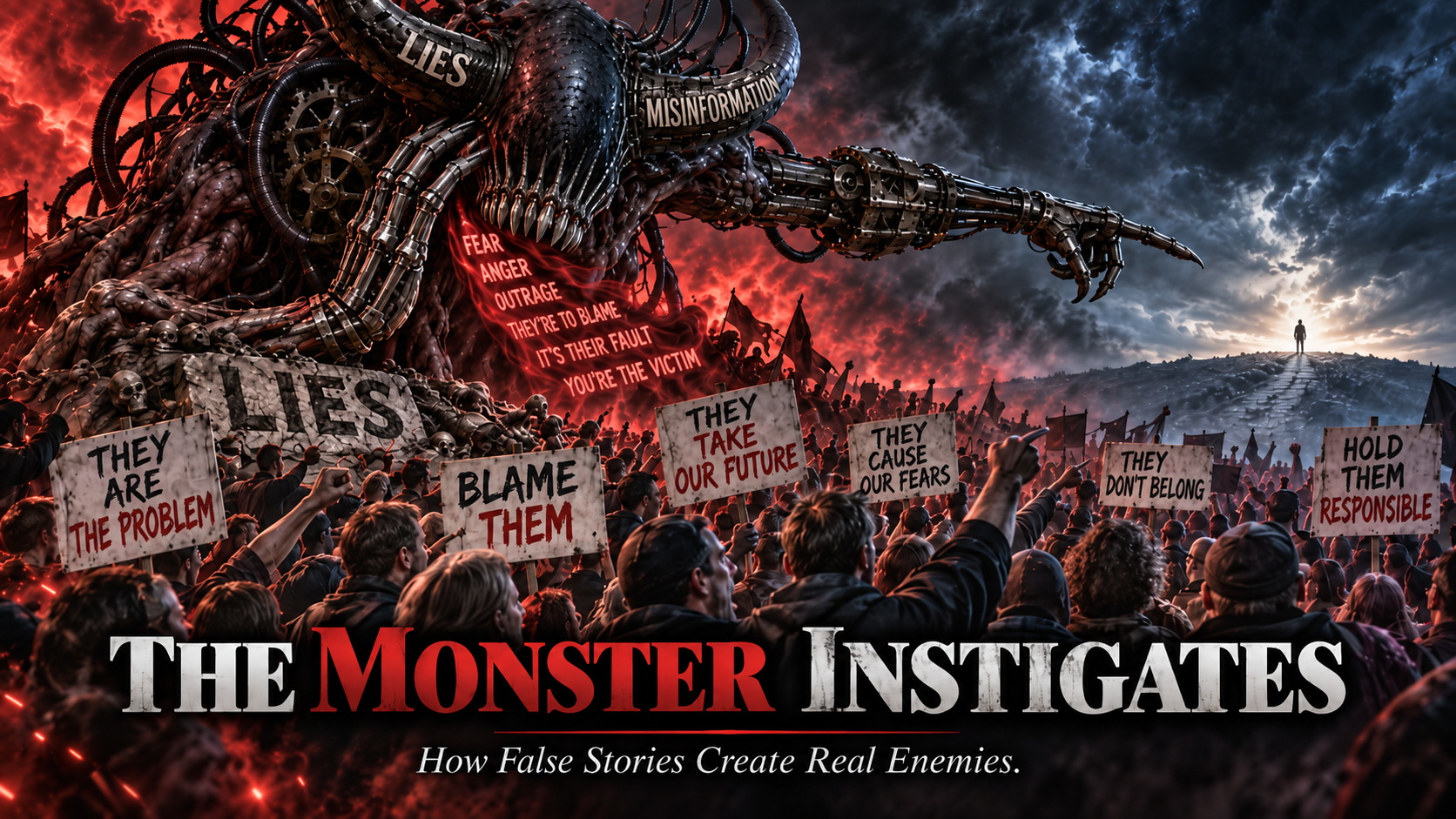
Lies do not have to convince everyone to do damage. Sometimes all they have to do is make an existing grievance worse.
The monster will share a false story. It can identify somebody who was previously unknown, and then it can attach a name and photograph and create a controversy. It can give angry people a person to blame. It can make a home address suddenly interesting to strangers who had never heard of the person a week earlier.
The lies it shares may eventually be disproved, but that does not mean everybody who heard them will see the correction. It does not mean everybody will believe the correction, and it does not erase whatever somebody already decided to do because of the original story.
That is why TRUTH is pulled through the monster’s teeth rather than simply lying on the ground. Truth must be destroyed, lest you see or hear it and weaken the monster.
The monster benefits from the time between the lie and the truth. By the time the correction arrives, the creature may already have put a face on the grievance, given that face a name and shown angry people where to direct their blame.
The Monster Has Operating Instructions
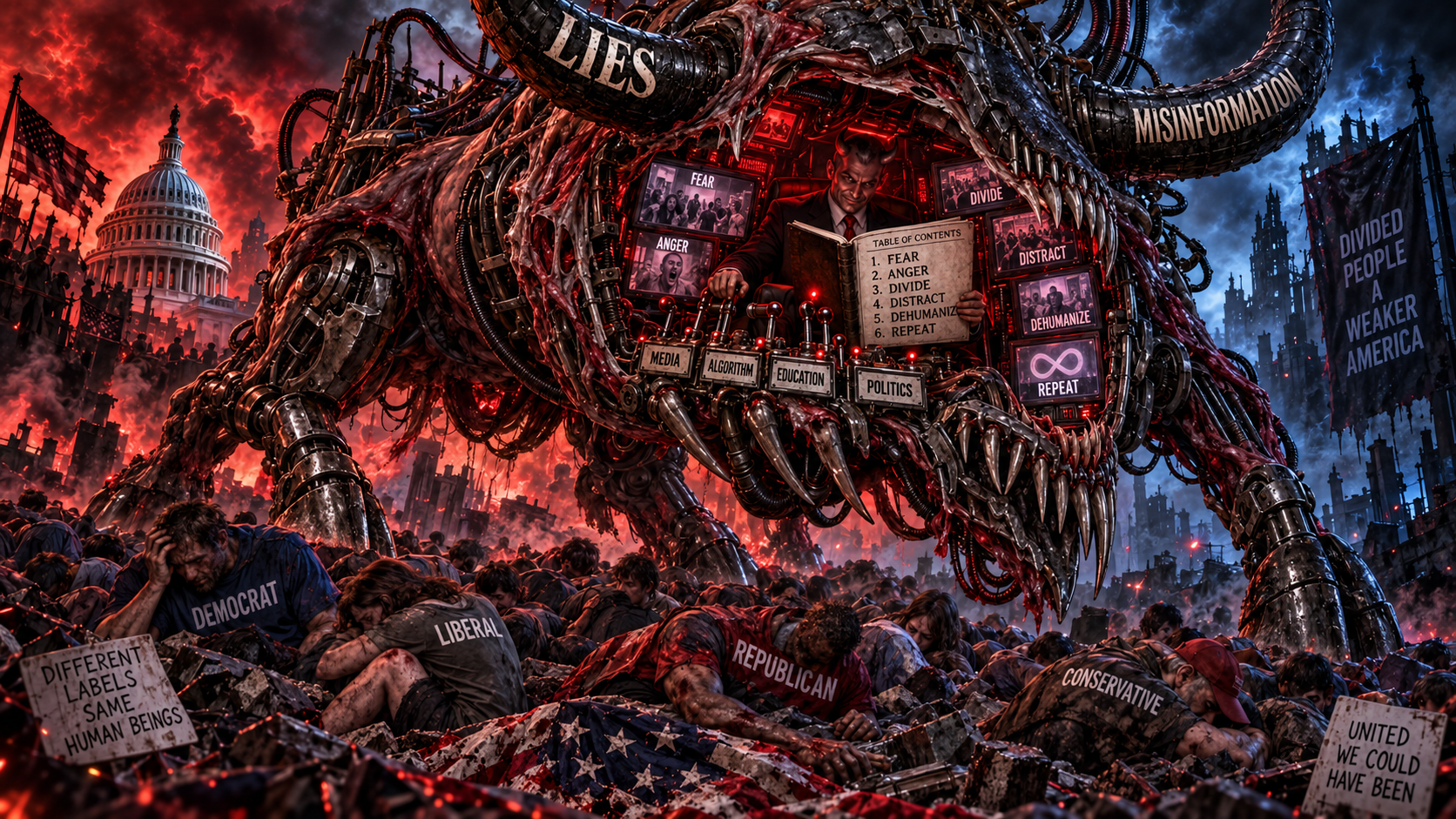
The set of operating instructions for the machine is FEAR. ANGER. DIVIDE. DISTRACT. DEHUMANIZE. REPEAT. The sequence matters because each command prepares the person for the next one.
Fear tells somebody there is a threat, while anger tells him who caused it. Division tells him that the people on the other side are not like him, and distraction keeps him from looking closely at contradictions. Dehumanization removes the individual person from the argument and replaces that person with an enemy.
Then the cycle starts again. The monster does not need a party. It only needs people willing to stop seeing one another as people. One person may stop at anger, another may repeat the lie and somebody else may harass the person the monster has identified. Most people will go no further, but the monster keeps feeding because it does not need everyone to go further.
When the Monster Gives Anger a Face
The monster becomes more dangerous when it takes a broad political grievance and gives people one human being to blame. An argument about an election, court ruling, prosecution, policy or government decision can suddenly become about one person. His name is repeated, his photograph circulates, his family is identified and people begin talking about where he lives or where he will appear.
Most people who hear or repeat those accusations will never harm anyone. But the monster has changed the environment when the grievance is no longer aimed at an idea or institution. It now has a face, a family and a physical place in the world.
The monster does not stop with the person it first identifies. A spouse can become part of it. A child can be dragged into the anger. A home that meant nothing to strangers yesterday can become part of the story today. The grievance spreads because the monster has taught people who to blame and where that person exists outside the screen.
Defending Democracy: When the Sky Begins to Darken

A protection team cannot stop the political outrage caused by the monster. We cannot control the monster or determine what millions of people choose to believe. Agents can, however, recognize when the sky begins to darken around the principal and when the monster is affecting the people and the environment around that person.
The monster changes the atmosphere around the protectee before it ever announces itself as a threat. A place that felt routine yesterday can feel different today. The crowd is louder, the language is harsher, the signs are more personal and the accusations that began online are now being repeated by real people standing outside a stadium, courthouse, public meeting or residence. What had been political disagreement begins to feel more personal, more confrontational and less predictable.
Around a public event, that change may be felt in the parking lot before it is seen at the entrance. People arrive already angry, repeating the same story, carrying the same grievance and blaming the same person. Conversations have a different edge. Groups gather where they did not gather before. People argue with staff, press against barriers or encourage one another to confront the person the monster has given them to blame. The crowd is still made up of individuals, most of whom will never hurt anyone, but the atmosphere around them has changed.
The same thing can happen around a home. A quiet street begins attracting unfamiliar cars, strangers stopping to look at the residence, people taking photographs or asking neighbors questions. Family members begin seeing their names or photographs online. Staff members receive more angry calls. Neighbors notice people who do not belong there. The monster has carried the grievance off the screen and into the places where the protectee and family actually live.
That is what it means when the sky begins to darken. Fear is growing, anger is becoming more personal and misinformation is drawing attention toward a real person, family or place. Sometimes the room is a ballroom, sometimes it is a stadium parking lot and sometimes it is the sidewalk outside a residence. The walls do not define the room. The people, mood, noise and behavior around the protectee do.
The monster can darken that environment long before anyone crosses a line. The people remain individuals, not political labels, and the atmosphere itself tells part of the story. What was normal no longer feels normal. What was distant is getting closer. What lived on a screen has entered the street.
How Citizens Defeat the Monster
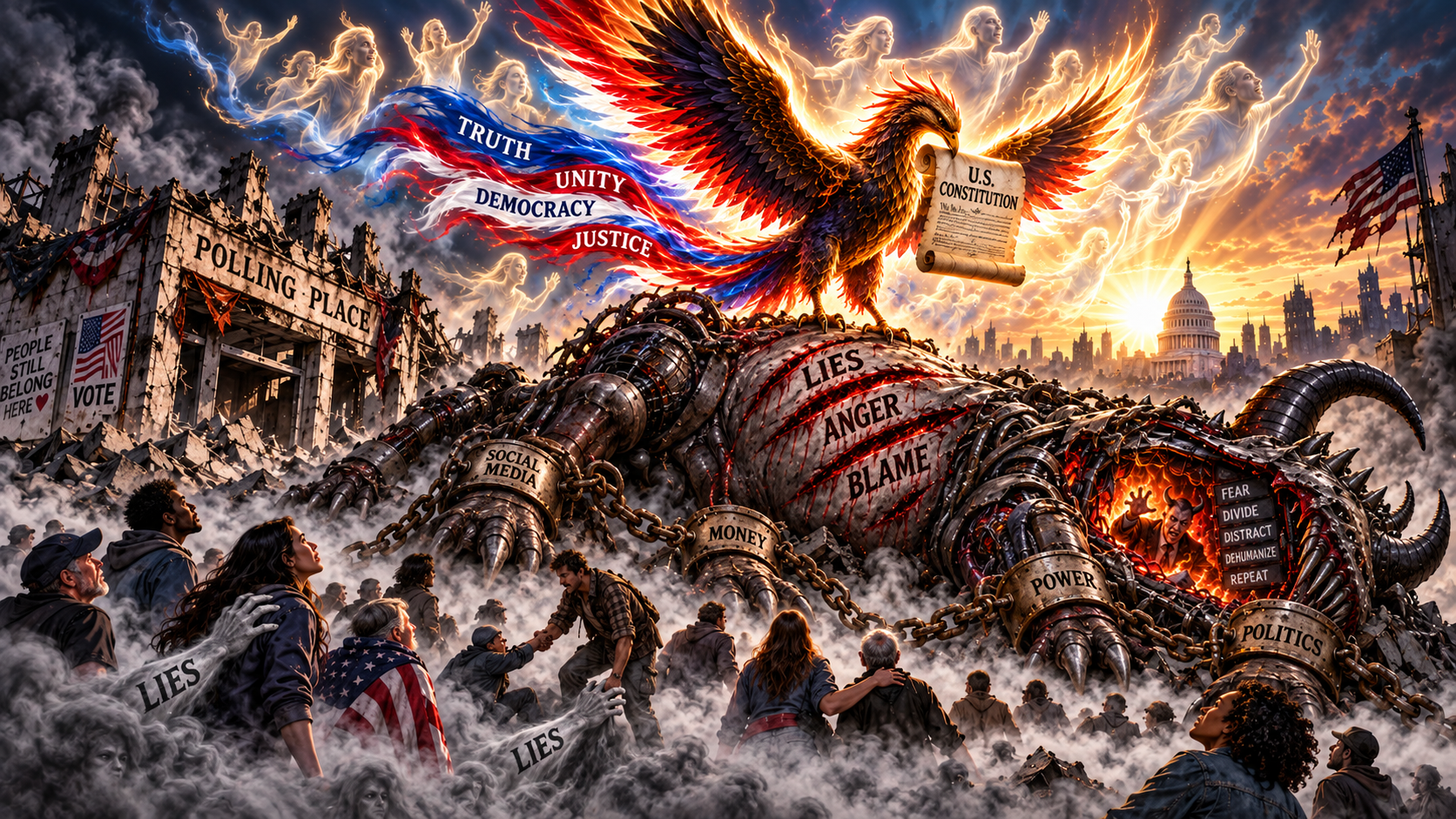
The monster depends on speed. It wants us angry before we think, sharing before we read and choosing a side before we know what happened. One of the simplest ways to weaken it is to slow down long enough to ask whether what we are being told is true.
Before passing along a political accusation, find out where it came from. Find the original source. Look for independent confirmation. Read beyond the headline. Check the date. Look at what came before and after the short video clip. If the photograph or story seems designed to make you instantly furious, give yourself enough time to determine whether that anger belongs to the facts or to the person trying to manipulate you.
Fact-checking does not require believing a fact-checker because somebody told you to. It requires learning how to verify information yourself. Media-literacy research describes methods such as lateral reading: leaving the original page, investigating who is behind the information and checking independent sources before deciding whether a claim deserves your trust.
Skepticism does not mean believing nothing. Believing nothing makes a citizen just as easy to manipulate as believing everything. Skepticism means requiring evidence before giving someone your trust, your anger or your fear.
Education takes power away from the monster. Study civics. Understand what the Constitution actually says. Understand the powers of Congress, the presidency, courts, states and local government. Understand what government can do, what it cannot do and what requires the consent of other institutions before it can happen.
That knowledge matters because fear is easier to manufacture when people do not understand the system being described to them. In 2026, the Annenberg Constitution Day Civics Survey found that 35 percent of U.S. adults could not name all three branches of the federal government. The survey included 1,034 U.S. adults. That is not trivia. If citizens do not understand how government is structured, they are easier to frighten with claims about powers government does not have or actions one part of government cannot take by itself.
Citizens also have to learn to listen again. Listening does not mean surrendering a belief. Debate does not require hatred. Compromise does not mean weakness. Democracy requires people who deeply disagree to continue living together under the same Constitution after the argument, election, court decision or legislative vote is over.
Argue the issue. Challenge the facts. Debate policy. Vote. Protest. Organize. Petition government. Support a candidate. Oppose a candidate. Those are democratic acts, and losing one of those arguments does not turn the person who won into an enemy.
No matter how badly you want change, do not let that desire be turned into fear by false prophets. Be skeptical of anyone who tells you that everything will be lost unless you follow him, that compromise is betrayal, that everyone asking questions is part of the enemy and that only one person or one movement can save you.
Fear can make people surrender judgment before they realize what they have given away. A citizen in a democracy has power, but power carries responsibility. Government is not something that happens to us from somewhere else. We elect it, fund it, criticize it, obey it, challenge it and change it. We also live with the consequences of the choices we collectively make.
We cannot blame the monster for everything while continuing to feed it. Validate before you share. Confirm before you accuse. Fact-check misinformation before you help spread it. Ask who benefits from making you afraid. Learn enough civics to recognize when someone is misrepresenting what government can or cannot do. Listen to people you disagree with. Debate them. Compromise when compromise is possible. Respect democratic institutions even when they produce an outcome you dislike.
Truth, Education, Skepticism, and Listening starves it. Debate and compromise, and Remembering that the person on the other side is still a human being starves it. Together it defeats it.
Bottom Line
The monster is alive because we continue to feed it. Political power gives it purpose. Social media gives it reach. Partisan media gives it a voice. Money keeps the gears turning. Lies give it horns. Misinformation gives it teeth. Fear gives it strength and anger keeps it moving, but we still decide whether to give it breath.
Reader FAQ
What is the Monster Engine
The Monster Engine is a metaphor for the political machinery created when political power, social media, partisan media, money, misinformation and human fear begin feeding one another. The monster becomes powerful when people stop seeing political opponents as individual human beings and begin seeing only identities and enemies.
What are the four pillars of the Monster Engine
The four pillars are political power, social media, partisan media and money. Political power gives the creature purpose. Social media gives it reach and speed. Partisan media can repeatedly reinforce a political worldview, while money creates incentives to capture and hold attention.
Does the Monster Engine belong to one political party
No. The monster will serve anyone willing to feed it. Political fear, misinformation, outrage and dehumanization can come from the political right, political left, foreign actors, organizations, opportunists or people using politics simply to generate attention and money.
Is partisan political media automatically misinformation
No. Political commentary and partisan perspective are not the same thing as misinformation. A politically oriented outlet can report accurate information, and a supposedly neutral source can make mistakes. The danger described in this article develops when citizens stop verifying information, stop seeking competing evidence and accept a preferred source merely because it confirms what they already believe.
How can citizens fight misinformation
Slow down before sharing. Identify the original source, seek independent confirmation, read beyond headlines, check dates and context, and determine who is behind a claim. Citizens should be particularly cautious when a story immediately confirms everything they already believe or appears designed primarily to make them furious.
Why does civic education matter
Citizens who understand the Constitution, the branches of government, federalism, elections, courts and the limits of governmental power have a stronger foundation for evaluating political claims. Civic knowledge also reminds citizens that democracy gives them influence while placing responsibility on them for how they use it.
Why does the article discuss executive protection
The connection is atmospheric. Political anger can alter the environment surrounding a public official before anyone makes a direct threat. A crowd, public event, neighborhood or residence can look and feel different when accusations move from screens into the physical world. Recognizing that change does not mean treating ordinary disagreement, protest or political affiliation as dangerous.
About Independent Security Advisors / EPTraining.us
Independent Security Advisors and EPTraining.us approach executive protection as a system that begins well before an agent is standing beside the principal. Threat assessment, protective intelligence, advance work, site assessment, movement, communications and continuing reassessment are used to identify changes in the environment before those changes enter the reactionary gap.
The Defending Democracy Initiative examines threats, intimidation and protective problems affecting elected officials, judges and other public servants without treating political disagreement itself as a threat. Its purpose is to help protection professionals recognize when grievance, fixation and behavior are beginning to change the security problem surrounding the client.
About the Author
Matthew C. Parker is CEO of Independent Security Advisors LLC and Director of Training for EPTraining.us. A retired U.S. Army Senior Non-Commissioned Officer, combat veteran, instructor and executive-protection practitioner, Parker’s work includes executive and dignitary protection, threat assessment, protective intelligence, curriculum development and training for professionals responsible for protecting elected officials and other at-risk persons. I interned for a Democratic U.S. senator, later supported Mitt Romney for president, and today I am an independent. So I have agreed with Democrats, Republicans, and at different times, neither of them. My experience has taught me that I can strongly oppose someone politically without inventing something evil about the person.
Through ISA’s Defending Democracy Initiative, Parker examines threats and intimidation directed toward public officials as security problems that can interfere with their ability to travel, meet constituents, attend public events and perform the duties for which they were elected. His approach to protective intelligence is straightforward: start with the facts, identify what is known and what is not, and do not make an assumption part of an intelligence conclusion simply because it fits what we already believe.
Internal EPTraining.us Resources
Readers interested in the broader relationship between public-official protection and democratic continuity can continue with Defending Democracy: Protecting Public Officials in an Era of Escalating Threats. Read Defending Democracy: Protecting Public Officials
The Georgetown Executive Protection Case Study provides a deeper example of atmospheric assessment, crowd behavior, movement and the environment surrounding public officials. Read the Georgetown Executive Protection Case Study
Readers interested in the training behind ISA’s protective methodology can review the current Executive Protection Training Syllabus. Review the ISA Executive Protection Training Syllabus
External Sources and Further Reading
The 2026 Nature Human Behaviour study examines how deceptive online networks used identity deception for political or financial objectives and reached millions of U.S. social-media users during the 2020 election. Read the Nature Human Behaviour study on deceptive online networks
Reuters Institute’s 2026 Digital News Report examines the growing role of news creators and social and video networks in public information consumption. Read Reuters Institute’s 2026 analysis of news creators
The American Psychological Association reviews research on media literacy, lateral reading and methods for evaluating online claims and sources. Read the APA media-literacy review
The Annenberg Public Policy Center’s 2026 Constitution Day Civics Survey measures Americans’ knowledge of the branches of government and constitutional rights. Read the 2026 Annenberg Civics Survey
The 2024 Nature study examines the role of digital advertising in financing websites that publish misinformation. Read the Nature study on advertising and misinformation
Foreign Influence Reference
- ODNI, FBI and CISA Joint Statement on Foreign Election Influence — Official reporting on manufactured videos, fake articles and efforts to stoke divisions among Americans.
Author: Matthew C. Parker
Publisher: Independent Security Advisors LLC / EPTraining.us
Article section: Defending Democracy
Date published: September 2026
Hashtags
#TheMonsterEngine #DefendingDemocracy #Misinformation #Disinformation #PoliticalOutrage #PoliticalPolarization #PoliticalDivision #MediaLiteracy #CivicEducation #FactCheck #Democracy #ProtectiveIntelligence #PublicOfficialSecurity #TruthMatters #Civics