
 E-mail us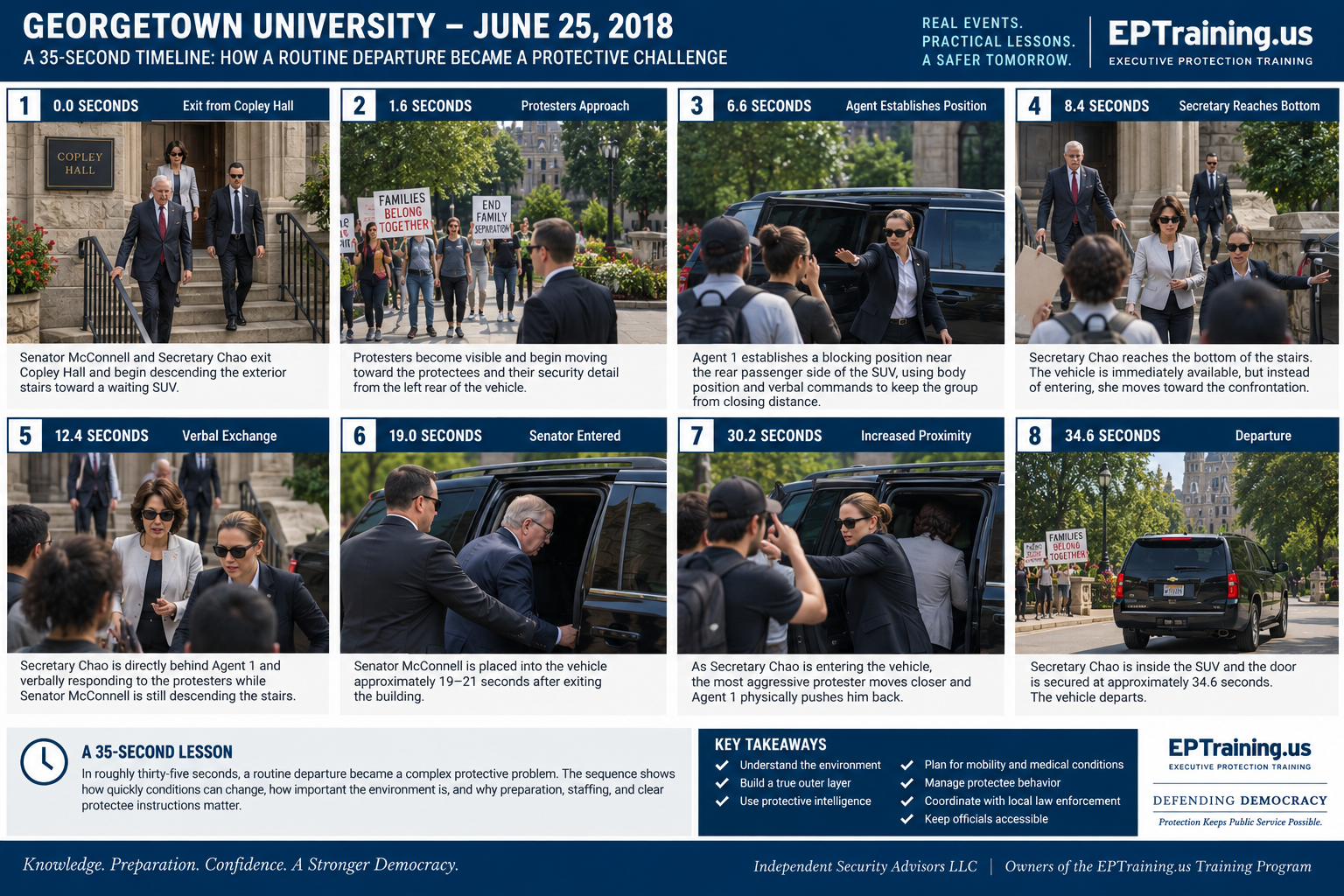
Georgetown Executive Protection Case Study: Was EPTraining.us Right in 2018?
Executive Protection Case Study
What the McConnell-Chao confrontation still teaches about protective intelligence, atmospheric assessment, off-campus security, and defending democracy
By Matthew C. Parker
CEO and Director of Training, EPTraining.us
EPTraining.us is owned and operated by Independent Security Advisors LLC
This EPTraining.us executive protection case study revisits the June 25, 2018 confrontation involving Senator Mitch McConnell and Secretary Elaine Chao at Georgetown University. Using the original video, the 2018 Independent Security Advisors assessment, and government information released afterward, the article examines threat assessment, protective intelligence, atmospheric assessment, advance work, staffing, movement, local-law-enforcement coordination, protectee behavior and protection in depth.
On June 25, 2018, Senate Majority Leader Mitch McConnell and Secretary of Transportation Elaine Chao left an event at Georgetown University and moved toward a waiting SUV. Within seconds, what should have been a routine departure became a protective problem. A small group of protesters approached the couple over the Trump administration’s immigration and family-separation policies.
McConnell was still carefully descending the exterior stairs, one protective agent moved to intercept the approaching group, and Chao reached the bottom of the stairs but did not immediately enter the vehicle. Instead, she moved toward the confrontation and responded to protesters who were challenging her husband.
The entire sequence developed in roughly thirty-five seconds. No one was assassinated, kidnapped, or seriously injured, and nothing in the available evidence establishes that the protesters were an organized violent group. That does not make the incident unimportant. In executive protection, we should not have to wait for somebody to be shot before deciding there is something worth studying. Near misses, uncontrolled approaches, thin staffing, difficult movement, protectee behavior, and situations in which a close-protection agent is forced to solve several problems at once can tell us a great deal about whether the protective system is working as intended.
That is why EPTraining.us examined the incident in 2018. The original review was prepared by Independent Security Advisors LLC, owner and operator of the EPTraining.us training program. It used publicly available video, contemporary reporting, information about the protectees and Georgetown University, and the executive-protection methods being taught in our program at the time. ISA did not possess the agencies’ internal advance reports, radio traffic, intelligence products, staffing requests, operational plans, or interviews with the assigned agents. The original review acknowledged that evidentiary limitation.
Today, that limitation gives us an even more useful question to ask. We are no longer looking only at what could be seen in the video. Later government testimony, Inspector General material, and U.S. Capitol Police reporting allow us to compare the major findings from our 2018 open-source review with the protective model the government subsequently described for Members of Congress away from Capitol Hill.
The central question is simple: EPTraining.us identified a series of protective weaknesses in 2018. When government information later became available, were those findings supported?
On the major system-level issues, the answer is yes, although some of the language in the original report was stronger than the evidence allowed.
What the Video Actually Showed
The strongest evidence in the Georgetown case has always been the video. The full EPTraining.us case study breaks the movement down second by second because the sequence shows how quickly a protection team can lose options.
At 0.0 seconds, the party exits Copley Hall. At approximately 1.6 seconds, the protesters are visible approaching from the left rear of the vehicle. Within the next several seconds, the agents begin changing positions. By approximately 6.6 seconds, Agent 1 has established a blocking position near the rear passenger side of the SUV. At approximately 7.8 seconds, she is using her position and verbal instructions to prevent the group from moving closer.
At approximately 8.4 seconds, Secretary Chao has reached the bottom of the stairs. Instead of immediately entering the waiting vehicle, she moves toward the confrontation. By approximately 12.4 seconds, she is directly behind Agent 1 and verbally responding to the protesters while Senator McConnell remains on the stairs. McConnell is finally placed into the SUV roughly 19 to 21 seconds after the party exits the building.
The movement continues after McConnell is secured. At approximately 22.8 seconds, Agent 2 reaches the rear of the vehicle and initially places himself between Chao and the protesters. At 23.4 seconds, the movement begins shifting around the SUV. At approximately 25.5 seconds, the rear driver’s-side door is opened while Chao remains outside. As she is finally entering the vehicle at approximately 30.2 seconds, one protester moves closer and Agent 1 physically pushes him back while giving verbal commands. Chao enters at approximately 30.8 seconds, and the door is secured at approximately 34.6 seconds.
Those times are important because they show something that is difficult to appreciate from a single photograph. Once the principals were committed to the stairs and vehicle area, the close-protection agents had increasingly limited space, limited time, and several competing responsibilities. That is where the real case study begins.
For the contemporaneous public account of the incident, see the Washington Post report on the McConnell-Chao Georgetown confrontation.
When the Close-Protection Agent Becomes the Outer Perimeter
One of the strongest lessons in the case concerns Agent 1. Once she recognized the approaching group, she moved to intercept it, established a blocking position, used open hands and verbal direction before increasing physical contact, adjusted as the protesters moved, and remained between the group and the protectees for an extended period. The original report was critical of the planning surrounding the movement, but it also specifically recognized Agent 1’s performance. That credit remains appropriate.
The more useful question is why a close-protection agent became the primary physical barrier between protesters and the principals. The agent immediately beside the protectee should normally be the last protective layer, not the entire protective system. Depending on the mission, other personnel may be observing the approaches, controlling the exterior area, supporting the advance, coordinating with host law enforcement, or maintaining enough distance so the close-in agent remains available to move the principal.
At Georgetown, several of those functions effectively collapsed onto a very small number of people. That does not mean the agents were incapable. It means the visible system gave them very little margin once the situation changed. By the time Agent 1 was physically managing protesters beside the SUV, an outer-security problem had become a close-protection problem.
That distinction remains central to the EPTraining.us approach to protection. Our current training continues to emphasize that threat assessment and protective intelligence must produce operational decisions rather than remain background research. Visit EPTraining.us
Senator McConnell’s Mobility Was Operational Information
The original case study also examined Senator McConnell’s mobility. His childhood polio and resulting leg impairment were publicly known, and the video shows him carefully descending the exterior stairs while using the handrail. The lesson is not that McConnell could never use stairs. The issue is whether the advance and route plan adequately accounted for the speed at which the principal could move if the environment changed.
A route that works perfectly under normal conditions may become less useful during an emergency if the principal cannot simply increase speed. Once the protesters appeared, the agents could not rush McConnell down the stairs without introducing a separate possibility of a fall or other injury. Medical and mobility information therefore belongs in operational planning because it can influence route selection, exposed movement time, staffing, transportation positioning, emergency evacuation, and the value of an alternate entrance or exit.
The original study identified a reduced-mobility entrance at Copley Hall and questioned whether it should have received greater consideration. No later public government report establishes that this specific entrance was required, so that remains an EPTraining.us operational finding rather than an official government conclusion. The broader lesson is much simpler: if the principal cannot move rapidly, the route and the protection plan need to account for it before something happens.
Secretary Chao Changed the Protective Problem
Secretary Chao’s actions created another useful lesson. When she reached the bottom of the stairs, she did not immediately enter the vehicle. She moved toward people confronting her husband and answered them. Contemporary reporting captured her repeatedly telling the protesters to leave McConnell alone.
From a human standpoint, that reaction is understandable. Chao was not merely a Cabinet secretary traveling with another government official. McConnell was her husband. That relationship became an operational variable once criticism directed toward him changed her movement.
While Agent 1 was containing the protesters, Agent 2 still had responsibility for moving McConnell, and Chao remained outside the vehicle. The detail’s limited manpower was being consumed one function at a time. This is why protectee briefings matter. If a confrontation is reasonably foreseeable, both protectees should understand what the detail expects if one occurs, who is responsible for moving each person, which doors will be used, what an emergency instruction means, and what happens if one spouse wants to remain and engage.
A principal may see a few students carrying signs and asking questions. The agent may see an open vehicle door, a second principal who has not yet been secured, an uncontrolled public area, an unknown number of additional people nearby, a closing distance problem, and an evacuation platform that cannot leave while one protectee remains outside. The time to reconcile those different perspectives is before the movement begins, not beside the vehicle.
The Protective Margin Compressed at the Door
The final loading sequence illustrates why distance matters. At approximately 30.2 seconds, as Chao was entering the SUV, one protester moved closer and Agent 1 physically pushed him back. There is no evidence that the protester possessed a weapon or intended to seriously injure the Secretary, and the case should not be exaggerated beyond what the video establishes.
The protection issue is uncertainty at close range. Standoff gives an agent time to observe, evaluate, and respond. Once an unknown person is within grabbing or striking distance while the principal is boarding a vehicle, much of that margin disappears. The vehicle door was open, the principal was entering, attention was divided between loading and crowd management, and Agent 1 had already spent a substantial amount of time containing the group.
The original report described this as a near miss because physical intervention became necessary during one of the most vulnerable moments of a vehicle movement.
That does not mean a serious attack almost certainly would have occurred. It means the protection team had reached a point where it had to rely on immediate physical intervention rather than distance and earlier layers of security.
Atmospheric Assessment in Plain English
The Georgetown case also provides a good opportunity to explain atmospheric assessment without turning it into an academic exercise.
A direct-threat assessment asks whether an identified person, communication, organization, or behavior suggests a specific threat to the protectee. A geographic assessment looks at the physical environment: streets, entrances, exits, stairs, vehicle positions, barriers, sight lines, emergency routes, and places where people can gather or approach. A situational assessment looks at the circumstances surrounding this particular event, including the reason for the visit, expected audience, current demonstrations, recent incidents, schedule changes, and other immediate conditions.
An atmospheric assessment asks the broader operational question: How is this particular protectee likely to be received by the people around this location, over this issue, at this time?
That is why political, racial, ethnic, citizenship and immigration information, institutional positions, ideology, organizations, advocacy activity, recent demonstrations, and other demographic information can sometimes matter to protective planning. The information is not used to declare that someone is dangerous because of race, political affiliation, ethnicity, religion, immigration status, or another characteristic. It becomes useful when those factors intersect with the protectee, the issue, recent behavior, and the demonstrated ability of individuals or organizations to mobilize.
Georgetown presented precisely that kind of combination. Immigration and family separation were dominating national political discussion. The university had publicly expressed support for undocumented students and DACA recipients. The original study identified extensive political, cultural, racial, advocacy, and other student organizations. Recent demonstrations showed that immigration was an active issue, and administration officials had recently been confronted in restaurants and other public places.
Those conditions did not establish that a violent attack was likely. They supported a more limited but operationally important conclusion: protest, rapid mobilization, verbal confrontation, and attempted close access were reasonably foreseeable.
That distinction between the probability of activity and the probability of violence is essential. A protection team does not need evidence of an assassination plot before deciding that a departure point should be watched more closely or that local officers may be useful outside the venue.
For a more detailed explanation of how EPTraining.us applies threat assessment to protective operations, see Executive Protection Training: Mastering the Threat Assessment Process.
An Assessment Has to Change Something
The real value of an atmospheric assessment is what happens after it is completed. If the assessment indicates a greater probability of confrontation, then the information should influence the plan. The detail may increase exterior observation, strengthen an outer security layer, coordinate with local or campus law enforcement, shorten the exposed route, reposition transportation, prepare an alternate exit, increase staffing, or brief the protectees differently.
That was a major concern in the original Georgetown review. The available open-source information suggested that protest was a more probable operational problem than assassination or kidnapping, yet the visible departure posture provided little warning or standoff before the protesters were close to the vehicle. Once that occurred, the close-protection team had fewer choices.
This is why we teach students that an assessment sitting in a binder has limited value. The important question is what the information causes the detail to do differently.
What EPTraining.us Said in 2018
The 2018 case study identified a series of broad protective concerns. We argued that the off-campus environment should have changed the protective posture; that the departure point needed greater observation and control; that the close-protection agents needed an outer layer so they were not simultaneously protecting the principals and acting as the crowd-control barrier; that host or local law-enforcement support should have been part of the planning discussion; and that staffing, route selection, transportation, mobility, protective intelligence, and protectee instructions needed to reflect the actual environment surrounding the event.
Hindsight: Did Later Government Material Support Those Findings?
There has never been a publicly released U.S. Capitol Police, Department of Transportation, Georgetown Police, or other government after-action report specifically investigating the June 25 Georgetown confrontation. What later materials can tell us is whether the protective system EPTraining.us said was needed was consistent with the model government officials themselves described.
The strongest comparison comes from 2019 congressional testimony by then-U.S. Capitol Police Chief Matthew Verderosa. Discussing Member security away from Capitol Hill, he explained that USCP considered the total assessment for the event and adjusted resources according to factors including the venue, type of event, and number of Members involved. The hearing record describes an approach involving perimeter security, resources able to respond to an individual or group, protective-intelligence capability, uniformed and plainclothes personnel, and coordination outside the immediate close-protection team.
Read the 2019 Legislative Branch Appropriations hearing record on GovInfo
Now compare that description with the original Georgetown review. EPTraining.us said the operating environment should influence the protective posture. We said the agents beside the principals needed an outer layer. We said protective intelligence or exterior observation should identify changing conditions before the protectees were committed to the movement. We said local-law-enforcement support could keep public-order responsibilities farther away from the principals. We also argued that staffing and other resources should be based on the mission rather than an assumption that an off-the-record or low-profile event would remain unnoticed.
Those are not two fundamentally different protection philosophies.
They describe substantially the same layered system.
Chief Verderosa did not admit that the Georgetown detail failed, and his testimony should not be characterized that way. What the later testimony does show is that the protective architecture EPTraining.us said should have been more visible at Georgetown closely resembles the off-campus Member protection architecture USCP later described publicly.
The Threat Environment Since Georgetown
The protective environment facing Members of Congress has continued to change since 2018. U.S. Capitol Police reported 5,206 Threat Assessment Section cases in 2018. By 2025, the agency reported 14,938 concerning statements, behaviors, and communications directed against Members of Congress, their families, staff, and the Capitol Complex.
Review the USCP historical threat-assessment case numbers
Read the USCP 2025 Threat Assessment report
The 2025 announcement is important for another reason. USCP Chief Michael Sullivan emphasized strengthening partnerships with law-enforcement agencies around the country to protect Members when they are away from Capitol Hill, and the agency says it establishes formal agreements with partner agencies to coordinate assistance in Members’ home districts.
That is directly relevant to the Georgetown lesson. The Member moves beyond the Capitol complex, the operating environment changes, and protection increasingly depends on intelligence sharing, planning, and cooperation with agencies that may be far outside the principal’s normal protective organization.
The Defending Democracy Connection
The Georgetown case belongs within the EPTraining.us Defending Democracy Initiative because executive protection is not supposed to shield public officials from criticism. The protesters had the right to oppose government immigration policy and peacefully challenge public officials. The protection mission was not to prevent McConnell or Chao from hearing political disagreement.
The protective concern begins when political disagreement becomes uncontrolled physical access, interference with movement, intimidation, assault, or an opportunity that another individual with a different intention could exploit. That is a security issue rather than a political judgment.
The larger Defending Democracy argument is that professional protection should help public officials remain accessible and continue performing their duties rather than simply separating them from the public. Members of Congress attend town halls and district events. Judges enter courthouses. Governors and mayors appear in public. Election officials, prosecutors, candidates, and other public servants work in environments where people may disagree strongly with them. Security should make those activities possible, not eliminate them.
EPTraining.us has developed that argument further in its Defending Democracy series, including the relationship between threats, intimidation, public access, and the ability of officials to continue functioning in public life. Defending Democracy: Why the Protection of Public Officials Is a Democratic Imperative
What Thirty-Five Seconds at Georgetown Still Teaches
When the Georgetown case is viewed only as a confrontation beside a black SUV, much of its value is missed. The real training value comes from looking backward from that moment. The political environment mattered because it helped identify the most foreseeable type of problem. Georgetown’s institutional and organizational environment mattered because it helped explain how quickly an issue could resonate locally.
Recent public confrontations mattered because they demonstrated a method of protest already being used against recognizable officials. McConnell’s mobility mattered because it affected movement speed. Chao’s relationship to her husband mattered because it affected her behavior. The stairs, vehicle position, staffing, public access, communications environment, and absence of a visible outer layer all influenced what the close-protection agents ultimately had to manage.
None of those factors alone caused the incident. Together, they shaped the operating problem.
By the time Agent 1 was physically containing a protester immediately beside an open vehicle door, the problem had reached the last protective layer. She reacted effectively under difficult conditions, and both principals ultimately departed without reported injury. A professional AAR should acknowledge that result while still asking how much of the problem could have been managed farther away and earlier in the process.
That was the heart of the 2018 case study, and the later government record gives us substantial reason to believe that the broader methodology was sound. Risk-based event assessment, protective intelligence, layered security, appropriate staffing, perimeter control, off-campus coordination, and the ability to adjust resources to the venue and threat are not merely retrospective EPTraining.us recommendations. They are also visible in later official descriptions of congressional protection.
So on the central question—whether the threat environment should have changed the operation and whether a layered protective system should have prevented a foreseeable crowd problem from collapsing onto the close-protection agents—the original EPTraining.us assessment held up well.
What the Full Georgetown Case Study Contains
This article presents only part of the analysis. The complete EPTraining.us Georgetown University Protective Operations Case Study contains the original video evidence and full second-by-second timeline, protectee and associated-threat analysis, medical and mobility considerations, geographic and atmospheric assessments, Georgetown political and demographic research, institutional and organizational information, advance and site-survey findings, arrival and departure analysis, transportation observations, agent-performance review, local-law-enforcement considerations, protectee-management lessons, and the full Hindsight comparison with later government material.
The value of the complete report is that it allows the reader to work through the evidence in sequence rather than simply accept our conclusion. Look at the environment, the protectees, the site, the route, the timeline, the agent positions, the vehicle, and the approaching group. Then ask the question that remains at the center of the case:
What could have been done earlier so that the close-protection agent did not have to solve the problem beside an open vehicle door?
That is where the training value is.
Frequently asked questions: Mitch McConnell and Elaine Chao at Georgetown University in 2018
What happened to Mitch McConnell and Elaine Chao at Georgetown University in 2018?
On June 25, 2018, protesters approached Senator Mitch McConnell and Secretary Elaine Chao as they departed an event at Georgetown University and moved toward a waiting SUV. The approximately 35-second confrontation created a useful executive-protection case study involving movement, crowd access, staffing, protectee behavior and vehicle loading. The article’s timeline documents the sequence in detail.
Was the Georgetown confrontation an assassination attempt?
No evidence reviewed by EPTraining.us establishes that the protesters were attempting to assassinate or seriously injure either official. The protective issue is the loss of distance and control around two principals during an exposed vehicle movement, not an unsupported claim that the protesters were violent attackers.
What is atmospheric assessment in executive protection?
Atmospheric assessment examines how a particular protectee is likely to be received in a particular environment at a particular time. It considers relevant political, institutional, social, organizational and behavioral conditions without treating race, ethnicity, religion, political affiliation or demographic characteristics themselves as evidence of a threat.
Why was Senator McConnell’s mobility relevant to the protection plan?
Mobility can affect movement speed, route selection, evacuation options, staffing and the amount of time a principal remains exposed. The Georgetown video showed McConnell carefully descending stairs, which made his mobility an operational planning consideration rather than merely biographical information.
Did later government information prove the 2018 EPTraining.us assessment was correct?
There is no publicly released government AAR specifically validating or rejecting the Georgetown case study. However, later congressional testimony and government material described an off-campus protection model involving threat-based resource decisions, protective intelligence, perimeter security, layered personnel and interagency coordination that was substantially consistent with the system-level concerns raised in the original ISA review.
How does the Georgetown case relate to the Defending Democracy Initiative?
The case demonstrates that professional protection should preserve public access rather than eliminate political disagreement. The security issue begins when disagreement becomes uncontrolled physical access, interference with movement, intimidation, assault, or an opportunity that another person could exploit.
Request the Complete Georgetown Case Study
A copy of the complete EPTraining.us Georgetown University Executive Protection Case Study is available to executive protection professionals, law-enforcement personnel, public officials, security managers, and others interested in the training lessons from this incident.
Email: [email protected]
Subject/Topic: GEORGETOWN
Please include your name, organization or agency if applicable, and your professional interest in the case study.
From Independent Security Advisors to EPTraining.us
The original 2018 after-action review was prepared by Independent Security Advisors LLC, the company that owns and operates the EPTraining.us executive protection training program. At the time, our materials commonly referred to the Independent Security Advisors Training Division, with EPTraining.us functioning primarily as the training website. The original case study reflects that earlier identity.
Today, our public training identity is EPTraining.us. Independent Security Advisors remains the owner and operating company, and that history remains important. When we discuss our executive protection curriculum, case studies, continuing education, Defending Democracy Initiative, and professional training programs, however, we want students, law-enforcement agencies, public officials, and protection professionals to recognize one clear training identity: EPTraining.us — owned and operated by Independent Security Advisors LLC.
For that reason, this article refers to the original work as the 2018 EPTraining.us case study, while recognizing that the historical document itself was prepared under the Independent Security Advisors name.
Related EPTraining.us Reading
For readers who want to continue from the Georgetown case into the broader EPTraining.us training and Defending Democracy material, these four articles provide the strongest internal path:
- Executive Protection Training: Mastering the Threat Assessment Process — how threat assessment becomes protective intelligence and operational planning.
- Defending Democracy: Why the Protection of Public Officials Is a Democratic Imperative — why professional protection supports public access and democratic function.
- Fear Is Already Here: Threats Against Public Officials Are Changing How They Serve — the continuing effect of threats and intimidation on public service.
- Why Didn’t You Just Listen? A Security Reckoning in Defending Democracy — why warning signs and threat trends need to produce protective action before a crisis