
 E-mail us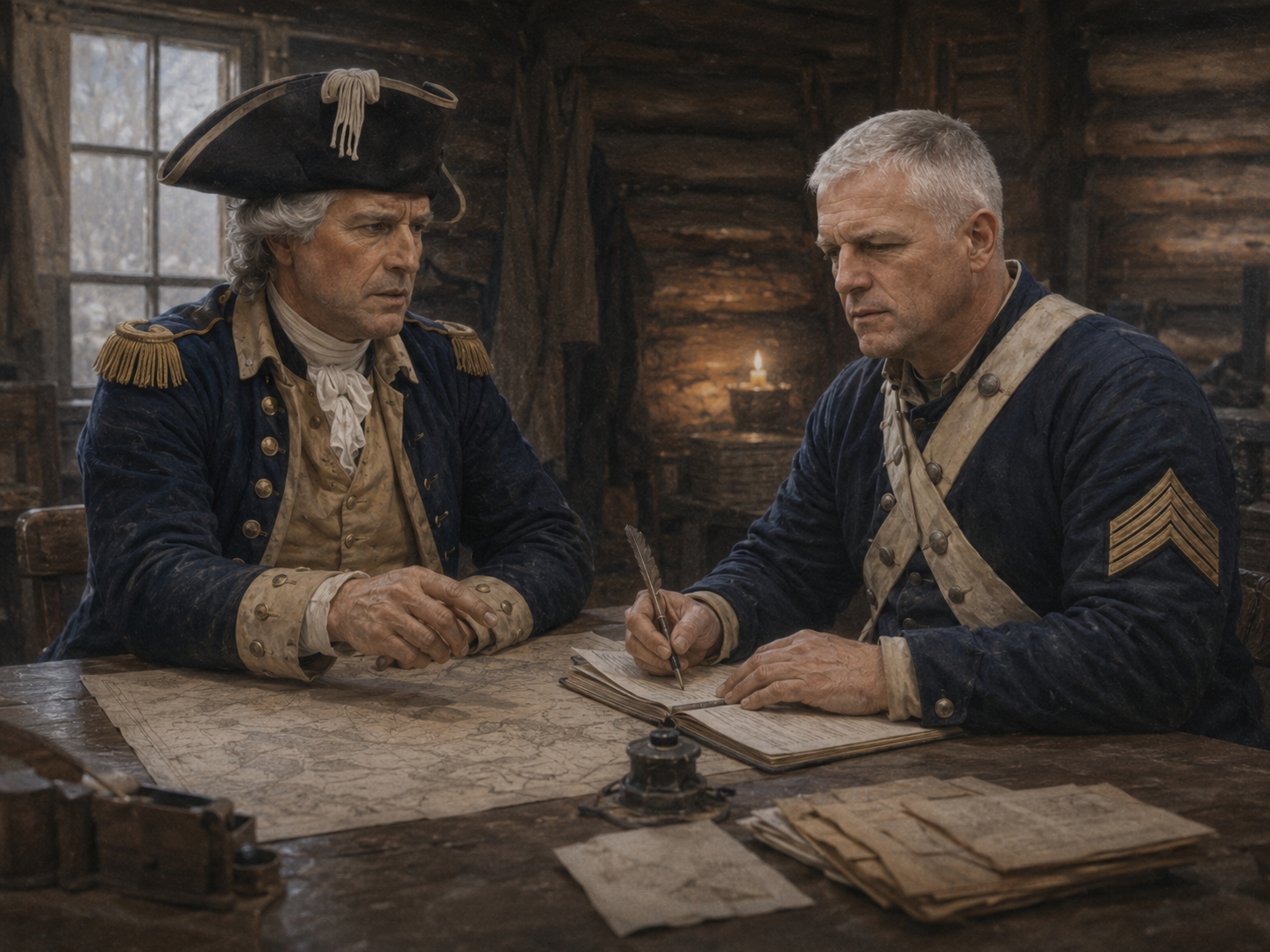
Matthew Parker in Conversation with General George Washington at Valley Forge
Thomas Hickey, the Commander-in-Chief’s Guard, Trust, Training, and the Protection of Command
Valley Forge, Pennsylvania – Spring 1778
George Washington created a personal guard in 1776. Within months, Thomas Hickey—one of the men tied to that protective organization—was convicted of sedition, mutiny, and treacherous correspondence with the enemy. This historical case study separates the documented record from assassination legend and examines what the breach teaches modern executive protection about insiders, trust, intelligence, training, headquarters security, and continuity.
Why This Historical Executive Protection Case Still Matters
George Washington created a personal guard in March 1776. Less than four months later, Thomas Hickey—a soldier connected to that protective organization—was convicted by court-martial of sedition, mutiny, and treacherous correspondence with the enemy and hanged.
Later retellings made the case more dramatic. They added assassination plots, poisoned food, and a completed scheme to murder Washington. The surviving court-martial record does not convict Hickey of attempting to assassinate the Commander in Chief. For me, that makes the case more useful, not less.
The documented protective problem is hard enough: an organization created to protect the commander was penetrated from within; the breach was exposed through information developed outside the Guard; Washington learned that careful selection could reduce uncertainty but could never certify loyalty; and, two years later, the same Guard was disciplined enough to help Baron von Steuben demonstrate a common training standard at Valley Forge.
Protection professionals should recognize the pattern. The principal is only one protected asset. Headquarters, information, money, staff, family, movement, and continuity all matter. A trusted person inside the perimeter also changes the geometry of the problem. The lesson is not that trust is impossible. The lesson is that trust should never be the only protective measure.
Historical Simulation and Editorial Note
This is a historically grounded fictional conversation. The setting is Valley Forge in 1778, after the documented Thomas Hickey court-martial of June 1776 and after Washington’s April 1777 instructions for reforming his Guard. The Commander-in-Chief’s Guard, Martha Washington’s presence at Valley Forge, the Isaac Potts headquarters, and Baron von Steuben’s use of the Guard in the model company are grounded in Washington Papers, Mount Vernon, and National Park Service records.
The surviving court-martial record convicts Hickey of sedition, mutiny, and treacherous correspondence with the enemy. It does not convict him of attempting to assassinate Washington. Later claims involving poisoned food or a completed murder plot are therefore not presented as established fact. Parker’s military and protective experience informs the questions, but Washington, the Guard, and the security of command remain the subjects of the case study.
Reader Navigation – Choose How You Want to Read This Case Study
This case study can be read two ways. Part I provides the historical interview; Part II can be read independently by students and practitioners who want the consolidated operational findings without reading the full conversation.
- Case Snapshot – A concise factual account of the Guard’s formation, the Hickey breach, Washington’s 1777 fidelity warning, and the Guard’s later role at Valley Forge.
- Part I – The Historical Interview – Matthew Parker questions Washington about the Guard, Thomas Hickey, information flow, insider access, headquarters security, family exposure, training, and trust.
- Part II – Protective After-Action Review and Lessons Learned – Skip directly here for the modern EP analysis: six consolidated findings and the curriculum connections they produce.
- FAQ – George Washington Bodyguard and Thomas Hickey – Direct answers on the Commander-in-Chief’s Guard, Hickey, assassination claims, fidelity, von Steuben, and modern executive-protection lessons.
- The Bottom Line – The central protective lesson in concise form.
- Related EPTraining.us Resources – Supporting ISA executive-protection, training-standards, and Defending Democracy material.
- Sources and Historical Notes – Primary and institutional sources supporting the historical record and analytical cautions.
Case Snapshot: Washington, Hickey, and the Guard
On March 11, 1776, Washington ordered regimental commanders to select men for a personal guard. Mount Vernon describes the new unit’s explicit mission as protecting Washington, the army’s cash, and official papers. Captain Caleb Gibbs commanded what became known as the Commander-in-Chief’s Guard, General’s Guard, or Life Guards.
In June 1776, Thomas Hickey, a member of the Guard, was tried by court-martial and convicted of sedition, mutiny, and treacherous correspondence with the enemy. Washington approved the death sentence after consulting his general officers, and Hickey was executed on June 28. The surviving record supports a serious internal-security breach; it does not support presenting Hickey’s conviction as an assassination conviction.
When Washington rebuilt the Guard in April 1777, he instructed officers to be extremely cautious because baggage, papers, and other matters of public importance might be placed entirely in the men’s care. His warning was unusually direct: there could be no absolute security for fidelity. At Valley Forge in 1778, the Guard remained close to headquarters and became part of Baron von Steuben’s model company for standardizing drill across the Continental Army.
PART I – The Historical Interview
Prefer the operational analysis? Skip the reconstructed interview and go directly to the Protective After-Action Review.
On the Road to Valley Forge
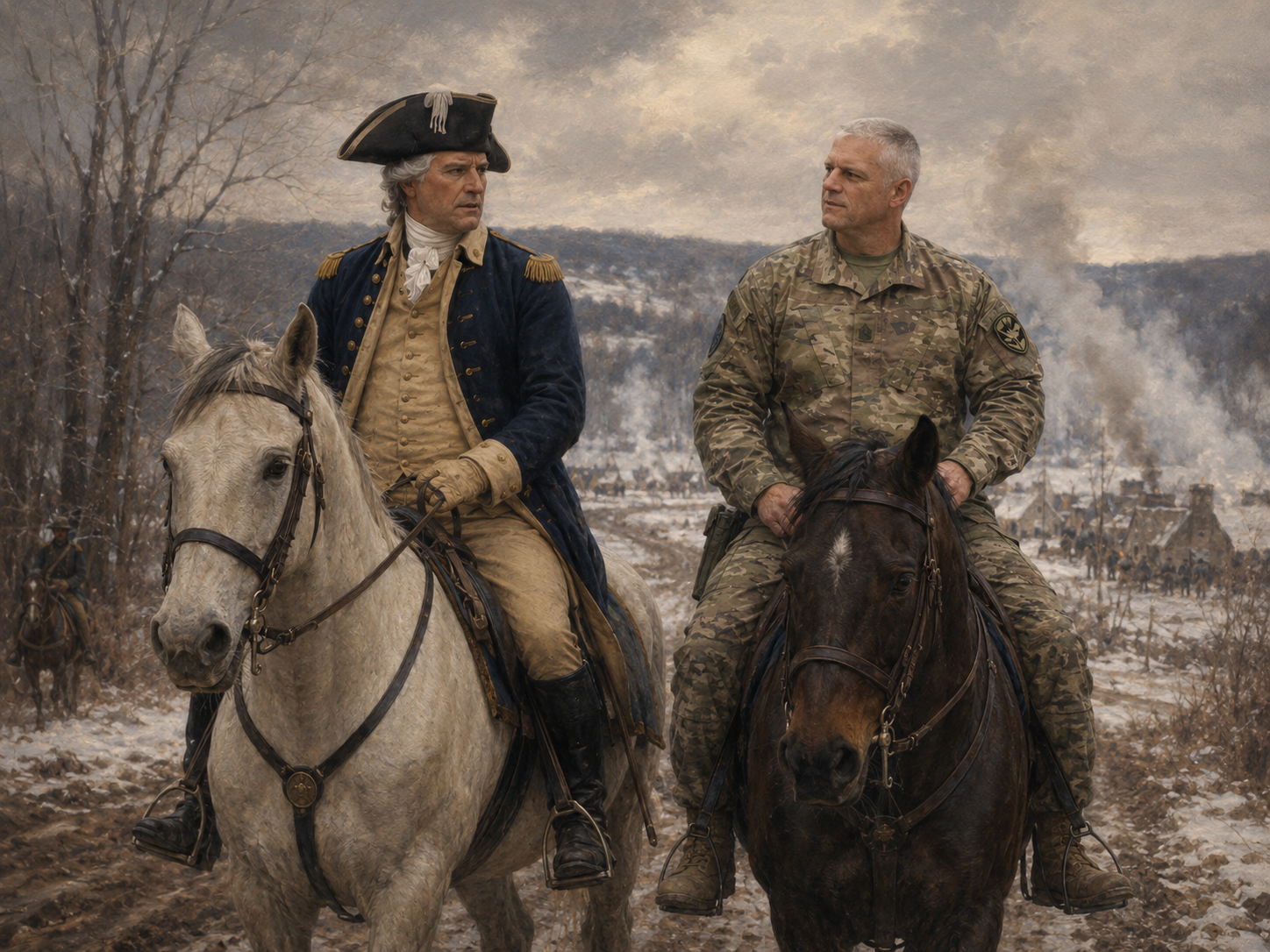
The road into Valley Forge was a mixture of frozen ruts, thawing mud, wagons, mounted officers, and men moving between scattered huts with the economy of soldiers who had learned not to waste energy. Matthew Parker rode beside George Washington in a uniform that did not belong to any army the General knew. The camouflage pattern, modern boots, subdued insignia, and unfamiliar fabric had already drawn looks from sentries along the road. Washington had noticed every one of them.
WASHINGTON: Your clothing announces you more effectively than a drum, Mr. Parker. I am told you are a soldier, yet I recognize neither your uniform nor your country’s manner of marking rank.
PARKER: United States Army, General. A later version of it. I spent most of my career as a cavalry scout and noncommissioned officer. For today, that is probably enough explanation.
Washington gave him the restrained look of a man accustomed to incomplete intelligence but not fond of it. He did not press immediately. Ahead, the camp opened across the winter landscape. Smoke drifted from huts. Horses stood picketed near headquarters. Men carried wood, repaired equipment, and moved in formations that were beginning to look more uniform than the army Washington had brought into winter quarters.
WASHINGTON: You look at the camp as though you expect it to answer a question.
PARKER: It usually does. Roads tell me how people move. Sentries tell me what an organization takes seriously. The distance between headquarters and the Guard tells me what can reach you before anyone has time to stop it. And soldiers on ordinary duties tell me more about discipline than soldiers arranged for inspection.
WASHINGTON: That last observation would please the Baron. He has spent several weeks informing my officers that what they call drill and what he calls drill are not always the same thing.
The Model Company
Washington turned his horse toward an open area where Baron Friedrich Wilhelm von Steuben was working with a selected body of soldiers. The Baron’s voice carried across the ground. His English remained limited, but his meaning did not. Commands passed through interpreters and officers, were demonstrated, repeated, corrected, and repeated again. The Commander-in-Chief’s Guard formed part of the model company, together with men drawn from different states, so that one standard could move outward through the army instead of remaining with one instructor.
PARKER: He is not merely teaching those men. He is creating a delivery system for the standard. Train a small group correctly, make them demonstrate it, then send the method outward until the army can reproduce it without the Baron standing there.
WASHINGTON: That is his intention. We have suffered from every state and many officers bringing their own method. The Baron simplifies the exercise, makes the men perform it alike, and obliges officers to concern themselves directly with instruction. He possesses the useful talent of making a man understand that repetition is not beneath him.
PARKER: A standard only matters if the next unit can perform it the same way. Otherwise you have a talented instructor, not a training system.
Washington looked at him more carefully. Parker had said it without admiration of himself and without the theatrical certainty of someone eager to impress a commander. It sounded like the judgment of a sergeant who had watched training succeed and fail often enough to know the difference.
WASHINGTON: You have trained soldiers.
PARKER: Yes, sir.
WASHINGTON: For how long?
PARKER: Long enough that I would rather watch what a unit can actually do than hear what an instructor says he taught. But I would prefer to save my own history until we have finished yours.
The answer brought the beginning of a smile to Washington’s face. He allowed the redirection.
A Uniform That Belongs
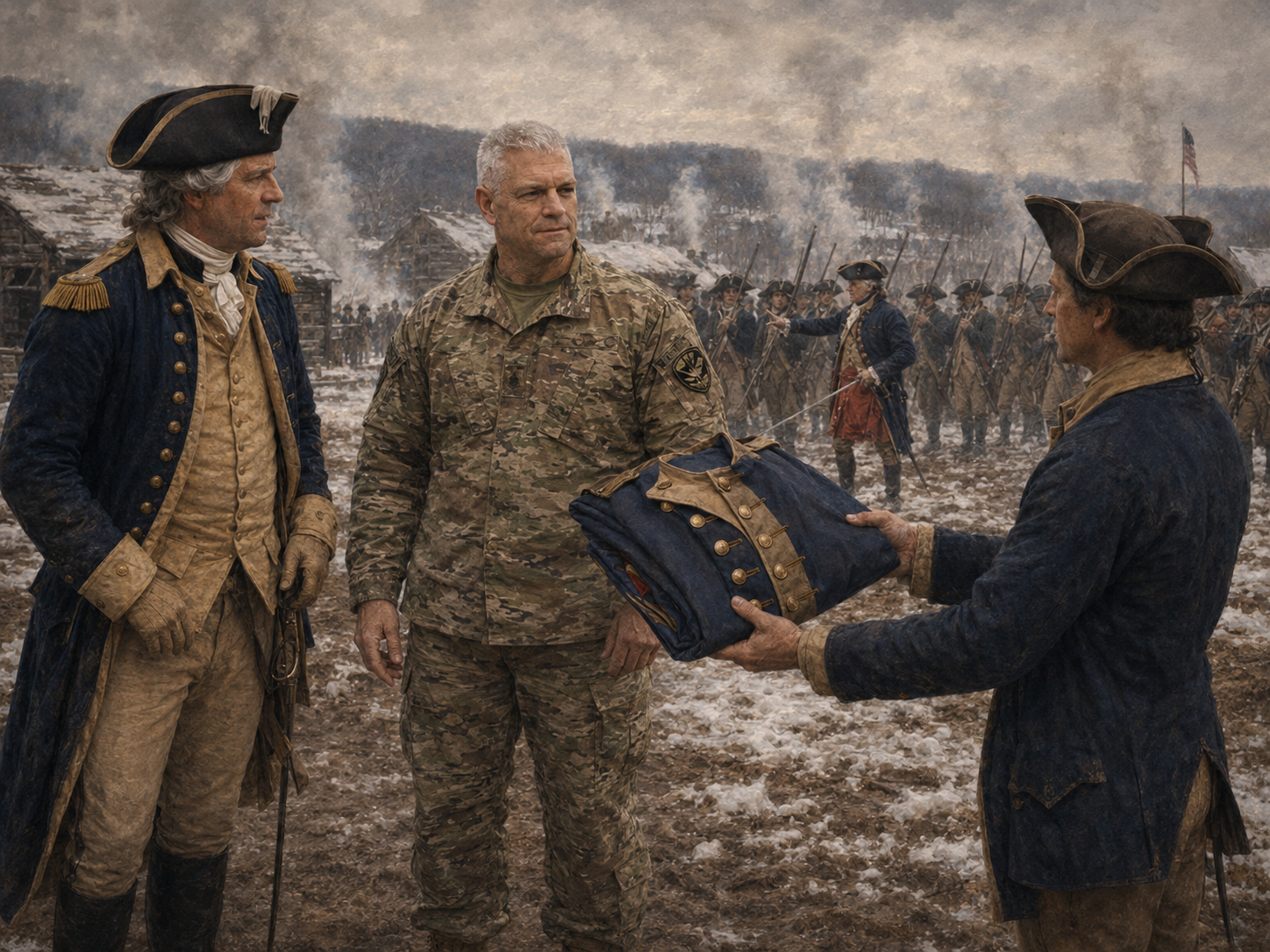
At headquarters, a sergeant from Captain Caleb Gibbs’s Guard waited with clothing Washington had ordered prepared after learning that Parker would be riding through camp. The modern uniform might have been useful evidence of another century, but it was useless camouflage in 1778. Parker changed into a serviceable Continental uniform appropriate to an experienced sergeant. The transformation did not make him look eighteenth century so much as it stopped every soldier in camp from staring at him.
WASHINGTON: Better. A man who attracts attention merely by standing still is poorly suited to observe anything unnoticed.
PARKER: That principle survives, General.
They entered the Isaac Potts house that served as Washington’s headquarters. It was both command post and household. Papers, aides, visitors, messengers, guards, servants, and family life occupied the same limited space. Martha Washington had been at Valley Forge since early February and was again managing the domestic side of a headquarters that never truly stopped being military. Parker noticed the obvious implication: an attack on this place would not affect only one man.
Why Create a Personal Guard?
PARKER: Before Thomas Hickey, I want to go back to the decision that created the Guard. In March 1776 you ordered men selected from the regiments for your personal guard. Why did you decide you needed a separate organization?
WASHINGTON: Because headquarters had become an object requiring protection in its own right. The army was moving from the siege of Boston toward a campaign in which my person, baggage, money, correspondence, and official papers would be exposed to movement and confusion. I required men whose duty was not divided by the concerns of a regiment elsewhere in the line. Captain Gibbs was to command them, and I wanted soldiers recommended for sobriety, honesty, good behavior, cleanliness, and soldierly appearance.
PARKER: So even at the beginning, this was not only a bodyguard. The Guard protected you, but also the command apparatus around you.
WASHINGTON: Precisely. A commander who survives while his dispatches, money, papers, or headquarters are lost may still find his command gravely injured. The business of an army is carried in more than the body of its general.
That answer reached the subject Parker wanted. Modern executive protection often concentrated public attention on the person standing nearest the principal, but Washington had created a unit whose mission already extended to documents, baggage, cash, headquarters, and the functioning of command.
Thomas Hickey: What the Record Actually Says
PARKER: Then less than four months after you formed that Guard, one of its own soldiers was condemned to death. This is where I want to be exact, because the story grew after the event. People later told versions in which Hickey was part of a clear plan to murder you, poison your food, or strike directly at headquarters. But the surviving court-martial did not convict him of attempting to assassinate you. It convicted him of sedition, mutiny, and treacherous correspondence with the enemy. Is that the fair way to state it?
Washington’s expression changed. The question was not about legend; it was about the distinction between what had been proved and what later generations wished the event to contain.
WASHINGTON: It is. There was dangerous disaffection in New York. Men were being enlisted or persuaded to join the King’s cause when the British arrived. Some of my Guard were implicated. Hickey was tried upon evidence sufficient for the court to convict him of mutiny, sedition, and correspondence with the enemy. I approved that sentence after consulting my general officers. I will not claim a charge that the court did not make merely because later telling makes it more dramatic.
PARKER: The documented case is serious enough without improving it. A soldier inside the commander’s own guard had entered a scheme connected to the enemy and tried to recruit or encourage others. That is an internal security failure whether or not we can prove he intended to attack you personally.
WASHINGTON: And at New York, with the enemy expected and a large Loyalist population in the city, such treachery could have caused great injury without a hand ever being raised against me personally.
How the Breach Was Found
PARKER: The other part I would emphasize is how the problem was discovered. Hickey was first confined on a counterfeiting matter. While in custody, another prisoner, Isaac Ketchum, heard him speak too freely about men joining the King when the British arrived. That information eventually reached the authorities and opened the larger inquiry. Your Guard did not uncover Hickey by watching him at his post.
WASHINGTON: No. The information came from outside the Guard. That fact was not lost upon me.
PARKER: What interests me is that the information came from outside your Guard. The men closest to a commander cannot see everything. A jailer, magistrate, clerk, innkeeper, family member, scout, or soldier in another unit may see something the Guard does not. The question is whether that information reaches someone who understands what it means before it is too late.
WASHINGTON: And whether that person acts before the information is rendered useless by delay.
PARKER: Yes, sir. Collection is not the same as protection. Information has to be judged, shared, and converted into a decision. Otherwise an organization can possess the truth and remain vulnerable to it.
Washington glanced toward the table where dispatches and reports lay in deliberate piles. He had spent the war building networks of scouts, informants, local committees, cavalry, aides, and correspondents because a commander who saw only what occurred inside his own camp saw too little.
Selection Is Only the Beginning
PARKER: When you formed the Guard, you depended upon regimental commanders to recommend good men. After Hickey, did you conclude that those recommendations were worthless, or that they could never be treated as certainty?
WASHINGTON: No. That would be foolish. A commander must use the knowledge of officers who have observed a man. Character matters. Habits matter. Family connections and a stake in the country may matter. But recommendation is evidence; it is not certainty.
PARKER: That is a harder standard than simply asking for a good recommendation.
WASHINGTON: It is also the answer I gave my officers in 1777. When I formed the Guard again, I told them I wished to be extremely cautious because my baggage, papers, and matters of great public importance might be left entirely in those men’s care. I also wrote what experience had already taught me: there can be no absolute security for fidelity.
Parker let the phrase sit between them. It was stronger than any modern slogan he could have supplied because it came from the commander who had already learned what happened when a selected guard proved disloyal.
PARKER: That may be the most important sentence in this entire case. No absolute security for fidelity. We still conduct background investigations. We check references. We examine history. We supervise. We control access. We look for changes in behavior. But none of those gives us permission to believe a person has been permanently certified as trustworthy.
WASHINGTON: Yet you would not have every man regard his comrade as a suspected traitor.
PARKER: No. That destroys the organization from the other direction. A protection team has to trust internally or it cannot function. The answer is not permanent suspicion. It is professional awareness and a system that does not collapse because one trusted person fails.
WASHINGTON: Then Hickey’s lesson is not that guards cannot be trusted.
PARKER: No, sir. It is that trust should never be the only protective measure.
The Guard Protects More Than Washington
PARKER: You have mentioned baggage, money, papers, and correspondence several times. If I looked only at the men standing nearest you, what would I misunderstand about what the Guard was actually protecting?
WASHINGTON: He would miss much of what makes me able to command. A messenger may carry intelligence more important than the sword at my side. A clerk may hold correspondence whose loss would expose plans, names, or intentions. The army’s money may be more attractive to a thief than my person is to an assassin. An enemy who cannot reach the commander may still attack his ability to command.
PARKER: Then the Guard’s duty was broader than keeping a man with a musket close to you. If an enemy could not reach your body but could cripple headquarters, expose your correspondence, seize the Army’s money, or interrupt the flow of orders, he could still damage your command.
WASHINGTON: I would caution you against making the last layer sound unimportant merely because others exist.
PARKER: I would never do that. When every earlier measure fails, the last man may be the only one left with time to act. My point is that we should not force him to solve a problem that could have been detected at the road, the gate, the desk, or the intelligence report hours earlier.
Washington accepted the distinction. It matched his own military instinct: sentries mattered, but so did scouts; headquarters guards mattered, but so did information from beyond headquarters; the commander’s safety mattered, but so did the army that had to continue after any single incident.
Martha Washington and the Household
PARKER: There is another piece of the headquarters that protection discussions often leave out. Mrs. Washington is here. Your aides live and work around you. Servants, messengers, visitors, officers, and petitioners move through the same house. The Guard is protecting a household and a command post at the same time.
WASHINGTON: Mrs. Washington has joined me in winter quarters throughout much of the war. Her presence is a comfort to me and to many who come through headquarters, but it also means that military danger is not confined to soldiers. The house cannot be managed as though no family lives within it, and it cannot be treated as an ordinary home while an army is directed from its rooms.
PARKER: That tension still exists. Family members may not be the principal, but they can share the exposure created by the principal’s position. The answer is not to turn the family into prisoners. It is to understand the risk, control what can reasonably be controlled, and make sure the protective plan includes the people who will actually be present when something goes wrong.
WASHINGTON: A sensible distinction. War has already demanded enough from families without our adding careless danger to what cannot be avoided.
Why the Guard Matters to von Steuben
PARKER: Now we are standing at Valley Forge two years after Hickey, and the same organization is being used by von Steuben as part of the model company. That is worth examining. You did not abolish the Guard because it had once been penetrated.
WASHINGTON: Of course not. One traitor does not condemn every loyal man who bears the same duty. The proper response to a failure is correction, not panic. The Guard continued to perform close duty around headquarters, and the men who proved themselves earned trust by conduct. The Baron wanted soldiers capable of learning a method precisely and demonstrating it to others. The Guard was suited to that purpose.
PARKER: That tells me something important about how you treated the incident. You did not confuse accountability with destruction of the organization. You tightened selection, thought more clearly about fidelity, maintained the mission, and kept training the unit. By 1778 the Guard had enough discipline to help standardize the rest of the Army.
WASHINGTON: A useful army cannot live forever in the moment of its last mistake. It must learn and then perform better.
Parker looked back through the window toward the drill field. That sentence could have been written above almost any serious after-action review. The purpose of examining failure was not to preserve blame; it was to change future performance.
Questions a Commander Must Ask
PARKER: Looking back on Hickey now, what questions do you believe a commander should ask about such a breach? Who selected the man? What was actually known about him? What changed after selection? Who else was involved? What did the enemy expect? What information existed elsewhere, how quickly did it reach headquarters, and what changed afterward?
WASHINGTON: Those are military questions, not inventions of your century. The vocabulary may differ. The responsibility does not. A commander must know the condition of his men, the disposition of his enemy, the security of his headquarters, and the reliability of information upon which he acts.
PARKER: That is why I would not reduce Hickey to a colorful assassination story. The real case is more useful. A newly created guard selected men believed trustworthy; one entered treacherous dealings; the breach was exposed through information developed elsewhere; you punished the offense, reconsidered fidelity, and kept the Guard functioning. That is serious enough without poisoned peas.
WASHINGTON: Then tell the truth. It is usually burden enough without decoration.
Washington Turns the Interview
For the first time since they entered headquarters, Washington closed the distance between the historical case and the man asking the questions. He had allowed Parker to keep his own background mostly outside the discussion. Now he returned to it deliberately.
WASHINGTON: You have been careful to examine my Guard without telling me much of the army that produced your opinions. Earlier you said you were a cavalry scout and a noncommissioned officer. How long did you serve?
PARKER: More than twenty years on active duty. I retired as a Sergeant First Class.
WASHINGTON: And you trained soldiers for much of that time?
PARKER: Yes, sir. Scouts first, then other soldiers and security personnel. I spent time protecting a senior commander in Iraq and later helped train protective details and security forces. After I retired, I continued teaching law enforcement, military personnel, and private security. Years later I went back overseas and trained again in Ukraine. Different uniforms, different wars, but the same problem keeps appearing: people have to perform correctly when the instructor is no longer standing beside them.
WASHINGTON: You returned to war after retiring?
PARKER: Yes, sir.
Washington studied him for a moment. He did not ask for medals, battle lists, or the sort of recital that men sometimes used to establish their importance. What interested him was function.
WASHINGTON: Were you an officer?
PARKER: No, General. Senior noncommissioned officer.
WASHINGTON: Good.
Parker smiled despite himself.
PARKER: I thought you might say that.
WASHINGTON: An army may have more officers than it requires and still suffer for want of good sergeants. The officer determines what must be done. The sergeant very often determines whether it is actually done.
PARKER: That part survives too.
Washington Makes an Offer
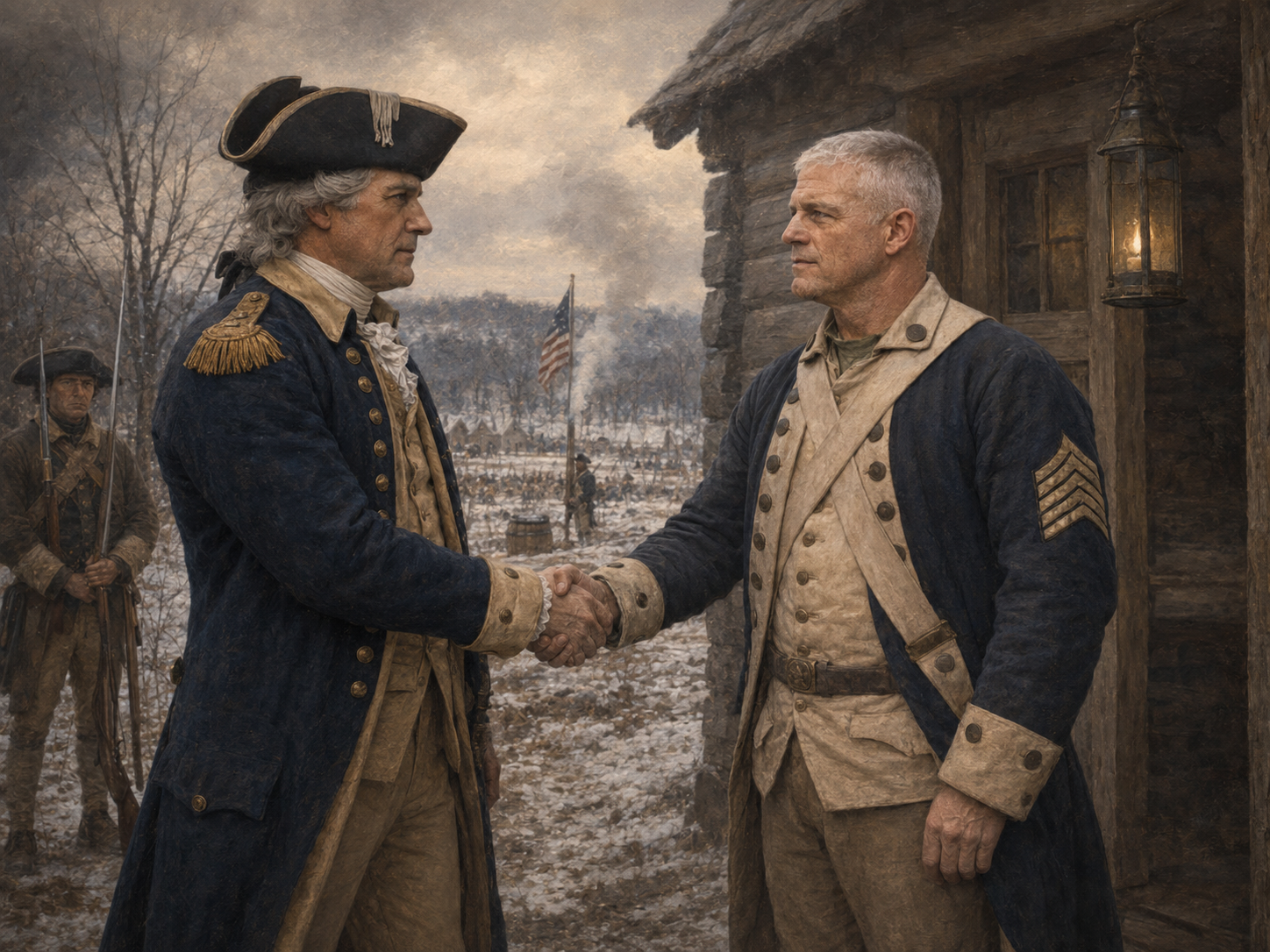
The General rose and walked slowly toward the window. Outside, the sounds of Valley Forge continued: men moving around headquarters, horses on frozen ground, sentries changing posts, and farther away the cadence of Baron von Steuben’s model company. Washington listened for several seconds before turning back.
WASHINGTON: You told me you are retired. I find that inconvenient.
Parker laughed. Washington did not, although the corner of his mouth suggested that he understood perfectly well what he had said.
WASHINGTON: My Guard requires men who understand that protection is more than standing near me with a weapon. Hickey demonstrated the danger of believing that the uniform itself proves the man wearing it is trustworthy. The Baron requires experienced noncommissioned officers who can turn instruction into habit. My scouts require men who understand the difference between seeing something and merely believing it. You have spent the better part of this day explaining the importance of precisely those things.
WASHINGTON: You have also made another point which deserves attention. The men closest to the commander cannot be the entirety of his security. The Guard must protect headquarters, papers, baggage, movements, information, and the people upon whom command depends. It must know whom it admits, notice what changes around it, and never allow familiarity to become blindness.
PARKER: That is the larger lesson from Hickey. He did not defeat the Guard from outside. He was already inside it. Once you accept that possibility, selection becomes only the beginning. You have to know your people, control access, share information, pay attention to changes, and build enough depth that one compromised individual cannot defeat the whole system.
WASHINGTON: When I first formed the Guard, I asked for sober and honest men of good behavior and soldierly appearance. Later I was more explicit with my officers: the men might be entrusted with my baggage, papers, and matters of great public importance, and there could be no absolute security for fidelity. A commander must trust men. There is no army without trust. But confidence must not become certainty merely because certainty is convenient.
PARKER: Agreed. A functioning protection team has to trust internally. The answer is not constant suspicion. It is professional awareness and a system that does not collapse if one person fails.
WASHINGTON: Then Hickey’s greatest lesson is not that guards cannot be trusted.
PARKER: No, sir. It is that trust should never be the only protective measure.
Washington looked again toward the drill field. The Guard that had once been embarrassed by treachery within its own ranks was now helping von Steuben teach a continental standard to the Army. The same organization that had been penetrated had survived, changed, and become useful in a larger transformation.
WASHINGTON: You said the best training survives the instructor.
PARKER: It has to.
WASHINGTON: Baron von Steuben is attempting precisely that. He can demonstrate the method, but he cannot personally train every regiment. The knowledge must pass through officers and sergeants until the standard no longer depends upon him.
PARKER: That is why the model company works. He is creating trainers, not merely trained men.
WASHINGTON: Then perhaps he requires another. My Guard also requires men who understand what you have explained today: that the sentry is more than a man holding a musket, that access is part of protection, that information from scouts and civil authorities may warn headquarters of dangers the close guard cannot see, and that the man standing beside the commander is the last defensive measure rather than the first.
Washington paused, then continued with the deliberateness Parker had come to recognize as more significant than enthusiasm.
WASHINGTON: You understand soldiers. You understand sergeants. You understand training. And you have plainly spent considerable time considering how important persons should be protected. Remain here. Assist Baron von Steuben where your experience may be useful, and assist Captain Gibbs in improving the training and awareness of the Commander-in-Chief’s Guard. Where appropriate, work with the scouts and detached parties whose reports come into headquarters. You will introduce no weapon or invention from your century. You will work with the men, equipment, and circumstances available to us now.
Parker looked once toward the folded modern uniform he had worn into camp, then toward the Continental coat that had allowed him to move through Valley Forge without becoming the day’s principal attraction. Beyond the headquarters, Steuben’s commands carried across the cold air. The Guard stood its posts. Martha Washington remained inside the house, and the commander in chief waited for an answer.
PARKER: Yes, sir. I’ll stay.
PART II – Protective After-Action Review and Lessons Learned
The documented Hickey case is stronger than the later legend. It presents a newly created protective organization penetrated by disaffection and treacherous correspondence, with the breach exposed through information that originated outside the Guard. That makes it a case about insider access, information flow, personnel reliability, headquarters security, and continuity—not a dramatic assassination story that the surviving court-martial record cannot prove.
Washington also understood that the protected asset was larger than his person. The Guard protected baggage, money, papers, correspondence, headquarters, and the functioning of command. His 1777 statement that there could be no absolute security for fidelity is an unusually clear historical expression of the limits of vetting.
1. Protect the command function, not only the commander
Washington’s Guard was not simply a man-with-a-musket bodyguard. Its mission included the Commander in Chief, official papers, money, baggage, headquarters, and the machinery that allowed command to continue. At Valley Forge, headquarters was also a household: aides, servants, messengers, visitors, and Martha Washington occupied the same environment.
Modern executive protection should make the same distinction. Protecting the principal while losing the information, staff, communications, transportation, residence, or continuity function that allows the principal to work can still be a mission failure. Family and headquarters security belong inside the protective system, not outside it.
2. Insider access changes the geometry
Hickey did not have to defeat an outer perimeter because he already belonged to the organization. That is the defining protective value of the case. Insider access changes what must be watched, what can be reached, and how much damage can occur before a conventional protective response begins.
Selection and background knowledge matter, but they are only the beginning. Access discipline, supervision, continuing awareness, information sharing, and redundancy are necessary because a trusted role creates opportunity as well as responsibility.
3. Information outside the close detail can become protective intelligence
The Guard did not uncover Hickey by observing him at his post. The broader inquiry developed from information that surfaced outside the Guard after his detention on a counterfeiting matter. For a modern protection team, the lesson is straightforward: the people closest to the principal cannot see everything.
Protective intelligence depends on collection beyond the detail and on a process that can receive, evaluate, share, and act on relevant information. A jailer, investigator, employee, family member, local officer, coworker, or other source may see something the close team does not. Information becomes protective only when it reaches someone able to understand its significance and act in time.
4. Vetting reduces uncertainty; it does not permanently certify fidelity
Washington wanted men of good character, sobriety, soldierly appearance, and strong ties to the country. Yet in 1777, after the Hickey experience, he wrote that there could be no absolute security for fidelity. That is not an argument against trust. It is an argument against confusing selection with permanent certainty.
Modern programs use background investigations, references, licensing checks, access controls, supervision, reporting systems, and continuing evaluation for the same reason. A functioning protective team has to trust internally, but trust should be supported by a system that does not collapse if one trusted person fails.
5. A professional AAR corrects the organization instead of freezing it in its last failure
Washington did not abolish the Guard because one of its members betrayed the organization. He retained and reformed it, tightened his thinking about selection and fidelity, and kept the mission functioning. By Valley Forge the Guard was disciplined enough to become part of von Steuben’s model company.
That transformation matters to a standards-based training program. The purpose of an after-action review is not to preserve blame. It is to change future performance. Von Steuben’s model-company method reinforces the second half of the lesson: a standard has value only when other units can reproduce the required performance after the original instructor is gone.
6. Historical review requires evidentiary discipline
The Hickey story has accumulated assassination claims that are more dramatic than the surviving court-martial record. Repeating them as established fact makes the case less useful, not more. A protective AAR has to distinguish what was proved, what was suspected, what was discovered later, and what has been added by retelling.
The same discipline applies to modern incidents. Survival does not prove that every protective layer worked. Suspicion does not become evidence because it fits a compelling narrative. Good analysis asks what was known at the time, who knew it, what authority existed, what action was reasonable, and what should change afterward.
Frequently Asked Questions: George Washington Bodyguard, Thomas Hickey, and Executive Protection
Did George Washington have a bodyguard?
Yes. In March 1776 Washington ordered the formation of a personal guard drawn from the Continental Army. The unit became known as the Commander-in-Chief’s Guard, General’s Guard, or Life Guards. Its mission extended beyond standing near Washington; it also protected official papers, money, baggage, headquarters, and other parts of the command function.
Who was Thomas Hickey?
Thomas Hickey was a soldier in Washington’s Guard who was tried by court-martial in June 1776. He was convicted of sedition, mutiny, and treacherous correspondence with the enemy, and he was executed on June 28, 1776.
Was Thomas Hickey convicted of trying to assassinate George Washington?
No. The surviving court-martial record does not convict Hickey of an assassination attempt. Later accounts associated the broader Loyalist conspiracy with possible plans against Washington, but poisoned-food stories and a completed assassination scheme should not be presented as established facts from Hickey’s conviction.
Why did Washington reorganize his personal guard in 1777?
When Washington formed a new Guard company in April 1777, he stressed extreme caution because the men might have sole care of baggage, papers, and matters of public importance. He sought men of good character and explicitly acknowledged that there could be no absolute security for fidelity.
What did Washington mean by ‘no absolute security for fidelity’?
He was acknowledging a permanent personnel-security problem: careful selection can reduce risk, but it cannot guarantee future loyalty. For modern executive protection, the principle supports background screening, supervision, access control, continuing awareness, and redundancy rather than blind trust or permanent suspicion.
How did Baron von Steuben use Washington’s Guard at Valley Forge?
The National Park Service states that von Steuben used the Commander in Chief’s personal guard and selected men from the states as a model company to demonstrate a standardized drill. The model company helped transmit a common method through the Continental Army.
Why is the Hickey case relevant to modern executive protection?
The case combines insider access, personnel reliability, protective intelligence, headquarters security, command continuity, family exposure, and after-action learning. Its strongest lesson is not that guards cannot be trusted; it is that trust should never be the only protective measure.
Was Washington’s Guard the same as a modern Secret Service detail?
No. The authorities, structure, technology, legal environment, and mission were different. The historical value is comparative: Washington’s Guard already protected the person and critical command assets, and its experience raises recognizable modern questions about access, intelligence, reliability, continuity, and training.
The Bottom Line
Washington’s experience does not teach permanent suspicion. It teaches disciplined trust. The Commander-in-Chief’s Guard had to be trusted enough to stand near the commander, handle sensitive papers, guard money and baggage, and operate inside headquarters. Hickey demonstrated why that trust could not become the only control measure.
For me, the most important line in the case remains Washington’s own warning that there could be no absolute security for fidelity. That is not cynicism. It is professional realism. Build the team carefully. Know the people. Control access. Share information. Maintain redundancy. Learn from failure. Train until the standard survives the instructor.
Protect the principal—but protect the command function too.
Related EPTraining.us Resources
- Executive Protection Training Syllabus – ISA syllabus connecting threat assessment, protective intelligence, planning, movement, legal responsibilities, and performance-based evaluation.
- Dignitary and Executive Protection Specialist Course – Current course description and training architecture for professional protective operations.
- ISA Executive Protection Training Standards – ISA approach to measurable training standards, regulatory requirements, and curriculum review.
- Defending Democracy Initiative – ISA analysis and training support for protecting public officials and preserving legitimate public function.
- Defending Democracy: Protecting Public Officials in an Era of Escalating Threats – Current ISA analysis of public-official security, accessibility, and mission continuity.
- The Man Behind the Office Door: Henry Clay Frick – Companion historical case study on organizational grievance, access control, and executive vulnerability.
Sources and Historical Notes
- George Washington’s Mount Vernon – Life Guards – Overview of the Guard’s formation, selection criteria, mission, Caleb Gibbs, and the Hickey episode.
- Founders Online – General Orders, 27 June 1776 – Washington’s approval of Hickey’s court-martial sentence and editorial notes on the evidence and broader Loyalist conspiracy.
- Founders Online – Washington to Spotswood, McClanachan, Bowman, and Febiger, 30 April 1777 – Washington’s instructions for reforming the Guard, including baggage, papers, selection criteria, and his warning that there could be no absolute security for fidelity.
- National Park Service – General von Steuben – NPS account of von Steuben’s standardized training system and use of Washington’s personal guard in the model company.
- National Park Service – Valley Forge Cell Phone Guide: Washington’s Guard – NPS interpretation of the Commander in Chief’s Guard at Valley Forge and its role in von Steuben’s model company.
- National Park Service – Washington’s Headquarters – The Isaac Potts house as Washington and his household’s headquarters during the 1777-1778 encampment.
- National Park Service – February 1778 Journals of Valley Forge – Contemporary documentation of Martha Washington’s arrival at Valley Forge on February 5, 1778.
Historical caution: The article separates the documented Hickey court-martial from later assassination legends. It does not treat poisoned-food stories or a completed assassination plot as established facts. It also avoids reading modern executive-protection doctrine backward into the eighteenth century; the modern analysis appears after the historical interview.
About Independent Security Advisors, EPTraining.us, and Defending Democracy
Independent Security Advisors LLC (ISA) operates EPTraining.us, a U.S.-based executive protection training program serving law enforcement, military, public-safety, corporate-security, and private-sector protection professionals. ISA uses historical case studies, contemporary incidents, regulatory requirements, and operational experience to connect threat assessment, protective intelligence, planning, physical security, movement, advance work, law, communications, emergency response, and performance-based evaluation within one protective system.
ISA’s Defending Democracy Initiative applies the same system-based approach to public officials, candidates, judges, prosecutors, election personnel, and other public servants whose legitimate duties can be disrupted by intimidation or targeted violence. The historical institutions are different, but the principle is consistent: protection should preserve the person and the lawful function that person is expected to perform.
About the Author
Matthew C. Parker is CEO of Independent Security Advisors LLC and Director of Training Operations for EPTraining.us. Retired from the U.S. Army, his assignments ranged from combat leadership and protective-services duties to training-department management and service as a Master Instructor at the U.S. Army Chemical, Biological, Radiological, and Nuclear School, where he was recognized as Instructor of the Cycle and Instructor of the Year. He also served as an instructor with Army ROTC at Virginia Tech.
Parker has more than three decades of military, government, security/executive-protection, training, and advisory experience, including international security and training work in Iraq and Ukraine. His work has included executive and dignitary protection, law-enforcement training, development of protective-service training, government and security advising, and standards-based curriculum development.
ISA has advocated measurable executive protection training standards for more than a decade and continues to evaluate professional standards against regulation, training requirements, operational practice, and demonstrated competency.