
 E-mail us
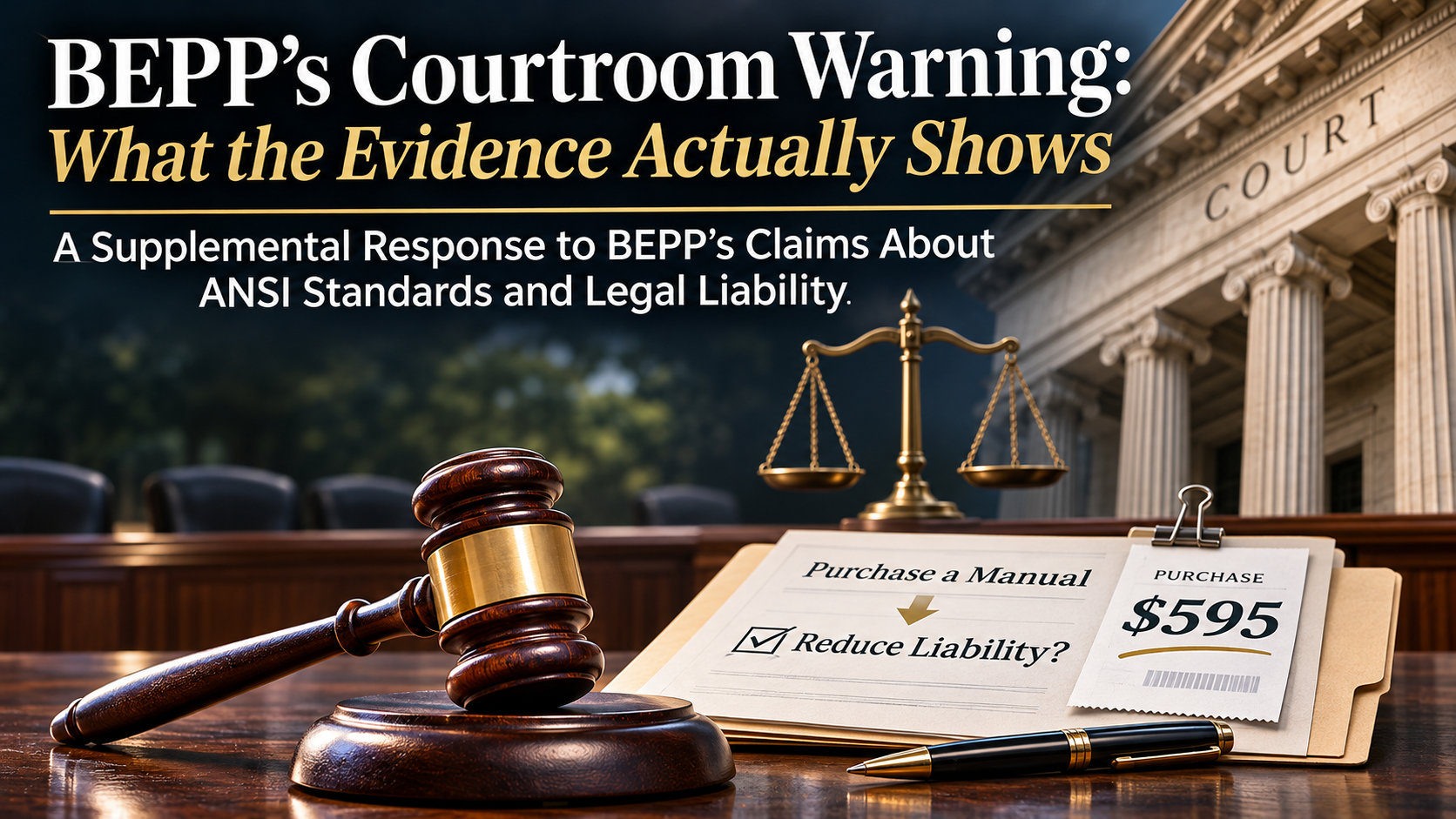
BEPP’s Courtroom Warning: What the Evidence Actually Shows
A Supplemental Response to BEPP’s Claims About ANSI Standards and Legal Liability
BEPP’s Courtroom Warning: By Matthew C. Parker
CEO, Independent Security Advisors LLC
Director of Training, EPTraining.us
November 6, 2026
Let’s be clear:
BEPP has published an ANSI-approved executive protection standard. But it has not demonstrated that courts will use it as the measure of professional conduct, that the industry has widely adopted it, or that buying the manual reduces an agent’s legal liability. Those are three different claims, and BEPP should not present them as though they have already been established.
Abstract
The Board of Executive Protection Professionals (BEPP) continues promoting ANSI/BEPP EPS-2026 as a benchmark that may determine how executive protection professionals are judged in negligence litigation. Its latest white-paper campaign develops that argument further, while its October 29 response suggests that agents who do not buy the $595 manual are likely to be measured against it. This supplemental article examines the legal evidence, the findings of a September 2026 Government Accountability Office report, and the distinction between a standard that a court could consider and one that has been shown to govern the profession.
Bottom Line Up Front
Voluntary professional standards can be considered in negligence cases, including cases where a defendant never formally adopted the standard. BEPP is correct about that general legal principle. However, the court decisions it cites do not establish that EPS-2026 is the accepted benchmark for executive protection, that agents will be judged against it, or that purchasing its publication reduces legal liability. Those additional conclusions require evidence that BEPP has not provided.
BEPP Is Predicting a Courtroom Outcome It Has Not Demonstrated
On October 29, 2026, BEPP published What a Standard Is Worth, responding to my earlier examination of professional standards and their cost. The organization stated:
“A professional who declines to buy the standard is still likely to be measured against it.”
BEPP compared the $595 purchase price with the potential expense of defending a negligence lawsuit. Its argument was that purchasing the publication represented inexpensive professional risk management because an agent might someday have to explain why a procedure in the manual was not followed.
BEPP’s comparison of its $595 publication price with the potential expense of defending a negligence lawsuit is particularly troubling. The argument essentially suggests that practitioners should purchase the publication because someone might someday use its contents against them in court.
Consider the implications: a private organization develops a voluntary standard, charges $595 for access, and then presents the possibility of future litigation as a justification for purchasing it. That is hardly a convincing demonstration of professional value. The possibility that a publication might be introduced as evidence in a negligence lawsuit does not establish that its recommendations represent accepted industry practice or that failing to purchase or follow them constitutes negligence.
If BEPP genuinely believes its recommendations are so important that practitioners may someday be judged against them, why place those recommendations behind a $595 barrier? Professional standards should earn acceptance through demonstrated merit, practical value, and widespread recognition—not through warnings about the potential consequences of failing to purchase them.
New Efforts
BEPP’s newer white-paper campaign continues examining how courts may hold professionals accountable to voluntary ANSI standards. Its September 23 article on legal defensibility presents EPS-2026 as evidence of a recognized executive protection standard of care. These publications are no longer simply encouraging employers to examine the standard. They are making predictions about the role EPS-2026 will play in future litigation.
There is nothing improper about discussing the legal significance of voluntary standards. Employers and practitioners should understand that such publications may be considered in negligence cases. However, the fact that courts have considered other voluntary standards does not establish that they will consider EPS-2026 in the same manner, much less that the publication will determine whether a protective professional acted negligently.
BEPP has not identified a published negligence decision applying EPS-2026 to an executive protection assignment. It has not demonstrated widespread adoption of the finished publication by independent protective organizations, and it has not provided evidence showing that purchasing the manual reduces the likelihood of an adverse court decision. Those omissions matter when the organization uses potential litigation to help justify the publication’s price.
BEPP’s Description of What a Plaintiff Must Prove Is Incomplete
BEPP’s October 29 response provides an example involving a protectee injured during a movement where an advance, emergency medical plan, or threat assessment was not completed. BEPP argues that plaintiff’s counsel would need to show that the profession had already documented the relevant procedure and the defendant failed to follow it.
That leaves out much of what a plaintiff must establish in a negligence case.
The plaintiff must show that the defendant owed a legal duty, breached that duty, and caused compensable harm. Whether an agent failed to follow a procedure appearing in a published standard may be relevant to the question of reasonable care, but it does not automatically establish those other elements. The plaintiff must still connect the alleged failure to the circumstances of the assignment and the injury involved.
Consider the protective practices BEPP identifies. Threat assessments, advances, emergency planning, and identifying appropriate medical facilities were established protective responsibilities long before BEPP published EPS-2026 in June 2026. Government agencies and private protective organizations have used these practices for decades. ASIS and authors of books, manuals and references I have mentioned previously have all written very well received and respected works on these topics. And considering the 280 participants in the BEPP standard one must ask how much of this previous work made it into the BEPP standards guide.
If an agent fails to conduct an appropriate threat assessment and a client is subsequently injured, the agent’s decisions may be examined. But the existence of BEPP’s publication does not create that responsibility for the first time. The question is whether a threat assessment was reasonably required, what information was available, what the agent actually did, and whether any failure contributed to the injury.
A plaintiff’s attorney could attempt to introduce EPS-2026 as evidence. Another attorney might rely on established government practices, employer procedures, expert testimony, contractual obligations, or the other professional publications. The court would have to determine what evidence is admissible, and the fact-finder would have to evaluate the conduct under the applicable legal requirements.
BEPP’s argument moves too quickly from the existence of an ANSI-approved publication to the conclusion that agents are likely to be measured against it. That conclusion has not been established by the examples the organization provides.
The Court Decisions Do Not Establish BEPP’s Prediction
I addressed BEPP’s cited decisions in my October 29 article, and I do not intend to repeat that entire analysis. However, three rulings demonstrate why the distinction between a voluntary publication and an established legal responsibility is important.
In Sawyer v. Dreis & Krump Manufacturing Co. (1986), New York’s highest court explained that an ANSI safety standard could be considered as evidence of accepted industry practice. The court also recognized that such a standard was not conclusive proof of negligence and that the jury had to evaluate the circumstances of the accident.
This decision supports BEPP’s general position that voluntary standards may be introduced in negligence litigation. It does not establish that every ANSI-approved publication automatically becomes the applicable measure of professional conduct.
A second decision demonstrates why that connection matters. In Deitrick v. Long Island Power Authority (2018), homeowners sued a gas company following an explosion during Hurricane Sandy. Their experts attempted to rely upon an ANSI requirement to establish that the company should have taken additional precautions. The court rejected the argument because the experts could not demonstrate that the cited ANSI requirement reflected general custom or usage within the gas industry.
BEPP has offered no executive protection court decision establishing that its recently published standard has achieved the status it predicts. Until such evidence exists, the organization’s statements about likely courtroom use remain predictions rather than demonstrated legal consequences.
The GAO Report Provides an Important Independent Comparison
On September 3, 2026, the U.S. Government Accountability Office published Secret Service: Protection Policies Should Be Consistently Updated to Better Ensure Protectee Safety. The report examined Secret Service protective policies, compared aspects of its operations with the Diplomatic Security Service and U.S. Marshals Service, and interviewed additional organizations with protection responsibilities.
BEPP was one of ten organizations interviewed. However, being interviewed by GAO is not the same as having GAO approve, endorse, or adopt EPS-2026. This is significant because GAO did not conclude that EPS-2026 had replaced organizations’ practices or become the accepted benchmark for protective operations. The GAO report is useful evidence of how established protective organizations develop and review their requirements. It is not evidence that GAO endorsed BEPP’s publication, and it should not be presented that way.
Employers and Clients Still Have Responsibilities and Choices
BEPP acknowledges that EPS-2026 is voluntary. It also recognizes that clients may reject recommendations based on a professional standard. On its website, the organization explains that when a client declines a recommendation, the practitioner has a documented basis for the advice provided.
I agree that documenting recommendations can be important. However, the existence of a recommendation in BEPP’s publication does not automatically make it the only acceptable protective procedure. Nor does a client’s refusal automatically relieve the protective team of responsibility for foreseeable risks.
Consider an employer with established procedures for conducting advances and moving a protectee through public venues. The employer examines EPS-2026 and determines that its existing methods are appropriate for the assignments it performs. If an incident occurs, the relevant questions would concern the risks involved, the adequacy of those procedures, and how the protective team performed its duties. Simply demonstrating that a procedure differed from BEPP’s publication would not settle the issue.
The same principle applies when a client refuses a recommended protective formation or requests a different travel arrangement. The team must evaluate the risks, consider reasonable alternatives, explain significant concerns, and determine whether the assignment can be performed responsibly. Documenting those decisions may be valuable, but neither documentation nor ownership of a particular manual guarantees protection against liability.
An employer cannot keep a relevant voluntary standard out of court simply by refusing to adopt it. That is an important legal distinction. However, BEPP has not demonstrated that every employer must organize its protective operations around EPS-2026 or that a different, reasonable procedure creates additional legal exposure.
In short
BEPP cannot simply declare that executive protection professionals will be measured against its privately developed publication and expect the profession, the courts, or regulatory authorities to accept that assertion. Professional authority is not established through a publisher’s proclamations. It must be earned through demonstrated acceptance, independent recognition, and actual use within the profession.
BEPP has presented no verifiable evidence that EPS-2026 has achieved that standing. Until it does, its warning that practitioners will be judged against the publication is not an established legal reality. It is an unsupported claim that could appear to some designed to encourage compliance with a standard whose authority BEPP has yet to demonstrate.
Does the $595 Purchase Reduce Legal Liability?
BEPP continues promoting its manual as a professional investment that may help practitioners manage legal exposure. The printed publication currently costs $595, plus $25 for shipping within the continental United States. and I do not dispute that understanding professional standards can be useful. An agent who studies different protective methods and understands the reasons behind them may be better prepared to make appropriate decisions.
But the professional value of learning something is different from the legal consequence of owning the publication in which it appears. Purchasing EPS-2026 does not establish that an agent can perform the procedures described. It does not guarantee that the agent will exercise reasonable care, and it does not prevent a client or another injured party from filing a negligence lawsuit.
BEPP has not provided independent evidence demonstrating that buying its manual reduces liability or that declining to purchase it increases the likelihood of an adverse judgment.
This distinction is especially important for veterans, retiring law-enforcement officers, and other practitioners entering private executive protection. They may already be paying for training, insurance, licensing, equipment, and professional development. They should evaluate whether a $595 publication provides information worth purchasing, not assume that ownership offers legal protection because the publisher predicts future courtroom use.
I recognize that developing and maintaining a professional standard costs money. BEPP has the right to recover legitimate expenses and promote its publication. But the organization is also asking practitioners to accept claims about professional authority and legal exposure. Those claims must stand on their own evidence, regardless of how many people contributed to the publication or how much it costs to produce.
Conclusion
BEPP has accomplished the development of an ANSI-approved standard for executive protection. I recognize the work involved and the potential professional value of an organized reference document. However, ANSI approval does not automatically establish the document as the governing benchmark for the entire profession, and the court decisions BEPP cites do not establish that EPS-2026 will determine an agent’s legal responsibilities.
The organization has demonstrated that voluntary standards may be considered in negligence litigation. It has not demonstrated that EPS-2026 is already likely to be used against executive protection agents, that a practitioner following another appropriate procedure is negligent, or that purchasing the $595 manual reduces legal exposure.
The September 2026 GAO report provides an important independent comparison. GAO interviewed BEPP, but it did not endorse EPS-2026 or declare it the profession’s benchmark.
If BEPP wants practitioners to accept its predictions about legal liability, it should identify the evidence supporting them. Which courts have applied EPS-2026? Which independent organizations have adopted the finished publication as their governing operational standard? What evidence shows that purchasing it or following its requirements produces a measurable reduction in liability?
Those questions are not personal attacks. They concern the accuracy of the claims BEPP is making to the profession.
I support professional standards and the continuing improvement of executive protection. But I do not accept the argument that because some voluntary standards have been considered in court, BEPP’s newly published standard will necessarily be used to judge practitioners. That conclusion does not follow from the evidence.
A possible future use in litigation is not an established legal obligation, and a publisher’s prediction is not proof of professional acceptance. BEPP should not promote those things as interchangeable.
Sources
- BEPP, What a Standard Is Worth, October 29, 2026 — BEPP’s argument concerning potential litigation, purchase price, and the use of voluntary standards.
- BEPP, Why an ANSI Standard Is More Legally Defensible Than a Non-Accredited Standard, September 23, 2026 — BEPP’s discussion of ANSI approval and evidentiary significance.
- BEPP, Resources and White Papers — BEPP’s public description of its executive protection industry white paper.
- BEPP Official Website — Statements concerning benchmark status, risk mitigation, and client rejection of recommendations.
- BEPP Frequently Asked Questions — Voluntary compliance, industry adoption, and anticipated benefits.
- Sawyer v. Dreis & Krump Manufacturing Co. (1986) — Judicial consideration of ANSI standards as evidence of industry custom.
- Elledge v. Richland/Lexington School District Five (2002) — Voluntary standards considered despite nonadoption by the defendant.
- Deitrick v. Long Island Power Authority (2018) — Rejection of an attempted use of an ANSI requirement not demonstrated to reflect accepted industry practice.
- Government Accountability Office, GAO-26-108455, September 3, 2026 — Review of Secret Service protection policies and protective best-practice references.
- Cornell Law School, Legal Information Institute — Negligence — Elements and principles of negligence claims.
- ANSI Board of Standards Review — Scope and limits of ANSI’s standards-approval review.
- Matthew C. Parker, A Standard’s Value Must Be Demonstrated, Not Simply Declared, October 29, 2026 — Original article to which this update relates.
About the Author
Matthew C. Parker is CEO of Independent Security Advisors LLC (ISA) and Director of Training for EPTraining.us. His professional experience includes twenty years of military service, military instruction and curriculum development, executive and dignitary protection operations, and international security advising. Since retiring from the U.S. Army in 2011, Parker has directed protective operations, developed and evaluated executive protection training programs, and provided protective training and advisory services in the United States and internationally.
#ExecutiveProtection #BEPP #EPS2026 #ANSI #ANSIStandards #ExecutiveProtectionStandards #ProfessionalStandards #VoluntaryStandards #LegalLiability #ProfessionalAccountability #LegalDefensibility #RiskManagement #ProtectiveOperations #ExecutiveProtectionTraining #IndependentSecurityAdvisors #MatthewParker #EPTrainingUS