
 E-mail us
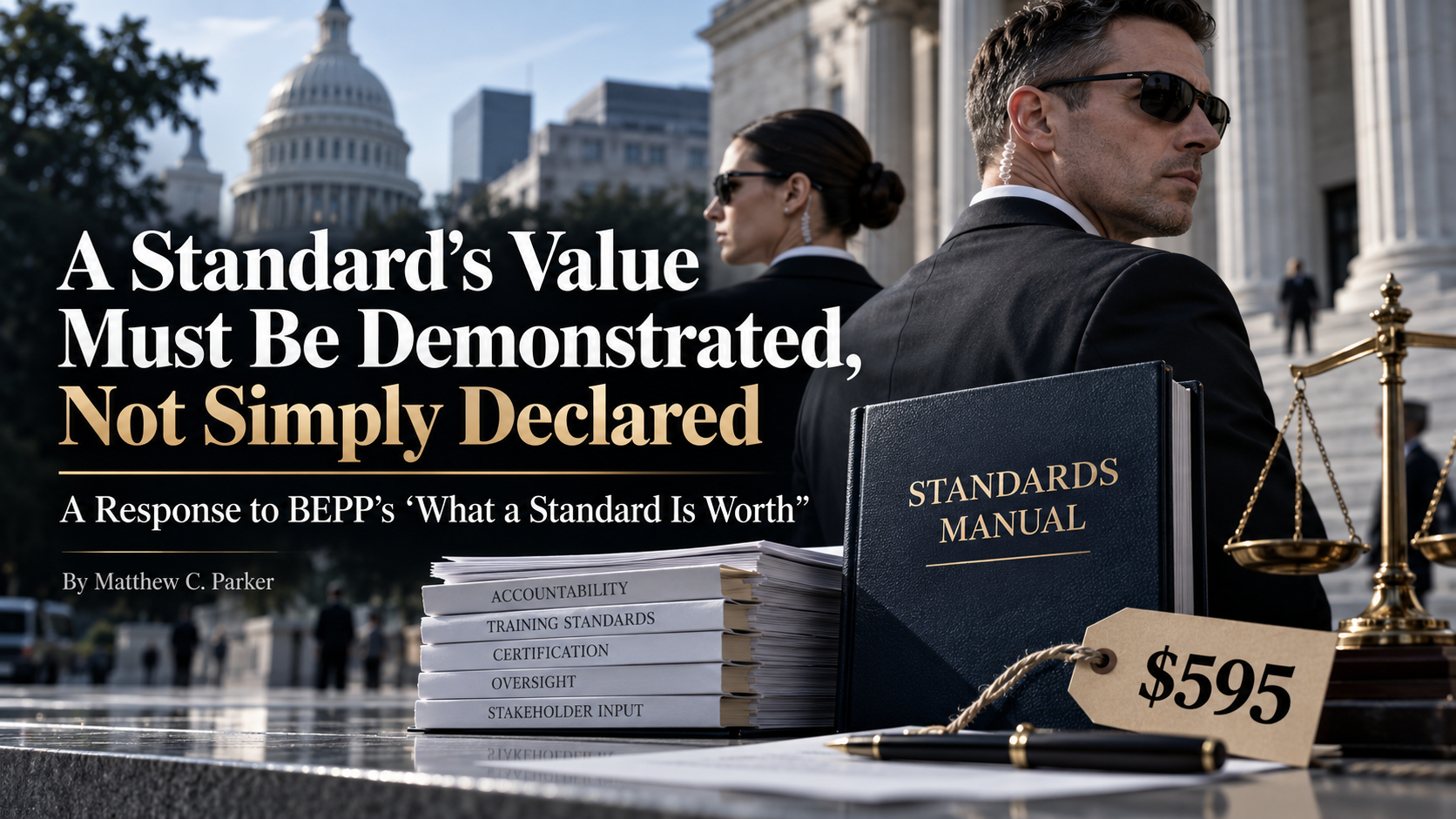
A Standard’s Value Must Be Demonstrated, Not Simply Declared
A Response to BEPP’s “What a Standard Is Worth”
Executive Protection Standards: By Matthew C. Parker
CEO, Independent Security Advisors LLC
Director of Training, EPTraining.us
October 29, 2026
“Methinks thou dost protest too much,”
Shakespeare
First, let me say how much I appreciate the Board of Executive Protection Professionals (BEPP) responding to my article, If Standards Matter, Who Gets to Read Them? As a private-sector standards developer, it’s good to see them step forward to share their thoughts on others’ professional analyses of their work. Professional standards warrant serious discussion, particularly when an organization seeks to make its publication a recognized benchmark for an entire profession. It’s currently not, but it could be over time.
I recognize the work contributed by BEPP’s volunteers; I know many of them. More than one or two have shared a classroom with us. And I understand that developing, publishing, and maintaining professional standards involves expenses. Neither point was disputed in my original article. My concern was whether charging $595 for access to a professional standard is reasonable when the stated objective is to improve the knowledge and performance of executive protection professionals.
But BEPP’s response does go considerably further than explaining its publication price. It questions my professional independence, compares the cost of its publication with tuition charged by my training academy, and suggests that my decision not to join its standards-development committee weakens my criticism of the finished document. It also presents several court decisions to support the argument that executive protection agents who do not purchase its publication may nevertheless be judged against its requirements in court (They won’t).
These are separate issues, but they all deserve an answer because they concern the authority BEPP claims for its work, the value it places upon that work, and the responsibilities it believes practitioners should assume.
My Position on Professional Standards
My position on professional standards did not begin with BEPP. In 2011, Independent Security Advisors began developing its Dignitary and Executive Protection Training Program in response to requests from law-enforcement. We used established Instructional Systems Development principles to identify training requirements, establish instructional objectives, prepare lesson plans, and evaluate student performance.
We consulted with protective practitioners, examined applicable federal and state requirements, and submitted our programs for review and acceptance by appropriate agencies. The objective was to establish training based upon documented requirements and measurable performance rather than the personal opinions or preferred techniques of individual instructors. As this process moved forward we learned a great deal about standards and have written articles on the topic since 2018.
Now BEPP emphasizes that I was invited to participate in its standards-development process and declined. That is mostly correct, although I wasn’t directly contacted until BEPP was a few years into the process, and I did take part in its draft review with several recommendations. But BEPPs response also fails to mention that I offered to contribute in other ways. More focused on training and converting their manual into a study guide, the proposal was an opportunity to examine actual research, agency requirements, and documented performance results with professionals who develop and manage training programs.
BEPP declined my assistance on training, just as I am free to decline membership on its committee. However, declining committee membership does not disqualify anyone from examining the resulting publication as I did with the draft. Truth is, professional standards should withstand reasonable questions regardless of whether those questions come from committee members, instructors, employers, or practitioners who were not involved in writing them. If the objective is to improve the profession, the quality of the information being offered should matter more than whether the person providing it belongs to a particular committee.
ANSI Approval and the Authority of Voluntary Standards
BEPP places considerable emphasis on the participation of more than 280 professionals and the ANSI approval of EPS-2026. I recognize that bringing together professionals from different backgrounds can produce useful results. A consensus process can identify common practices, improve terminology, and provide an organized method for examining recommendations. However, the number of people contributing to a publication does not establish that every recommendation is correct, necessary, or the best available method. Those questions must be answered by examining the requirements themselves, considering the circumstances in which they will be applied, and determining whether they produce the intended results.
The distinction between ANSI approval and technical evaluation is particularly important. According to the ANSI Board of Standards Review, its responsibility is to determine whether standards submitted for approval meet the “applicable procedural requirements”, meaning did you follow the guidelines for your meetings, etc.
Truth is, ANSI expressly states that its Board of Standards Review does not evaluate the technical content of standards or hear appeals concerning technical issues. This does not mean BEPP’s recommendations are necessarily wrong. It means that ANSI approval does not independently establish that those recommendations have been tested, are operationally effective, or represent the best method of conducting protective operations.
BEPP itself acknowledges that ANSI approval concerns the development process rather than the technical content. That distinction should be made clear whenever its publication is described as an American National Standard. The designation American National Standard also does not give BEPP governmental authority.
State regulatory agencies, law-enforcement training commissions, and government training institutions already establish requirements for particular protective assignments and instructional programs. Those requirements differ according to jurisdiction, assignment, and applicable law. A law-enforcement officer assigned to protect a public official may operate under different legal and administrative requirements than a private executive protection agent working under contract.
A state regulatory agency may decide to adopt all or part of EPS-2026, but that would be a decision made by the agency under its own authority. Publication of an ANSI-approved document does not automatically replace existing requirements or invalidate previously approved programs.
BEPP also points to a university incorporating its publication into bachelor’s and master’s degree programs as evidence of its value. We had a similar agreement with the university years ago. And that may demonstrate interest in their document and a willingness by the university to incorporate some of its recommendations into an academic program.
However, adoption by a university does not establish that every recommendation has been independently tested or that other established protective practices are inferior. The same principle applies to ISA’s programs. Regulatory acceptance and academic recognition are important, but neither should prevent continued evaluation of technical requirements or the methods used to measure professional performance. The question should always be whether a requirement improves the work being performed, not merely how many organizations have agreed to use it.
What BEPP’s Court Decisions Actually Establish
BEPP devotes a substantial portion of its response to court decisions involving voluntary professional standards. Its argument is that an executive protection agent who does not purchase EPS-2026 may still be judged against its requirements in court. (And again, they won’t be). BEPP then presents the $595 purchase price as a relatively inexpensive form of professional risk management.
A lawyer is a relatively inexpensive form of professional risk management. Your insurance company is a relatively inexpensive form of professional risk management. Both give advice and will defend that advice for you in court. But, in fairness to BEPP I did examine and research the cases cited in support of their argument.
Unfortunately, they do not establish that BEPP’s publication has become the professional standard against which every executive protection agent will be measured. The cases address how courts have or may use voluntary standards when examining accidents and allegations of negligence. But, they do not establish that a newly published private standard automatically becomes a legal requirement for an entire profession. At $595.00 a book i’m not sure a court can afford a copy.
BEPP is correct that courts sometimes consider voluntary standards when deciding whether someone acted responsibly. Such publications may help explain accepted industry practices or the precautions that reasonably should have been taken in a particular situation. However, allowing a publication to be considered as evidence does not make it law, and it does not mean that everyone must follow it.
The distinction is clearly explained in McComish v. DeSoi (1964), where the New Jersey Supreme Court considered private industry safety codes in an industrial accident case. The court recognized that these codes could help explain accepted practices, but specifically distinguished them from laws or absolute legal requirements. The codes were useful because they provided information about recognized safety practices, not because the organizations that published them possessed regulatory authority.
The same distinction appears in Sawyer v. Dreis & Krump Manufacturing Co. (1986), a decision by New York’s highest court involving ANSI standards for an industrial machine. The court ruled that the standards could be considered as evidence if they represented accepted industry practices. However, the jury still had to examine the circumstances of the accident and determine whether the conduct was reasonable.
The ANSI publication did not settle that question. In fact, the court ordered a new trial, in part because the jury had not been properly instructed about the limits of the standards’ importance. This is directly relevant to BEPP’s position because the decision recognizes that an ANSI publication can be useful in court but may not really control the outcome.
Another important decision is Egede-Nissen v. Crystal Mountain (1978), which involved ANSI standards concerning ski-lift operations. The Washington Court of Appeals recognized that voluntary requirements could be considered when examining whether the resort had acted negligently, but it rejected treating a violation of the relevant voluntary provisions as automatic negligence.
The court also distinguished between requirements adopted into government regulations and voluntary provisions that had not been adopted. The importance of that distinction should be clear to anyone working in a regulated profession. A private organization may publish a recommended procedure, and that procedure may be considered when evaluating an incident, but publication alone does not make the procedure a government requirement.
BEPP also cites Elledge v. Richland/Lexington School District Five (2002), which involved national playground-safety guidelines and ASTM standards. The South Carolina Supreme Court ruled that the guidelines should have been admitted as evidence even though the school district had not formally adopted them.
However, the court did not determine that the school district was negligent simply because those standards existed. This is an important example because it shows that an organization cannot necessarily prevent a relevant safety standard from being considered simply by refusing to adopt it. At the same time, the court must still determine what the organization was responsible for and whether it failed to exercise reasonable care.
The remaining decisions BEPP cites support the general principle that voluntary standards may be considered in court, but they do not establish the additional authority BEPP suggests for its own publication.
Hansen v. Abrasive Engineering and Manufacturing (1993) recognized that advisory ANSI standards could help determine whether reasonable care had been exercised. Kent Village v. Smith (1995) allowed ANSI requirements to be considered when they were relevant to the parties and the circumstances of an accident. In Norman v. Ogallala Public School District (2000), the Nebraska Supreme Court upheld a negligence judgment involving a student injured during a welding class. An ANSI recommendation concerning protective clothing was considered along with the school’s responsibilities and the circumstances of the accident.
These decisions demonstrate that voluntary standards can be important evidence, particularly when they address a recognized hazard, but their importance depends upon the circumstances in which they are being used.
BEPP also cites two cases involving the responsibilities of organizations that develop professional safety standards. In Meneely v. S.R. Smith (2000), a swimming-pool industry association was held responsible for failures involving safety standards it had developed and maintained. In Snyder v. American Association of Blood Banks (1996), the New Jersey Supreme Court examined the responsibilities of a private association whose standards influenced blood-banking practices.
Both decisions demonstrate that private standards organizations may face legal consequences when their actions contribute to harm. This is relevant to BEPP’s responsibility for developing and maintaining its publication, but it does not establish that BEPP has regulatory authority over executive protection agents or that the organization can determine the legal requirements for every protective assignment.
Finally, BEPP relies upon The T.J. Hooper (1932), a case involving tugboats that lacked radio receivers capable of obtaining storm warnings. The court recognized that common industry practices do not necessarily establish what reasonable care requires. An entire industry can fail to adopt reasonable safety precautions, even when those precautions are available. That finding is important because it demonstrates that agreement within a profession does not settle every question about safe or reasonable conduct.
Consensus may provide useful guidance, but an accepted practice can still be inadequate, just as a less common practice may be reasonable and effective. This principle applies to BEPP’s publication as much as it applies to any other collection of professional recommendations.
I am not suggesting that these court decisions are unimportant or that voluntary standards have no legal significance. They clearly demonstrate that courts may consider such standards when examining an incident. However, none of the decisions involved EPS-2026, none involved an executive protection assignment, and none established that BEPP’s publication is legally required or has been accepted as the controlling standard for executive protection.
BEPP has provided no court decision establishing that its publication has achieved that status. Its response takes a recognized legal principle concerning voluntary standards and applies it to EPS-2026 without demonstrating that courts or the broader profession have accepted that particular document as the controlling authority.
BEPP’s Claims About Legal Liability
This brings us to BEPP’s suggestion that an executive protection agent who does not purchase its publication is still likely to be measured against it in court. BEPP has provided no evidence that EPS-2026 has been established as the legal standard executive protection agents must follow.
A lawyer might introduce the publication during a future negligence case, and a judge might allow it to be considered as evidence. That possibility exists, but it does not establish that the publication is legally binding or that an agent has acted improperly simply because a particular BEPP recommendation was not followed. BEPP is presenting a possible legal argument as though it were an established fact. Its cited decisions do not support that broader conclusion.
BEPP illustrates its argument with an example involving a protectee injured during a movement where an advance, emergency medical plan, or threat assessment was not completed. Those are established protective practices that government and private-sector protective organizations were using long before EPS-2026 was published. Whether a particular precaution was reasonably required would depend upon the assignment, available intelligence, identified threats, operational conditions, and responsibilities of the protective team.
If an injury occurred, a court would examine those circumstances and determine what the agent was expected to do, what actually happened, and whether the agent’s actions contributed to the injury. Existing government requirements, organizational procedures, contractual obligations, and testimony from experienced protective professionals could also be relevant. BEPP’s publication might be considered, but it would not automatically settle those questions.
This distinction is important because BEPP’s argument suggests that its publication has created a new level of legal exposure for agents who do not purchase it. The court decisions it cites do not establish that result. They do not show that EPS-2026 has already been accepted by employers, regulators, or the courts as the controlling professional benchmark. Nor do they establish that purchasing and following BEPP’s publication will protect an agent from negligence claims.
The relevant question remains whether the agent acted reasonably under the circumstances and met the responsibilities of the assignment. Those responsibilities existed before BEPP published its standard and will continue to exist regardless of whether an individual agent purchases the document.
There is also a contradiction in BEPP’s position. If the organization believes its publication may eventually influence how courts examine an agent’s conduct, that strengthens the argument for making the information widely available. An organization seeking to improve professional performance should want practitioners to understand its requirements, examine the supporting material, and determine how those requirements apply to their assignments.
Charging $595 for access while warning agents that they may someday be judged against the document does little to encourage widespread understanding. It may help sell the publication, but it does not establish that the price improves professional performance or reduces the risk of mistakes during protective operations. In other words the sky is falling method of selling books may not be all that effective.
Consensus Is Important, but Performance Still Matters
BEPP repeatedly emphasizes that more than 280 professionals contributed to developing EPS-2026. I recognize the value of bringing together different professional perspectives, particularly when those participants have experience in law enforcement, government protection, corporate security, and private protective operations. However, the number of contributors does not eliminate the need to evaluate the finished work.
A committee can agree upon a procedure without establishing that it is appropriate for every operational environment, and a recommendation can receive substantial support without being independently tested. The purpose of professional standards should be to establish useful expectations that can be applied and evaluated, not simply to document what a committee has agreed upon. So, if you think it works, you must test it, or your standards are just paper with ink on it.
This is also why the distinction between ANSI’s procedural approval and technical evaluation matters. BEPP correctly acknowledges that ANSI does not independently evaluate the technical content of EPS-2026. The book may contain useful advice or requirements, and its contributors may be highly experienced, but that doesn’t prove that every piece of advice or recommendation is necessary or that the procedures described are more effective than established alternatives.
I am not questioning the professional qualifications of everyone who contributed to the publication. I am asking what independent evaluation was conducted. The same scrutiny should apply to any organization claiming that its practices represent a professional benchmark, including ISA.
Nevertheless, an organization promoting professional standards should be able to explain what those requirements are intended to accomplish and how their usefulness can be evaluated. The publication’s length, contributor count, and ANSI designation do not answer those questions by themselves.
The Price Question Remains Unanswered
BEPP explains that developing and maintaining its publication required considerable time, administration, editing, printing, and financial resources. I recognize those expenses, and I have never suggested that the people responsible for producing professional standards should work without compensation or that their organization should operate without revenue. My concern is whether those expenses justify the particular distribution model BEPP has chosen. Explaining what a publication costs to produce is different from explaining why individual practitioners should have to spend $595 to read the requirements that BEPP wants the profession to follow.
BEPP compares that price with the tuition we charge for our seven-day executive protection course. The comparison overlooks the difference between purchasing a reference document and attending an instructor-led educational program that includes practical exercises, supervised instruction, and performance evaluation. ISA also publishes reduced tuition rates for eligible veterans, law-enforcement personnel, and other qualifying students and groups. Will BEPP reduce the price for veterans or law enforcement?
More importantly, our tuition has no bearing on whether BEPP’s standard should be more affordable. Training tuition pays for the delivery of an educational program. Purchasing a standards publication provides access to the information contained in that document. Those are different products, and their value should be examined accordingly.
BEPP also challenges my comparison between its publication and the Bible, military manuals, government regulations, and other professional references. I recognize that these publications serve different purposes and are produced under different financial arrangements. My original article acknowledges those differences. The comparison was not intended to suggest that the cost of preparing a new professional standard is identical to the cost of printing an established religious text or distributing a government publication.
It was intended to demonstrate that substantial bodies of important information can be made available without requiring every reader to spend hundreds of dollars. BEPP’s response explains why its costs may differ, but it does not establish that less expensive access is impractical. Now taking BEPPs total argument on length, contributors, etc, I can still buy a book with multiple contributors, that provides advice and guidance, and for a lot less money.
The National Fire Protection Association provides a great comparison because it also developed professional standards through a consensus process. NFPA sells printed publications and paid digital services while providing free online viewing of its codes and standards under specified conditions. The organization must still maintain its standards, support technical committees, and periodically revise its publications.
Their approach demonstrates that recovering the cost of developing professional standards and providing free electronic viewing are not mutually exclusive. I am not suggesting BEPP must adopt every part of NFPA’s business model, after all the legal litigation BEPP has been involved with during this project, and given recent court decisions I understand you have some expenses other authors do not that you would like to recover. But the NFPA is a practical example of an organization that has chosen to make its requirements accessible while continuing to offer paid products and services.
I’m Not the Only One that Thinks So
Federal policy also recognizes that access to voluntary standards deserves consideration. OMB Circular A-119, Section 5(f), addresses the availability of voluntary consensus standards used by federal agencies. The guidance considers factors such as free read-only access, the cost of obtaining a publication, and whether affected parties can reasonably afford it. The circular does not require BEPP to distribute EPS-2026 without charge, and I am not suggesting otherwise. However, it demonstrates that the federal government recognizes the practical importance of making professional requirements available to those who may be expected to understand or follow them.
So it appears the US Federal government and the Vatican both believe it’s a practical idea to make professional standards available to those who may be expected to understand or follow them. Where would we be if the ten commandments were $500 dollars? We would never know they existed, hell and damnation would follow for violations of the rules we didn’t know existed because we couldn’t afford to read them. But I digress.
My preferred approach remains free electronic access for individual practitioners. Schools and training centers could pay a licence to reproduce the book or a fee for students to user the book online. Of course a reasonable charge for a printed copy would be nice.
BEPP is entitled to establish the price of its book. The issue is whether that price supports its stated objective of improving the industry. A large corporation may consider $595 a routine expense, but a military veteran entering civilian protective services, a newly licensed practitioner, or an individual law-enforcement officer preparing for protective duties may view that expenditure differently.
These are among the people professional standards are intended to help. Making the publication more accessible would not diminish the work of its contributors or reduce the importance of its recommendations. It would allow more professionals to read the material, understand what BEPP is proposing, and determine whether those recommendations improve their work.
Conclusion
BEPP has accomplished something by bringing together hundreds of contributors and publishing a comprehensive reference for executive protection. I recognize that accomplishment and the considerable effort required to complete the project. However, publication does not end the discussion about technical accuracy, existing regulatory requirements, the distinction between voluntary guidance and enforceable requirements, or the cost of accessing professional information. These are legitimate questions that should be examined on their merits rather than dismissed because the person raising them did not participate in the development committee.
The court decisions BEPP cites establish that voluntary standards may be considered when courts examine professional conduct. They do not establish that EPS-2026 has become a binding national requirement or that executive protection agents must purchase and follow it to meet their legal responsibilities. ANSI approval confirms compliance with applicable development procedures, but it does not independently establish technical effectiveness or replace existing government requirements. These distinctions are important, particularly when an organization promotes its publication as a professional benchmark and suggests that agents who do not purchase it may face legal consequences.
I remain willing to contribute to meaningful improvements in executive protection standards. My earlier offer to share appropriate ISA research, training evaluations, and curriculum-development experience remains open, as does the offer to host a working summit involving qualified instructors and program managers. I believe there is value in examining established requirements, comparing available methods, and evaluating proposed improvements through actual training and protective operations. ISA has followed that approach since 2011, and we continue to revise our programs as threats, technology, and professional requirements change.
My disagreement with BEPP should not be interpreted as opposition to professional standards or resistance to change. Professional improvement is not measured by the age of an organization, the number of contributors to a publication, or the number of pages in a document.
It is measured by whether the people performing protective duties are better prepared, whether the requirements they follow are appropriate for their assignments, and whether their performance can be evaluated.
The value of a standard should be established by what it improves, how its requirements can be evaluated, and whether the people expected to follow it can reasonably obtain it.
That remains my position.
Matthew C. Parker
CEO, Independent Security Advisors LLC
Director of Training, EPTraining.us
Original ISA article:
https://www.eptraining.us/executive-protection-standards-cost-accessibility/blog/
BEPP response:
https://www.linkedin.com/pulse/what-standard-worth-response-standards-matter-who-gets-read-them-pihvc
Existing EPTraining.us articles directly related to the reply:
-
Executive Protection Standards: What Makes a Standard Credible? — explains why publication and consensus do not establish technical performance.
-
Can We Teach It, Test It, and Trust the Result? — discusses measurable requirements and practical evaluation.
-
From Paper to Proof — links the response to your broader six-article standards examination.