
 E-mail us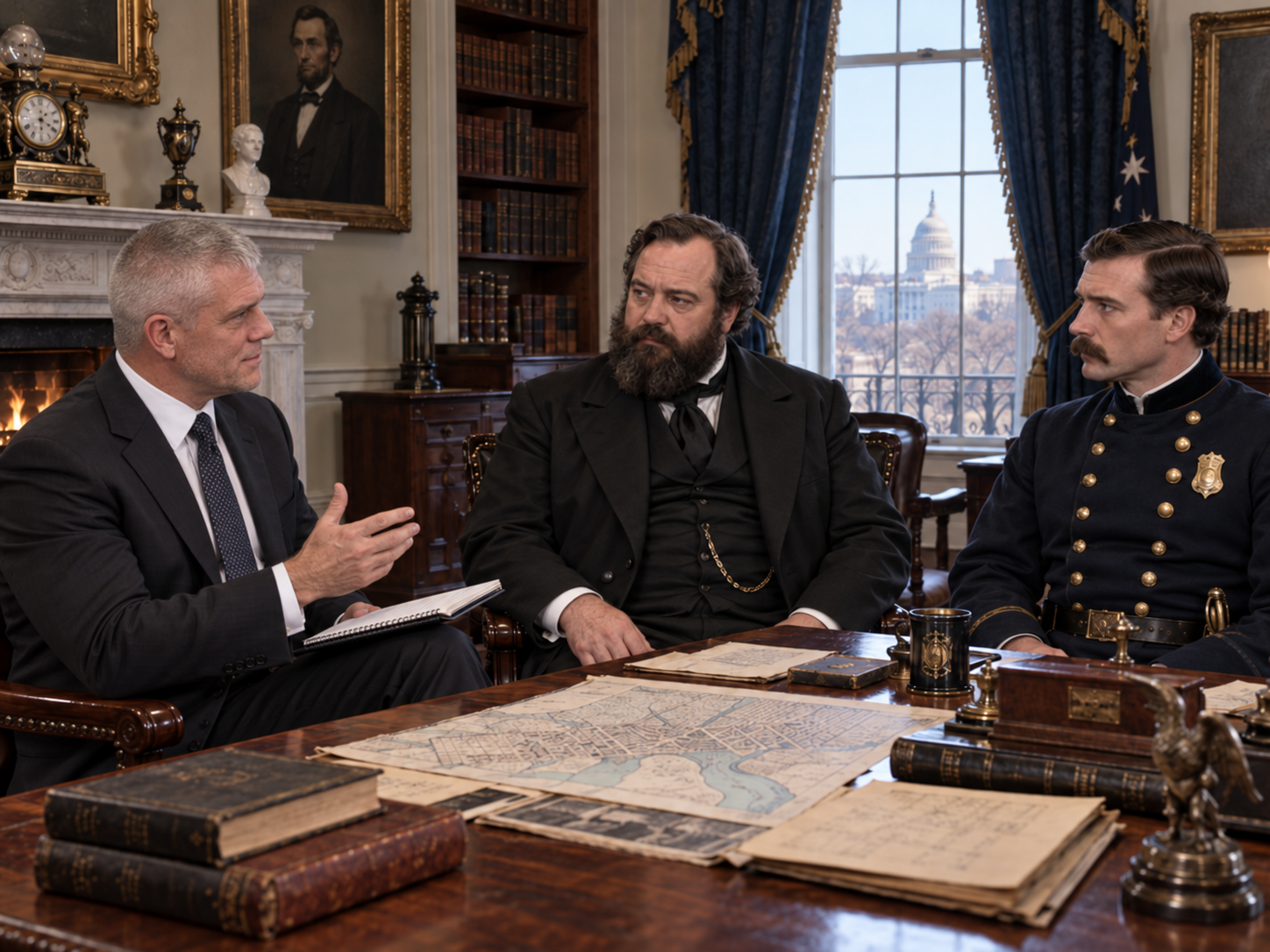
Matthew Parker in Conversation with Ward Hill Lamon and William H. Crook
Abraham Lincoln, the Baltimore Plot, White House Security, and Executive Protection Lessons Before the Modern Secret Service
Independent Security Advisors | EPTraining.us | Historical Executive Protection Case Study Series
Washington, D.C. — A historically reconstructed discussion spanning 1861–1865
Historical visualization: Matthew Parker with Ward Hill Lamon and William H. Crook during a reconstructed discussion of Abraham Lincoln’s security. Artistic reconstruction for the EPTraining.us Historical Executive Protection Case Study Series; not a historical photograph.
Abraham Lincoln faced assassination warnings before he entered the White House and resisted restrictive protection throughout the Civil War. This historical case study examines Ward Hill Lamon, William H. Crook, the Baltimore Plot, Ford’s Theatre, and the development of presidential protection through a modern executive-protection lens.
Why This Historical Executive Protection Case Still Matters
Abraham Lincoln’s protection story is often reduced to one terrible night at Ford’s Theatre and one police officer who was not outside the presidential box when John Wilkes Booth entered. That version is memorable, but it is too small for a serious executive protection case study.
Lincoln had security. The White House had guards before he became president. Franklin Pierce had already used a full-time personal bodyguard. During Lincoln’s presidency, military units, cavalry escorts, Metropolitan Police officers, friends, detectives, and federal officials all performed pieces of what we would now recognize as protective work. Ward Hill Lamon repeatedly acted as Lincoln’s informal personal protector. William H. Crook served in the White House police guard during the final months of the Civil War.
What Lincoln did not have was a single, integrated protective system responsible for connecting threat assessment, protective intelligence, route and movement planning, access control, advance work, site security, communications, transportation, contingency planning, and close protection around the president wherever he went.
That distinction is why this case belongs in modern executive protection training. The lesson is not that nineteenth-century protectors failed because they lacked twenty-first-century equipment. The lesson is that the fundamental protection problem was already visible: information had to change operations; access had to be managed; the principal’s personality had to be understood; public appearances created predictable exposure; and protection could not depend on one trusted man being in the right place at the right time.
The case also fits directly within ISA’s Defending Democracy work. Protection of an elected official is not intended to isolate that person from the public or prevent the official from performing legitimate duties. The mission is to preserve both the person and the public function. Lincoln’s insistence on accessibility made that balance unusually difficult, but the tension remains familiar to protection teams assigned to elected officials, judges, prosecutors, candidates, public administrators, and other principals whose work requires public contact.
Historical Simulation and Editorial Note
This is a historically grounded virtual interview and professional case study, not a transcript of an actual conversation. Matthew Parker did not interview Ward Hill Lamon or William H. Crook. The dialogue is an educational reconstruction built from historical records, government sources, published recollections, and later historical analysis.
The distinction matters because both Lamon and Crook left recollections that were published after Lincoln’s death, and retrospective memoirs must be handled carefully. They are valuable first-person sources, but memory, editing, later interpretation, and the passage of time can affect detail. Where the historical record is clear, the dialogue follows it. Where a precise verbatim response is not documented, the language should be understood as a reconstruction of the historically supported position rather than an invented quotation presented as fact.
The interview also moves across time. It uses Lamon’s experience from Lincoln’s 1861 journey to Washington and Crook’s experience in the final months of the presidency to examine one continuous protection problem: how the security around Abraham Lincoln evolved, where it worked, where it remained fragmented, and why the president himself was often the most difficult variable in the plan.
Reader Navigation — Choose How You Want to Read This Case Study
This case study is designed for two kinds of readers. The historical interview reconstructs the protection problem through conversation; the Protective After-Action Review can be read independently by students and practitioners who want the operational findings without reading the interview.
- Case Snapshot — A concise factual account of presidential security before Lincoln, the Baltimore warnings, the White House guard, and the April 14 protective environment.
- Part I — Historical Interview — Matthew Parker questions Ward Hill Lamon and William H. Crook separately and together about intelligence, accessibility, principal cooperation, public appearances, and continuity of protection.
- Part II — Protective After-Action Review and Lessons Learned — Skip directly here for the modern EP analysis and six consolidated findings.
- FAQ — Abraham Lincoln Bodyguard and Presidential Protection — Answers on Lamon, Crook, Baltimore, Ford’s Theatre, the Secret Service, and modern executive protection lessons.
- The Bottom Line — The central protective lesson in concise form.
- Related Resources and Sources — EPTraining.us material followed by the historical sources used for the case study.
Case Snapshot: Abraham Lincoln, Presidential Protection, and April 14, 1865
Presidential protection did not begin with Abraham Lincoln. The White House Historical Association dates the first permanent White House security force to August 23, 1842, when an auxiliary guard consisting of a captain and three men was established. Its responsibilities were limited, but recognizable: watching crowds, observing callers, and looking for suspicious activity around the Executive Mansion. During Franklin Pierce’s presidency, Thomas O’Neil served as a full-time personal bodyguard, creating a distinction between security around the presidential residence and protection closer to the president himself.
Lincoln inherited that developing security environment, but his election occurred as the Union was breaking apart. Before he even reached Washington, intelligence from Allan Pinkerton’s investigation and a separate warning carried by Frederick Seward on behalf of Secretary-designate William Seward and General Winfield Scott raised concern about an assassination attempt during Lincoln’s scheduled transfer through Baltimore. Lincoln initially resisted abandoning his public schedule, but the warnings ultimately changed the movement. Ward Hill Lamon accompanied him as the president-elect traveled by a less public plan through Baltimore and arrived safely in Washington on February 23, 1861.
During the Civil War, the protective posture around the president continued to evolve. Soldiers guarded the White House. Cavalry units escorted Lincoln. Police officers and military personnel accompanied him on movements. Lincoln nevertheless resisted turning the White House into an armed camp and disliked the restrictions that came with personal protection. In November 1864, several Metropolitan Police officers were assigned to guard the White House and protect the president. William H. Crook joined that environment in January 1865.
On April 14, 1865, the system remained fragmented. Lamon was in Richmond on official business. Crook had guarded Lincoln earlier but was not the officer accompanying the presidential party to Ford’s Theatre. Metropolitan Police Officer John Frederick Parker was assigned as the escort that evening. His exact movements and expectations have been debated ever since, but the National Park Service makes an important point for modern analysis: presidential security was a far more casual affair, there was no clear modern-style policy requiring Parker to maintain a fixed post outside the box, and he apparently viewed himself as a police escort rather than a dedicated personal-security agent.
The United States Secret Service did not fill that gap. Lincoln authorized its creation on April 14, 1865, but its original mission was combating counterfeiting, not protecting the president. It began work in July 1865. A continuing Secret Service presidential-protection role came only after the assassination of President William McKinley in 1901.
The Lincoln case is therefore not a story of a president who had no security. It is the story of a president protected by multiple people and organizations without the fully integrated protective system that later generations would come to expect.
PART I — The Historical Interview
Prefer the operational analysis? Skip the reconstructed interview and go directly to the Protective After-Action Review.
Before the White House: A Protector Without a Modern Detail
PARKER: Mr. Lamon, when modern accounts call you Abraham Lincoln’s bodyguard, how accurate is that description? How did you understand your own role in protecting him?
LAMON: I was his friend, his associate, and later the United States Marshal for the District of Columbia. I worried about his safety and acted on that concern whenever I could. There was nothing about it that resembled a modern service with fixed responsibilities around the president. Much of what I did came from knowing the man and believing that others were not taking the danger seriously enough.
PARKER: How much did Lincoln’s trust in you affect your ability to raise security concerns with him? Did that relationship also mean too much of the protection depended on you personally?
LAMON: That is fair. Mr. Lincoln would listen to me, although listening did not mean agreeing.
That is the first important distinction in the case. Lamon’s relationship with Lincoln gave him access and influence, but it did not create an institution. Personal loyalty can be a major protective asset. It can never substitute for a system that continues operating when the loyal individual is absent.
Baltimore: When Intelligence Changed the Movement
PARKER: Mr. Lamon, what made Baltimore different from the other public stops on Lincoln’s journey to Washington?
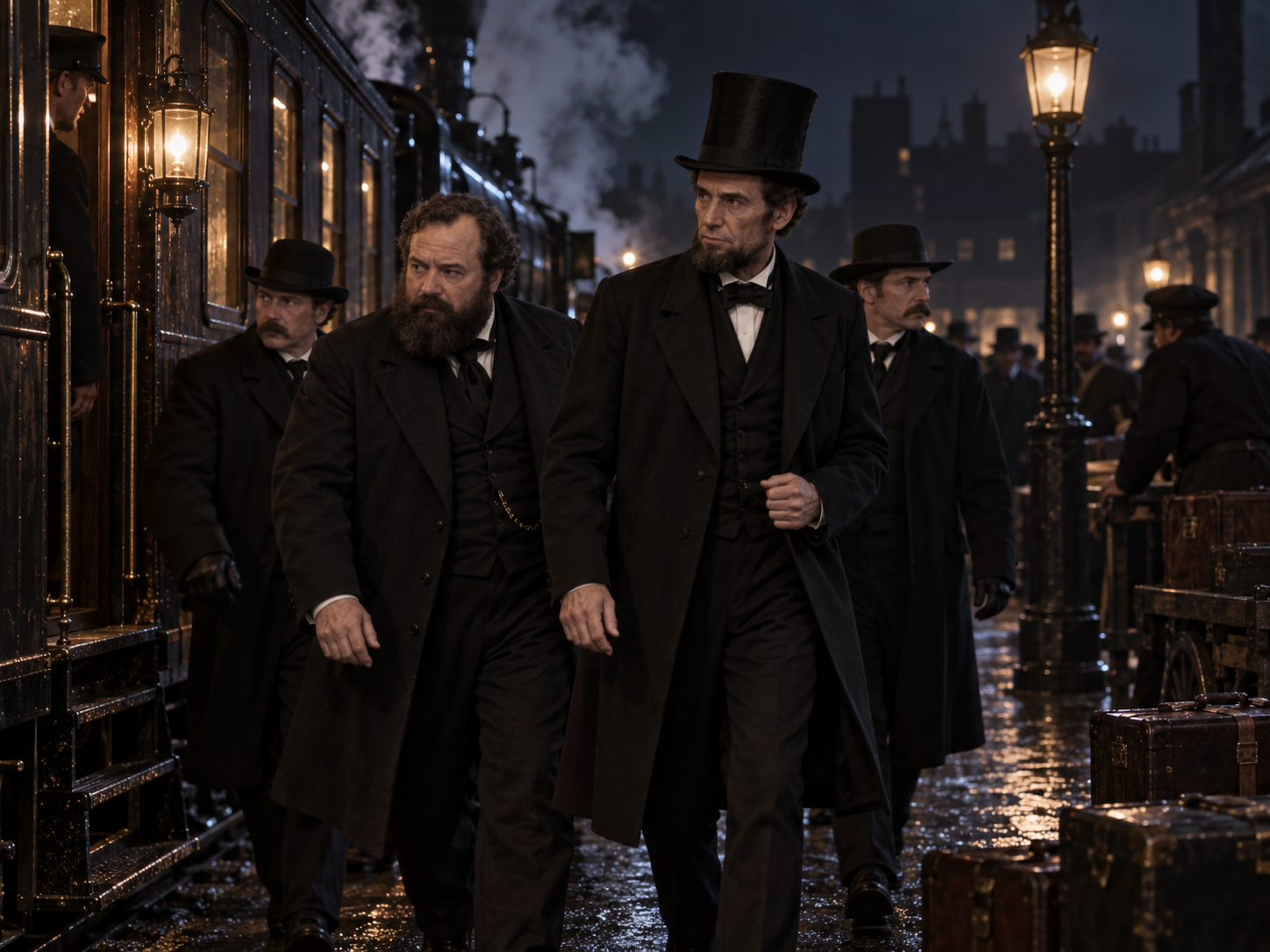
LAMON: The warnings were specific enough that men responsible for getting him to Washington believed the published route created an opportunity for an attack. The president-elect was expected to arrive at one station, cross the city, and continue from another. The time and place were known. He did not like the idea of changing his plans because he did not want to appear frightened, but the concern was no longer something we could simply ignore.
Pinkerton’s investigation was not the only warning reaching Lincoln. Frederick Seward also carried a separate warning associated with his father, William Seward, and General Winfield Scott. Whatever uncertainties remain about the exact size and organization of the alleged conspiracy, separate streams of information were pointing toward danger at a known vulnerability in the itinerary.
PARKER: Mr. Lamon, when separate warnings pointed toward the same movement through Baltimore, what did you believe had to happen to the original plan?
LAMON: And so the itinerary changed.
PARKER: Was changing the itinerary the point at which the warning became an actual protective decision rather than simply information you had received?
Lincoln completed public commitments in Pennsylvania, then returned quietly to Philadelphia and continued toward Washington by a different plan. Lamon accompanied him. Pinkerton and Kate Warne were involved in the intelligence, logistics, and movement. The scheduled exposure in Baltimore was reduced, information about the movement was restricted, and the president-elect reached Washington safely.
No gunfight followed. No dramatic arrest was required. No heroic close-protection response made the newspapers.
That does not make the operation a failure. It is what prevention looks like when it works.
A Successful Protective Operation May Look Uneventful
PARKER: Mr. Lamon, if the route was changed because of serious warnings and no attack then occurred, did the absence of an attack mean the warning had been exaggerated?
LAMON: We did not need to know every man who might have been involved. We needed to decide whether putting Mr. Lincoln through the expected movement was worth the risk.
PARKER: Once you decided the original movement created too much risk, what did you actually change about the way Lincoln traveled?
LAMON: We changed the timing and the manner of the movement. We limited who knew the plan, reduced his public exposure, and kept trusted people with him until he reached Washington.
This is why threat assessment and protective intelligence cannot be treated as paperwork separate from operations. Information has value only when it affects a decision. A credible assessment may change staffing, routes, transportation, site control, observation positions, coordination, arrival time, public access, or instructions to the principal.
Baltimore mattered because the intelligence changed the plan.
The Price of Protection: Lincoln Did Not Want to Look Afraid
The altered trip to Washington brought political ridicule. Newspapers and cartoonists mocked Lincoln for traveling secretly. That response affected him because his security decisions were never only security decisions. He was a president-elect trying to project steadiness while the nation was approaching civil war.
PARKER: Did he understand the danger, or did he simply think all of you were overreacting?
LAMON: He understood that people were angry enough to threaten him. What he resisted was allowing those people to determine how he behaved. He disliked the appearance of fear almost as much as he disliked the restrictions themselves.
PARKER: How did Lincoln’s public role, personal habits, political judgment, and tolerance for security affect what you could realistically do to protect him?
LAMON: That was the difficulty. You could show him the danger and still have another argument about the remedy.
That problem has not disappeared. A modern principal may accept that risk exists but reject a recommendation because it interferes with the mission, schedule, public image, family life, business practice, political obligations, or personal freedom. The protection team cannot solve that problem by simply declaring the principal unreasonable. It must understand what the principal is trying to accomplish, explain consequences clearly, create workable options, and preserve as much safety as possible without unnecessarily destroying the mission.
Protection succeeds through cooperation, not domination.
The White House: Security Around the Building, Security Around the Man
 PARKER: Mr. Crook, by the time you entered the White House guard in January 1865, the country had already spent nearly four years at war. Was the president surrounded by a formal system by then?
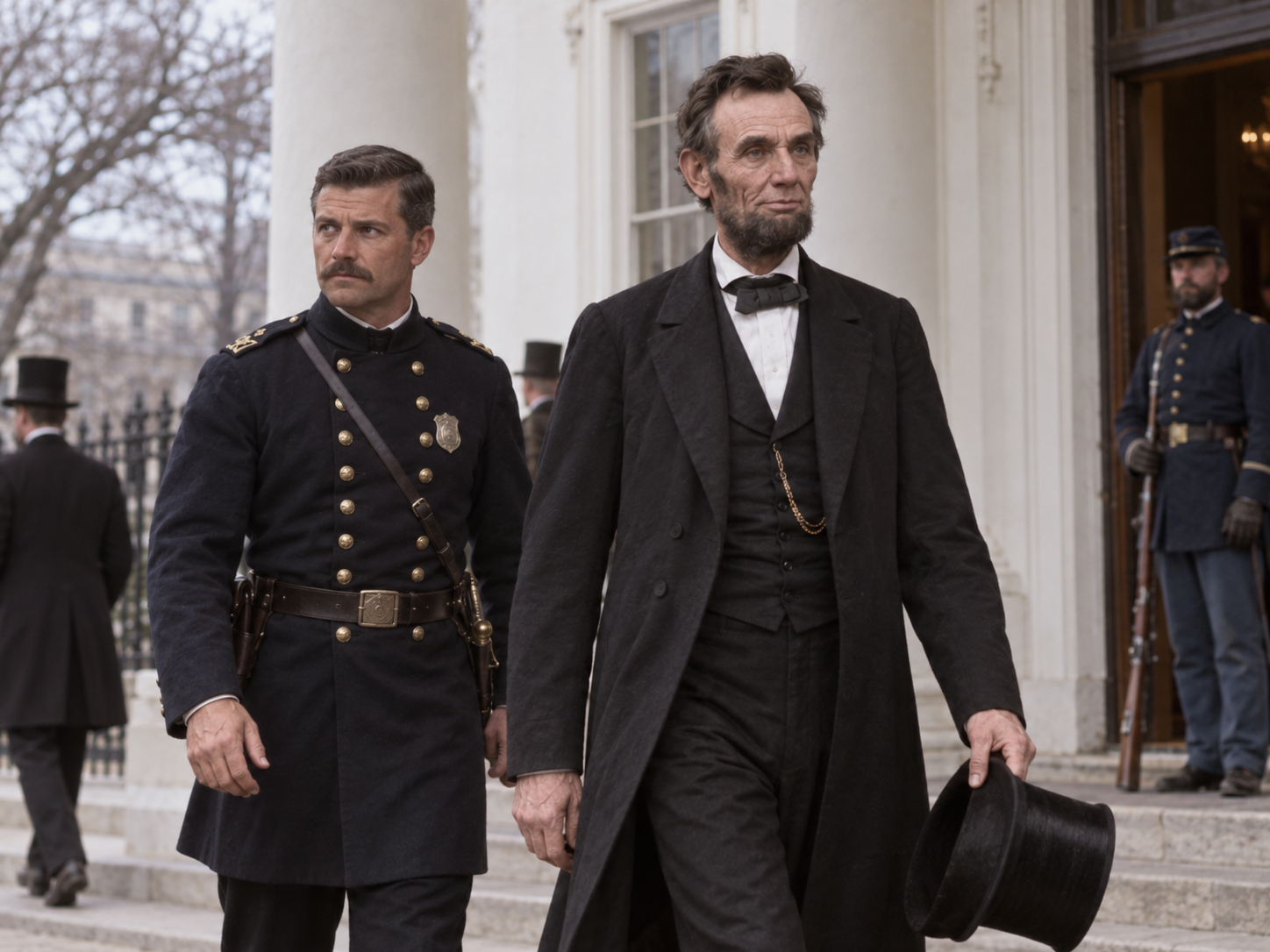
CROOK: There was more security than people sometimes imagine. Soldiers had guarded the White House. Cavalry escorted the president. Police officers were assigned to the house and to him. But no, it was not a single service with the kind of authority and organization that later generations would expect.
PARKER: Did having guards at the White House mean the president had continuous protection wherever he went, or were those two different things?
CROOK: They were different things. Our responsibility was practical: watch access, stay near him, go with him when he moved, and be ready if something happened.
The White House Historical Association records that four to five Metropolitan Police officers were assigned in November 1864 to guard the White House and protect Lincoln following a request by Lamon. Crook joined the protective environment shortly afterward. His later recollections describe duties that modern agents would recognize: guarding the president, accompanying him outside the White House, remaining close during movements, and watching access around him.
The recognizable pieces were there, but the integration was not.
The President Who Resisted Being Guarded
PARKER: What did you learn quickly about President Lincoln as a principal?
CROOK: That he did not like being treated as if every movement required a wall of men around him. He wanted to walk. He wanted to go to the War Department. He wanted to see people. He understood there were threats, but he could be fatalistic about whether anyone could really stop a determined assassin.
PARKER: When Lincoln insisted on walking, seeing people, or attending a theater, how did that affect what you and the other guards had to do? Could protection simply stop him from performing those parts of the presidency?
CROOK: No. He would not have accepted that kind of life. We had to work around the way he believed the presidency should be carried out.
Lincoln’s resistance should not be romanticized, but neither should it be treated as a unique defect. Public officials are expected to remain visible. Elected leaders meet constituents. Judges and prosecutors enter courthouses. Corporate executives visit facilities and speak to employees. Candidates enter crowds because personal contact is part of campaigning.
Protection has to support those functions.
The professional objective is controlled accessibility: reduce unnecessary uncertainty, create distance where possible, establish observation and intervention points, coordinate the site, define who can approach, plan transitions, and understand what conditions would force a change.
Accessibility Is Not the Same as Vulnerability — Unless Nobody Manages It
PARKER: Mr. Crook, when citizens could approach the president with relatively little separation, was accessibility itself the threat?
CROOK: Not every person who approached Mr. Lincoln was dangerous. Most were not. The difficulty was that the president’s desire to see ordinary people made it harder to separate harmless access from dangerous access before someone got close.
PARKER: If most people approaching Lincoln were ordinary citizens rather than threats, what made an approach or a person concerning enough to deserve closer attention?
CROOK: Someone who insisted on getting closer than his business required, ignored instructions, or behaved in a way that did not fit the ordinary flow of callers would naturally draw more attention.
Treating every citizen as hostile would have defeated Lincoln’s political purpose and probably made security less effective by burying real warning behavior in an ocean of false alarms. The goal is not maximum suspicion. It is enough structure to identify what is different before the suspicious person reaches arm’s length.
Two Protectors, One Difficult Principal
The conversation brings Lamon and Crook together. Their experiences sit at opposite ends of Lincoln’s presidency: Lamon traveled with the president-elect during the 1861 warning in Baltimore; Crook guarded the president in the last months of the Civil War.
PARKER: Did either of you find Abraham Lincoln easy to protect?
LAMON: No. He did not want fear deciding where he went or how he appeared before the public.
CROOK: And he expected a degree of freedom that made constant protection difficult. He wanted people to reach him, and he did not like being surrounded.
PARKER: Was the greater problem a lack of concern around Lincoln, or having to protect him within limits he himself was willing to accept?
LAMON: The limits were the greater problem. People around him were concerned, but Mr. Lincoln did not always accept what they wanted him to do.
PARKER: Even if Lincoln had accepted every recommendation, would his cooperation alone have solved the protection problem? What happened when the person who knew him best was away or another officer took the assignment?
CROOK: In our time, much depended on who happened to be there.
That sentence captures the institutional weakness better than any argument about one individual guard.
The Threat Environment Did Not End When the War Was Ending
By April 1865, the strategic picture had changed. Richmond had fallen. Robert E. Lee surrendered the Army of Northern Virginia at Appomattox on April 9. Washington celebrated. The war that had defined Lincoln’s presidency appeared to be reaching its conclusion.
That did not mean the threat to Lincoln was disappearing.
John Wilkes Booth had been involved in a conspiracy that initially focused on kidnapping the president. In April, the plot shifted toward assassination. The final attack plan also targeted Secretary of State William Seward and Vice President Andrew Johnson. Seward was violently attacked in his home. Johnson’s assigned attacker did not carry out his part of the plan.
PARKER: Mr. Lamon, with the war apparently ending in April 1865, would you have reduced protection around Lincoln because the military situation was improving?
LAMON: No. I had worried about Mr. Lincoln for years. Victory did not make every enemy disappear.
For modern protection teams, the same problem appears during transitions. Elections, verdicts, layoffs, prosecutions, military defeats, public controversies, leadership changes, and other major events may reduce one form of danger while intensifying grievance, humiliation, fixation, or desire for retaliation. The end of the most visible phase of a crisis does not automatically justify reducing the protective posture.
April 14: The Missing Men and the Wrong Question
Ward Hill Lamon was not in Washington on April 14. Lincoln had sent him to Richmond on official business. Lamon later recalled warning Lincoln before he left and had long been concerned about the president’s nighttime movements and attendance at theaters.
William H. Crook had been with Lincoln earlier on April 14 but was not the officer assigned to accompany the presidential party to Ford’s Theatre that evening.
That assignment fell to Metropolitan Police Officer John Frederick Parker.
The traditional story often stops there: Parker left the corridor, Booth entered the presidential box, therefore Parker failed and Lincoln died.
The historical record requires more care. The National Park Service notes that Parker’s precise whereabouts at the moment of the shooting remain uncertain and, more importantly, that nineteenth-century presidential security did not operate under the clear modern expectations later readers often project backward. Parker apparently understood himself primarily as a police escort for the presidential carriage, not as a dedicated close-protection agent required to maintain a fixed post outside the box throughout the performance.
His absence remains operationally important because there was no effective protective presence stopping Booth from approaching the box. But a professional after-action review has to ask a larger question.
PARKER: Mr. Lamon, with you in Richmond and Mr. Crook not assigned to the theater, did Lincoln’s protection become too dependent on which individual happened to be present? What does that tell us about the way responsibility was organized?
LAMON: That too much depended on individuals.
CROOK: And that the responsibility was not organized the way it would be today.
PARKER: What should a properly organized protection system have provided so that one officer was never the final protective layer between an assassin and the president?
CROOK: More than one layer, clearer responsibility, and protection that did not disappear simply because one man was somewhere else.
That is a systems question.
Ford’s Theatre: When Prevention Ran Out of Time
A theater created obvious protective challenges even by the standards of 1865. The president would be stationary for an extended period. The venue contained multiple entrances, employees, performers, backstage spaces, corridors, patrons, and routine movement. Lincoln’s attendance was public knowledge. His location inside the building was predictable.
Booth also possessed something especially dangerous: familiarity with the theater. As an actor, he understood the building and could move through it with less suspicion than an unknown outsider.
Once Booth reached the presidential box with a weapon, the protective problem had already collapsed into reaction at very close range.
Modern close-protection training must prepare agents to respond when prevention fails. But the existence of reaction skills does not reduce the importance of everything that should happen earlier. Advance work, access control, credentialing, observation, route and movement planning, liaison with venue personnel and law enforcement, emergency evacuation, medical planning, and control of the immediate protective area are intended to create time and distance before an attacker is within striking range.
The more important protective question is not why Lincoln failed to defend himself after Booth entered the box, but how Booth reached the box with so little resistance.
The Last Question
PARKER: If neither of you knew Booth’s name, the date of the attack, or where an attempt would occur, what would you still change if you could return to the beginning of Lincoln’s presidency with only the experience you had gained?
LAMON: I would make protection less dependent on whether Mr. Lincoln believed a particular warning. He could disagree with a recommendation, but the country should have had a permanent organization responsible for assessing the danger and maintaining the protective system around him.
CROOK: I would make the protection continuous. Not only at the White House and not only when someone believed a specific threat was imminent. The president moved from one environment to another, and the responsibility should have moved with him.
PARKER: How would each of you compare what happened in Baltimore with what happened at Ford’s Theatre? What was different about the way warning information and protective responsibility affected those two events?
LAMON: In Baltimore, the warning changed what we did before Mr. Lincoln reached the danger.
CROOK: At Ford’s Theatre, the protection around the president was not organized with that same continuity.
PARKER: What single principle would each of you leave with modern protection professionals from Lincoln’s case?
LAMON: Yes. No president’s safety should depend on one man being there.
CROOK: And the responsibility should continue wherever the president goes, regardless of who is on duty.
PART II — Protective After-Action Review and Lessons Learned
The Abraham Lincoln bodyguard question is useful for public interest and search, but it is professionally incomplete. Lincoln’s security cannot be understood by identifying one man and assigning him responsibility for the president’s survival. Lamon, Crook, military escorts, White House guards, Metropolitan Police officers, detectives, and other personnel all performed pieces of the mission at different times.
The executive-protection lesson is that those pieces must become a system.
1. Presidential Protection Existed Before Lincoln — but the Mission Was Fragmented
The first permanent White House security force dates to 1842. Franklin Pierce used a full-time bodyguard beginning in 1853. Lincoln was protected at various times by White House guards, military personnel, cavalry escorts, police officers, and trusted associates such as Lamon. By late 1864, Metropolitan Police officers had been assigned more formally to guard the White House and protect the president.
It is therefore inaccurate to say that Lincoln simply had no protection.
The stronger conclusion is that the protective mission remained fragmented. Security around the Executive Mansion, escort duties, military protection, police work, personal loyalty, and threat information were not integrated under a single organization with continuous responsibility for the president wherever he went.
Modern executive protection depends on integration because the principal’s vulnerability moves. A protected residence does not secure the route. A secured venue does not protect the transition from the vehicle. A close-protection agent cannot simultaneously perform intelligence analysis, site advance, transportation security, screening, communications, and emergency medical functions. The protective system has to connect those disciplines so a gap in one layer does not become direct access to the principal.
2. Threat Intelligence Has Value Only When It Changes Operations
The Baltimore movement is the clearest success in the case. Lincoln did not have to know the identity of every suspected conspirator. His team had enough concern, from more than one information channel, to conclude that the published transfer through Baltimore created unnecessary exposure.
The plan changed.
That is the operational purpose of protective intelligence. Assessment should drive intelligence requirements; intelligence should inform risk decisions; and those decisions should change the plan when conditions justify it.
Modern teams should be able to answer a practical question after every significant assessment: What are we doing differently because of what we now know? The answer may involve staffing, route selection, timing, transportation, site control, surveillance detection, observation, access procedures, law-enforcement coordination, family precautions, communications, or instructions to the principal.
If the assessment changes nothing, either the information did not justify a change or the organization has failed to convert analysis into action.
3. Principal Cooperation Is an Operational Variable, Not an Administrative Issue
Lincoln knew threats existed. His resistance was not based solely on ignorance. He disliked being restricted, valued accessibility, worried about appearing fearful, and sometimes expressed fatalistic views about whether a determined assassin could ultimately be stopped.
Those attitudes materially affected the protective mission.
A protection team cannot plan only for the principal it wishes it had. It must plan for the principal it actually has. That means understanding personality, habits, schedule, public role, family requirements, political or corporate mission, tolerance for security, and likely reactions to restrictions.
The goal is not to win an argument with the protectee. It is to produce informed decisions and workable mitigations. Trust matters because a principal is more likely to accept an inconvenient recommendation from a team whose judgment has been consistently professional, discreet, and proportionate.
Lamon’s influence with Lincoln shows the value of that trust. It also shows its limit: personal trust is strongest when it supports an institutional process, not when it has to substitute for one.
4. Accessibility and Public Events Require Controlled Access and Advance Work
Lincoln believed the presidency should remain connected to the public. That belief increased exposure, but accessibility itself is not a security failure. Public officials and executives often need to meet people they do not know personally.
The protection question is how uncertainty is managed before the unknown person reaches the principal.
A modern advance examines entrances and exits, holding areas, credentialing, staff access, adjacent spaces, emergency routes, vehicle placement, medical response, crowd flow, law-enforcement coordination, observation positions, lighting, communications, and the principal’s expected movements. At a theater or similar venue, the immediate protective area around the principal must also be controlled throughout the event rather than only during arrival and departure.
Ford’s Theatre demonstrates why public-event security cannot be reduced to placing one officer nearby. Booth knew the venue, moved naturally inside it, and reached a predictable presidential location. The protective opportunity existed before he opened the door to the box.
5. Redundancy and Continuity Distinguish a Protective System from a Bodyguard
Lamon’s absence in Richmond and Crook’s different assignment on April 14 are important precisely because neither absence should have been decisive.
A professional protective system assumes that individuals will sometimes be unavailable. Personnel rotate. Vehicles fail. Routes close. schedules change. A principal adds an unscheduled stop. A trusted agent becomes sick. An advance agent is delayed. A radio fails. A venue changes an entrance.
The system has to absorb those disruptions.
That requires defined responsibilities, supervision, communication, relief, contingency planning, backup routes, alternate transportation, cross-trained personnel, and clear standards for transferring responsibility from one environment or team to another.
The heroic-bodyguard model asks whether the right person was standing close enough to react.
The systems model asks why the threat was allowed to depend on that final reaction at all.
6. The End of a Conflict Does Not Automatically End the Threat — and Hindsight Must Be Disciplined
April 1865 is a reminder that transition periods can be dangerous. The Confederate military position was collapsing, but grievance, ideological commitment, humiliation, anger, and revenge had not disappeared. Booth’s conspiracy demonstrates how a threat can persist or mutate even as the larger conflict appears to be ending.
Modern protection teams should reassess during transitions: after elections, court decisions, disciplinary actions, terminations, mergers, public controversies, military or political defeats, leadership changes, major announcements, and other events that alter the emotional or operational environment around a principal.
At the same time, an after-action review must resist the opposite error: pretending the final outcome was obvious in advance. We know Booth killed Lincoln. The people making decisions before the attack did not know that future fact.
The professional standard is therefore not, “Why did they fail to predict Booth?” It is, “What information, vulnerabilities, behaviors, resources, and procedures were available at the time, and what changes could reasonably have been made from them?”
That is how history produces usable lessons instead of invented certainty.
Frequently Asked Questions: Abraham Lincoln Bodyguard and Presidential Protection
Who was Abraham Lincoln’s bodyguard?
There was no single person who served as Abraham Lincoln’s exclusive bodyguard throughout his presidency. Ward Hill Lamon is the individual most commonly described as Lincoln’s informal or personal bodyguard because he was a close friend, accompanied Lincoln during the altered 1861 movement through Baltimore, served as U.S. Marshal for the District of Columbia, and repeatedly involved himself in Lincoln’s safety. William H. Crook was a Metropolitan Police officer assigned to White House guard duty during the final months of Lincoln’s presidency. Military personnel, cavalry escorts, police officers, and other officials also performed protective functions at different times.
Was Ward Hill Lamon officially Abraham Lincoln’s bodyguard?
Not in the modern sense of an agent assigned to a permanent presidential protective detail. Lamon was Lincoln’s friend and U.S. Marshal for the District of Columbia, and the U.S. Marshals Service describes him as acting as Lincoln’s personal and unofficial bodyguard. His protective role was genuine, but it was based on a combination of friendship, official position, access, and personal initiative rather than membership in a dedicated presidential-protection agency.
Who was William H. Crook?
William H. Crook was a Washington police officer who entered White House guard service in January 1865 and later remained associated with White House service through multiple presidential administrations. His 1910 memoir, Through Five Administrations, is an important first-person source on Lincoln’s final months. Like other retrospective memoirs, it should be compared with contemporary records and other historical evidence rather than treated as infallible.
Did the White House have security before Abraham Lincoln?
Yes. The White House Historical Association identifies an auxiliary guard established on August 23, 1842, as the first permanent White House security force. During Franklin Pierce’s presidency, Thomas O’Neil served as a full-time personal bodyguard. Lincoln therefore inherited an evolving security system rather than beginning presidential protection from nothing.
Was the Baltimore Plot real?
There is strong historical evidence that serious warnings about a possible attack caused Lincoln’s travel plan to change. Allan Pinkerton’s investigation produced information indicating danger during the Baltimore transfer, while a separate warning reached Lincoln through Frederick Seward from sources associated with William Seward and General Winfield Scott. Historians have debated the exact structure, membership, and maturity of the alleged conspiracy. For executive protection, the key fact is that multiple warning streams converged on a known movement vulnerability and produced a protective decision.
Why did Lincoln travel secretly through Baltimore?
Lincoln’s published itinerary required a predictable transfer between railroad stations in Baltimore. After the warnings were evaluated, the plan was altered to reduce exposure. Lincoln traveled through the city at night under a different schedule with trusted personnel accompanying him and reached Washington safely on February 23, 1861.
Did Abraham Lincoln resist security?
Yes. Historical accounts consistently describe Lincoln as reluctant to accept extensive protective restrictions. He valued accessibility, disliked appearing afraid, resisted turning the White House into an armed camp, and could be fatalistic about assassination. That did not mean he was unaware of threats. It meant the protection team had to work with a principal whose tolerance for security was limited.
Why was the Secret Service not protecting Lincoln?
The Secret Service was not yet a presidential-protection agency. Lincoln authorized its creation on April 14, 1865, and it began operations in July 1865 with a mission focused on suppressing counterfeiting. A continuing Secret Service role in presidential protection developed only after President William McKinley was assassinated in 1901, with federal funding and legal authority expanding afterward.
Was John Frederick Parker responsible for Lincoln’s assassination?
It is too simplistic to make Parker solely responsible. He was the Metropolitan Police officer assigned to escort the president to Ford’s Theatre, and the absence of effective security outside the presidential box is an important operational failure. However, the National Park Service notes that Parker’s precise whereabouts are uncertain and that no clear policy defined the kind of fixed close-protection responsibility modern readers often assume he had. The larger failure was systemic: fragmented responsibility, weak redundancy, limited site control, and no permanent organization integrating the presidential-protection mission.
What does Ford’s Theatre teach modern executive protection teams?
A public venue must be treated as a complete protective environment. The principal’s location, public access, staff movement, adjacent spaces, entrances, exits, emergency routes, transportation, medical response, communications, and local-law-enforcement coordination all matter. Close protection is only one layer. If an attacker reaches the principal at arm’s length, most preventive opportunities have already passed.
How does the Lincoln case connect to ISA and EPTraining.us executive protection training?
ISA uses historical case studies to show why executive protection disciplines cannot be taught or operated in isolation. Threat assessment should inform protective intelligence; intelligence should shape operational planning; planning should affect advance work, site security, access, movement, transportation, communications, local coordination, and principal instructions. The Lincoln case gives students a clear comparison between individual courage or loyalty and a protection-in-depth system designed to continue functioning when circumstances change.
The Bottom Line
Abraham Lincoln was not unprotected. He was incompletely protected by a system still evolving toward the modern idea of presidential protection. That distinction changes the lesson. The first permanent White House security force existed before Lincoln, Franklin Pierce had already used a full-time personal bodyguard, and during Lincoln’s presidency soldiers guarded the Executive Mansion, cavalry units escorted him, police officers were assigned to protect him, friends such as Ward Hill Lamon pressed him to accept greater precautions, and officers such as William H. Crook performed recognizable protective duties.
What remained missing was an integrated organization with continuous responsibility for the president across intelligence, planning, movement, sites, access, transportation, communications, emergency response, and close protection. Baltimore demonstrated what could happen when threat information changed the operation: the team identified a predictable exposure, altered the plan, restricted information, reduced public visibility, and moved the president-elect safely through the threatened area. Ford’s Theatre demonstrated the opposite problem. A highly visible principal entered a predictable public venue while responsibility remained fragmented and heavily dependent on the individuals present that evening. Once Booth reached the presidential box, the problem had already become a close-range emergency.
For ISA and EPTraining.us, the central lesson is not that Lincoln needed one better bodyguard. Protection must be organized as a system around the principal and the mission. Assessment must drive intelligence; intelligence must change planning; and planning must shape access, site control, movement, transportation, staffing, communications, coordination, and contingency response. The system must also survive the absence of any one agent.
Lincoln’s personal philosophy made him extraordinarily difficult to protect because he believed accessibility was part of both his character and the presidency. Modern technology and protective doctrine have changed, but the professional question has not: How do you protect a principal who believes remaining accessible is part of who he is and part of the job he was chosen to do? That is not merely a question from 1865. It is still the work.
Related EPTraining.us Resources
- Executive Protection Training Syllabus — Current ISA course structure, learning outcomes, and protective-operations curriculum.
- Dignitary and Executive Protection Specialist Course — Program information for law enforcement, military, corporate-security, public-safety, and private-sector protection professionals.
- Executive Protection Training: Mastering the Threat Assessment Process — ISA’s approach to turning threat assessment and protective intelligence into operational decisions around the principal.
- ISA Executive Protection Training Standards — ISA’s approach to measurable standards, regulatory alignment, curriculum design, and performance-based protective-service training.
- Defending Democracy Initiative: Protecting Public Officials — ISA analysis of threats, intimidation, political violence, and protection for elected officials and other public servants.
- About Independent Security Advisors — Background on ISA, its training division, and development of its executive-protection programs.
Sources and Historical Notes
- National Park Service — The Baltimore Plot — Historical overview of the warnings, Pinkerton investigation, Frederick Seward’s separate warning, Lamon’s role, and Lincoln’s altered movement to Washington.
- National Park Service — FAQ: The Assassination — Ford’s Theatre historical guidance on Lincoln’s security, John Frederick Parker, Lamon’s absence, and the limits of nineteenth-century presidential protection.
- White House Historical Association — Guarding the White House — Timeline covering the 1842 permanent guard, Franklin Pierce’s full-time bodyguard, Civil War White House security, military escorts, and the 1864 Metropolitan Police assignment.
- U.S. Marshals Service — Ward Hill Lamon — Government history of Lamon’s friendship with Lincoln, Baltimore role, U.S. Marshal service, protective concerns, and absence in Richmond on April 14, 1865.
- Library of Congress — Recollections of Abraham Lincoln, 1847–1865, Ward Hill Lamon — Public-domain digitized edition of Lamon’s recollections.
- Library of Congress — John G. Nicolay Papers: Related Resources — Bibliographic reference for William H. Crook’s Through Five Administrations: Reminiscences of Colonel William H. Crook, Body-Guard to President Lincoln.
- National Archives — Appendix 7: A Brief History of Presidential Protection — Historical development of presidential protection before and after Lincoln.
- National Archives — Records of the U.S. Secret Service — Archival history of the Secret Service’s 1865 establishment and original anti-counterfeiting mission.
- White House Historical Association — Secret Service and the Presidents — Overview of the later evolution of Secret Service presidential protection.
About Independent Security Advisors, EPTraining.us, and Defending Democracy
Independent Security Advisors LLC (ISA) operates EPTraining.us, a U.S.-based executive protection training program serving law-enforcement, military, public-safety, corporate-security, and private-sector protection professionals. ISA training connects threat assessment, protective intelligence, mission planning, advance work, protection in depth, physical security, movement, communications, legal and ethical responsibilities, medical response, and performance-based evaluation so students learn to see protective operations as one integrated system rather than a collection of unrelated skills.
ISA’s Defending Democracy Initiative applies that same system-based approach to the protection problems facing elected officials, judges, prosecutors, candidates, election personnel, and other public servants. Abraham Lincoln’s case is historically unique, but the operational problem remains familiar: protection must preserve the principal’s ability to perform a legitimate public mission while reducing the opportunities that threats can exploit.
Publisher: Independent Security Advisors LLC / EPTraining.us