
 E-mail us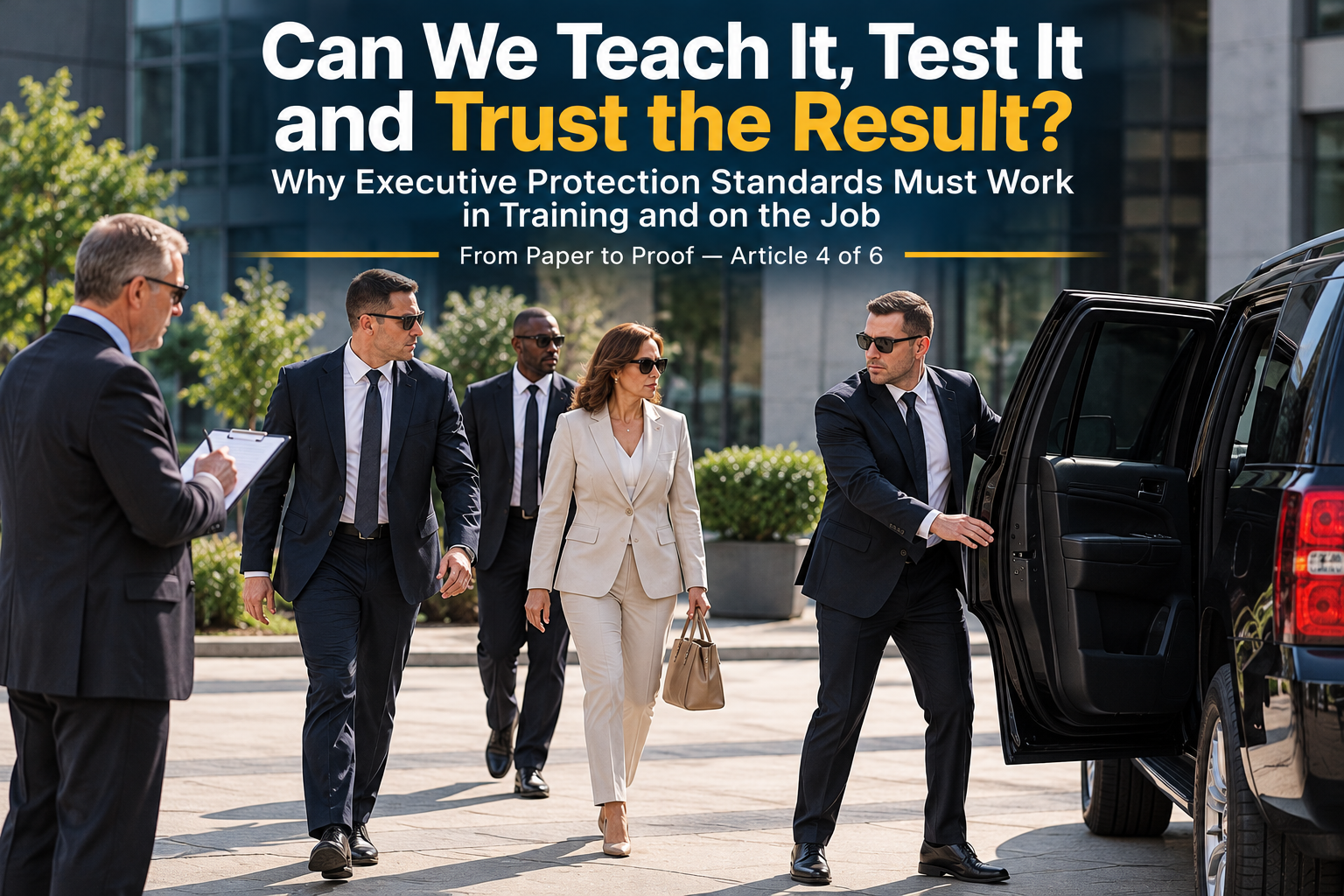
Can We Teach It, Test It, and Trust the Result?
Why Executive Protection Standards Must Work in Training and on the Job
From Paper to Proof — Article 4 of 6
By Matthew C. Parker
Chief Executive Officer, Independent Security Advisors LLC (ISA)
Director of Training, EPTraining.us
Abstract
Executive protection standards must address actual protective duties and be clear enough to teach, test, and apply. This article examines the responsibility of standards developers to explain why a requirement is necessary, what agents must do to meet it, and how compliance can be measured. Drawing on established military and law-enforcement training methods and ISA’s experience developing executive protection courses, Matthew C. Parker proposes a practical review of written standards involving qualified instructors and independent evaluators.
Bottom Line Up Front
A professional executive protection standard must be clear enough to teach, test, and apply. Before training organizations are expected to follow a new requirement, its developers should be able to explain why it is necessary, what protective duty it addresses, and how compliance will be measured. A requirement that is easy to teach and test is not necessarily a requirement that belongs in a professional standard.
A Standard Has to Work
I have spent much of my professional career developing instruction, supervising instructors, and evaluating students. My experience includes military instructional programs, law-enforcement training, and the development of ISA’s executive protection curriculum. During that time, I have encountered requirements that looked reasonable on paper but created problems when we attempted to use them in training.
Sometimes the language was unclear. Sometimes the requirement failed to explain what students were expected to accomplish. In other cases, it did not account for the conditions under which the student would eventually work.
These problems become apparent when instructors prepare lessons, develop practical exercises, or attempt to evaluate performance. The instructor has to decide what to teach and how to determine whether the student performed the task correctly.
The organizations developing new executive protection standards have undertaken substantial work. I recognize the value of reviewing professional practices, consulting experienced practitioners, and reaching agreement on written requirements. However, approving the wording of a standard is different from determining whether its requirements can be taught, tested, and applied during protective operations.
I am not suggesting that the developers conducted no testing. I am asking what testing was conducted, what was measured, and what the results established.
These are important questions because training organizations may eventually be expected to build courses around those requirements. Before that happens, we should know whether the requirements address actual protective duties and whether qualified instructors can apply them consistently.
From Written Standards to Actual Training
We have already discussed how executive protection courses are developed and how ISA uses Instructional Systems Design. Now consider what happens when an organization publishes a new professional standard and expects training providers to follow it.
Suppose a standards committee decides that executive protection agents should wear brown shoes with a brown belt. Why? What protective duty does that requirement address? Was it based on operational experience, research, or testing? What evidence shows that wearing those particular colors improves an agent’s ability to protect a client?
I can teach a student to wear matching shoes and a belt. I can include the requirement in the syllabus, write a lesson plan, and examine whether the student complied. But what have I accomplished? I have demonstrated that the student can follow a dress code. I have not demonstrated that the requirement improves executive protection.
That is the difference between writing a requirement and establishing that it belongs in a professional standard. A requirement may be easy to teach and test without having any demonstrated value to protective operations. If a dress requirement serves a legitimate purpose, the standards developers should be able to explain that purpose and provide supporting evidence.
Now consider a standard requiring protective personnel to conduct an advance before a principal visits a location. This concerns an established protective duty. However, the written requirement still needs to tell us what is expected. Must the agent inspect the location, identify security concerns, examine arrival and departure arrangements, and prepare an advance report? Which tasks are mandatory, and how do we determine whether they were completed properly?
Once those requirements are clear, I can develop the necessary training. The curriculum identifies what students must learn, the syllabus lists the subjects, and the lesson plans guide the instructors. Written examinations can test the student’s knowledge, while practical exercises allow us to determine whether the student can perform the work. The training objectives and evaluations must be based on what the standard actually requires.
There is also a difference between a requirement directed at an individual agent and one directed at the protective organization. We can test whether an agent can conduct a protective advance. If the standard requires an organization to establish written procedures for conducting and approving advances, we must examine the organization’s procedures and records. These are different responsibilities and cannot be evaluated in the same way.
If the standards developers have not identified the required tasks, explained what satisfactory performance looks like, or tested whether qualified people can apply the requirement consistently, they leave important decisions to individual schools and instructors. One instructor may teach and test something entirely different from another while both claim to follow the same professional standard.
This is why I believe standards developers must do more than agree on the wording of a document. They should establish why each requirement is necessary, identify the protective duty it addresses, and determine whether it can be taught and evaluated. The wording itself is also important. An instructor must know whether a statement establishes a mandatory requirement, recommends a practice, permits an action, or simply provides information.
ISO provides useful guidance on those distinctions.
Requirements, Recommendations and General Information
The International Organization for Standardization (ISO) distinguishes requirements, recommendations, permissions and statements of possibility through specific terms.
Shall — Requirement
“When a planned movement changes, protective personnel shall notify the team members designated in the protective communications plan before the revised movement begins, except when the plan’s emergency procedures apply.”
This establishes an obligation. An instructor can develop an exercise involving a change to a principal’s movement schedule, and an evaluator can determine whether the required notification occurred.
Should — Recommendation
“Protective personnel should obtain acknowledgment of routine movement-change messages from designated recipients.”
This recommends a practice without making it a universal condition of compliance. A recommendation may be appropriate when circumstances, equipment or operational procedures differ.
May — Permission
“The protective team leader may designate another authorized team member to relay routine movement-change information.”
This permits delegation without requiring it in every situation.
Can — Possibility
Radio reception can be affected by building construction, underground parking facilities, terrain and other obstructions. Protective personnel need to understand these limitations when planning communications and preparing contingency procedures.
Knowledge of equipment limitations supports operational planning. Training objectives and assessments establish what students must demonstrate when applying that knowledge.
These terms help instructors understand what a standard requires. They also help evaluators distinguish between mandatory duties and recommended practices.
But even a perfectly written mandatory requirement still needs a sound reason for being included in the standard. We can test whether an agent followed a rule. We must also establish whether that rule serves a legitimate protective purpose.
That is why I believe proposed professional requirements should be examined by qualified instructors and experienced practitioners before schools are expected to teach them.
From ANSI Approval to Practical Application
On June 8, 2026, an executive protection standard developed by a private standards organization received approval as an American National Standard. That approval followed ANSI’s established process for developing voluntary consensus standards.
As discussed earlier in this series, ANSI reviews the standards-development process. Its Board of Standards Review does not evaluate the technical content of the standards it approves. That leaves an important question for those of us responsible for training executive protection agents. How do we take the published requirements and turn them into instruction, practical exercises, and examinations?
A professional standards document may contain requirements, recommendations, and useful information. An instructor can teach all three, but they serve different purposes. Explaining a recommended practice is not the same as testing an agent against a mandatory requirement.
I would welcome information from standards developers about any practical testing conducted before publication. Were the requirements given to qualified instructors? Could those instructors develop measurable training objectives? Did independent evaluators agree on what constituted satisfactory performance?
These are not criticisms of the consensus process. They are questions about how the finished standard can be used by training organizations, protective personnel, and employers.
I believe the next step is to select several requirements and examine them through practical instruction and evaluation. We have the instructors, training methods, and experience needed to conduct that work. The review should not stop with the original wording. Protective duties, equipment, and operating conditions change, and standards must be reviewed as those changes occur.
When Technology Changes, Training Must Change
The American Automobile Association (AAA) provides a useful example of how established training changes over time.
AAA published Sportsmanlike Driving in 1935. Driver instruction during the middle of the twentieth century addressed vehicles and equipment that differed from those found in many modern automobiles, including manual transmissions and conventional braking systems.
Today’s AAA How to Drive curriculum addresses modern vehicles and their safety technologies. Manual-transmission instruction remains useful for people who operate those vehicles, but it is no longer an essential part of every driver’s basic instruction.
The objective remains preparing people to drive safely. What students need to learn changes as vehicles, equipment, and operating conditions change.
Executive protection training faces the same responsibility. ISA began demonstrating the operational use and potential threat of drones in its training in 2015. At that time, unmanned aircraft were becoming more accessible, and their use presented concerns that protective personnel needed to understand.
ISA subsequently expanded its drone-related instruction and practical demonstrations, including training for law-enforcement personnel. Developments in Ukraine have reinforced the importance of understanding how unmanned aircraft can be used for surveillance and attacks.
Professional standards require similar attention. A requirement should not remain in place merely because it appeared in an earlier edition. When protective duties change, the requirement should be reviewed and updated when necessary.
We already have established methods for reviewing and improving professional training. There is no need to invent a new process simply because we are examining executive protection standards.
Established Methods for Evaluating Training
The Army, FLETC, and state law-enforcement training programs have been developing and evaluating training for decades. Their methods are well established. They identify what personnel need to do, teach those skills, and test whether students can perform them.
For example, if we teach protective formations, students must demonstrate those formations. If we teach protective advances, students must conduct an advance and prepare a report. A written examination alone cannot establish that a student can perform either task.
The FLETA Procedures and Standards Manual, 2025 Edition, reinforces this approach. It calls for training based on actual job duties, testing, qualified instructors, and periodic review. It also requires feedback on how graduates perform after training. These are principles ISA has followed in developing and reviewing its courses since 2011. ISA does not claim FLETA accreditation.
Virginia provides another example. Its 32E Personal Protection Specialist entry-level training requires five practical exercises and a comprehensive written examination. The state establishes the requirements, while qualified instructors determine how best to prepare students to meet them.
We can apply the same approach to proposed executive protection standards. Select a requirement, determine whether it addresses an actual protective duty, and have qualified instructors teach and test it. If the requirement is unclear, impractical, or cannot be evaluated consistently, we need to identify the problem and correct it before recommending its adoption.
Putting the Requirements to a Practical Test
I would begin by selecting a limited number of proposed executive protection requirements covering essential duties such as communications, advance planning, and risk assessment. We do not need to examine an entire standards document at once. A few carefully selected requirements would provide a reasonable starting point.
Before preparing an exercise, I would want to establish that the requirement addresses an actual protective duty. Experienced agents, instructors, and training managers could review it alongside existing training materials, operational procedures, and applicable regulations.
Once we establish that the requirement is appropriate, qualified instructors could determine how to teach it and how to test performance. Independent evaluators could then observe the exercises and determine whether students performed the required tasks correctly.
This could be accomplished during a controlled working session with several qualified instructors and evaluators. We would not need to send the requirement to several schools or create a new national training program.
Testing a Protective Communications Requirement
Consider the communications requirement discussed earlier.
Suppose the standard requires protective personnel to notify designated team members when a principal’s planned movement changes. We could develop an exercise in which the principal’s departure time or destination changes shortly before movement.
The student would receive the new information and be expected to notify the appropriate members of the protective detail. The instructor would prepare the exercise around the written requirement, including any exceptions that apply during an emergency.
Before the exercise, the evaluators would establish what constitutes satisfactory performance. They would identify who must be notified, when the information must be transmitted, and what the student must do to complete the task correctly.
Each evaluator would observe the exercise and record the results independently. Only after the evaluations were completed would they compare their findings.
If the evaluators disagree, we would examine the reason. Perhaps the requirement was unclear. Perhaps the exercise did not provide enough information. The scoring instructions might also need correction.
We would document those problems, make the necessary changes, and conduct the exercise again.
I would also ask the instructors whether the written requirement provided enough information to prepare the lesson and exercise. If experienced instructors interpret the same requirement differently, the standards developers need to know that.
But agreement among instructors and evaluators is not enough. We must also establish that the requirement is appropriate for the type of protective operation involved.
A large government protective detail may have staffing, equipment, and authority that a privately employed agent does not. We must account for those differences when deciding whether a requirement is suitable for general use.
The purpose is not simply to get students through an exercise. We want to know whether the requirement is necessary, whether instructors can teach it, and whether independent evaluators can agree on the results.
When problems are found, they should be documented and corrected. That information would help standards developers improve their work before asking the profession to adopt it.
Even a successful practical exercise, however, does not answer every question. We also need to consider how graduates perform when they are assigned to actual protective duties.
The Test Does Not End at Graduation
A student may pass a written examination or practical exercise and later have difficulty performing the same task during a protective assignment. This is one reason I believe training programs must consider what happens after graduation.
Consider a student who successfully completes a protective-advance exercise. During training, the student identifies the security concerns, prepares arrival and departure arrangements, and submits an acceptable report.
Later, while working on a protective detail, the same agent may prepare an advance report that leaves out important information. That deserves attention. We need to determine whether the problem came from the training, the agent’s experience, or the conditions under which the assignment was conducted.
Sometimes additional training may be necessary. In other cases, the agent may lack the equipment, staffing, or support needed to complete the assignment properly. These are different problems and should not be treated as though they have the same solution.
Feedback from graduates, employers, and supervisors can help training organizations identify areas that need improvement. It can also reveal weaknesses in the original standard. A requirement that works during a controlled exercise may be difficult to apply under the conditions of an actual protective assignment.
Protective assignments often involve confidential information, so we must be careful about what is reviewed and disclosed. We can examine whether an agent performed an assigned task properly without unnecessarily identifying the client or revealing sensitive security arrangements.
Employers should also understand what a graduate was taught and tested on. A certificate of completion does not explain which practical exercises the student performed or how those exercises were evaluated. Training records can provide that information.
The same principle applies to professional standards. We should examine whether the requirements are useful to instructors, students, and employers and whether they remain appropriate for actual protective assignments.
A student passing an examination establishes what the student demonstrated during that examination. It does not establish that every requirement is suitable for the profession or that the student will always perform correctly on the job.
That is why testing, graduate feedback, and periodic review must be part of the process.
An Invitation to Test the Requirements
I have previously offered to share ISA’s curriculum-development experience, training materials, and records of external training reviews with those involved in developing executive protection standards. I also offered to host a three-day working conference bringing qualified instructors and training managers together to examine proposed requirements.
That offer remains open.
I would welcome participation by standards developers, experienced protective practitioners, law-enforcement training personnel, and qualified private-sector instructors. We could select a limited number of written requirements, examine the duties involved, prepare practical exercises, and evaluate the results.
Several qualified instructors could review the requirements and prepare the instruction. Independent evaluators could observe the exercises, record their findings, and compare their results. When they identify problems, we could document those problems and recommend corrections.
I am not suggesting that every instructor must use identical lesson plans or that every school must teach the same course. The standard should establish the requirement. Qualified instructors should be able to determine how best to teach it.
The conference would not be intended to approve or reject an entire standards document. It would give those developing the standards an opportunity to examine selected requirements with people who have spent their careers teaching and evaluating protective skills.
We already have the experience and training methods needed to conduct this work. We should use them before requiring schools, employers, or protective personnel to rely on standards that have not been examined in practice.
The profession is discussing new standards, training-provider requirements, and professional certification. Before adding those requirements, I believe we should examine the standards themselves.
I am not suggesting that the existing standards have failed. I am asking their developers to show what was tested, what results were obtained, and what those results establish. Where that work has not been completed, we should be willing to conduct it.
ISA is willing to participate in that effort and make its instructional experience and training resources available.
That is how we move from paper to proof.
About the Author
Matthew C. Parker is Chief Executive Officer of Independent Security Advisors LLC (ISA) and Director of Training for EPTraining.us. His professional experience spans more than three decades and includes military service, executive and dignitary protection operations, law-enforcement instruction, international security advising, and protective program development.
Parker is a U.S. Army/Department of Defense Master Instructor. During his military career, he served as a department head at the U.S. Army Chemical Warfare School, where his responsibilities included supervising instructors, developing and reviewing lesson plans, managing instructional programs, and evaluating instructor performance. He also taught military science at Virginia Tech.
Since establishing ISA in 2011, Parker has directed executive protection operations, developed and evaluated professional training programs, and provided protective-security instruction and advisory services in the United States and internationally, including Iraq and Ukraine.
Sources and Related Reading
Standards Development and Interpretation
- American National Standards Institute — Board of Standards Review
- ANSI — Essential Requirements for American National Standards
- Board of Executive Protection Professionals — Standards Development and Approval Updates
- International Organization for Standardization — Foreword and Supplementary Information
- International Organization for Standardization
- Standards Council of Canada
- Health Standards Organization — Standards Development
Training Development and Evaluation
- Federal Law Enforcement Training Accreditation — Procedures and Standards Manual, 2025 Edition
- Federal Law Enforcement Training Centers — FLETC Journal, Spring–Summer 2018
- U.S. Army TRADOC Pamphlet 350-70-14 — Training and Educational Development
- U.S. Army — NCOES Course Redesign at the Soldier Support Institute
- Virginia DCJS — 32E Personal Protection Specialist Entry-Level
- Virginia Administrative Code — 6VAC20-174-300
- Centers for Disease Control and Prevention, Quality Training Standards.
- IntraHealth International, Training and Learning Standards, October 2012.
Training Development and Technology
- AAA — Historical Timeline
- AAA — 90 Years of Driving Education
- ISA — Executive Protection Training Syllabus
- ISA — Executive Protection Training and Drones
- ISA — Drone Training: Keeping Our Word to Our Students
Alt text: Executive protection instructors and independent evaluators observing agents during a practical protective training exercise.
#ExecutiveProtection #ExecutiveProtectionTraining #ExecutiveProtectionStandards #ProtectiveServices #ProfessionalStandards #TrainingStandards #TrainingEvaluation #InstructionalSystemsDesign #FLETA #SecurityTraining #ProtectiveOperations #ExecutiveProtectionCertification #IndependentSecurityAdvisors #EPTraining