
 E-mail us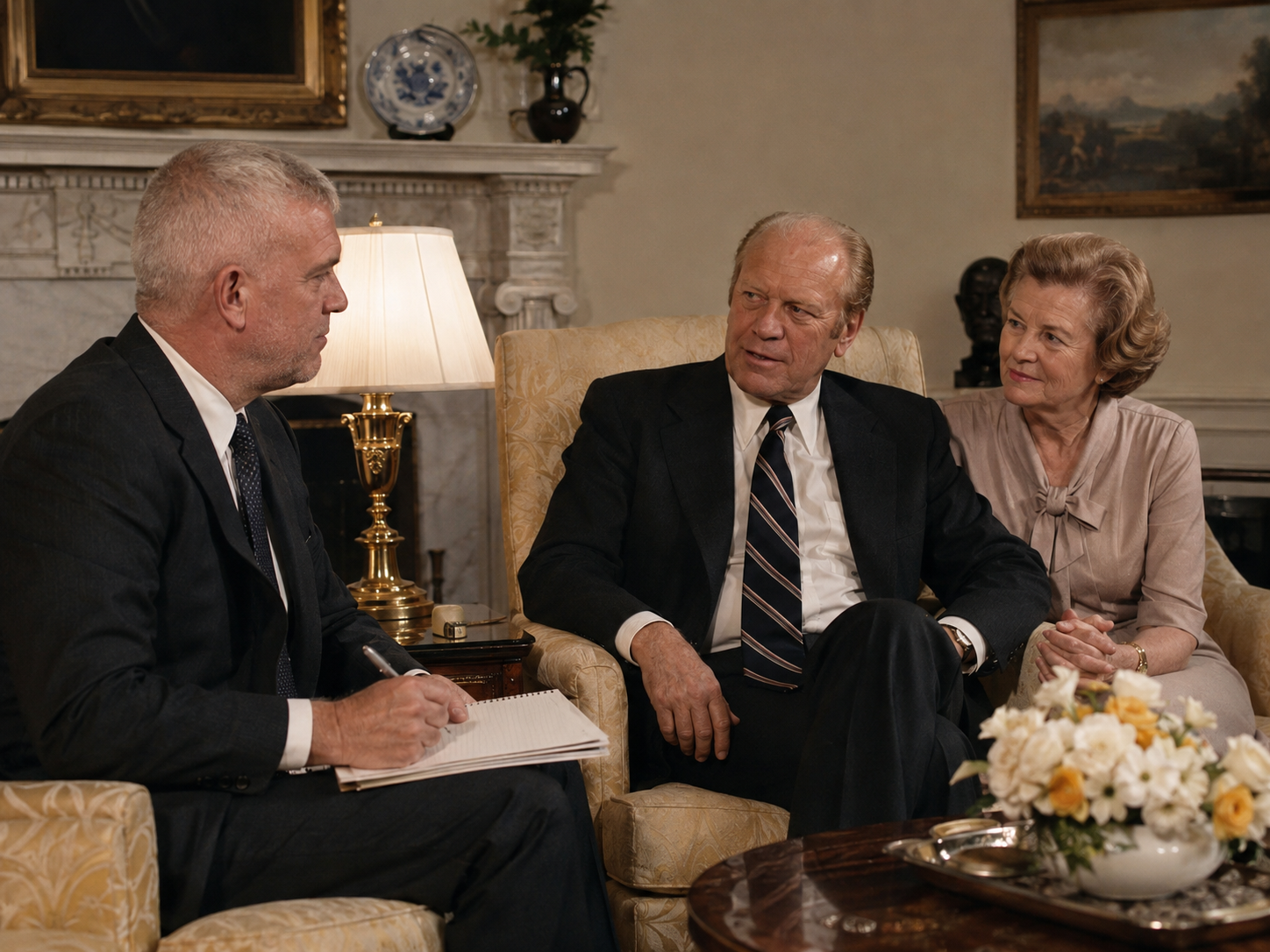
Gerald Ford Assassination Attempts: Matthew Parker in Conversation with President Gerald R. Ford and First Lady Betty Ford
Two assassination attempts, seventeen days, and the question every protection professional should ask: what changed before the next attack?
By Matthew C. Parker
Independent Security Advisors | EPTraining.us | Historical Executive Protection Case Study Series
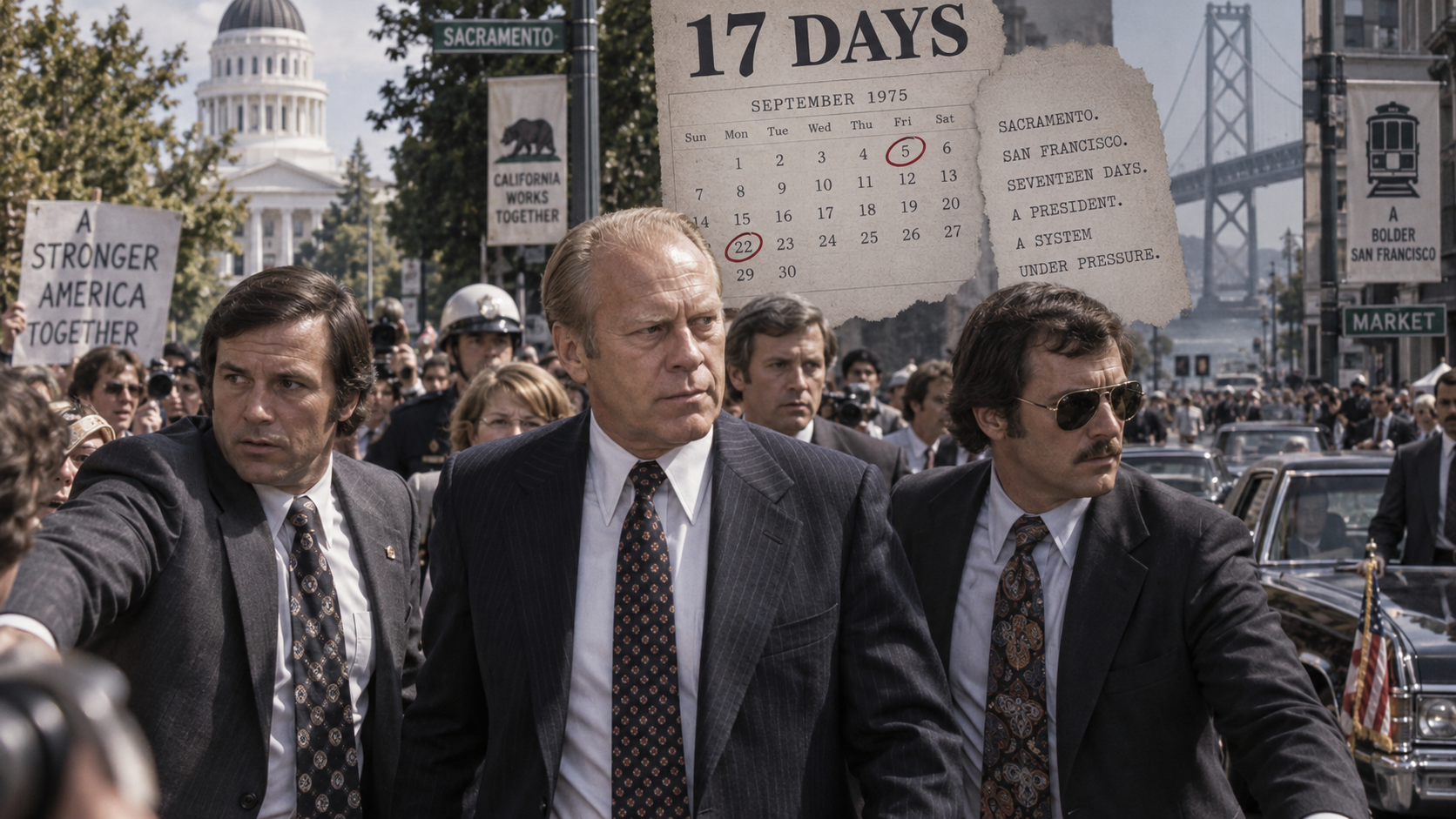
Historical visualization: President Gerald Ford moves through a 1975 public appearance as Secret Service agents maintain close protection. Artistic reconstruction for the EPTraining.us Historical Executive Protection Interview Series; not a historical photograph.
Someone tried to kill President Gerald Ford. The protection system had seventeen days to learn. Then someone tried again. This historical interview and protective after-action review examines what changed between Sacramento and San Francisco – and what modern executive protection should learn from it.
Why This Historical Executive Protection Case Still Matters
Someone tried to kill the President. The protection system had seventeen days to learn. Then someone tried again.
That is what keeps bringing me back to September 1975. On September 5, President Gerald R. Ford walked from the Senator Hotel toward the California State Capitol in Sacramento. Lynette “Squeaky” Fromme stood in the crowd close enough to bring a .45-caliber pistol within roughly two feet of him. Secret Service agent Larry Buendorf reacted at the point where prevention had almost no time left. Investigators later established that the pistol had ammunition in the magazine but no cartridge in the chamber. Ford was moved away, continued his schedule, and publicly said the incident would not stop him from maintaining personal contact with the American people.
Seventeen days later, on September 22, Ford stepped out of the St. Francis Hotel in San Francisco and walked toward his limousine. The protective operation was not identical to Sacramento. The threat environment had changed. The Secret Service had already begun an internal review of the first attempt. Ford had publicly acknowledged that the Service made security recommendations and that he felt an obligation to follow them. At the hotel, White House advance man Bob Goodwin later recalled that the Service specifically asked Ford not to cross the street and work the crowd. Ford accepted the restriction. The movement changed.
Sara Jane Moore still found a position from which she could fire at the President.
For a protection professional, Ford surviving both attacks is the beginning of the analysis, not the end. Sacramento asks what happens when an attacker reaches the innermost protective space before the threat is recognized. San Francisco asks the harder question: after an actual assassination attempt changes the threat environment, how quickly can intelligence, advance work, crowd management, movement, communication, protectee cooperation, and contingency planning change with it?
The case also forces us to deal with the purpose of protection. Ford believed the President had to remain visible and accessible. The Secret Service had to keep him alive. Those responsibilities were not identical, but neither could simply erase the other. Protection could not become an excuse to isolate the President from the Presidency. At the same time, presidential preference could not become the entire risk-management plan.
Betty Ford adds another part of the mission that often disappears from traditional protection histories. An attack does not end when the principal reaches the armored vehicle. Families need confirmed information. Staff must account for people. Communications must continue. Schedules must be reassessed. The principal has to decide how to continue the public mission, while the protection team has to make sure continuity does not become repetition of the same exposure.
Taken together, the seventeen days show protection as it actually exists: not as one bodyguard beside one principal, but as a system that has to assess, communicate, adapt, move, react, recover, and keep the legitimate mission functioning.
Historical Simulation and Editorial Note
This is a historically grounded reconstructed interview, not a transcript of an actual conversation. Gerald and Betty Ford are reconstructed from Ford Presidential Library records, President Ford’s written statements and public remarks, Ford Presidential Foundation oral histories, photographs, contemporary reporting, and later biographical material. The dialogue is used to ask modern executive-protection questions, but it does not invent a briefing, warning, private thought, or intelligence conclusion where the surviving record does not establish one.
Matthew Parker asks the questions. The historical figures answer within the limits of the documented record. Modern protective interpretation is placed in the surrounding narrative and in the Protective After-Action Review rather than being presented as historical testimony from Ford, Betty Ford, or the agents.
President Ford’s reconstructed answers are anchored specifically in his September 5 written recollection of the Sacramento movement, his September 5 public remarks, his videotaped deposition in United States v. Fromme, his September 12 St. Louis interview on Secret Service recommendations and presidential accessibility, his September 22 written account and public remarks after San Francisco, and later interviews in which he discussed presidential risk, public contact, and his relationship with the Secret Service. Where Parker asks a modern protective question Ford did not answer directly in the surviving record, the response is a conservative synthesis of Ford’s documented positions and experience, not a claimed quotation or newly invented historical fact.
Reader Navigation – Choose How You Want to Read This Case Study
This case study is designed for two kinds of readers. Part I reconstructs the human and operational problem through a historical interview. Part II can be read independently by students and practitioners who want the protective findings without reading the full interview.
Case Snapshot: Two Attempts in Seventeen Days
 On September 5, 1975, Ford left the Senator Hotel in Sacramento and walked through a public crowd toward the California State Capitol. In the President’s own written statement, he remembered a woman in a red or orange dress standing in the second row. As he approached, she moved a handgun toward him from about two feet away. Secret Service personnel reacted immediately. A federal court opinion later noted that there was no cartridge in the chamber, although the pistol’s magazine contained ammunition.
Ford did not withdraw from the public schedule. Later that day he praised the Secret Service and said the incident would not prevent him from continuing personal contact with Americans. One week later, in a St. Louis television interview, he drew the balance more precisely: the Secret Service made recommendations and he felt an obligation to follow them, while he still believed Americans should have an opportunity to see their President close-up.
The Secret Service also began reviewing the Sacramento operation. A September 30 Office of Inspection report states that the Director ordered the Offices of Inspection and Training on September 11 to review the advance, security at the Capitol, the attack, the response, and the follow-up investigation. The review was underway before the second attempt.
On September 22, Ford left the St. Francis Hotel in San Francisco. Goodwin later recalled that, about forty-five minutes before the movement, the Secret Service told him it did not like the crowd and asked that Ford not cross the street to shake hands. Goodwin carried the request to Ford, who accepted it. Ford walked toward the limousine and waved across the street instead. Sara Jane Moore fired from the crowd. Ford’s own written account says he heard what sounded like a gunshot, was pushed down, crawled into the limousine at Secret Service direction, and was covered by agents Ron Pontius and Jack Merchant and White House aide Donald Rumsfeld as the car departed.
The Ford Library preserves another part of the story: Betty Ford reached Air Force One without knowing that Moore had fired at her husband. That fact takes the case beyond reaction at the curb. It raises questions about emergency communications, accountability, family notification, and what happens after the principal is physically moving away from danger.
PART I – The Historical Interview
Prefer the operational analysis? Skip the reconstructed interview and go directly to the Protective After-Action Review.
Two Different Memories of the Same Seventeen Days
The reconstructed conversation takes place years after the Ford presidency. Gerald and Betty Ford remember the same month from different positions inside the protective problem: he was the principal in the movement; she was the spouse and protectee who often had to wait for confirmed information.
PARKER: Mr. President, Mrs. Ford, when you look back on September 1975, do you remember the same seventeen days?
PRESIDENT FORD: Not exactly. Sacramento began as an ordinary walk across Capitol Park. I noticed a woman in a bright red or orange dress and stopped because I thought she wanted to shake hands or speak to me. Then a hand came through the front row with a large pistol, roughly two feet away, and the Secret Service moved almost immediately. San Francisco was different. I was only a few feet from the limousine, waved toward the crowd across Post Street, heard what sounded like a gunshot, and was pushed down before I had time to identify who had fired. The two moments felt different, but both went from routine presidential movement to emergency in seconds.
BETTY FORD: I remember waiting. The person in the middle of the event has something to do. The family often has nothing to do except wait for someone to say what happened and whether the person they love is safe.
PARKER: Before Sacramento, how did you understand the relationship between the Secret Service mission and your own responsibility as President?
PRESIDENT FORD: I never thought their mission and mine were identical. I said publicly that the Secret Service made recommendations and that I felt an obligation to follow them. I also believed Americans should be able to see their President firsthand and close-up. After Watergate, that mattered to me. The President has to weigh personal risk against the responsibilities of the office. I was not willing to disclose specific security measures, but I was not willing to let security turn the Presidency into permanent isolation either.
BETTY FORD: That was easier for Jerry to say than for the family after somebody stood close enough to point a gun at him.
Sacramento: When the Weapon Is Already There
Ford’s written account is unusually useful because it fixes the geometry of the moment. He was walking and shaking hands. The crowd was only a few rows deep. He noticed Fromme before the weapon appeared, but nothing about her visible presence had yet separated her from the public the President had come to meet. Then the gun was about two feet away.
PARKER: Mr. President, what do you remember seeing first?
PRESIDENT FORD: What first caught my attention was the woman in the brightly colored dress. I thought she wanted to get closer, so I stopped instead of simply continuing the movement. Then I saw a hand come through the people in front of me with a large pistol in it. In my later testimony I estimated that the weapon was about two feet away. I did not have time to study the person holding it. The Secret Service reaction and my movement began almost immediately.
PARKER: Once Agent Buendorf had to act at that distance, did survival answer every question about the protection plan?
PRESIDENT FORD: What I could say from where I stood was that the Secret Service reacted very quickly and effectively, and I praised them for that the same day. I could not stand in that crowd and certify every intelligence, advance, or crowd-control decision that had been made before the weapon appeared. That is one reason an after-action review matters. Gratitude for the agent who acted and an honest examination of how the situation developed are not inconsistent.
That distinction matters. Buendorf’s reaction deserves recognition. It also occurred after Fromme had already penetrated the distance that every close-protection agent would prefer never to surrender. Praising the reaction and examining the earlier layers are not contradictory.
PARKER: Did the fact that the pistol had no round chambered change the seriousness of the protective lesson for you?
PRESIDENT FORD: No. At the time I did not know the weapon’s mechanical condition. In my later testimony I said I did not recall hearing a click, and I could not say whether her thumb was on the hammer or her finger was on the trigger. What I knew in the moment was that a large pistol was in my immediate space. The later finding that there was no cartridge in the chamber was important evidence, but it did not make the encounter harmless or change what the agents had to assume when they saw the weapon.
Why Ford Kept Moving
Ford continued to the California State Capitol and later made his position public. He praised the Secret Service, rejected the idea that Fromme represented Californians generally, and said he intended to keep meeting Americans. A week later he said the Service made recommendations and that he felt an obligation to follow them, while continuing to defend public access.
PARKER: Why was continuing the schedule so important to you after somebody had just tried to kill you?
PRESIDENT FORD: My reaction that day was fairly simple. Once I saw that the Secret Service had handled the immediate danger, I thought I had better get on with the rest of the day’s schedule. I also said publicly that the incident was not going to prevent me from continuing contact with the American people. A President cannot learn what people are thinking only by remaining in the safety of the Oval Office. Meeting people face to face was part of the job, and I was not willing to let one person with a gun dictate whether the President could continue doing it.
PARKER: Did you see accepting a specific security recommendation as inconsistent with remaining accessible?
PRESIDENT FORD: No. I drew that distinction publicly a week later. The Secret Service made recommendations, and I felt an obligation to follow them, but I also believed the public should have an opportunity to see the President close-up. I did not see those positions as contradictory. A specific concern could justify a specific change in movement or contact without turning every future appearance into permanent isolation.
BETTY FORD: The family may draw that line more cautiously, but I understood what he meant. The office could not stop functioning because we were afraid.
What Changed After Sacramento?
This is the question that makes the Ford case different from most historical assassination studies. There was not a generation between the attacks. There were seventeen days. The Secret Service had already started a formal review. The President had already been forced to reconsider the balance between access and risk. The next public movement happened while the lessons from the first attempt were still being worked through.
PARKER: Mr. President, after Sacramento, did you feel that the threat had moved from something possible to something proven?
PRESIDENT FORD: Yes. I had seen the pistol myself, so the danger could no longer be treated as abstract. For a period afterward I accepted additional protective measures, but I did not change my basic view that a President had to travel, appear in public, and meet people. Years later I said that the danger of assassination was part of the job. The experience made the risk personal; it did not erase the responsibilities of the office.
PARKER: When the Secret Service identified a specific concern in San Francisco, were you willing to let that concern change the movement?
PRESIDENT FORD: Yes. That was consistent with what I had already said publicly after Sacramento: when the Service made a security recommendation, I felt an obligation to follow it. I did not make a practice of describing those measures in public because revealing them could make protection more difficult. If the Service identified a specific problem with a specific crowd or movement, I could accept a change without accepting the idea that the Presidency should withdraw from public contact altogether.
Goodwin’s later oral history documents that exchange. He recalled that the Service disliked the crowd outside the St. Francis, asked him to tell Ford not to cross over and work it, and that Ford answered, “That’s fine.” Goodwin believed the decision may have saved Ford from moving directly toward the position Moore later occupied. His counterfactual cannot be proved. The operational fact can: a concern was identified, communicated to the principal, accepted, and translated into a changed movement.
Sara Jane Moore: Known to Government Is Not the Same as Known Threat
Moore creates a more complicated intelligence problem than Fromme. Before the shooting, she had contacts with federal and local law enforcement, had served as an FBI informant, had been detained by San Francisco police with a handgun the day before the attack, and had been interviewed by Secret Service agents. After the shot, those facts look like a warning chain. Before the shot, they still had to be interpreted.
PARKER: How should we examine a person who was already known to government without pretending that every later fact was obvious beforehand?
PRESIDENT FORD: I would begin with what the people responsible actually knew before the shot, not with everything investigators learned afterward. My earlier service on the Warren Commission had already shown me how much more complete a record looks after an event has occurred. I was not in the San Francisco field office and could not tell you what every police officer or Secret Service agent knew at every minute. The fair question is what information existed, how it was understood at the time, whether it reasonably called for additional action, and whether it reached the people who could act on it.
PARKER: What should matter more to a protection team: the fact that a person appears in a government file, or the behavior, intent, capability, access, and changes that make the information operationally relevant?
PRESIDENT FORD: I would be reluctant to write a Secret Service threat-assessment formula from the President’s chair. A name in a government file, by itself, could not tell me enough. The professionals had to decide whether the information showed a reason to investigate further, watch the person, restrict access, or change the President’s movement. What I would expect afterward is an honest review of whether the information that mattered was assessed properly and reached someone with the authority and time to act.
That is the fair use of hindsight. Moore’s pathway should be studied, but not simplified into the claim that every agency contact automatically made her a clearly identified assassin. The professional question is whether information was collected, assessed, updated, shared, and connected to an operational decision in time to matter.
San Francisco: A Changed Movement, Another Attack
Ford’s written statement places him only a few feet from the limousine when the shot was fired. He had not crossed the street to work the crowd. He waved. Moore fired. Ford was forced down, directed into the car, and covered as the limousine left for the airport.
PARKER: Did San Francisco feel different from Sacramento because you heard the shot before you understood the attacker?
PRESIDENT FORD: Yes. In Sacramento I saw the weapon before the agents moved me. In San Francisco my own statement was that I was only two or three feet from the limousine, I looked toward the crowd and waved, then heard what sounded like a gunshot. Almost immediately I was pushed down and moved toward the car. There was no time for me to identify the shooter or decide what the next movement should be. The agents were already doing that.
PARKER: When an attack is underway, should the principal expect the close agents to ask permission before moving, shielding, or extracting him?
PRESIDENT FORD: No. My own account of San Francisco shows what happened: I was pushed down, directed into the limousine, and covered as we left. Later that evening I thanked the Secret Service for doing what was necessary and essential. In that kind of moment the agents cannot stop to negotiate with the principal. Their responsibility is to act first and explain afterward.
Ford publicly thanked the Secret Service and San Francisco police after the attack. White House records identify Pontius and Merchant in the limousine with him, along with Rumsfeld. The names matter because systems still depend on trained people making decisions at speed.
PARKER: Can we recognize the agents who moved you and still ask what the outer layers were supposed to accomplish before the shot was fired?
PRESIDENT FORD: Yes. I thanked the Secret Service publicly after both attempts because the men around me acted when it mattered. That did not give me personal knowledge of every intelligence, advance, or crowd-control decision that preceded either attack. The Service conducted its own review, and Congress examined protective procedures as well. You can honor the people who performed well and still ask what the system should learn.
Oliver Sipple and the Variable Nobody Can Plan
Oliver Sipple, a former Marine standing near Moore, intervened as she attempted to continue the attack. His action affected the event, but no protective plan can make a helpful bystander one of its required layers.
PARKER: What does a bystander like Oliver Sipple tell us about the difference between a plan and a real incident?
PRESIDENT FORD: I would start with the fact that Mr. Sipple acted quickly and helped avert additional danger. I wrote to thank him for his selfless action. From the President’s standpoint, his intervention was an unexpected act by a citizen in the crowd, not something the detail could have planned. I was grateful for it, but no responsible protection plan can assume that a bystander will be in exactly the right place and act at exactly the right moment.
BETTY FORD: And the consequences can reach the bystander too. Mr. Sipple became part of a national story because he acted in a few seconds.
Betty Ford: The Incident Does Not End at the Limousine
The Ford Library’s September 22 photographs preserve a striking detail: Betty Ford boarded Air Force One and greeted her husband without yet knowing that Moore had fired at him. Goodwin’s oral history describes a similar information gap in the control car, which raced toward the airport without radio contact and without knowing whether the President had been hit.
PARKER: Mrs. Ford, what should a protective organization remember about the family after an attack?
BETTY FORD: That the family needs confirmed information too. Tell them what is known, tell them what is not known, and do not make them learn something that serious from rumor or television if it can be avoided.
PARKER: Is speed more important than accuracy in that first notification?
BETTY FORD: Both matter, but false information can be its own kind of damage. The first useful message is simple: what happened, is he safe, where is he going, and when will we know more?
PRESIDENT FORD: The same problem applies to staff and family. When we returned from California that evening, I said publicly that Betty and I had spoken with all four of our children and that they were relieved we were safe. Getting the principal into the car is essential, but the emergency does not simply disappear when the doors close. The people responsible still have to establish what happened, where the principal is going, who needs to know, and what information has actually been confirmed.
The Protectee Is More Than the Threat
Ford’s presidency also reminds us that executive protection is not only about hostile actors. Months before the assassination attempts, a wet aircraft stairway in Salzburg helped create the public caricature of Ford as clumsy despite his record as a championship-level football player at Michigan. Betty Ford’s breast cancer, her independent public role, and the family’s later confrontation over alcohol and prescription medication each point to a different boundary of the protective mission: agents can reduce certain risks, but they cannot eliminate illness, family crisis, reputation, fatigue, environmental hazards, or every bad decision.
PARKER: Mr. President, should a protection team treat environmental hazards such as wet stairs, poor lighting, fatigue, or a bad surface as real operational risks even when no adversary is present?
PRESIDENT FORD: I can answer that from experience rather than from a security manual. A wet stairway can put a President on the ground without an attacker anywhere nearby; I proved that point in Salzburg. The public may remember the photograph or the joke. The people responsible for a movement still have to treat the surface, weather, lighting, fatigue, and other ordinary hazards as real conditions that can affect the principal.
PARKER: Mrs. Ford, did having your own public positions and schedule change what protection had to understand about you?
BETTY FORD: Yes. The First Lady is connected to the President, but she still has her own work, travel, opinions, and risks. Protection has to understand the person’s mission, not just the title.
PARKER: Did your later recovery experience reinforce the idea that people around a protectee sometimes have to say something the protectee does not want to hear?
BETTY FORD: Yes. Protecting someone does not always mean making the person comfortable. Sometimes it means telling the truth and insisting that a problem be faced.
The Last Question: What Is Protection For?
PARKER: Mr. President, after two attempts in seventeen days, what did you need the people protecting you to understand about the Presidency that could not be learned from a security manual?
PRESIDENT FORD: The President still has to do the job. I said in 1975 that meeting people face to face was an important part of the Presidency, and years later I said I did not change my style after the attempts because a President cannot simply isolate himself in the White House. That did not mean disregarding the Secret Service. I said just as clearly that I felt an obligation to follow their recommendations. The balance I believed in was straightforward: reduce the risks you can, act immediately when danger appears, but do not let the threat take over the responsibilities of the office.
PARKER: Mrs. Ford, what did you need those same agents to remember that the President might not say himself?
BETTY FORD: That the principal is also a person. Somebody is waiting for him. When danger comes, bring him home, and let the family know what you know.
Parker closed the notebook. Betty looked at Ford, then toward Parker.
BETTY FORD: And watch the stairs.
PRESIDENT FORD: I knew that was coming.
PART II – Protective After-Action Review and Lessons Learned
The interview is the human side of the case. The after-action review asks a different question: what should a professional protection team learn from the documented record without reading modern doctrine backward into 1975?
For me, the answer starts with the seventeen-day interval. The first attempt was not simply an event to close out after the principal was safe. It was a trigger event that changed the threat environment while the President continued to travel. The review therefore has to examine what changed between Sacramento and San Francisco, what information existed, what decisions were made, what actually altered the second movement, and which vulnerabilities remained.
1. An Actual Attack Is a Trigger for Reassessment – Not the End of the Incident
Fromme’s approach on September 5 changed the operating environment immediately. The question after a real attack is not only whether the close agent reacted correctly. The team has to reopen assumptions about threat assessment, protective intelligence, advance work, crowd access, route and movement design, transportation, local-law-enforcement coordination, communications, protective equipment, medical contingencies, and protectee behavior.
The Secret Service did begin that process. Its September 30 inspection report states that the Director ordered a formal review on September 11. That matters because it shows the system was not static between the attacks. It also shows the practical difficulty of learning while operations continue: the review was still in progress when Moore fired on September 22.
Modern protection teams do not always get the luxury of completing the report before the next movement. A trigger event should therefore produce immediate interim controls while the deeper review continues.
2. Excellent Close Protection and Incomplete Prevention Can Exist in the Same Event
Buendorf’s Sacramento reaction and the actions of Pontius and Merchant in San Francisco deserve recognition. But successful emergency reaction should not become a reason to stop the analysis. In Sacramento the weapon was already within approximately two feet. In San Francisco a shot had already been fired.
Close protection exists because prevention can fail. It is the final mobile layer around the principal, not a substitute for intelligence, advance work, access control, standoff, route design, observation, and movement planning. The professional objective is to make the close agent necessary as rarely as possible – and decisive when that last layer is all that remains.
3. Protectee Cooperation Is an Operational Capability
Ford was not simply a resistant principal who ignored security. The historical record is more useful than that caricature. He strongly defended public access, but on September 12 he also said the Secret Service made recommendations and he felt an obligation to follow them. Goodwin’s St. Francis recollection shows that relationship working in practice: the Service identified a specific concern, staff carried it to Ford, Ford accepted it, and the movement changed.
That is what good protectee relations are supposed to accomplish. Rapport is not ceremonial. It creates the trust required for a warning to change behavior without turning the protection team into the owner of the principal’s mission. A technically correct recommendation that the principal will not hear, understand, or accept may have little operational value.
4. Protective Intelligence Is About Relevance, Movement, and Decision
Moore is the harder case because she was not invisible to government before the shooting. She had law-enforcement and federal contacts, had acted as an FBI informant, had been detained with a handgun, and had been interviewed by Secret Service agents. None of those facts, standing alone, automatically established that she would attempt to assassinate Ford the next day.
The lesson is not that every person known to an agency should be treated as an imminent attacker. That would overwhelm the system and produce its own legal and operational problems. The lesson is that information has to be continually assessed for behavior, intent, capability, access, change, proximity to the protectee, and the decision it should alter. The protection function needs mechanisms for updating an assessment when new information appears and for moving relevant information to the people who have authority to change the operation.
Protective intelligence is therefore not a database. It is a process: collect, evaluate, compare, update, disseminate, decide, and reassess.
5. Movement Transitions Remain Vulnerable Even After Security Tightens
Both attacks occurred during movement. Sacramento happened while Ford walked through a public crowd. San Francisco happened during the short transition from a hotel door to an armored limousine. The second movement had already been modified because the Service did not like the crowd, yet Moore still had a firing position across the street.
That is why the hotel-to-car movement cannot be treated as a few harmless seconds between two secure places. The advance has to think in three dimensions: crowd location, lines of sight, standoff, vehicle position, door timing, principal exposure, agent positions, local police deployment, alternate exits, observation, and what happens if the movement stops unexpectedly.
Goodwin’s account is particularly useful because it shows a partial success. The team recognized one exposure and changed the plan. The attack demonstrates why reassessment has to continue beyond the first mitigation. Reducing one vulnerability does not prove the movement is now safe.
6. Extraction Is Not the End: Communications, Family, and Continuity Still Matter
After Moore fired, Ford was moved into the limousine and driven rapidly to the airport. Physically, that was the correct direction: create distance and get the principal away from the scene. Operationally, however, the incident continued.
Goodwin remembered racing to the airport in the control car without radio contact and not knowing whether Ford was alive. The Ford Library records that Betty Ford reached Air Force One without knowing her husband had just survived another assassination attempt. These are not side stories. They are part of the protective system.
Emergency movement requires an information plan: principal status, accountability for staff and agents, destination, medical status, family notification, command-and-control continuity, law-enforcement coordination, and the next decision. A principal can be physically removed from the threat while the organization is still operating in informational confusion.
And then comes the hardest continuity question: what does the principal do next? Ford’s answer was to keep governing. The protection team’s job was not to defeat that mission. It was to make the next movement smarter than the last one.
FAQ – Gerald Ford Assassination Attempts and Executive Protection
Were the Fromme and Moore assassination attempts connected?
No credible evidence established that Lynette Fromme and Sara Jane Moore acted together. The protective value of placing the attacks side by side is the seventeen-day timeline: the second attempt lets us examine how a protection system adapts after the first attack has already made the danger real.
Did Fromme’s pistol actually misfire?
The more precise description is that the pistol did not fire because no cartridge was in the chamber. A federal court opinion in the Fromme case noted that the magazine contained ammunition but the chamber was empty. That distinction matters in a professional case study because technical accuracy matters even when it does not change the seriousness of the protective breach.
Did the Secret Service make changes after Sacramento?
Yes. The public record does not support the claim that nothing changed. A Secret Service Office of Inspection report states that a formal review was ordered on September 11. Ford also acknowledged receiving Secret Service recommendations. Goodwin later described a specific change in San Francisco: Ford accepted the Service’s request not to cross the street and work the crowd outside the St. Francis Hotel.
Did Gerald Ford refuse Secret Service protection because he wanted to shake hands?
That is too simple. Ford strongly valued accessibility and accepted risk that protectors would naturally prefer to reduce, but he publicly said he felt an obligation to follow Secret Service recommendations. The operational issue was how to balance access against specific risk, not a simple choice between protection and no protection.
Was Sara Jane Moore already known to government before the San Francisco attack?
Yes. She had prior contacts with federal and local law enforcement and had been interviewed by Secret Service agents before the attack. The fact that someone is known to government, however, is not the same as a validated assessment that the person is an imminent threat to the President. The professional question is how the available information was interpreted, updated, shared, and connected to an operational decision.
Who protected Ford in Sacramento?
Secret Service agent Larry Buendorf is central to the Sacramento account because of his immediate close-range reaction. He later served as special agent in charge of President and Mrs. Ford’s post-presidency detail. His career also illustrates the long-term trust that can develop between a protectee and the people responsible for protection.
Who moved Ford after the San Francisco shot?
Ford’s own written statement identifies Secret Service agents Ron Pontius and Jack Merchant and White House aide Donald Rumsfeld as covering him in the limousine after he was pushed down and directed into the vehicle. Ford later publicly thanked the Secret Service and San Francisco police for their actions.
What role did Oliver Sipple play?
Oliver Sipple, a former Marine standing near Moore, intervened as she attempted to continue the attack. His action affected the outcome, but a protection plan cannot rely on a favorable bystander being in the right place. Helpful chance is not a protective layer.
Why is Betty Ford important to an executive-protection case study about attacks on the President?
Because protection extends beyond the few seconds of physical reaction. The Ford Library records that Betty Ford reached Air Force One without knowing Moore had fired at her husband. That raises operational questions about family notification, confirmed information, staff accountability, spouse protection, and continuity after emergency extraction.
What is the most important modern lesson from the seventeen days?
A changed threat environment must produce a changed assessment and, when justified, changed operations. The goal is not to predict every attacker with certainty or isolate the principal from the mission. It is to integrate intelligence, advance work, access control, movement, close protection, communications, local coordination, family notification, and protectee cooperation early enough that survival does not depend only on the last reaction at arm’s length or after a shot is fired.
The Bottom Line
Someone tried to kill the President. The system had seventeen days to learn. Then someone tried again.
I do not read that history as a simple verdict that the Secret Service failed twice or succeeded twice. That would be too easy and, more importantly, not very useful. In Sacramento, Buendorf’s close-range reaction mattered after Fromme had already reached dangerous proximity. In San Francisco, the protection system had changed in measurable ways – a formal review was underway, Ford had accepted security recommendations, and the movement outside the St. Francis had been altered – yet Moore still found a position from which she could fire.
That is the lesson that stays with me. Protection has to learn while the principal continues to live, travel, work, campaign, govern, meet people, and make decisions. The threat assessment cannot remain frozen after the environment changes. Intelligence has to move from possession to assessment to decision. Advance work has to convert risk into distance, control, and options. The protectee relationship has to be strong enough for a warning to change behavior. Emergency extraction has to flow into communications, accountability, family notification, medical planning, and continuity.
Once the gun is at arm’s length, or once the shot is already in the air, prevention has surrendered most of its remaining time. The professional objective is not maximum isolation and it is not heroic reaction as a substitute for planning. It is an integrated protective system around the principal – strong enough to preserve life while allowing the principal to continue the legitimate mission.
Related EPTraining.us Resources
The Man Behind the Office Door – Henry Clay Frick Assassination Attempt and Executive Protection – Companion historical interview and AAR on personalized grievance, access control, protective intelligence, and corporate executive protection.
Grover Cleveland and the Protection Question We Still Have Not Solved – Historical case study on the transition from fixed-site White House security toward mobile presidential protection and the continuing problem of principal resistance.
Executive Protection Training Syllabus – ISA course structure, learning outcomes, and protective-operations framework.
Dignitary and Executive Protection Specialist Course – Program information for law enforcement, military, corporate security, and private-sector protection professionals.
Executive Protection Training: Mastering the Threat Assessment Process – How ISA connects threat assessment and protective intelligence to operational decisions around the principal.
ISA Executive Protection Training Standards – ISA standards, measurable learning objectives, accreditation, and curriculum-validation approach.
Defending Democracy Initiative – ISA analysis of threats, intimidation, political violence, and protection of elected officials and democratic institutions.
About Independent Security Advisors – ISA background, training history, and executive-protection program development.
Sources and Historical Notes
The interview is a historical reconstruction. The following sources establish the principal chronology, Ford’s documented statements, the assassination-attempt records, and the later oral-history material used in the reconstruction. Where the record does not establish a specific briefing, warning, private thought, or intelligence chain, this article treats the point as unresolved rather than inventing a convenient answer.
Gerald R. Ford Presidential Library and Museum – Assassination Attempts, September 1975 – Photographs and captions documenting both assassination attempts and Betty Ford’s arrival at Air Force One.
President Gerald R. Ford – Statement on the September 5, 1975 Sacramento Attempt – Ford’s written recollection of the Sacramento movement and the appearance of Fromme in the crowd.
United States v. Lynette Alice Fromme – October 24, 1975 Opinion – Federal court opinion addressing the President’s videotaped testimony and noting that no cartridge was in the chamber while the magazine contained live ammunition.
President Gerald R. Ford – Statement on the September 22, 1975 San Francisco Attempt – Ford’s written recollection of leaving the St. Francis Hotel, hearing the shot, and being moved into the limousine.
American Presidency Project – Remarks Following the Sacramento Assassination Attempt, September 5, 1975 – Ford’s public statement praising the Secret Service and reaffirming personal contact with Americans.
American Presidency Project – Interview With Reporters in St. Louis, September 12, 1975 – Ford on Secret Service recommendations, risk, and the importance of public access.
American Presidency Project – Remarks on Returning From California, September 22, 1975 – Ford’s public thanks to the Secret Service and San Francisco police after the second attempt.
Gerald R. Ford Presidential Foundation – Larry Buendorf Oral History – Oral-history and biographical record of the agent central to the Sacramento reaction and later post-presidency detail leadership.
Gerald R. Ford Presidential Foundation – Bob Goodwin Oral History – Goodwin’s account of the St. Francis crowd restriction, the changed movement, the emergency motorcade, and the communication gap.
U.S. Secret Service Office of Inspection – Review of Procedures Related to the September 5 Attempt – Released Secret Service report dated September 30, 1975; states that the review was ordered on September 11.
Gerald R. Ford Presidential Library – Preliminary Secret Service Material on Sara Jane Moore – Ford Library file containing the September 26 Secret Service memorandum and preliminary intelligence material concerning Moore.
Library of Congress – President Ford’s Videotaped Testimony in the Fromme Trial – Documents the President’s videotaped deposition, played for the jury on November 15, 1975, and its place in United States v. Fromme.
TIME – Part of the Job, April 13, 1981 – Ford’s later reflection that he did not change his public style after the 1975 attempts and that a President cannot obtain complete security by isolating himself in the White House.
CNN Larry King Live – Gerald Ford interview replay, December 27, 2006 – Preserves Ford’s later first-person recollections of both 1975 attempts, his response to future public appearances, and his view of the Secret Service.
About Independent Security Advisors, EPTraining.us, and Defending Democracy
Independent Security Advisors LLC (ISA) operates EPTraining.us, a U.S.-based executive protection training program serving law enforcement, military, public-safety, corporate-security, and private-sector protection professionals. ISA training integrates threat assessment, protective intelligence, operational planning, advance work, physical security, movement, communications, legal and ethical responsibilities, medical response, and performance-based evaluation.
ISA’s Defending Democracy Initiative applies the same system-based approach to threats against elected officials, judges, candidates, prosecutors, election personnel, and other public servants whose legitimate duties can be disrupted by intimidation or political violence.
About the Author
Matthew C. Parker is CEO of Independent Security Advisors LLC and Director of Training Operations for EPTraining.us. Retired from the U.S. Army, his assignments ranged from combat leadership and protective services to Training Department Manager and Master Instructor at the U.S. Army Chemical, Biological, Radiological, and Nuclear School, where he was recognized as Instructor of the Cycle and Instructor of the Year. A protective-services practitioner and special adviser, Parker has more than three decades of military, government, security and executive-protection, training, and domestic and international advisory experience, including work in Iraq and Ukraine.
His work has included executive and dignitary protection, law-enforcement training, development of protective-service training, government and security advising, and standards-based curriculum development. Through ISA and EPTraining.us, Parker has advocated measurable executive protection training standards for more than a decade and continues to evaluate emerging professional standards against regulation, training requirements, operational practice, and demonstrated competency.