
 E-mail us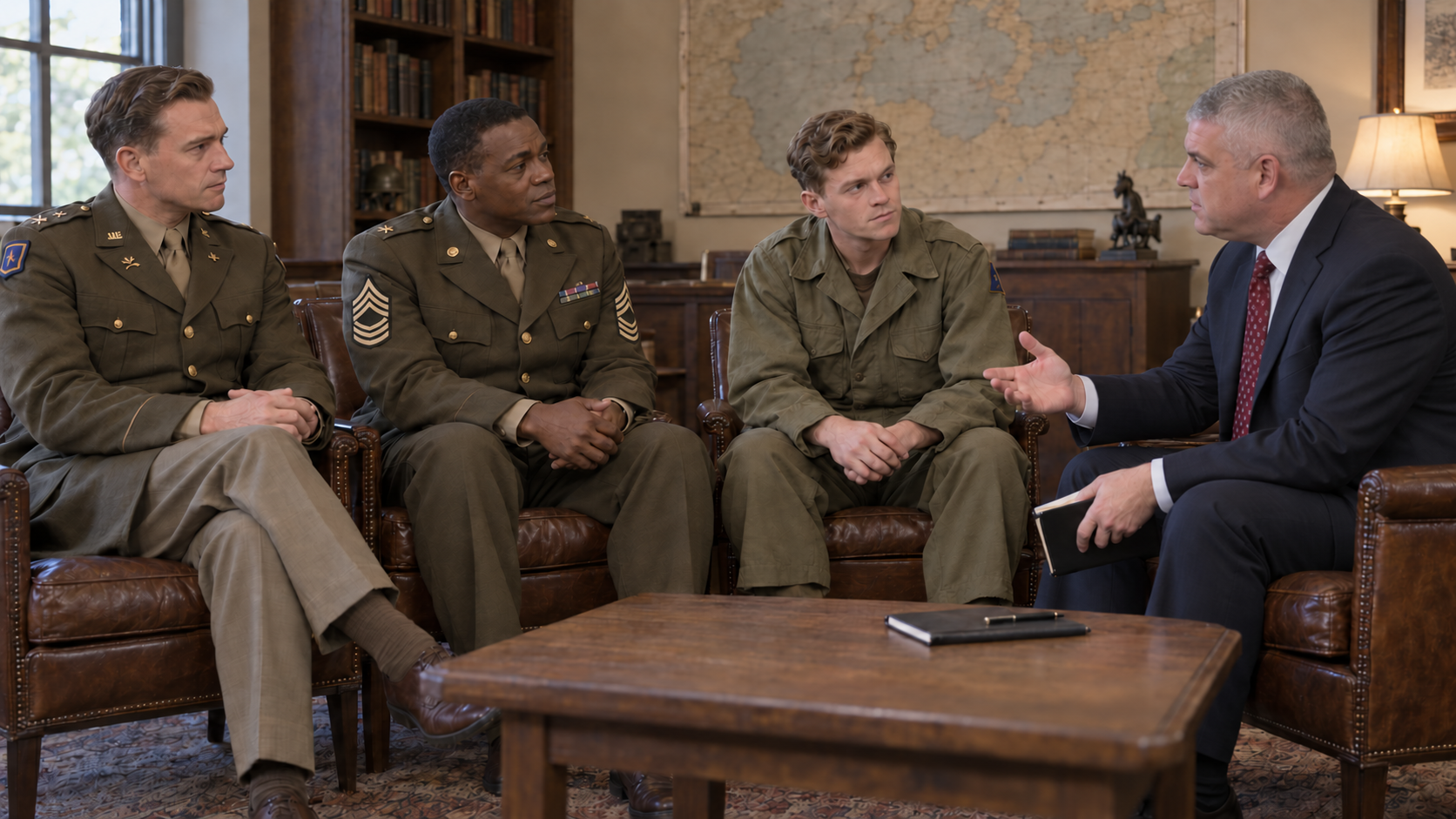
The General Was Never Alone
General Patton’s executive protection,
General George S. Patton, the Men Who Served Around Him, and the Executive Protection Lessons of His Final Movement
A Historically Grounded Virtual Interview and Executive Protection Case Study
By Matthew C. Parker
EPTraining.us Historical Executive Protection Interview Series
Independent Security Advisors LLC
Why the Patton Case Still Matters
General George S. Patton Jr. is usually studied through the campaigns he commanded, the armored formations he drove across Europe, the controversies he created, and the force of personality that made him one of the most recognizable American generals of the Second World War. Those subjects matter, but they can hide another part of the story.
Patton did not move through war alone. Aides, orderlies, drivers, military police, guards, staff officers, communications personnel, medical personnel, and many others helped him function. Some remained near him long enough to learn his habits. Some accompanied him into dangerous places. Some controlled crowds, vehicles, schedules, access, equipment, and the countless ordinary details that surrounded an extraordinary commander.
They were not a modern executive protection detail, and it would be historically careless to pretend otherwise. Their duties belonged to the wartime U.S. Army of the 1940s. Yet their experiences expose problems that remain familiar to anyone responsible for a senior military commander, public official, corporate executive, or other high-risk principal:
- How do you support a principal whose mission requires movement and exposure?
- How much does knowing the principal improve protection?
- What happens when the principal’s personality changes the plan?
- Who watches the environment while everyone else is focused on the mission?
- Why must transportation be treated as part of protection rather than as a separate support function?
- How should an after-action review handle conflicting evidence without converting hindsight into blame?
This interview brings together three documented perspectives from men who served around Patton: Major Alexander C. Stiller, Master Sergeant William George Meeks, and George Fagert. Stiller gives us the perspective of an aide who moved close to Patton’s command and was repeatedly exposed to combat. Meeks gives us the perspective of a longtime personal orderly who knew the General through daily service. Fagert gives us the perspective of a soldier assigned to Patton’s personal guard detail.
The interview then moves to December 9, 1945. None of these three men should be made to describe a collision they did not witness. That portion of the case therefore relies on the official accident findings and the recorded statements of the people who were actually present: Patton’s driver, Private First Class Horace L. Woodring; Major General Hobart R. Gay, who was seated with Patton; and Technician Fifth Grade Robert L. Thompson, the truck driver.
The distinction is essential. Historical case studies lose their value when dramatic dialogue is allowed to replace evidence.
Editor’s Note: Historical Reconstruction and Source Discipline
This is a historically grounded virtual interview created for professional education. Matthew Parker did not interview Stiller, Meeks, or Fagert. Their dialogue is reconstructed from documented roles, military records, published award citations, archival material, and attributed recollections. It must not be represented as a verbatim transcript or as newly discovered testimony.
The published record is not equally detailed for all three men. Stiller’s military role and combat actions are documented in Army award citations. The National Archives identifies Meeks as Patton’s personal orderly for many years and as a pallbearer at Patton’s funeral. Fagert’s personal-guard service and recollections appear in a 2016 profile published while he was living at Chapel Hill Community.
Where the record supports a fact, the interview uses it. Where it supports only a careful inference, the language remains qualified. Where the record does not establish an answer, the interview does not invent one for convenience.
The same rule governs the discussion of Patton’s fatal collision. Conspiracy claims are not substituted for the official record. The available investigation described a traffic accident and assigned carelessness to both drivers. That conclusion can be examined, including conflicts within the recorded accounts, without turning uncertainty into an assassination theory.
The Men Around the General
Major Alexander C. Stiller — The Aide in Motion
Alexander Chapman Stiller served as an aide-de-camp to Patton in Third Army. His decorations reveal how far that duty could extend beyond headquarters. A Silver Star citation records that he crossed the Rhine with the initial assault wave on March 22, 1945, repeatedly exposing himself to enemy fire and continuing with the leading elements after reaching the east bank. Five days later, near Hammelburg, enemy fire killed his driver, wounded his gunner, and wounded Stiller. His Distinguished Service Cross citation states that he remained in position, rallied the force, and directed its defense.
Stiller’s experience matters because it destroys the comfortable assumption that proximity to a senior commander always means distance from frontline danger. In Patton’s army, an aide might move from maps and briefings to a river crossing, an armored column, or a position under sniper fire.
Master Sergeant William George Meeks — The Man Who Knew the Routine
William George Meeks served for years as Patton’s personal orderly. His work did not resemble Stiller’s combat actions, but it offered something no brief protective assignment can create: familiarity accumulated through daily service. Meeks knew the difference between the public General and the man living inside a demanding routine.
That kind of knowledge is operational. It helps a team recognize what is normal, what has changed, what the principal is likely to request, and what seemingly minor detail may become important later. The National Archives also identifies Meeks as the pallbearer standing at the left of Patton’s casket during the funeral in Luxembourg. His service therefore connects Patton’s daily life to the General’s final honors.
George Fagert — The Guard Watching the Environment
George Fagert fought with the 90th Infantry Division and was later assigned to Patton’s personal guard detail. In a published account of his recollections, Fagert described meeting Patton’s train, opening a path through the people on the platform, escorting him to the staff car, and traveling with the General. That is not merely ceremonial movement. It involves crowd management, close observation, a transition between transportation modes, and the transfer of the principal from one controlled space to another.
Fagert’s account also preserves the human contradiction around Patton. He admired the General while recognizing that soldiers could react to him with sharply different emotions. For a protector, that distinction matters. Admiration for the principal cannot replace an honest assessment of how other people perceive him.
The Interview
Part One: Alexander Stiller — Movement Toward Danger
The reconstructed setting is a Third Army command post in Germany during the closing weeks of the war. Maps cover a table. Vehicles idle outside. The front is moving, and the headquarters must move with it.
PARKER: Major, the word aide can sound administrative to someone who has never served around a wartime commander. Your record describes something considerably more dangerous. What did serving General Patton require from you?
STILLER: It required being ready to go where the command required. The General could not understand an advancing army only from a desk. Information came to headquarters, but he also expected the people around him to see conditions, move with the formations, carry instructions, and understand what the units were doing. The work changed with the situation.
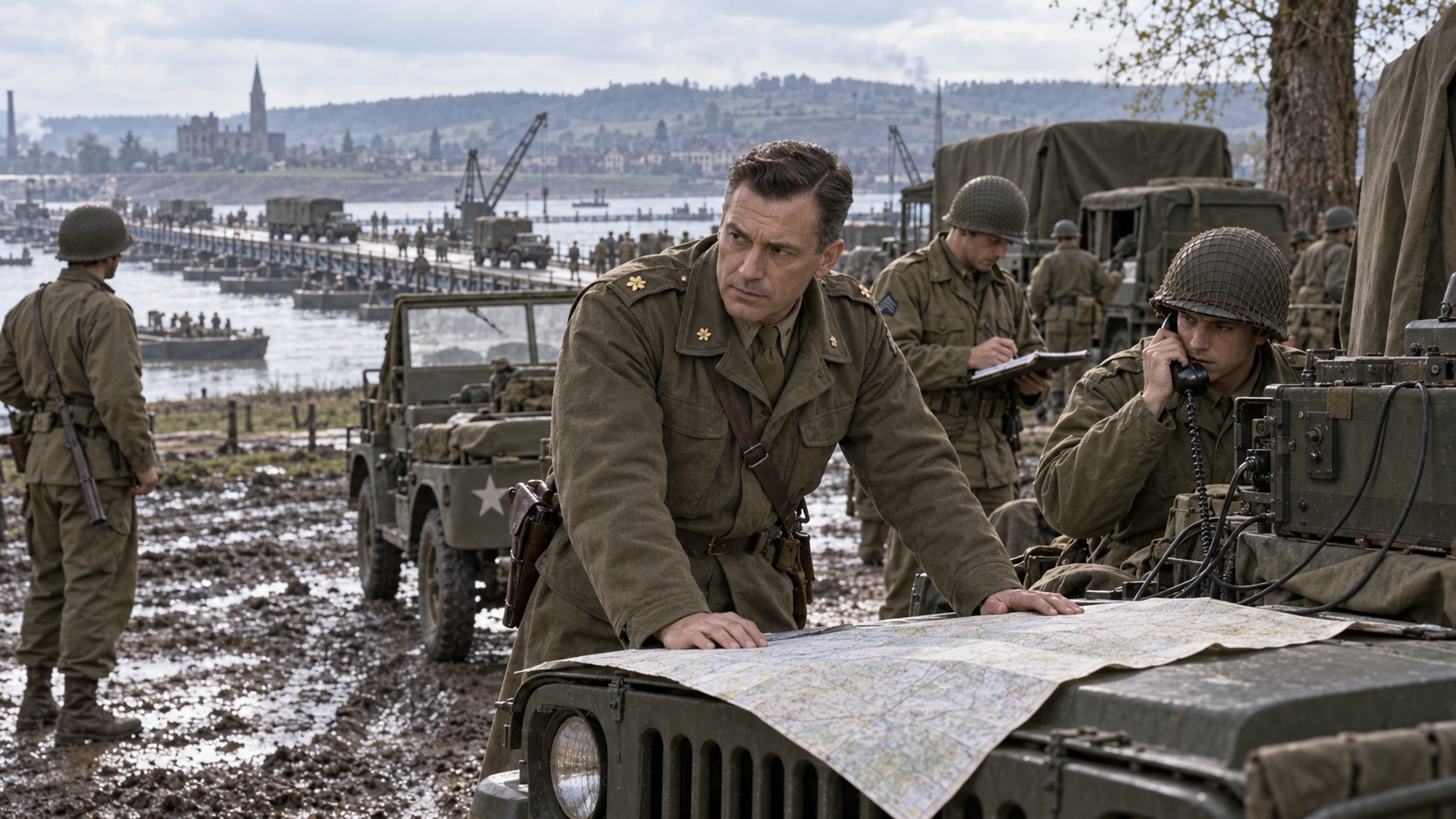
PARKER: On March 22, 1945, you crossed the Rhine with the initial assault elements. That placed one of Patton’s aides under direct fire with the troops making the crossing. Why be that far forward?
STILLER: An army crossing a defended river is not an abstract mark on a map. Someone at the command level has to understand whether the crossing is succeeding, where resistance is strongest, what the lead elements require, and whether the position can be held. You cannot answer every question from the far bank.
PARKER: Five days later, near Hammelburg, the danger became more personal. Your driver was killed, your gunner was wounded, and you were wounded. Yet the award citation says you stayed in position and directed the defense. At that point, were you still performing the role people imagine when they hear general’s aide?
STILLER: Titles become less important when a force is under fire. The men needed leadership, the position had to be defended, and the situation did not allow anyone to wait for a more convenient person to take responsibility.
Parker leaves the next question unasked for a moment. Stiller’s record does not describe a bodyguard shielding Patton. It describes an aide operating inside the command system that allowed Patton to lead a moving army. That is a different protective contribution, but it is still part of the environment around the principal.
PARKER: I have worked protection for Army generals, and there is a tension that comes with the assignment. The detail wants predictability, time, distance, and control. The commander’s mission often demands movement, speed, personal observation, and access to people. Did Patton make that tension more difficult?
STILLER: Patton expected momentum. If the army could move, he wanted it moving. If he believed he needed to see something, the people around him had to be prepared for the possibility that he would go. The answer could not always be delay.
PARKER: Then the job was not to create a safer imaginary version of General Patton. It was to support the actual commander.
STILLER: Yes. You planned for the man you served and the mission he had.
PARKER: What did familiarity give you that an officer newly assigned to him would not have?
STILLER: You learned the pace he expected. You learned which questions mattered to him, when he wanted to see a unit himself, and how quickly an apparently settled movement could change. Familiarity did not remove uncertainty. It gave you a better chance of being ready when the uncertainty appeared.
PARKER: Was Patton careless with danger?
Stiller does not accept the easy answer.
STILLER: A commander accepts dangers because the command cannot function without exposure. That is not the same as saying every risk is necessary. The difficult work is separating the risk the mission requires from the risk created by habit, impatience, or poor preparation.
PARKER: That may be the central question of this entire case. Which danger belonged to the mission, and which danger did not have to be there?
Part Two: William George Meeks — Knowing the Man Behind the Rank
The second setting is quieter. There are no river crossings on the map. The focus is the daily life that continues before the General enters a briefing and after everyone else thinks the official day has ended.
 PARKER: Master Sergeant, an aide could know Patton’s operational intentions. You knew his personal routine. What did years of daily service allow you to see?
MEEKS: Rank tells you what authority a man holds. Daily service tells you how he lives with it. You learn what he expects, how he prepares, what he notices, what irritates him, and what he does when the day does not follow the plan.
PARKER: Modern protection teams use the phrase baseline behavior. We want to know what normal looks like so that we can recognize when something has changed. Did you know Patton well enough to notice those changes?
MEEKS: If you serve someone long enough, you notice. Fatigue, illness, frustration, unusual silence, a change in routine—none of those automatically means danger. They are information. The important thing is knowing the difference between the man’s normal habits and something that deserves attention.
PARKER: How much of your work was invisible to everyone who saw Patton in public?
MEEKS: Most support work is invisible when it is done correctly. The General appears where he is expected, wearing what he needs, carrying what he requires, and ready for the next obligation. People see him. They do not necessarily see all the preparation that made the appearance possible.
PARKER: That sounds familiar. A protection operation is often judged by how little disruption the principal and the public notice. But invisibility can create a problem. People begin assuming the movement happened by itself.
MEEKS: It never happens by itself.
Parker turns from routine to trust.
PARKER: A personal orderly has access to private moments, belongings, conversations, and vulnerabilities. What made trust different in your position?
MEEKS: Trust was not something to announce. It was demonstrated every day. The General had to know that his personal affairs would remain personal, that instructions would be followed, and that the person near him understood the responsibility of being there.
PARKER: Did knowing him make it easier to disagree when necessary?
MEEKS: Knowing a man may help you understand how to approach him. It does not guarantee he will agree. General Patton expected people to perform their duties. If a concern belonged to your duty, you raised it properly and were ready for his decision.
PARKER: Can familiarity improve communication without making a protector so comfortable that he fails to speak when something is wrong?
MEEKS: Familiarity can help you notice. Discipline determines what you do after noticing.
PARKER: At the end, you helped carry General Patton to his grave. What does that say about service that began in ordinary daily duties?
Meeks looks away from Parker before answering.
MEEKS: Service does not always end where you expect. You prepare a man for another day, another movement, another responsibility, until there is no next movement to prepare. Then you carry out the last duty that remains.
The answer is reconstructed, but the image behind it is not. A National Archives photograph shows Meeks beside Patton’s casket at the funeral in Luxembourg.
Part Three: George Fagert — Guarding the Transitions
The third setting is a German railway platform. A staff car waits beyond the crowd. Soldiers and civilians press toward the route between the train and the vehicle. This is the kind of short movement that can look insignificant to everyone except the person responsible for it.
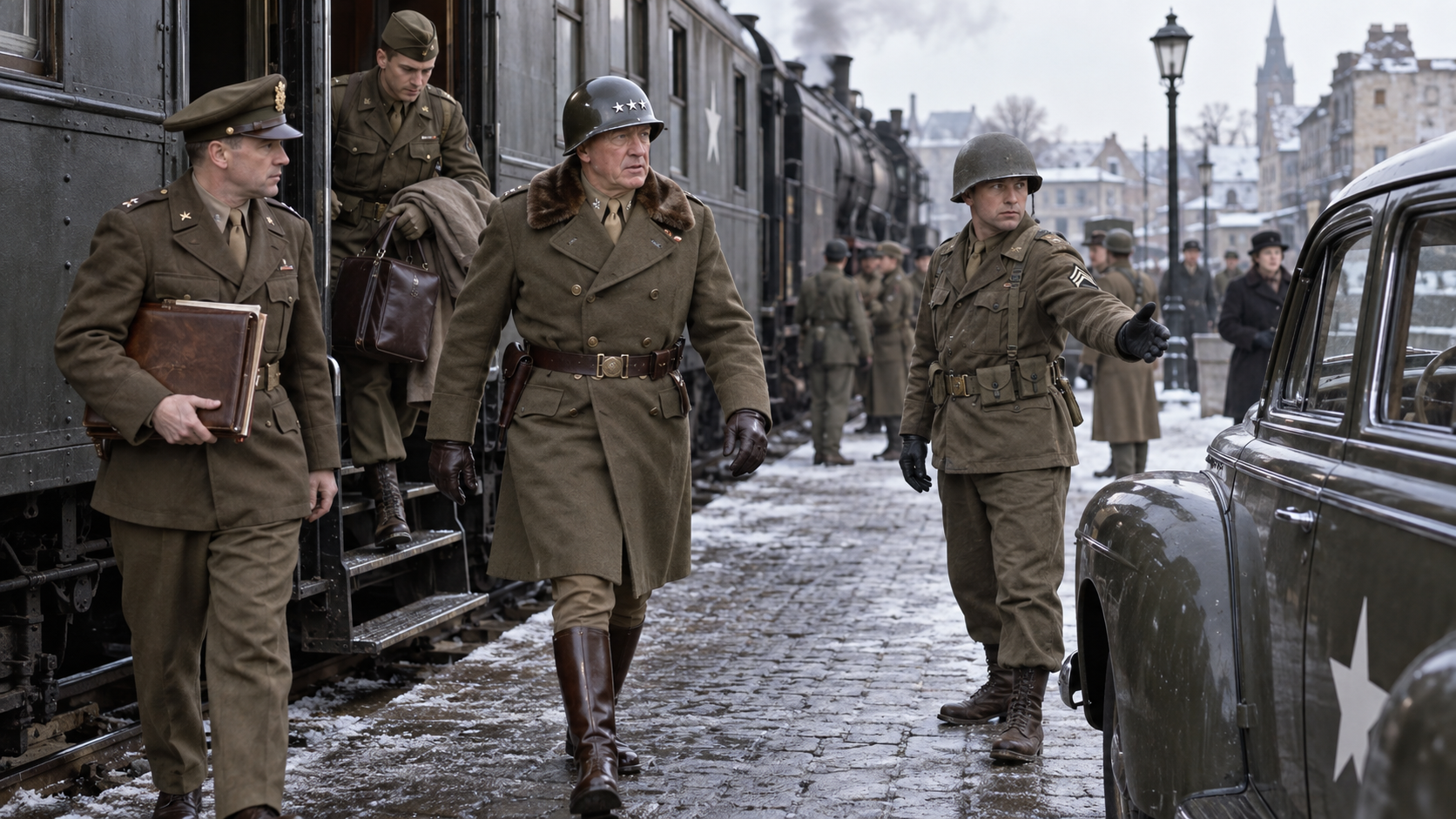 PARKER: Mr. Fagert, your published recollection begins at a train station. You met Patton’s train, opened a path through the crowd, and escorted him to the staff car. What were you watching?
FAGERT: The General could not remain on the train, and the car could not come onto the platform. That meant he had to pass through the people between them. My responsibility was to make that passage possible and keep enough space to see what was happening around him.
PARKER: Today we would call that a transitional movement. The principal leaves one environment, crosses a less-controlled space, and enters another. Why can those few yards be harder than the train or the car?
FAGERT: Because the crowd moves, the General moves, and the people around him may all want something at once. Some want to see him. Some want to speak. Some simply get in the way. You have less time to decide what matters.
PARKER: Your account says you went with Patton wherever he traveled. What did that require beyond standing close?
FAGERT: You watched the people and the route. You paid attention to the next vehicle, the next doorway, the next station, and whatever changed from the last place. Standing near the General was only useful if you were still watching what could reach him.
PARKER: You also remembered that soldiers had very different feelings about Patton. You admired him, but you knew admiration was not universal. Did protecting him require you to separate your opinion of the General from your assessment of everyone else?
FAGERT: It did. A guard cannot assume that other people see the principal the way he does. Some men respected Patton. Some resented him. Most were simply trying to survive the war and get through the day. You watched conduct, not just emotion.
PARKER: That deserves emphasis. Anger is not the same as intent, and criticism is not an attack. But a guard who refuses to acknowledge hostility because he admires the principal is not being loyal. He is leaving the principal blind.
Fagert nods.
PARKER: Did Patton’s personality help or complicate the work?
FAGERT: Both. He wanted soldiers to see him, and he wanted to see them. That visibility was part of how he led. It also meant movement through crowds and places that could not be completely controlled.
PARKER: So the guard’s job was not to erase access. It was to manage it.
FAGERT: Yes. If you made it impossible for Patton to be Patton, you would not be supporting his mission. But if you treated every appearance as harmless because he had done it before, you would not be guarding him either.
Three Responsibilities Around One Principal
The setting changes again. Stiller, Meeks, and Fagert sit at the same table. The scene is intentionally interpretive; the value lies in placing three documented roles beside one another, not in claiming that this meeting occurred.
PARKER: Each of you saw a different part of General Patton’s operating environment. Major Stiller dealt with a command moving through battle. Master Sergeant Meeks dealt with the man’s daily routine. Mr. Fagert dealt with the people and spaces immediately around him. Which role was protection?
STILLER: None of us alone could claim the whole responsibility.
MEEKS: But each could affect his safety.
FAGERT: And each could see something the others did not.
PARKER: That is the beginning of a protective system. Not one guard standing beside a principal, but people performing different functions and sharing what the principal’s safety and mission require them to know.
Patton’s Personality Was an Operational Fact
PARKER: Let us talk plainly about Patton. A protection plan can look excellent on paper and still fail if it assumes the principal will behave like someone else. What did his personality force the people around him to do?
STILLER: Prepare for speed and personal involvement. He did not want the army explained to him only through reports.
MEEKS: Learn how he communicated and what he expected. A message delivered badly might be rejected even when the information mattered.
FAGERT: Stay ready when he moved toward people rather than away from them.
PARKER: I recognize that problem. The principal’s personality is not an inconvenience outside the security plan. It is one of the conditions the plan must address. You do not get to protect the principal you wish you had.
Familiarity Can Protect—or Blind—the Team
PARKER: All three of you benefited from familiarity. But familiarity carries a danger of its own. When people have completed the same movement repeatedly, they may stop seeing it as an operation. How did you keep routine from becoming complacency?
MEEKS: By remembering that a routine is still made of decisions. The same clothing, vehicle, driver, route, or schedule can create confidence, but confidence does not remove the need to notice change.
FAGERT: A station you used before could contain different people the next time. A crowd could behave differently. The route from the train to the car was familiar, but the environment never belonged to you.
STILLER: In combat, yesterday’s information aged quickly. A road believed open could close. A quiet area could receive fire. Familiarity helped only when it made preparation faster, not when it replaced preparation.
Mission and Protection Were Not Opposing Teams
PARKER: There is a lazy way to describe this conflict. The commander wants to do the mission; security wants to stop him. That turns protection into an obstacle and the principal into a problem. Is that how it felt around Patton?
STILLER: The security of the commander existed to preserve command. It had no purpose separate from the mission.
FAGERT: Keeping him away from every soldier and every movement might reduce one kind of exposure while preventing him from leading the way he believed necessary.
MEEKS: The question was how to support him without pretending the danger was gone.
PARKER: Exactly. The professional answer is rarely unlimited freedom or complete restriction. It is informed risk, deliberate mitigation, and an honest conversation with the principal about what cannot be controlled.
The Limits of the Closest Person
PARKER: Mr. Fagert, you may have stood closest during a movement. Could the closest man see everything?
FAGERT: No. If I was opening the path, I was watching the path. Someone else had to watch what I could not.
PARKER: Major Stiller, could the aide manage the entire environment while carrying out the commander’s instructions?
STILLER: No. An aide had responsibilities that demanded attention. Protection could not depend on the aide noticing every hazard.
PARKER: Master Sergeant Meeks, could personal familiarity replace route planning, vehicle safety, or medical preparation?
MEEKS: No. Knowing the man helped with one part of the problem. It did not control the road.
Parker closes the notebook for the first time.
PARKER: Then the General was never alone, but proximity alone was never enough. That is the lesson I wanted the three of you to establish before we examine the last movement of his life.
December 9, 1945 — The Final Movement
The Historical Record
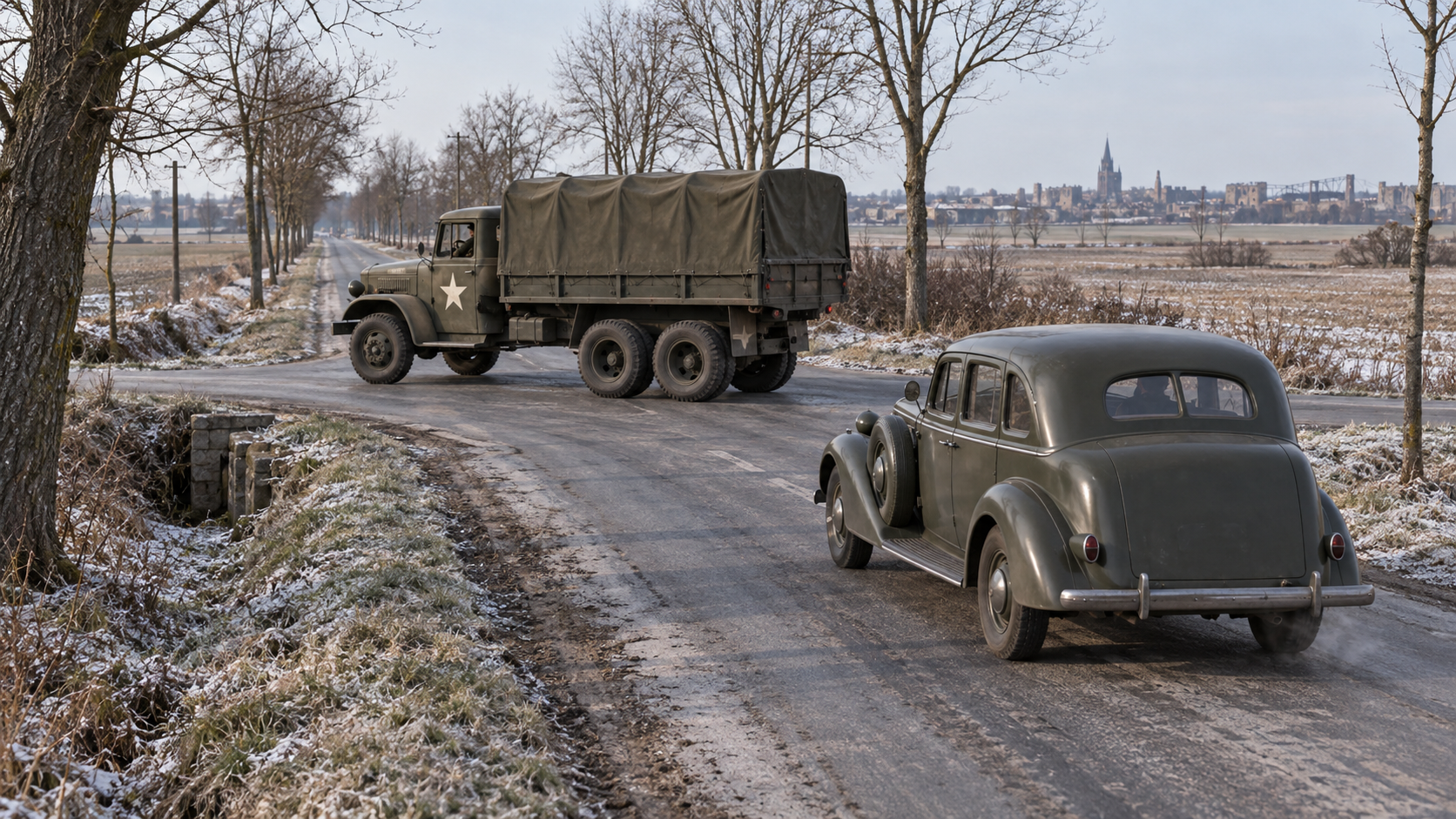 By December 1945, the war in Europe had ended. Patton commanded the Fifteenth Army and was preparing to leave Germany. On Sunday, December 9, he departed Bad Nauheim with Major General Hobart R. Gay for a pheasant-hunting trip. PFC Horace L. Woodring drove the 1938 Cadillac staff sedan. A second vehicle, driven by Sergeant Joseph Spruce, accompanied them and later moved ahead because Spruce knew the route.
At approximately 11:45 a.m., on Highway N-38 near Mannheim, a 2½-ton GMC truck driven by T/5 Robert L. Thompson began a left turn across the Cadillac’s direction of travel toward a quartermaster facility. The Cadillac struck the truck. Gay and Woodring were not seriously injured. Patton was thrown inside the passenger compartment and suffered a catastrophic cervical spinal injury that left him paralyzed. He died in the Army hospital at Heidelberg twelve days later, on December 21, 1945.
The collision was not an enemy attack. It was not documented as an assassination attempt. The official military-police report attributed the accident to carelessness by both drivers.
That conclusion does not eliminate every question. It gives the review a disciplined starting point.
What the Witnesses Reported
The public-affairs message releasing the investigation preserved several points that are too often lost when the event is retold:
- The investigating officer estimated the Cadillac’s speed at about 35 miles per hour. Woodring gave a similar estimate of 30 to 35 miles per hour.
- Gay remembered that the Cadillac had slowed substantially at a railroad crossing and might still have been moving slowly when the truck crossed its path.
- The report listed the road and both vehicles in excellent condition.
- The report listed both drivers as sober.
- The report entry said Thompson signaled the left turn, while Woodring stated that he saw no signal or earlier indication of the turn.
- Thompson said he had already begun turning before he noticed the approaching staff car.
- No disciplinary action was taken against either driver.
These differences matter. They do not prove a conspiracy. They demonstrate why eyewitness perception, physical evidence, and an investigator’s conclusions must be separated and compared.
The Voices That Belong to This Part of the Case
Stiller, Meeks, and Fagert help us understand the system around Patton, but the December 9 movement belongs factually to Woodring, Gay, Thompson, Spruce, the responding personnel, and the military-police investigators. A responsible historical interview should not ask men who were elsewhere to remember a collision they did not see.
Gay’s account described Patton looking at derelict wartime vehicles along the road and commenting on the waste of war immediately before the truck crossed in front of them. Woodring said he attempted to stop but did not have enough distance to avoid the collision. Thompson said he did not notice the Cadillac until he had started the turn.
The operational picture is therefore not one of an attacker defeating a protective formation. It is a transportation event in which two vehicles, moving on an open road in postwar Germany, entered the same space with insufficient time or distance to prevent impact.
That may sound less dramatic than the theories that later grew around Patton’s death. It is more useful to the protection professional because ordinary transportation risk is real, recurring, and often underestimated.
Parker’s After-Action Review
Having served on and led protection details for U.S. Army generals in Iraq, I recognize the tension described by the men who served around General Patton. The technology was different. The vehicles were different. The medical system was different. The operating environment was different. But the fundamental problem is familiar.
You are responsible for protecting a principal whose mission may require movement toward the danger you would prefer to avoid. The general is not cargo. He commands, observes, decides, communicates, and leads. A plan that makes those duties impossible may reduce exposure while defeating the reason protection exists.
That reality does not excuse unnecessary risk. It makes disciplined risk management more important.
AAR Purpose
An after-action review is not a courtroom, a conspiracy forum, or an opportunity to make the reviewer look smarter than the people who were present. It should determine what happened, what was expected, what was known, what worked, what did not work as intended, and what should change in the next operation.
For December 9, the principal facts are clear enough to define the problem. Patton was critically injured during a vehicle movement. There was no hostile attack. The road and vehicles were reported to be in good condition. Both drivers were reported sober. The investigating officer assigned carelessness to both drivers. The eyewitness accounts do not agree on every detail, particularly the Cadillac’s speed and whether the truck signaled before turning.
Those conflicts are not clutter to be discarded. They are part of the evidence.
What Was Supposed to Happen?
The movement was intended to take Patton and Gay from Bad Nauheim to a hunting area near Mannheim. Spruce’s accompanying vehicle carried additional personnel and equipment and moved ahead when local route knowledge became important. The staff sedan was expected to follow the road, maintain separation, arrive at the destination, and return the principals safely.
No extraordinary hostile-threat posture appears warranted by the evidence available for this trip. The relevant hazards were transportation hazards: intersecting vehicle movement, speed, visibility, route familiarity, following distance, occupant positioning, communications between vehicles, and the ability to summon medical help after a collision.
What Actually Happened?
The truck began crossing the Cadillac’s lane to enter a quartermaster area. The Cadillac driver perceived the conflict too late to stop before impact. Patton’s body moved forward inside the rear compartment, and the interior structure caused catastrophic injury. A movement that had not been organized around an expected attack nevertheless produced the loss of the principal.
The immediate cause belongs to the collision. The professional review must then examine the conditions that allowed a relatively ordinary traffic event to produce an extraordinary consequence.
What Worked?
The movement included an accompanying vehicle and personnel with local route knowledge. The collision occurred in an area where military personnel and facilities were present. Responders reached the scene, Patton was removed to an Army hospital, specialized medical assistance was requested, and his wife was brought to Germany. The response gave him twelve days of care after an injury that was catastrophic at the moment of impact.
It is important to identify what worked because an AAR that records only failure cannot reproduce successful actions during the next emergency.
What Requires Scrutiny?
1. Transportation risk was the threat that materialized
There is no evidence that an enemy, extremist, assassin, or political opponent caused the collision. The fatal hazard was another military vehicle making a turn across the route. Threat assessment in protection cannot stop at the question, “Who wants to hurt the principal?” It must also ask, “What can hurt the principal?”
2. The recorded accounts conflict
Gay’s description of very low speed after the railroad crossing does not match Woodring’s estimate of 30 to 35 miles per hour or the investigating officer’s approximate 35-mile-per-hour finding. The report’s entry that the truck signaled conflicts with Woodring’s statement that he saw no signal. A modern review would preserve those differences and compare them with scene measurements, vehicle damage, sight lines, timing, and any available physical evidence. It would not select the most convenient account and call the matter resolved.
3. Route knowledge existed, but vehicle coordination still mattered
Spruce moved ahead because he knew the route. That was a practical decision, but it also changed the order and spacing of the vehicles. A modern operation would ask how the move was briefed, how the lead vehicle communicated, what following interval was expected, whether the principal vehicle was being guided or merely following, and what action each driver should take when the formation changed near an intersection or entrance.
4. Passenger protection was part of vehicle selection
The 1938 sedan transported Patton comfortably, but the rear compartment contained hard interior structures capable of causing severe injury during sudden deceleration. A modern vehicle assessment would examine occupant restraints, seating position, head and neck protection, interior hazards, vehicle compatibility, and whether the principal was properly secured before movement. That is not an accusation against people in 1945. It is a modern lesson drawn from the mechanism of injury.
5. “Routine” reduced the psychological visibility of the risk
The war was over. The trip was recreational. The General had survived combat, battlefield travel, and years of exposure. Those facts can make a noncombat journey feel safer than it is. They do not change the physics of two vehicles entering the same space.
6. Medical planning must begin before the injury
Patton’s survival for twelve days reflects the care he received, but the case also reminds us that traumatic injury can occur without gunfire or an attacker. Route planning should identify appropriate medical facilities, communications procedures, emergency contacts, casualty movement options, and who assumes control of the protective mission if the principal becomes incapacitated.
7. Command continuity belonged in the plan
Patton’s injury instantly changed more than one man’s medical condition. He was a four-star general commanding an army, preparing to leave Europe, and responsible for a staff and continuing military duties. Protection planning for a senior leader should account for delegation of authority, preservation of sensitive information, notification procedures, family liaison, public communication, and the organization’s ability to continue when the principal cannot.
What Should Be Sustained?
Future operations should sustain the practice of assigning experienced drivers, using route-knowledgeable personnel, moving with support, maintaining communications, and arranging rapid access to medical care. They should also sustain the professional humility shown when a reviewer distinguishes fact from inference and refuses to label every unexplained detail evidence of a plot.
What Should Be Improved?
A modern detail should use a written or clearly briefed movement plan even for an apparently ordinary trip. The plan should define vehicle order, driver responsibilities, primary and alternate routes, communications, following distance, speed expectations, actions at intersections and railroad crossings, destination access, emergency medical facilities, vehicle recovery, and authority if the principal changes the plan.
The principal should receive a concise safety briefing appropriate to the movement. Drivers should confirm that every occupant is secured before departure. The team should reassess conditions whenever the route, vehicle order, destination, weather, schedule, or purpose of travel changes.
AAR Bottom Line
Based on the historical evidence, I would not call Patton’s death an assassination, and I would not reduce it to a simple statement that “the protection failed.” A collision occurred, Patton suffered catastrophic injuries, and the official investigation found carelessness by both drivers. The available accounts contain differences that deserve acknowledgment, but those differences do not establish a murder plot.
The protection lesson is more demanding than a conspiracy theory because it applies to every detail. Transportation is not the space between protective operations. Transportation is a protective operation. The danger may be an ambush, a mechanical failure, a fatigued driver, a poorly coordinated convoy, an uncontrolled intersection, weather, debris, or another vehicle making a turn.
General Patton’s final movement did not become dangerous because someone wanted him dead. It became dangerous because movement always contains hazards, and on December 9, 1945, one of those hazards reached the principal.
Lessons Learned
Lesson One: Protect the Principal Who Actually Exists
Patton’s personality was not separate from the operation. His urgency, visibility, preference for personal observation, willingness to move, and impatience with delay shaped the environment around him. A plan built for a quiet, predictable principal would not survive contact with General Patton.
The modern application is straightforward: principal intelligence begins with the person. The team must understand routines, preferences, decision-making style, health, family considerations, professional obligations, tolerance for disruption, and likely reactions when security recommends a change. The purpose is not to control personality. It is to prevent personality from surprising the plan.
Lesson Two: The Mission and the Protection Plan Must Support Each Other
Stiller’s experience shows why military protection cannot be reduced to keeping a commander away from danger. Patton’s mission required knowledge of a moving battlefield. The aide and staff had to preserve his ability to command while reducing risks that did not contribute to the mission.
The same principle applies to public officials and executives. A mayor must meet the public. A judge must reach the courthouse. A chief executive must visit facilities. Protection succeeds when it enables the legitimate mission with controlled exposure, not when it wins every argument by canceling the mission.
Lesson Three: Knowing the Principal Is Operational Intelligence
Meeks’s years of service gave him a baseline that a newly assigned person could not immediately possess. He knew routines, expectations, and normal behavior. That knowledge could reveal fatigue, illness, agitation, an unusual request, or a change in decision-making.
The lesson is not to make one trusted aide the only keeper of personal knowledge. The detail should learn from household staff, executive assistants, drivers, family members, medical personnel, and others who understand the principal, while respecting privacy and need-to-know limits. Important knowledge should not disappear when one experienced person takes leave.
Lesson Four: Transitions Concentrate Risk
Fagert’s remembered movement from train to staff car captures a recurring vulnerability. Trains, aircraft, buildings, and vehicles can each provide controlled spaces. The short distance between them often does not. Crowds compress, responsibilities overlap, doors remain open, attention divides, and the principal may pause unexpectedly.
Advance work should therefore identify every transition: residence to vehicle, vehicle to entrance, backstage to platform, aircraft stairs to motorcade, elevator to lobby, and motorcade arrival to secure room. A short distance is not a small operation merely because it takes less time.
Lesson Five: The Closest Person Cannot Be the Entire System
The person beside the principal may be managing pace, conversation, physical proximity, and immediate reactions. That person cannot simultaneously see every approach, manage every vehicle, monitor every communication, screen every individual, and plan every contingency.
Protection in depth distributes responsibilities. Advance personnel control the destination. Drivers manage the vehicle. intelligence personnel monitor relevant information. Static security controls access. The close-protection element manages immediate movement. Command ensures that these functions share a common plan.
Lesson Six: Familiarity Must Shorten Preparation, Not Replace It
Repeated success can disguise accumulating risk. A familiar route feels safe because nothing happened yesterday. A familiar driver is trusted because prior movements were uneventful. A familiar crowd is assumed harmless because it behaved well before.
Experience should allow the team to prepare faster and notice anomalies sooner. It should never become the reason the team stops checking weather, traffic, construction, vehicle condition, staffing, medical resources, destination access, or changes in the threat environment.
Lesson Seven: Transportation Is Protection
The principal remains the principal after the door closes. Driver selection, training, rest, vehicle choice, maintenance, seating, occupant restraints, route design, communications, convoy discipline, and emergency action all belong to the protective mission.
No hostile actor is required for a transportation failure to become fatal. Patton’s case makes that point with unusual clarity.
Lesson Eight: Review All Hazards, Not Only Hostile Threats
Threat assessment and hazard assessment overlap but are not identical. Hostile-threat analysis asks about intent and capability. Operational risk analysis also considers accidents, illness, weather, fire, structural conditions, crowd pressure, mechanical failure, and other nonhostile dangers.
The detail must ask both who may harm the principal and what may harm the principal. Focusing exclusively on adversaries can leave the team well prepared for an attack that never comes and poorly prepared for the emergency that does.
Lesson Nine: Conflicting Evidence Must Remain Visible
The accident record contains differences in speed estimates and signaling. A weak analysis hides the conflict. A professional analysis records it, evaluates the reliability and vantage point of each source, and explains what can and cannot be concluded.
MGT 304’s emphasis on analysis and source reliability is operational here. Information does not become true because it supports the reviewer’s preferred theory. Nor does uncertainty authorize the reviewer to invent certainty.
Lesson Ten: An AAR Must Improve the Next Operation
If the review ends with blame, admiration, or mystery, it has not completed its professional purpose. The findings must change something: driver selection, briefings, vehicle order, route planning, communication, occupant safety, medical contingencies, documentation, principal instructions, or command oversight.
History becomes training only when the lesson can influence future performance.
Frequently Asked Questions
Was General Patton assassinated?
No credible historical evidence establishes that Patton was assassinated. The official record describes a traffic collision on December 9, 1945, and the military-police investigation attributed the accident to carelessness by both drivers. Later suspicion and conflicting recollections do not by themselves prove a murder plot.
Was Patton’s death a protection failure?
It should not be reduced to that label without qualification. The movement ended in the loss of the principal, so a protection professional must examine it. But outcome alone does not prove that a person or team ignored a known threat or violated an established procedure. The historical record supports a transportation accident with catastrophic consequences. The responsible conclusion is that the event exposes transportation and occupant-safety risks, not that it proves a conventional close-protection failure.
Why did Patton suffer fatal injuries when the other occupants survived?
Patton was thrown inside the rear passenger compartment and struck an interior structure, suffering a severe cervical spinal injury. Gay and Woodring avoided comparable trauma. Differences in seating position, body movement, point of contact, and simple chance can produce very different injuries in the same collision.
Were the drivers drunk or were the vehicles defective?
The released accident findings listed both drivers as sober and described the road and vehicles as being in excellent condition. Claims that the truck driver was intoxicated conflict with that official record and should not be presented as established fact without stronger evidence.
Did the truck signal before turning?
The record conflicts. The report entry stated that the truck signaled a left turn. Woodring’s sworn statement said he noticed no hand signal or earlier indication. A careful case study preserves both statements and does not convert the disagreement into proof of either conspiracy or innocence.
How fast was Patton’s car traveling?
Woodring estimated approximately 30 to 35 miles per hour, and the investigating officer estimated about 35 miles per hour. Gay recalled that the Cadillac had slowed substantially at a railroad crossing and may still have been moving much more slowly. The differences illustrate the limits of eyewitness speed estimates and the need for physical reconstruction when available.
Could a modern protection detail have prevented the fatal injury?
No one can answer with certainty. Modern vehicles, occupant-restraint systems, communications, trauma care, route-monitoring tools, driver training, and protective doctrine offer capabilities that did not exist in the same form in 1945. Those improvements might reduce risk or injury severity, but claiming that a modern team would definitely have saved Patton would be speculation.
What was Alexander Stiller’s correct role?
Major Alexander C. Stiller served as an aide-de-camp to Patton in Third Army. He was not simply a ceremonial companion. His award citations document participation in the Rhine crossing and extraordinary heroism near Hammelburg, where he was wounded after his driver was killed and his gunner wounded.
Who was William George Meeks?
Master Sergeant William George Meeks was Patton’s personal orderly for many years. The National Archives identifies him as a pallbearer at Patton’s funeral in Luxembourg. His relevance to protective study lies in long-term principal knowledge, trust, routine, and close daily support.
Who was George Fagert?
George Fagert was a decorated infantry veteran who later recalled assignment to Patton’s personal guard detail. His published account describes meeting Patton’s train, controlling the path through a crowd, escorting him to a staff car, and traveling with him. His recollections provide a valuable view of close movement and crowd transition, although they are not a complete official history of Patton’s security organization.
Why does a historical military case belong in executive protection training?
Because the operating questions remain recognizable. A principal has a mission. Personality affects cooperation. Movement creates exposure. Staff members possess different pieces of relevant information. Transportation can injure or kill without hostile intent. Emergency response and continuity matter when prevention fails. The technology changes; the need to integrate those functions does not.
What is the single most important lesson from Patton’s final movement?
Transportation is not merely how the detail gets from one protective operation to another. It is part of the protective operation. The risk assessment, plan, driver, vehicle, route, communication, passenger safety, and emergency response must reflect that fact every time the principal moves.
Protective Analysis
The Patton case does not fit neatly into a single course topic. That is precisely why it belongs in executive protection training. The men around Patton demonstrate how principal knowledge, mission requirements, movement, communications, personal security, staff support, transportation, and emergency response overlap.
The current ISA Executive Protection Training Syllabus treats those functions as connected. The progression begins with threat and environmental assessment, moves through operational planning and advance work, and continues into secure transportation, transitional movement, communications, emergency action, and medical planning. Patton’s final movement shows why that integration matters even when no hostile actor is present.
MGT 201, MGT 303, and MGT 304 are relevant because a professional assessment must distinguish hostile intent from other hazards and test the reliability of the information supporting decisions. EPO 300 and EPO 400 apply because route, vehicle, schedule, destination, contingencies, and medical support belong in the operation before movement begins. MGT 306 and MGT 307 apply directly to secure transportation and the changing risks of movement and static locations. EPO 401 and EPO 402 address the human challenge of communicating risk to a strong principal whose mission and personality may resist delay or restriction. EPO 403 reinforces that emergency medical and hard-site planning are not optional additions after something goes wrong.
The lesson is not that a 1945 staff movement should be judged as if it had been designed under a 2026 curriculum. The lesson is that the historical event helps explain why modern protective programs now connect these functions.
Editorial Conclusion
The familiar image of General Patton is a solitary figure in polished boots and a decorated helmet, standing above a map or addressing an army. The operational reality was different. A commander of that scale depended on people whose names rarely appear in the larger histories.
Alexander Stiller moved inside the command system and into direct combat. William Meeks knew the General through years of personal service and daily routine. George Fagert watched crowds and guided the short, exposed passage from train to staff car. Woodring drove. Gay traveled beside the General. Spruce knew the route. Medical personnel responded when the movement failed.
No one of them was the protective system. Together, their roles show why the system matters.
Patton survived the campaigns that made him famous. His final injury came after the war, during a Sunday drive to a pheasant hunt. There was no enemy formation ahead, no assassin in the crowd, and no battlefield order forcing the movement. A truck crossed the route, the vehicles collided, and the interior of the staff sedan became the hazard that reached him.
That is not an argument for fear. It is an argument for professional attention.
Know the principal well enough to recognize change. Understand the mission well enough to support it. Treat every transition as a place where control can narrow. Build enough depth that the closest person is not the only person watching. Plan transportation as protection. Prepare the medical response before movement. Preserve conflicting evidence. Use the AAR to improve the next operation.
The General was never alone. The enduring question is whether all the people around the principal are operating as one protective system.
Related EPTraining.us Resources
- Executive Protection Training Syllabus — Current ISA course structure, learning outcomes, and protective-operations curriculum.
- Dignitary and Executive Protection Specialist Course — Program information for law enforcement, military, corporate-security, and private-sector protection professionals.
- Executive Protection Training Standards — ISA’s approach to measurable standards, curriculum validation, and professional training.
- Executive Protection: Mastering the Threat Assessment Process — How information is translated into protective decisions and risk mitigation.
- The Man Behind the Office Door: Henry Clay Frick — A companion historical interview on organizational grievance, access control, and executive vulnerability.
- Defending Democracy Initiative — ISA’s work on the protection of elected officials, judges, candidates, and public servants.
Sources and Historical Notes
- U.S. Army — The 80th Anniversary of Gen. Patton’s Final Battle — Current Army account of the collision, hospitalization, death, and 80th-anniversary commemoration.
- National Archives — The Funeral of General George S. Patton Jr. — Archival account identifying William Meeks as Patton’s longtime personal orderly and as a pallbearer.
- Library of Congress — George S. Patton Papers Finding Aid — Collection description for Patton’s diaries, correspondence, military papers, photographs, and death-and-funeral material.
- Military Times Hall of Valor — Alexander C. Stiller — Published Silver Star and Distinguished Service Cross citations documenting Stiller’s role and combat actions.
- United Church Homes — George Fagert: Guarding General Patton — Published profile containing Fagert’s attributed recollections of personal-guard service.
- Patton’s Car Accident — Investigation Findings, December 13, 1945 — Transcription of the Seventh Army public-affairs message releasing the military-police findings and statements by Gay, Woodring, and Thompson.
- The National WWII Museum — General George S. Patton — Current biographical overview and historical context.
About Independent Security Advisors and EPTraining.us
Independent Security Advisors LLC operates EPTraining.us, a U.S.-based executive protection training program serving law enforcement, military, public-safety, corporate-security, and private-sector protection professionals. The program connects threat assessment, protective intelligence, operational planning, advance work, physical security, secure transportation, movement, communications, legal and ethical responsibilities, emergency medical planning, and performance-based evaluation.
The historical interview series uses documented events to examine a central ISA principle: protection is not one person standing beside a principal. It is an integrated system built around the principal, the mission, the operating environment, and the people who must keep all three functioning.
#GeneralPatton #ExecutiveProtection #CloseProtection #SecureTransportation #ProtectiveIntelligence #LessonsLearned #EPTraining