
 E-mail us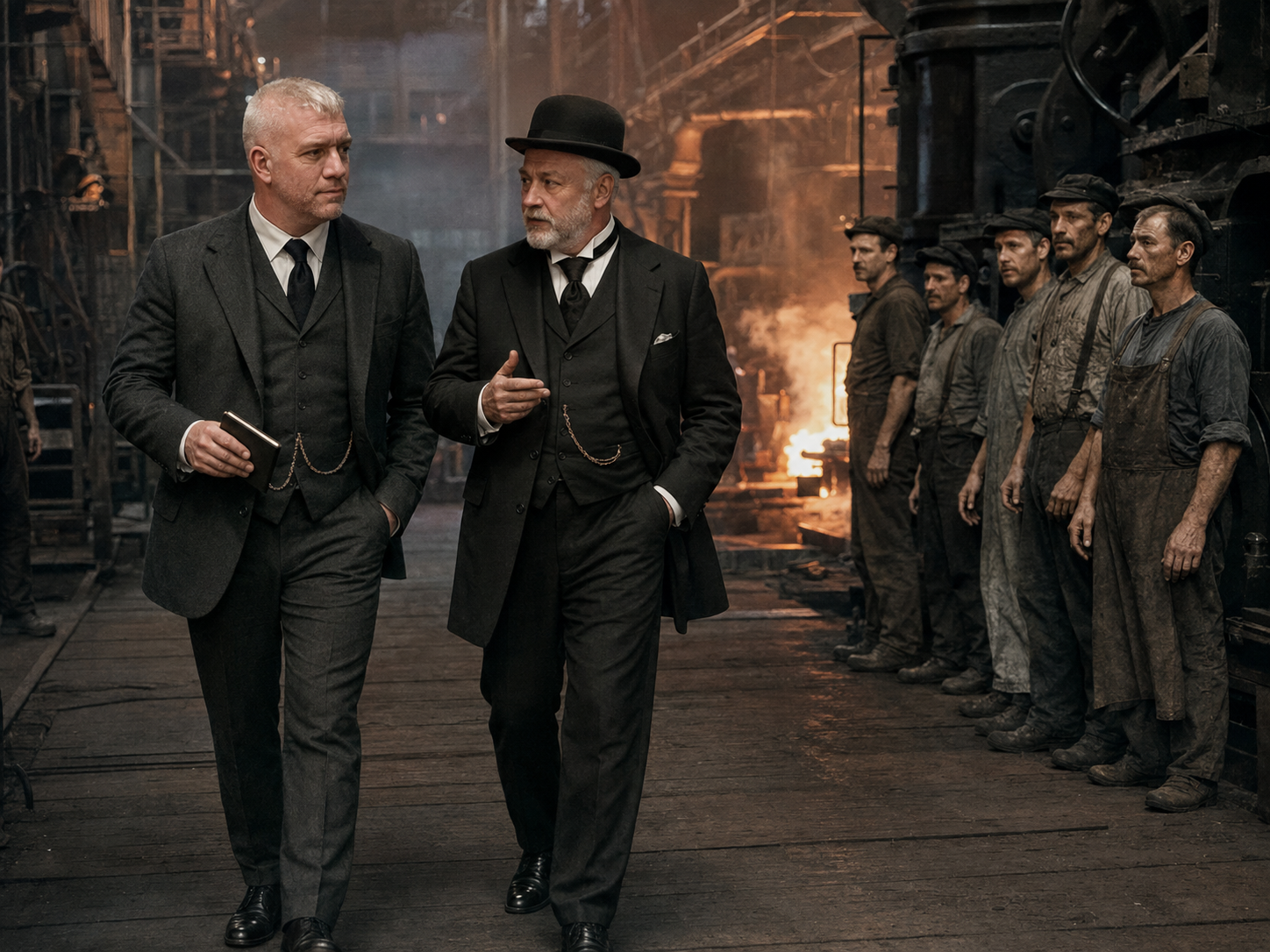
Matthew Parker in Conversation with Henry Clay Frick
Henry Clay Frick, the Homestead Strike, Workplace Violence, and Executive Protection Lessons from the 1892 Assassination Attempt
Pittsburgh and Homestead, Pennsylvania – Summer 1892
Historical visualization: Matthew Parker and Henry Clay Frick walk the Homestead works during the 1892 labor crisis. Artistic reconstruction for the EPTraining.us Historical Executive Protection Interview Series; not a historical photograph.
Why This Historical Executive Protection Case Still Matters
Independent Security Advisors (ISA) and EPTraining.us use historical case studies to examine how threat assessment, protective intelligence, workplace violence, physical security, movement, access control, and continuity planning intersect around a principal. The Henry Clay Frick assassination attempt moves that analysis into the private sector. A violent industrial conflict became personally attached to the executive most visibly associated with the company response, while the organization’s largest security effort remained concentrated on the industrial property at Homestead.
That distinction remains relevant to modern executive protection and insider-threat programs. Organizations often begin by protecting the asset they believe is under attack: the factory, headquarters, network, event, or workforce. The Frick case asks a more difficult question. When does hostility toward an institution become fixation on the person identified with its decisions, and how quickly can the protection system recognize that the threat has changed?
The same institutional principle appears in ISA’s Defending Democracy Initiative. Violence and intimidation can influence an institution even when the attacker fails to kill the person targeted. In public service that may affect how officials govern; in a corporate crisis it can affect executive decision-making, workforce relations, operations, family security, and continuity. The cases are different, but the protective objective is similar: keep the principal safe enough to continue the legitimate mission while preserving the institution’s ability to function.
Historical Simulation and Editorial Note
This is a historically grounded virtual interview, not a transcript of an actual conversation. The setting follows the violence surrounding the Homestead Strike and the July 23, 1892 attempt by anarchist Alexander Berkman to assassinate Henry Clay Frick in Frick’s Pittsburgh office. The reconstructed dialogue uses documented events to ask modern executive-protection questions; where the surviving record does not establish what Frick knew, believed, or was told, the interview avoids inventing a convenient answer.
The distinction between Berkman and the Homestead workers is essential. Berkman was not a Carnegie Steel employee, was not a member of the Amalgamated Association at Homestead, and did not act on behalf of the union. He came to Pittsburgh after the violent confrontation between workers and Pinkerton personnel and independently decided that killing Frick would advance the workers’ cause. The case therefore concerns an outsider who adopted an organizational grievance and personalized it against an executive.
This article does not attempt to settle the political, economic, or moral arguments surrounding the Homestead Strike. Those disputes are part of the operating environment and help explain why the atmosphere had changed. They do not transfer responsibility for Berkman’s decision to commit violence to workers, union members, critics of Carnegie Steel, or anyone else who did not participate in his attack.
Reader Navigation – Choose How You Want to Read This Case Study
This case study is designed for two kinds of readers. The historical interview reconstructs the problem through conversation; the Protective After-Action Review can be read independently by students and practitioners who want the operational findings without reading the interview.
- Case Snapshot – A concise factual account of the Homestead crisis, Berkman’s attack, and the protective problem.
- Part I – Historical Interview – Matthew Parker questions Frick about personalized grievance, access, protective intelligence, family exposure, management coordination, and continuity.
- Part II – Protective After-Action Review and Lessons Learned – Skip directly here for the modern EP analysis: six consolidated findings and the operational lessons they produce.
- FAQ – Frick Assassination Attempt and Executive Protection – SEO-focused answers on the attack, outsider threats, protective intelligence, reassessment, access control, and modern EP lessons.
- The Bottom Line – The central protective lesson in concise form.
- Related Resources and Sources – Supporting EPTraining.us material followed by the historical sources used for the case study.
Case Snapshot: Frick, Homestead, and July 23, 1892
In the summer of 1892, the conflict at Carnegie Steel’s Homestead works became one of the most violent labor disputes in the United States. The July 6 confrontation between locked-out workers and Pinkerton personnel produced deaths, injuries, national press attention, and intervention by the Pennsylvania militia. Henry Clay Frick, chairman of Carnegie Steel and the executive directing the company response in Pennsylvania while Andrew Carnegie was in Scotland, became the most visible individual associated with management’s position.
Seventeen days later, on July 23, Alexander Berkman entered Frick’s Pittsburgh office using a plausible business pretext and attacked him at close range with a pistol and knife. Berkman was not a Carnegie Steel employee and did not represent the Homestead union. He had adopted the conflict as an ideological cause and selected Frick as the person through whom he intended to strike at the larger institution. Frick survived, continued to participate in subduing the attacker, received medical treatment, and returned quickly to company business.
The protective lesson is not that Carnegie Steel had no security. It had devoted substantial resources to protecting the Homestead works. The problem is that property security and executive protection are different missions. By the time Berkman produced a weapon inside Frick’s office, most preventive opportunities involving threat reassessment, visitor control, distance, recognition, and protective intelligence had already passed. The Frick case is therefore less about the few violent seconds of the attack than about the changing environment that allowed an unknown outsider to reach the man directing the crisis.
PART I – The Historical Interview
Prefer the operational analysis? Skip the reconstructed interview and go directly to the Protective After-Action Review.
Pittsburgh: When a Company Becomes a Man
Henry Clay Frick’s office had returned to business. The furniture was again in place. Correspondence moved across desks. Employees carried papers connected to a dispute that had already produced deaths, national headlines, militia intervention, and one attempted assassination. There was one visible change: a man now watched the entrance more closely. Frick saw where Parker’s attention had gone.
FRICK: They are more particular about visitors now. I suppose you are going to ask why they were not as particular on Saturday.
PARKER: I will, but I want to start earlier. When did Homestead stop being only a threat to Carnegie Steel and become a threat to Henry Frick?
FRICK: I am not certain I made that distinction before the attack. Homestead was a business dispute. A bitter one, certainly, but the dispute concerned the works, the union, and the company’s position.
PARKER: From the company’s perspective. The protective problem is that the public does not always separate the institution from the person carrying out its decisions. Mr. Carnegie was in Scotland. You were here. Your name was in the newspapers and you were giving the orders people could see. Whether fairly or unfairly, you had become a human representation of the company’s position.
FRICK: Criticism came with the office. Berkman, however, had never worked at Homestead.
PARKER: Exactly. If he had been an employee, we would begin with employment history, supervisors, discipline, coworkers, threats, and access. Berkman was different. He attached himself to somebody else’s grievance. That means the people formally involved in the dispute were not necessarily the limit of the threat population. An organizational grievance had become portable, and you had become the person an outsider could physically reach.
Predictability Is Not Blame
FRICK: There is something dangerous in that reasoning. After someone commits violence, people begin explaining why the victim should have expected it.
PARKER: I agree, which is why I separate justification from predictability. Berkman had no right to enter your office and try to kill you. A labor dispute, political anger, or ideology did not create that right. The protective question is different: after the deaths of July 6, the defeat of the Pinkerton force, the militia’s arrival, national attention, and the growing personal association between you and Homestead, should somebody have reassessed your exposure?
FRICK: You would have changed the security plan without knowing an assassin was coming?
PARKER: I would have reassessed it. Those are not the same thing. I would look for threats directed specifically at you, people trying to locate you, attempts to learn your schedule, correspondence becoming more personal or violent, unfamiliar people appearing around the office or home, and language shifting from opposition to your decisions toward fixation on you as the problem. I would also examine the simplest question: how could an unknown visitor physically reach you?
FRICK: There was no warning naming Berkman.
PARKER: None that I have found, and that matters. Saying your people should have known Alexander Berkman was coming would require prophecy. Saying the conditions around you may have justified stronger controls requires only recognizing that the operating environment had changed.
Protecting the Works, Protecting the Man
FRICK: You have reached the Pinkertons.
PARKER: Only as a comparison. Carnegie Steel was willing to employ hundreds of armed men to secure the Homestead works. Those men were there for the property and the labor confrontation. That did not make them a protective detail around your office, residence, movements, or family. An organization can have substantial security and still leave its principal exposed if the security is organized around the wrong asset.
FRICK: Would you have filled this building with armed guards?
PARKER: No. Particularly after July 6, a conspicuous armed presence could have created new problems. I would begin with how the office functioned. Who could request to see you? Who verified identity and purpose? Where did an unknown visitor wait? What happened when the story was plausible but not yet confirmed? At what point did uncertainty end, and how close was the visitor to you while that uncertainty still existed?
FRICK: Berkman used a story about work. The office had to remain accessible. I could not conduct business if every man who came here were treated as a criminal.
PARKER: Nor should you. The objective is controlled accessibility, not isolation. Your office existed so people could reach the company’s leadership. Protection had to support that mission. The question is where the uncertainty should have been resolved. Preferably before the inner office door opened, not while the visitor was already close enough to produce a pistol.
July 23: When Prevention Ran Out of Time
PARKER: What do you remember when Berkman entered?
FRICK: He had a business pretext. Then he produced the pistol. I did not know him.
PARKER: At that moment the problem changed from prevention to reaction. Before the weapon appeared, the protective questions were identity, access, distance, recognition, and whether the visitor should have reached you at all. Once the pistol came out at close range, those layers had lost most of their remaining time.
Berkman fired at Frick and continued the attack at close range before being overpowered. Frick survived serious wounds and remained physically engaged in the struggle. The dramatic fact of his resistance became part of the historical memory of the event, but Parker kept returning to a different question.
PARKER: People remember that you fought him, and your willingness to fight mattered once the attack began. But courage should not be confused with a protective system. The more useful question is why Henry Frick had to fight his assassin inside Henry Frick’s office.
FRICK: You do not value toughness?
PARKER: I value it considerably. I simply do not use it as a mitigation measure.
PARKER: There is another point. Once Berkman was under control, you reportedly did not want him killed. You wanted him turned over to the authorities.
FRICK: He had been subdued. Stopping him and punishing him were different matters.
PARKER: That distinction remains important. The protective purpose of force is to stop the threat. What happens after the threat is controlled enters a different legal and ethical space.
Homestead: Grievance, Behavior, and Fixation
The reconstructed conversation shifts to the Homestead works so the same protective problem can be examined in the environment that produced the grievance. Industrial noise filled the buildings, heat rolled from the machinery, and employees watched the chairman pass. The scene is interpretive, not a claim that this particular post-assassination walk is historically documented.
FRICK: You are watching the men. Some of them despise me. Does that concern you?
PARKER: Their anger concerns me, but not because anger automatically equals violence. I am more interested in behavior that shows movement toward personal fixation: someone repeatedly appearing where you are, asking about your home, seeking your schedule, testing access, or shifting from opposing your decisions to describing violence against you as necessary or justified. That is different from a worker glaring at the chairman during one of the most bitter labor disputes in the country.
FRICK: So you would not treat every hostile worker as a possible assassin?
PARKER: No. That would make the situation worse and probably tell us less about the people who actually required attention. Threat assessment should distinguish protected speech, anger, grievance, mobilization, fixation, approach behavior, and preparation. The presence of hostility changes the atmosphere; behavior tells us where to look more closely.
FRICK: Then your answer is that executives should avoid the works when the workforce is hostile?
PARKER: No. If your job requires you to be here, I plan around you being here. Protection is not supposed to make the principal incapable of performing the mission. It is supposed to make exposure deliberate rather than accidental: understand the risk, create distance and control where possible, coordinate the site, plan movement, and decide in advance what conditions would require a change.
Management, Family, and Continuity
PARKER: Security cannot settle Homestead. It cannot decide wages, union recognition, replacement labor, or company policy. But it cannot be blind to management decisions that materially change the threat environment either. If the company takes an action likely to produce a major increase in hostility, whoever is responsible for your security should hear about it before the change appears in the newspaper.
FRICK: And if security objects to the decision?
PARKER: Management hears the risk and decides. The protection function should not run the company. The company should not make the protection function blind.
PARKER: The same principle applies beyond this office. Once someone demonstrates willingness to target you personally, I would reassess your residence, your family, your predictable movements, and the staff around them. I would not turn Clayton into a fortress without evidence. I would ask whether the fixation stopped with you rather than assuming that it did.
FRICK: My wife and children had nothing to do with Homestead.
PARKER: Agreed. Their innocence does not determine the attacker’s boundaries. Reassessment is not the same thing as overreaction; it is how we determine what measures are proportionate.
PARKER: And there is one more level. If Berkman had killed you, who had the authority, information, correspondence, and operational knowledge to continue the company’s work? Executive protection and continuity are related but not identical. The company should protect its chairman, and it should still be able to function if that protection fails.
FRICK: It was a corporation, not a monarchy.
PARKER: Good. Any organization important enough to protect its leadership should also be resilient enough to survive the loss of one leader.
The Last Question
PARKER: Mr. Frick, take away everything learned after the attack. It is the morning of July 23. You do not know Berkman’s name and you do not know that he is coming. What would you change?
FRICK: I would not change the company’s position because someone might resort to violence. But I would pay considerably more attention to who could reach the man responsible for carrying that position out.
PARKER: Then the attack changed your view of access more than your view of policy.
FRICK: Yes. There is little sense fortifying a steel mill if a stranger can walk into the chairman’s office.
The conversation ended there. The plant did not.
PART II – Protective After-Action Review and Lessons Learned
The Henry Clay Frick assassination attempt brings together several problems that modern executive protection teams are trained to treat as one system: threat assessment, behavioral threat, protective intelligence, physical security, access control, movement, family and residential exposure, legal restraint, and continuity. The case should not be reduced to the dramatic fact that Frick survived being shot and stabbed. Its real value is in identifying what changed before Berkman reached him, how those changes should have altered protective decisions, and where organizational security failed to follow the threat from the steel works to the executive directing the crisis.
1. An Organizational Grievance Can Become Personal – and the Attacker May Come from Outside the Organization
The Homestead dispute concerned Carnegie Steel, organized labor, wages, bargaining power, replacement labor, plant control, and management authority. Those were institutional issues, but institutions are abstract while executives are visible. With Carnegie overseas and Frick directing the company response in Pennsylvania, hostility toward the company could attach itself to the man who appeared to embody its decisions. A modern threat assessment therefore has to examine not only hostility toward the organization, but also whether language, attention, surveillance, correspondence, or approach behavior is becoming personally focused on a particular executive.
Berkman also demonstrates why workplace-violence and insider-threat programs cannot stop at the employee roster. He was not a disgruntled employee, former employee, or Homestead union representative. He adopted the dispute as an ideological cause and selected Frick as a symbolic target. Protective intelligence must therefore look beyond formal organizational boundaries and ask whether outside actors are adopting, amplifying, or personalizing a grievance that originated somewhere else. The protective significance lies in behavior and movement toward the target, not simply in the actor’s employment status.
2. Triggering Events Require Reassessment; Risk Cannot Be Frozen in the Conditions That Existed Yesterday
The environment around Frick changed sharply after July 6. Men had been killed and injured. The Pinkerton force had been defeated and surrendered. The Pennsylvania militia occupied the area. National press attention intensified, and Frick’s name became increasingly associated with the company response. None of those facts made an assassination predictable in detail, but together they created a materially different operating environment. In modern protective operations, that kind of change should trigger a fresh assessment rather than an assumption that yesterday’s staffing, access, routes, office procedures, and protective posture remain adequate.
A threat assessment is not a document that remains valid simply because no named attacker has emerged. Significant violence, public mobilization, inflammatory attention, changes in the principal’s visibility, termination or disciplinary actions, litigation, political controversy, public announcements, or other triggering events should cause the team to reassess access, staffing, transportation, routes, residence, family exposure, advance work, local coordination, and protectee instructions. Assessment has operational value only when new information is converted into changed protective decisions.
3. Protective Intelligence Does Not Require Knowing the Attacker’s Name
The surviving historical record does not establish that Frick’s office possessed a specific, actionable warning naming Berkman before he arrived. A responsible after-action review should not manufacture that failure. The stronger lesson is that protective intelligence can change operations even when the individual attacker remains unknown. Collection, verification, source evaluation, behavioral analysis, and open-source information are useful because they can reveal whether hostility is becoming personal, whether approach behavior is increasing, whether someone is testing access, and whether ordinary business procedures are creating avoidable proximity to the principal.
This is where intelligence has to become an operational plan. Berkman’s pretext was plausible because it concerned the same industrial environment dominating Frick’s business. The protective answer is not to assume every visitor is dangerous. It is to verify identity and purpose, establish where visitors wait, layer access, define who can approve exceptions, and resolve uncertainty before inner access is granted. Information that never changes site control, staffing, observation, or access procedures is not yet useful protective intelligence.
4. Property Security Is Not Executive Protection
Carnegie Steel had security. It had physical barriers, guards, and had attempted to use a large Pinkerton force in connection with control of the Homestead works. That effort was directed primarily at an industrial site and labor confrontation. It did not automatically create a protective system around Frick’s office, residence, transportation, movements, family, or schedule. Physical-security management and executive protection overlap, but they are not interchangeable missions.
The distinction remains important in modern corporations. A company can spend heavily on facility security, cyber security, investigations, event security, or guard-force operations and still leave senior leadership vulnerable because no one has integrated those functions around the actual exposure of the principal. Modern EP planning links threat assessment to rings of security, site control, staffing, observation, transportation, and movement. The question is not how much security an organization owns; it is whether the right capabilities are positioned around the threat, the principal, the mission, and the places where vulnerability actually exists.
5. Protection Must Support the Principal’s Mission and Extend Beyond the Office
Frick could not run Carnegie Steel by becoming inaccessible. Executives, elected officials, judges, prosecutors, corporate leaders, and other principals must continue to meet people, travel, make decisions, and appear in environments that may generate controversy. The protective objective is controlled accessibility, not maximum isolation. Advance work, movement planning, route selection, transportation, communications, local-law-enforcement coordination, staffing, site control, and protectee instructions should reduce avoidable exposure while preserving the legitimate mission.
Once a grievance becomes personal, the assessment should also follow the principal beyond the office. Residences, family members, staff, recurring routes, predictable arrivals and departures, and other patterns may become relevant. Advance and movement disciplines matter because vulnerability often appears during transitions rather than at the protected destination itself. That does not mean every family member requires a permanent detail or every critic should be treated as a threat. It means the team should reassess and apply proportionate measures instead of assuming that a workplace grievance will remain physically confined to the workplace.
Management coordination is part of that system. Security cannot settle the conflict producing the risk and should not dictate business policy. It does, however, need timely awareness of management decisions likely to alter the environment, and it needs a trusted channel for communicating the protective consequences of those decisions. The protection function should not run the company; the company should not make the protection function blind.
6. Reaction, Restraint, and Continuity Matter – but They Come After Prevention
Frick’s physical resistance helped him survive, but the principal’s courage, athletic ability, aggressiveness, or luck is not a protective measure. Once a principal must physically fight an attacker at arm’s length, earlier layers have already lost most of their available time. Close-protection reaction and emergency medical readiness remain essential because no preventive system is perfect, but heroic reaction should never substitute for assessment, protective intelligence, distance, access control, and planning.
The aftermath also matters. Frick reportedly insisted that Berkman be turned over to legal authorities once he had been subdued. Modern law differs from the law of 1892, but the enduring operational distinction remains recognizable: protective force is used to stop a threat, while retaliation after control has been achieved raises a different legal and ethical question. Protective professionals therefore need force law, ethics, reporting, evidence preservation, and post-incident coordination to be part of the same preparation as physical response.
Finally, the case extends beyond Frick’s survival. A mature protection program asks who assumes authority if the principal is incapacitated or killed, who has access to critical information, who communicates with employees and stakeholders, and how the institution avoids paralysis. Operational planning therefore has to consider both protection of the person and continuity of the organization. Executive protection supports the principal’s ability to perform the mission; resilience ensures the mission can continue even when protection fails.
Frequently Asked Questions: Henry Clay Frick Assassination Attempt and Executive Protection
What happened in the Henry Clay Frick assassination attempt?
On July 23, 1892, anarchist Alexander Berkman entered Henry Clay Frick’s Pittsburgh office using a business pretext and attacked him at close range with a pistol and knife. Frick survived. For executive protection professionals, the important question is not only how he survived the assault, but how an outsider was able to move through ordinary business access until the attack began inside the chairman’s office.
Was Alexander Berkman a Carnegie Steel employee or a Homestead union member?
No. Berkman was not a Carnegie Steel employee and was not a member or representative of the Homestead union. He adopted the workers’ grievance as an ideological cause and chose Frick as a symbolic target. That distinction is important to workplace-violence, insider-threat, and protective-intelligence programs because the person who acts may come from outside the population with the most obvious organizational grievance.
Why is the Frick case still relevant to modern executive protection?
The case shows how an organizational conflict can become personally attached to a visible executive, how a major triggering event can change risk without producing a named attacker, and how substantial property security can coexist with weak protection of leadership. Those are modern problems involving threat assessment, protective intelligence, access control, physical security, movement, family exposure, and continuity.
How can an organizational grievance become a personal threat to an executive?
A dispute begins with policy, employment, politics, litigation, regulation, or another institutional issue, but attention may shift toward the person seen as responsible for that decision. Protective teams should watch for changes in language and behavior: repeated personal references, efforts to locate the principal, schedule or residence inquiries, access testing, surveillance, or statements that frame violence against the individual as a solution to the larger grievance.
Why is property security different from executive protection?
Facility security protects buildings, equipment, information, and operations. Executive protection is organized around the principal and the principal’s mission across offices, residences, vehicles, routes, events, and other environments. Carnegie Steel devoted major resources to Homestead, yet Berkman reached Frick’s desk. The lesson is that security resources are only effective when they are aligned with the threat and the person actually being targeted.
What should a protection team do after a major triggering event?
Reassess. A lethal confrontation, termination, lawsuit, public controversy, political event, public announcement, or surge in hostile attention can change the operating environment even when no specific attacker has been identified. The reassessment should determine whether staffing, observation, access control, site security, routes, transportation, advance work, family precautions, local coordination, and protectee instructions still match the current risk.
How can protective intelligence help when the attacker is unknown?
Protective intelligence is not limited to identifying a person by name. It collects and evaluates information for operational relevance: changes in hostile language, fixation, approach behavior, access testing, surveillance, unusual inquiries, online activity, or changes in the principal’s visibility and exposure. The purpose is to convert those indicators into decisions early enough to create distance, control access, adjust movement, and reduce opportunity.
How does this case connect to ISA and EPTraining.us executive protection training?
ISA uses historical cases such as Frick to show why protection disciplines cannot be taught or operated in isolation. Threat assessment must inform protective intelligence; intelligence must change planning; planning must shape access, physical security, advance work, movement, transportation, communications, and coordination; and the response must account for law, ethics, medical readiness, protectee cooperation, and continuity. The Frick case gives students a practical way to see those functions as one protective system rather than separate topics.
The Bottom Line
Henry Clay Frick survived because Alexander Berkman failed to kill him. That is not the same as saying the protective system succeeded. By the time Frick had to fight Berkman inside his office, most preventive opportunities had already disappeared. The attacker had crossed the distance between an organizational grievance and the individual executive, entered a business environment that still required accessibility, and reached a position from which the final protective problem became reaction at close range.
The more instructive history lies outside those few violent seconds. A bitter industrial dispute became national. Management decisions became personally associated with Frick. An ideological outsider adopted a grievance that did not originate with him. A corporation that devoted substantial resources to securing industrial property had not built an equally deliberate protection system around the executive directing the crisis. The attacker then exploited an ordinary business requirement: people had to be able to reach the chairman.
For ISA and EPTraining.us, the Henry Clay Frick assassination attempt reinforces a central principle of modern executive protection: assessment has to drive intelligence, intelligence has to change planning, and planning has to shape access, physical security, movement, transportation, coordination, family precautions, response, and continuity. The strongest program is not the one that simply adds more guards after an attack. It is the one that recognizes when the threat has changed and adjusts before the office door becomes the final protective layer. Organizations tend to protect the thing they believe is under attack. At Homestead, Carnegie Steel concentrated on the factory. Berkman chose the office door.
Related EPTraining.us Resources
- Executive Protection Training Syllabus – Current ISA course structure, learning outcomes, and protective-operations curriculum.
- Dignitary and Executive Protection Specialist Course – Program information for law enforcement, military, corporate security, and private-sector protection professionals.
- Executive Protection Training: Mastering the Threat Assessment Process – How ISA connects threat assessment and protective intelligence to operational decisions around the principal.
- ISA Executive Protection Training Standards – ISA’s approach to measurable standards, curriculum validation, and protective-service training.
- Defending Democracy Initiative – ISA analysis of threats, intimidation, political violence, and security for elected officials and the democratic process.
- About Independent Security Advisors – Background on ISA, training history, and development of its executive-protection programs.
Sources and Historical Notes
- Library of Congress – 1892 Homestead Strike – Historical overview and primary-source research guide.
- Library of Congress – Homestead Strike: Topics in Chronicling America – Newspaper research guide and historical context.
- PBS American Experience – Henry Clay Frick (1849-1919) – Biographical background and Homestead context.
- PBS American Experience – Alexander Berkman (1870-1936) – Biographical background on Berkman and the assassination attempt.
- The Frick Collection – Frick Facts and Family History – Institutional background on Henry Clay Frick and his family.
- The Frick Collection Archives – Henry Clay Frick Letterpress Copybooks – Archival finding aid for Frick correspondence and business records.
About Independent Security Advisors, EPTraining.us, and Defending Democracy
Independent Security Advisors LLC (ISA) operates EPTraining.us, a U.S.-based executive protection training program for law enforcement, military, public-safety, corporate-security, and private-sector protection professionals. ISA training integrates threat assessment, protective intelligence, operational planning, advance work, physical security, movement, communications, legal and ethical responsibilities, medical response, and performance-based evaluation.
ISA’s Defending Democracy Initiative applies the same system-based approach to threats against elected officials, judges, candidates, prosecutors, election personnel, and other public servants whose legitimate duties can be disrupted by intimidation or political violence. Although Henry Clay Frick was a private-sector principal, the historical lesson intersects with that work: violence directed at an individual can be used to influence a larger institution. Effective protection preserves both the person and the lawful function that person is expected to perform.
#HenryClayFrick #ExecutiveProtection #ProtectiveIntelligence #ThreatAssessment #WorkplaceViolence #CorporateSecurity #HistoricalCaseStudy #EPTrainingUS #IndependentSecurityAdvisors