
 E-mail us
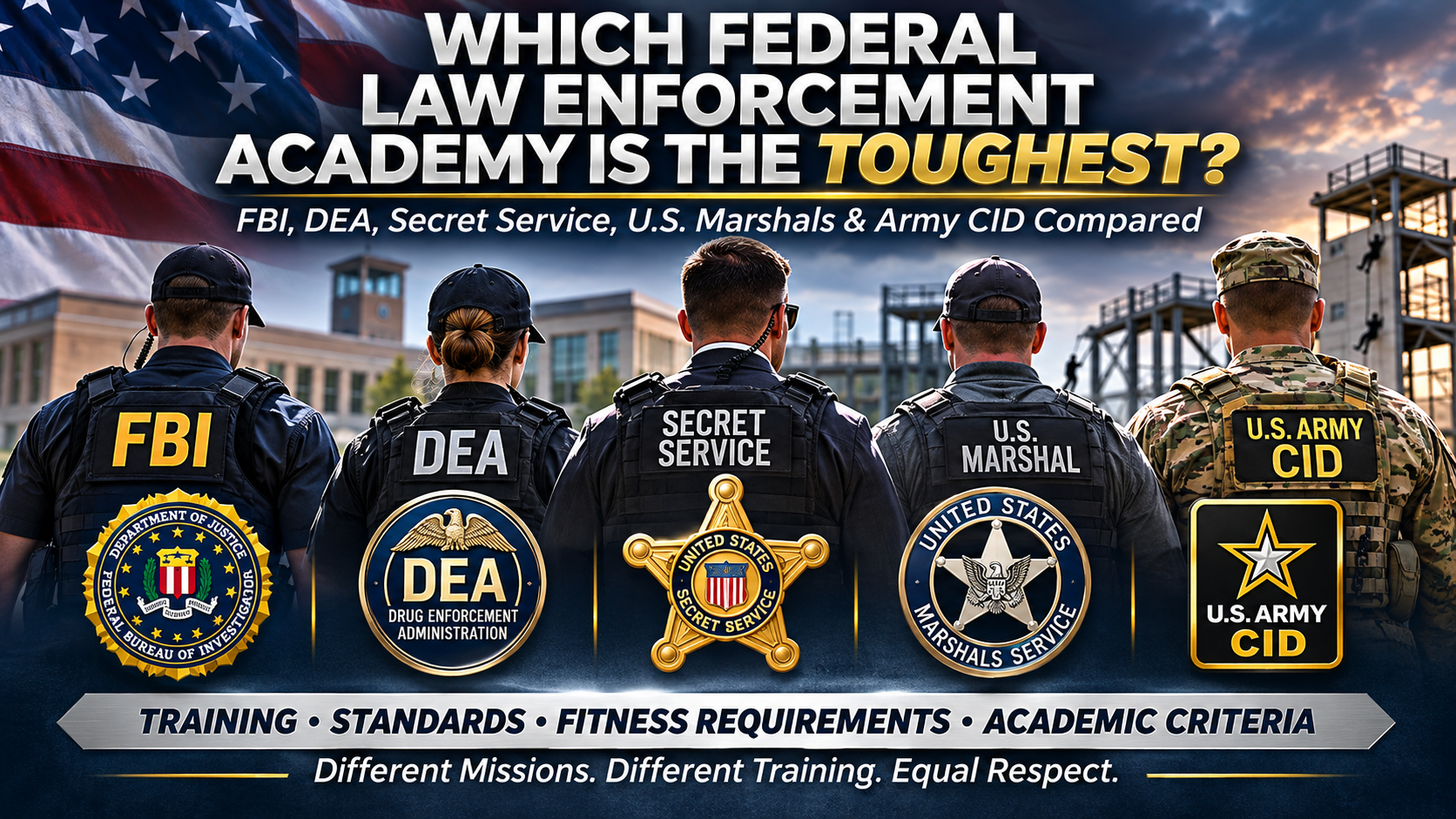
Which Federal Law Enforcement Academy Is the Toughest? Are We Asking the Wrong Question?
Toughest federal law enforcement academy: By Matthew C. Parker
Independent Security Advisors LLC | EPTraining.us
November 13, 2026
Bottom Line Up Front
A recent LinkedIn discussion asked which federal law enforcement academy is the toughest: the FBI, DEA, U.S. Secret Service, or U.S. Marshals Service. Everyone who has graduated from one of these academies probably has an opinion, and I certainly understand taking pride in the training you completed. But before declaring a winner, there is something important we need to consider.
There is no single, approved, unbiased assessment standard that determines which federal law enforcement academy is the toughest. These agencies have different missions. Their academies teach different subjects, emphasize different skills, and assess students according to the responsibilities they will have after graduation.
We reviewed the published training requirements of the four academies and compared them with a military training pathway involving Army Basic Combat Training, Military Police Advanced Individual Training, Criminal Investigation Division (CID) qualification, and additional executive or dignitary protection instruction.
There are measurable differences in training duration, physical fitness requirements, academic assessments, and practical exercises. Those differences are worth examining. But an FBI agent, Deputy U.S. Marshal, Secret Service agent, State Department Diplomatic Security agent, and military criminal investigator should be evaluated against the duties each is expected to perform.
Training is supposed to prepare people for their assigned missions, not win an argument about whose academy is tougher.
Four Federal Academies, Four Different Missions
The FBI, DEA, Secret Service, and U.S. Marshals Service are all federal law enforcement agencies. However, their basic training programs are designed to produce different specialists.
| Federal agency | Published initial training | Principal mission and training emphasis |
|---|---|---|
| FBI | Approximately 18 weeks | Federal criminal investigations, national security, intelligence, evidence, interviewing, surveillance, and investigative operations |
| DEA | 14 weeks | Drug trafficking investigations, criminal law, surveillance, firearms, tactical operations, driving, and evidence collection |
| U.S. Secret Service | Approximately 32 weeks, including introductory, FLETC, and agency-specific instruction | Criminal and financial investigations, protective intelligence, physical protection, advance work, and emergency response |
| U.S. Marshals Service | Approximately 19 weeks | Judicial security, fugitive operations, prisoner handling, arrest procedures, firearms, and protective services |
Sources: Official 2025–2026 agency recruiting and training publications.
The FBI’s Basic Field Training Course at Quantico provides more than 800 hours of instruction. Students receive training in federal law, investigative methods, firearms, defensive tactics, and practical investigative scenarios.
The DEA’s Basic Agent Training Program, also conducted at Quantico, prepares students for federal drug investigations. Its current curriculum requires passing scores in nine performance-based disciplines, including firearms, academics, practical exercises, driving, and tactical operations.
The Secret Service follows a longer training pipeline. Agents complete federal criminal investigator training at the Federal Law Enforcement Training Centers (FLETC), followed by agency-specific instruction at the James J. Rowley Training Center. This includes both criminal investigations and protective operations.
The Marshals Service trains at FLETC in Glynco, Georgia. Its curriculum covers the responsibilities of Deputy U.S. Marshals, including fugitive operations, judicial security, prisoner control, and protective assignments.
Each academy prepares its graduates for the work their agency performs.
An FBI agent investigating organized crime may spend considerable time developing evidence, conducting interviews, and preparing a criminal case. A Deputy U.S. Marshal may be responsible for apprehending a dangerous fugitive or protecting a federal court. A Secret Service agent may be assigned to criminal investigations or protective operations involving national leadership.
These duties require different training. The fact that one program takes longer than another does not establish that it is more difficult.
Federal and Military Training: Side by Side
The military provides another useful comparison because a soldier may complete several separate training programs before becoming a criminal investigator or protective specialist.
Consider a soldier who begins as a Military Police officer, subsequently qualifies as an Army CID Special Agent, and later receives specialized protective operations training.
| Training component | Federal special-agent pathway | U.S. Army Military Police-to-CID pathway |
|---|---|---|
| Initial professional foundation | Federal academy or FLETC criminal investigator training | Basic Combat Training, approximately 10 weeks, incorporated into Military Police OSUT |
| Occupational training | Agency-specific criminal investigation, enforcement, or protective duties | Military Police Advanced Individual Training, approximately nine additional weeks |
| Specialized investigative preparation | Included in the agency’s basic program or completed through additional training | CID Special Agent Course, approximately 15 weeks |
| Physical preparation | Agency-specific physical fitness and operational skills | Military fitness requirements, military field training, and Military Police conditioning |
| Practical assessments | Investigations, firearms, defensive tactics, arrest procedures, and other agency-specific exercises | Military tasks, law enforcement exercises, criminal investigations, evidence processing, and practical assessments |
| Additional protective training | Available or required according to the agency and assignment; included in Secret Service basic training | Specialized executive or dignitary protection training when assigned |
| Continued professional development | Field training, advanced courses, and recurring qualification | Military assignments, investigative field qualification, advanced courses, and recurring training |
Sources: FBI Training, DEA Training, Army Military Police Training, and Army CID Special Agent Course.
The Army’s Military Police One Station Unit Training (OSUT) combines Basic Combat Training and Advanced Individual Training into approximately 19 weeks. Soldiers learn basic military skills, physical conditioning, weapons handling, tactical field skills, and Military Police duties.
The CID Special Agent Course adds approximately 15 weeks of specialized instruction involving criminal law, criminalistics, crime scene processing, interviewing, crimes against persons, economic crimes, and other investigative subjects.
Together, these two formal courses represent approximately 34 weeks of training for the Military Police-to-CID example, excluding intervening service, field qualification, and any later specialized protection training.
A soldier who subsequently attends executive or dignitary protection training adds another professional discipline to that foundation.
This is where I believe the military pathway deserves particular recognition. Someone who completes all these stages has received military, law enforcement, criminal investigative, and protective operations training. In terms of the number and breadth of occupational training stages, that is one step beyond a basic federal criminal investigator academy.
That does not establish that the military individual is more capable than a Secret Service agent or other federal officer. The Secret Service includes protective training in its initial qualification, and federal agencies provide additional specialized instruction throughout their personnel’s careers.
The comparison demonstrates the breadth of one military training pathway, not superiority over another agency.
Comparing Actual Qualification Requirements
While there is no accepted overall toughness rating, several specific training requirements can be compared.
Physical Fitness: What Do the Agencies Actually Require?
Let’s look at what candidates must physically accomplish. Instead of comparing point systems, we can examine actual push-ups, sit-ups, pull-ups, running times, and other exercises. For this comparison, we will use a 25-year-old male candidate. The figures come from the agencies’ published fitness standards.
Physical Fitness Requirements — Male, Age 25
| Agency | Push-ups, sit-ups, and strength | Running and other requirements |
|---|---|---|
| FBI | 40 push-ups and 6 pull-ups | Run 300 meters in 49.4 seconds and 1.5 miles in 12 minutes, 24 seconds |
| DEA | 40 push-ups and 43 sit-ups in one minute | Run 1.5 miles in 11 minutes, 34 seconds |
| Secret Service | 50 push-ups in one minute, 42 sit-ups in one minute, and 7 chin-ups | Run 1.5 miles in 12 minutes, 51 seconds |
| U.S. Marshals | 33 push-ups in one minute and 40 sit-ups in one minute | Run 1.5 miles in 12 minutes, 18 seconds |
| U.S. Army | 14 hand-release push-ups in two minutes, deadlift 150 pounds three times, and hold a plank for 1 minute, 25 seconds | Run 2 miles in 19 minutes, 45 seconds, and complete the sprint-drag-carry exercise in 2 minutes, 31 seconds |
How to read these figures: The FBI, DEA, and Secret Service use scoring systems that allow different combinations of exercise results to achieve a passing score. The figures above are examples of combinations that satisfy their published standards. The Marshals Service and Army figures are minimum event requirements.
The FBI figures reflect its January 2026 applicant physical fitness assessment. The DEA figures reflect its final pre-employment assessment; academy training also includes a 300-meter sprint. The Secret Service figures reflect its final academy assessment.
Physical Fitness Requirements — Female, Age 25
The agencies also publish separate standards for female candidates.
| Agency | Push-ups, sit-ups, and strength | Running and other requirements |
|---|---|---|
| FBI | 22 push-ups and 3 pull-ups | Run 300 meters in 57.5 seconds and 1.5 miles in 13 minutes, 35 seconds |
| DEA | 22 push-ups and 41 sit-ups in one minute | Run 1.5 miles in 12 minutes, 59 seconds |
| Secret Service | 30 push-ups in one minute, 38 sit-ups in one minute, and 2 chin-ups | Run 1.5 miles in 15 minutes, 26 seconds |
| U.S. Marshals | 16 push-ups in one minute and 35 sit-ups in one minute | Run 1.5 miles in 14 minutes, 55 seconds |
| U.S. Army | 11 hand-release push-ups in two minutes, deadlift 120 pounds three times, and hold a plank for 1 minute, 25 seconds | Run 2 miles in 22 minutes, 45 seconds, and complete the sprint-drag-carry exercise in 3 minutes, 15 seconds |
These figures provide a much clearer understanding of what candidates must do. For example, a 25-year-old male FBI candidate who completes 40 push-ups, six pull-ups, a 49.4-second sprint, and a 12-minute, 24-second run earns enough points to pass the published applicant physical fitness test.
A Secret Service trainee of the same age who completes 50 push-ups, 42 sit-ups, seven chin-ups, and a 12-minute, 51-second run meets the published final academy fitness requirement. The U.S. Marshals Service takes a different approach. A 25-year-old male candidate must complete at least 33 push-ups and 40 sit-ups within one minute each and run 1.5 miles in 12 minutes, 18 seconds.
The Army tests additional physical abilities. Soldiers must lift weights, perform hand-release push-ups, sprint, drag a weighted sled, carry equipment, hold a plank, and run two miles. The Army’s test differs from the civilian agencies because it also measures loaded strength and the ability to move and carry weight. A 25-year-old soldier must meet the required minimum in each event.
These are actual physical performance standards. We can compare exercises directly when the agencies use similar tests. We can also see that the Army measures physical abilities not included in the standard fitness batteries of several civilian agencies. However, the exercises are not always performed under identical conditions. The Army’s hand-release push-up is different from a conventional push-up, and its two-mile run is longer than the 1.5-mile run used by the civilian agencies.
The figures tell us what the organizations require, but they do not establish which entire academy is toughest. That would also require examining the full physical training programs, academic examinations, firearms qualifications, and practical performance requirements.
Academic Requirements
The U.S. Marshals Service publishes a clear academic standard: students must pass five academic examinations with a minimum score of 70% on each. The DEA requires passing scores across nine performance-based disciplines, including academics, report writing, practical exercises, and tactical skills. The FBI, Secret Service, and Army CID also assess legal knowledge, investigative procedures, and practical performance according to their respective curricula. A passing requirement of 80% is numerically higher than 70%. That is an objective comparison. However, the score alone does not tell us how difficult the examinations are.
An examination involving complex investigative problems and applied legal judgment might be more demanding than one primarily testing recall. To evaluate academic difficulty fairly, we would need to examine the actual learning objectives and assessments.
Firearms and Practical Exercises
All five programs require firearms and practical skills training relevant to their assigned missions. Those requirements can be examined through qualification scores, accuracy standards, time limits, mandatory safety procedures, and practical performance evaluations. An 80% firearms qualification is not necessarily more difficult than a 90% qualification if the courses use different targets, distances, timing, and assessment conditions. Likewise, successfully completing a protective movement exercise is different from conducting a criminal investigation, executing a high-risk arrest, or processing a complex crime scene.
These are different professional skills. The appropriate question is whether graduates can perform them safely and competently.
What Does the Federal Government Use to Evaluate Training?
Fortunately, we do not have to invent the principles for evaluating professional training programs. The Federal Law Enforcement Training Accreditation organization (FLETA) has established accreditation standards specifically for federal law enforcement training. Its 2025 Procedures and Standards Manual requires training organizations to identify job-related tasks, develop training objectives from those tasks, establish student competency requirements, assess performance, and review examination results.
Several provisions are particularly relevant:
| FLETA standard | What it addresses |
|---|---|
| 3.04 — Task Validation | Identifying and validating the duties personnel must perform |
| 3.05 — Objective Development | Developing training objectives from job requirements |
| 3.12 — Written Examination and Practical Evaluation Criteria | Establishing standards of competence for students |
| 3.16 — Examination and Practical Evaluation Review | Reviewing assessment results to identify gaps in instruction or evaluation |
Source: FLETA Procedures and Standards, 2025 Edition.
The important point is that FLETA begins with the work graduates will be required to perform. The academy identifies the job requirements, develops instruction around those requirements, and evaluates students against established standards. Under Standard 3.12, training organizations may use numerical passing scores, practical pass/fail evaluations, or other appropriate assessment methods. FLETA provides a recognized system for assessing the quality and development of training programs. It does not establish that one federal academy’s curriculum is tougher than another’s.
That distinction supports the central point of this article: the appropriate measure of a training program is whether its graduates can meet the responsibilities of their assigned mission.
What the Government Accountability Office Found
In August 2025, the Government Accountability Office examined criminal investigator training within the military services.
Its report, Criminal Investigators: Program-Wide Evaluations and Clear Oversight Responsibilities Could Enhance Training Programs, reviewed the Army CID, Naval Criminal Investigative Service, Air Force Office of Special Investigations, and Coast Guard Investigative Service.
GAO found that these organizations conducted course-level reviews and collected training feedback but had not adequately evaluated the effectiveness of their complete investigative training programs. The report recommended better tracking of completed training, defined measures of effectiveness, documented results, and regular program-wide evaluations.
This is relevant because completing a course and demonstrating that an entire training program produces effective investigators are two different measurements. GAO did not determine which military investigative academy was toughest. Its work provides a sound basis for examining whether training requirements are connected to operational responsibilities and whether the results are being properly evaluated. The same principles can be applied when comparing federal civilian training programs.
Diplomatic Security: Another Example of Mission-Specific Training
Although the original LinkedIn discussion concentrated on four federal agencies, the State Department’s Diplomatic Security Service deserves mention. DSS special agents investigate crimes, protect American and foreign officials, and support security operations involving U.S. diplomatic personnel and facilities around the world.
The State Department’s Foreign Affairs Security Training Center provides specialized instruction, including surveillance detection, emergency medicine, firearms, defensive driving, and other protective skills. An agent working at a diplomatic mission overseas encounters responsibilities and operating conditions that may be very different from those of a Deputy U.S. Marshal assigned to judicial security.
Likewise, a Secret Service agent conducting an advance for a presidential visit has different responsibilities than an Army CID agent investigating a serious crime involving military personnel. All are professional law enforcement or protective assignments. Each requires specialized preparation. There is no reason to assume that one training program is automatically superior because its curriculum emphasizes a particular set of skills.
Can Graduation Rates Settle the Question?
Graduation and failure rates might provide additional information, but they cannot settle the question by themselves.
We examined available 2025–2026 graduation information for the four federal agencies and Army CID. Reliable, comparable records identifying how many students entered and graduated from the same training cohorts were not established for all five programs. Accordingly, there is no supported basis for declaring which has the highest non-graduation rate.
Even with complete figures, an evaluation would need to distinguish failures involving academic standards, firearms, physical fitness, and practical performance from voluntary withdrawals and medical or administrative separations. Failure rates are useful performance data, but they must be examined alongside the actual standards students are required to meet.
Conclusion: Give Every Graduate Their Due
All the chest-beating aside, until there is an approved, unbiased standard for determining which training academy’s curriculum is tougher, I think we should simply respect the achievements of the graduates and give each of them their due.
A Secret Service agent is trained for Secret Service responsibilities. An FBI agent is trained for FBI investigations. A Deputy U.S. Marshal, DEA agent, State Department protective agent, and Army CID investigator each receive training developed around their agency’s requirements. Graduating from one academy does not automatically make someone better or worse prepared than a graduate of another academy. Their qualifications should be judged against the missions they are expected to perform.
I would give additional recognition to the military practitioner who completes Basic Combat Training, Military Police AIT, CID Special Agent training, and specialized executive protection instruction. That cumulative training pathway adds military preparation and several occupational disciplines beyond the basic federal criminal investigator course. But that observation does not diminish the accomplishments of civilian federal agents, any more than the length of the Secret Service training program diminishes the accomplishments of FBI, DEA, or Marshals Service graduates.
Each organization has developed its training around the responsibilities of its personnel. Each graduate has completed the program and demonstrated the qualifications required for the position.
Every one of these graduates has our deepest respect.
That should matter more than deciding who gets to claim the toughest academy.
About the Author
Matthew C. Parker is CEO of Independent Security Advisors LLC and Director of Training for EPTraining.us. His professional background spans more than three decades of military service, executive and dignitary protection operations, instructional development, and international advisory work.
Parker served as a U.S. Army instructor and master instructor, including military training management responsibilities. His experience includes protective operations involving international officials, assignments in Iraq, and security training and advisory work in Ukraine. Since establishing ISA in 2011, he has developed executive protection training programs for law enforcement, military, and private-sector protective personnel.
References
- Federal Law Enforcement Training Accreditation — Procedures and Standards, 2025 Edition.
- U.S. Government Accountability Office — Criminal Investigators: Program-Wide Evaluations and Clear Oversight Responsibilities Could Enhance Training Programs, August 22, 2025.
- Federal Bureau of Investigation — New Agent Training.
- FBI Physical Fitness Test — January 2026 Scoring Tables.
- Drug Enforcement Administration — Special Agent Training Requirements.
- DEA Special Agent Test Preparation Guide — 2025.
- U.S. Secret Service — Special Agent Recruitment and Training Brochure, 2025.
- U.S. Marshals Service — Training Academy.
- U.S. Marshals Service — Physical Fitness Standards.
- U.S. Army — Army Fitness Test.
- U.S. Army — Army Fitness Test Commander’s Guide and 2025 Scoring Tables.
- U.S. Army — TRADOC Pamphlet 600-4.
- U.S. Army Military Police School — CID Special Agent Course.
- U.S. Army Criminal Investigation Division.
- U.S. Department of State — Foreign Affairs Security Training Center.
Search FAQ
Which federal law enforcement academy is the toughest?
There is no single approved, independently validated standard establishing which of the four academies is toughest. Each prepares its graduates for different duties.
Does the Secret Service have a longer initial training program than the FBI?
Yes. The published Secret Service initial training pipeline is approximately 32 weeks, compared with approximately 18 weeks for the FBI.
How does Army CID training compare with federal special-agent training?
A soldier following the Military Police-to-CID pathway completes military and law enforcement instruction before specialized criminal investigator training. Additional protective training depends on assignment.
Does FLETA rank federal law enforcement academy difficulty?
No. FLETA accredits law enforcement training programs against standards governing curriculum development, instruction, student assessments, and program evaluation.
Does a higher academic passing score mean an academy is tougher?
Not necessarily. The examinations must also be evaluated for subject matter, complexity, and required demonstrated performance.
What determines whether federal law enforcement training is effective?
Training objectives should reflect the actual duties graduates perform, and assessments should establish whether students have developed the required knowledge and skills.
#FederalLawEnforcement #LawEnforcementTraining #FBIAcademy #DEA #SecretService #USMarshals #ArmyCID #MilitaryPolice #FLETA #ExecutiveProtection