
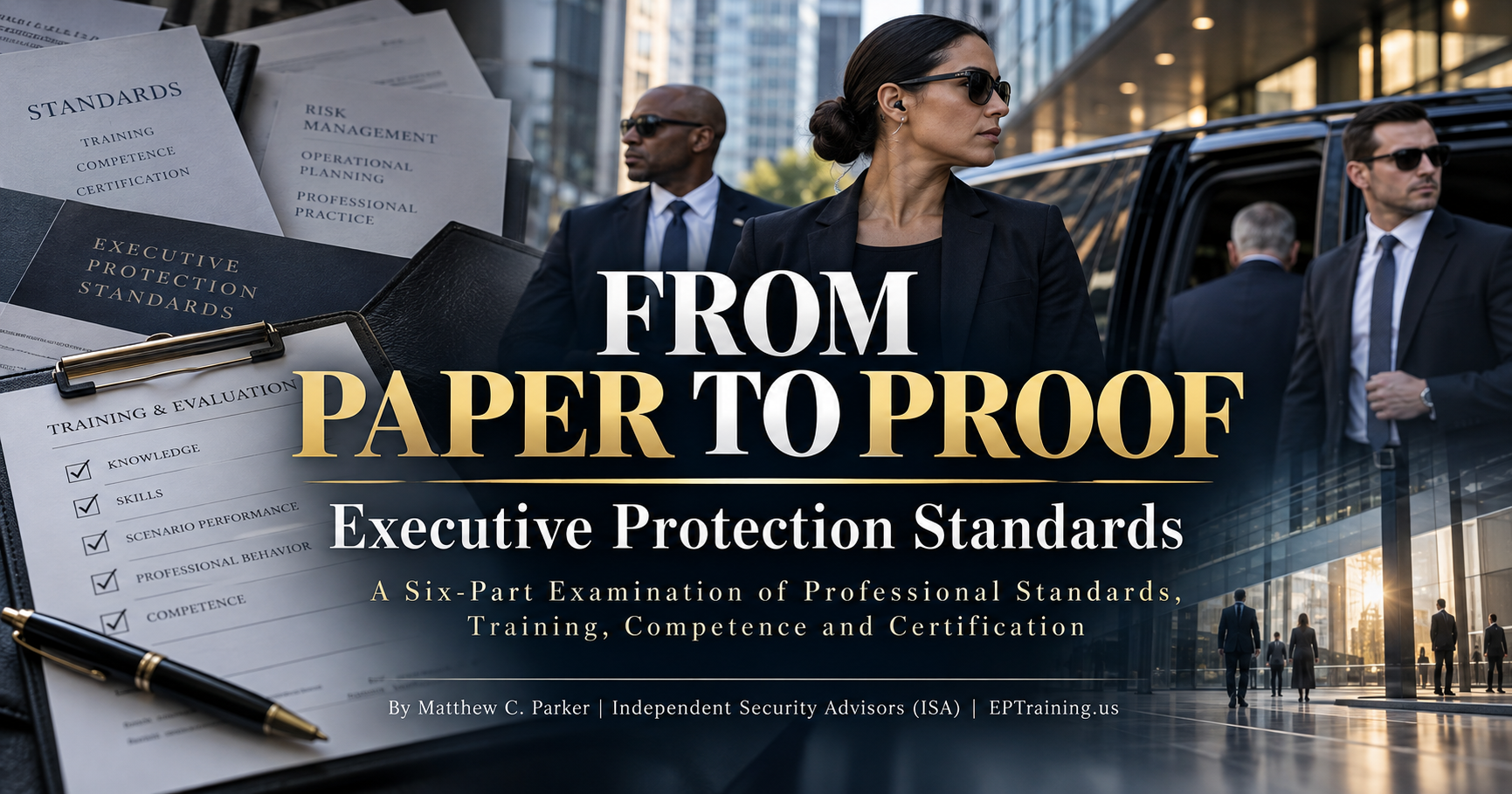
Executive Protection Standards: What Makes a Standard Credible?

Executive protection standards analysis by Matthew C. Parker examining ASIS, BEPP and verifiable professional requirements.

Executive Protection Standards: What Makes a Standard Credible?

Executive Protection Professional Standards: From Paper to Proof — Part 1 of 6

By Matthew C. Parker
Independent Security Advisors (ISA) | EPTraining.us


Independent Security Advisors has been working on measurable executive protection training standards since 2011, a few years before today’s ASIS, BEPP, and ANSI debate. Matthew Parker continues the argument that professional standards must be measurable, testable, and relevant to the people who actually perform protective operations.


Abstract

The publication of new executive protection standards by ASIS International and the Board of Executive Protection Professionals (BEPP) has raised important questions about professional requirements, industry recognition, and the benefits these documents may provide. In an eight-part series, BEPP argues that its ANSI-approved standard can improve hiring, justify protective budgets, support legal compliance and help establish expectations across the profession.

But what actually makes a standard credible? Matthew C. Parker examines the difference between requirements, recommendations, and good practices, the different purposes of the ASIS and BEPP standards, and what ANSI approval does—and does not—establish.


We Have New Executive Protection Standards. What Do They Establish?

In September 2025, ASIS International published its Executive Protection Standard. The Board of Executive Protection Professionals (BEPP) followed in June 2026 with ANSI approval of EPS-2026, its Standard for Providing Executive Protection. BEPP subsequently published an eight-part series examining what it believes its standard will mean for the executive protection profession.

The articles discuss the need for protective services, workplace responsibilities, hiring and qualifications, protective budgets, tax treatment, legal defensibility, international recognition and the expected long-term effects of EPS-2026.

These are subjects worth examining. Employers need qualified personnel, protective programs require adequate funding, and security professionals must understand their legal responsibilities. Establishing common requirements could help the industry address some of these concerns. However, there is a difference between publishing a professional standard and establishing that its requirements are appropriate, effective and useful. 

There is also a difference between a standard and the benefits an organization believes may result from adopting it. BEPP makes a case for why employers and practitioners should use EPS-2026. I believe we should first examine what the document actually establishes. 

What is an agent, protective team or employer required to do? How do we determine whether that requirement has been met? And what does meeting it accomplish?

Those are the questions I would ask of BEPP, ASIS or any other organization publishing professional standards.


A Professional Standard Must Establish Something We Can Check

A credible standard must establish a requirement that can be checked. We should be able to determine who is responsible, what must be done and what constitutes meeting the requirement. That does not mean every standard requires a numerical score. Some requirements can be measured by time, distance, accuracy or performance. Others can be checked through inspection, observation, testing or written records.

For example, a standard requiring an executive protection program to conduct and document a security risk assessment establishes something an employer can verify. We can determine whether the assessment was completed, whether it addresses the required subjects and whether the organization has acted upon its findings.

A requirement to establish emergency procedures can also be checked. Does the organization have those procedures? Are responsibilities assigned? Are the procedures reviewed and tested as required?

Those are professional requirements that can be evaluated. Now consider a statement recommending that an executive protection agent exercise good judgment or consider the legal consequences of an action. Of course an agent should exercise good judgment. And of course the law must be considered. But what exactly does that statement require? How do we determine whether the agent has met it?

Without more specific requirements, these statements provide advice rather than a useful basis for evaluating professional performance. This is why the distinction matters. A recommendation may be sensible, but it does not necessarily establish an obligation that can be checked.


A Recommendation Is Not the Same as a Requirement

In reviewing BEPP’s publication, I encountered extensive material that I would classify as recommendations, general information and established practices rather than professional requirements. Examples include guidance about professional attire, protective formations and the characteristics of protective vehicles.

Some of this information may be helpful, particularly to personnel entering the profession. There is nothing wrong with recommending appropriate clothing or explaining equipment characteristics. But we should distinguish that material from requirements governing protective operations.

Consider a recommendation that an agent wearing a brown belt should wear brown shoes. That is a dress convention. A company may adopt it as part of its appearance policy, and compliance would be easy to determine. But what does meeting that requirement establish about the agent’s ability to provide protection?

An agent may be dressed perfectly and still be unable to prepare a protective advance, recognize a threat, conduct a movement or respond properly to an emergency. The same distinction applies to recommendations concerning footwear. Advice about suitable grip or nonmarking soles may be useful for certain assignments. But footwear appropriate for an office environment may not be suitable for every protective operation. The actual requirement must account for the conditions involved.

BEPP also discusses the differences between armored and unarmored vehicles. Explaining that armor increases vehicle weight and that can affect performance and fuel consumption. This  provides useful background information, but it does not, by itself, establish a standard for selecting or operating a protective vehicle. A requirement concerning vehicle selection should address what must be considered for the assignment, including the threat, operating conditions and protective needs of the client.

The important question is not whether the information is useful. It is whether the information establishes a requirement that serves the purpose of the standard.

A professional standards document can legitimately include recommendations, explanations, illustrations and other guidance. Such material may help readers understand or apply its requirements. My concern is that BEPP’s publication contains extensive advice and general information, but it is not always clear what an agent, protective team or employer is actually required to do.

If we cannot identify those requirements and determine whether they have been met, how can we evaluate compliance with the standard?

BEPP’s publication runs to around 500 pages. Its length reflects a considerable effort by the professionals who contributed to it. But page count does not tell us how much of the material establishes requirements and how much consists of recommendations or instructional information.

I raised these concerns during my review of the publication and in discussions with participants in its development. I questioned how the material was organized and whether its actual requirements were clearly stated, and said this would serve well as a professional guide.

I believe the profession could benefit from both a well-written standards document and a comprehensive professional guide. However, much of BEPP’s publication that I reviewed reads more like a professional guide than a standards document. It contains substantial information, recommendations and good practices, but many of those passages do not establish clear requirements that can be measured or verified. Both types of publications have value, but they serve different purposes.


ASIS and BEPP Are Not Establishing the Same Requirements

The ASIS and BEPP publications are sometimes discussed as though they are competing versions of the same document. Their stated purposes are different, and that distinction matters. The ASIS Executive Protection Standard primarily addresses organizations responsible for developing, operating and maintaining executive protection programs. It concerns how an organization determines the need for protection, assesses risk, assigns responsibilities, provides resources, establishes operating procedures and evaluates the program. Those are management and operational responsibilities that can be checked.

For example, an organization should be able to demonstrate that it conducted the assessments required by its adopted standard, established the necessary procedures and assigned responsibility for carrying them out. The existence of those records does not guarantee that every protective operation will succeed. But it establishes a basis for determining whether the organization met specific requirements.

BEPP’s EPS-2026 takes a broader approach to the provision of protective services. Its material addresses individual agents, protective operations, procedures, professional conduct and related subjects. That creates a different set of questions.

Does a particular provision apply to the employer, the protective team, the detail leader or an individual agent? Does it establish a requirement, or does it recommend a practice? Can someone determine whether the provision has been met?

A requirement suitable for a large corporate protective program may not be appropriate for a small private-family detail. A procedure designed for federal law-enforcement personnel may not be suitable for privately employed agents with different legal authority and resources.

The ASIS standard should be examined against its stated purpose of establishing and managing protective programs. BEPP should be examined against its stated purpose of establishing requirements for providing protective services.


BEPP’s Eight-Part Series Raises Questions Beyond the Standard Itself

BEPP’s eight-part series presents EPS-2026 as a document that can do more than establish professional requirements. It argues that adoption can improve hiring, help justify protective budgets, support legal compliance, strengthen an employer’s position in litigation and encourage international recognition.

These are significant claims, particularly for employers considering whether to adopt the standard. Some may prove useful. A common reference could help organizations prepare job descriptions, establish procedures and explain their protective requirements to management.

But publishing a standard does not, by itself, establish that these benefits will follow. An employer still has to demonstrate that its personnel are qualified, its protective resources are appropriate and its actions comply with applicable law.

Likewise, ANSI approval does not establish eligibility for a particular tax benefit or guarantee that an employer will be protected from liability.

BEPP has explained what it believes its standard can accomplish. The next question is what evidence supports those claims.

The final article in this series will examine BEPP’s eight-part argument in greater detail, including its claims concerning hiring, budgets, legal responsibilities, taxation and international recognition.


Where ANSI Fits Into the Discussion

BEPP promotes EPS-2026 as an American National Standard approved by the American National Standards Institute (ANSI). The designation deserves an explanation because readers may reasonably assume that the United States government has approved EPS-2026 as the national standard for executive protection. It has not.

ANSI is a private, nongovernmental organization. It operates a voluntary consensus standards system and approves documents as American National Standards under its procedures. That designation is not a federal executive protection regulation, and it does not give ANSI or BEPP governmental authority to establish binding national requirements for the profession.

ANSI approval does establish something important. It indicates that the document satisfied ANSI’s requirements for its standards-development and consensus process. But there is a distinction that should not be overlooked. ANSI’s Board of Standards Review expressly states that it does not evaluate the technical content of the standards it approves.

In other words, ANSI examines whether the required development procedures were followed. It does not independently determine whether BEPP’s protective procedures are correct, appropriate for private-sector operations or effective.

So what does ANSI approval tell us about EPS-2026?

It tells us the document met ANSI’s standards-development requirements. It does not tell us whether BEPP got the executive protection requirements right.

That does not mean the requirements are wrong, nor does it mean the consensus process has no value. It means the document must still be judged by its actual content. An American National Standard may be adopted separately by an employer, included in a contract or incorporated into a government requirement. Those decisions can give particular provisions legal or contractual effect.

But the ANSI designation alone does not make EPS-2026 a mandatory federal standard for executive protection. That is an important distinction when considering the legal and commercial benefits BEPP attributes to its publication.


What Should Happen After a Standard Is Published?

I would like to see employers and protective-service providers examine both standards and report what they find. Which requirements are they adopting? Why are those requirements appropriate for their operations? Can they determine whether they are being met? And what improvements, if any, result from their use?

I am equally interested in the problems they encounter. Some requirements may be unclear. Others may depend on authority or resources unavailable to private-sector personnel. A requirement may be appropriate for a large protective organization but difficult to apply to a small detail. Some provisions may be written so broadly that they provide little guidance on what an organization or agent must actually do. Those concerns should be brought to the attention of the organizations responsible for the standards.

New standards will not always have years of practical use behind them. But the developers should be prepared to examine what works, correct what does not and update the requirements when necessary. Protective operations change. Threats change, technology develops and laws are revised. A requirement should not remain in place merely because it appeared in the first edition of a standards publication.

I also believe employers should distinguish between adopting a professional standard and demonstrating that they meet it. An organization can purchase a standard, cite it in a contract or identify it in a company policy. Those actions do not, by themselves, establish compliance. The question is whether the organization has actually met the applicable requirements and can demonstrate that it has done so. The same question applies to individual protective personnel.


What Makes a Standard Credible? The Answer

A credible executive protection standard must establish clear requirements for the work it claims to cover. We should be able to identify who is responsible, what must be accomplished and how to determine whether the requirement has been met.

Those requirements should be appropriate for the assignments involved, consistent with applicable law and clear enough that an employer, supervisor or practitioner can understand and apply them.

Recommendations, explanations and established good practices may help people understand those requirements. But they are not substitutes for the requirements themselves.

I support the continued development of professional executive protection standards. However, neither the length of a publication, the experience of its contributors nor its approval under a private standards-development process proves that its technical requirements are correct or effective.

A credible standard tells us what must be done, why it matters and how we determine whether it has been done.

That is the test I believe we should apply to ASIS, BEPP and any future executive protection standard.

In the remaining articles of From Paper to Proof, we will compare ASIS and BEPP, examine earlier research into professional competencies, consider how requirements should be tested, explore independent certification and evaluate the benefits BEPP claims for EPS-2026.

Next in the series: Two Executive Protection Standards: The Question Joe LaSorsa Asked 


Frequently Asked Questions

What makes an executive protection standard credible?

A credible standard establishes clear requirements that are appropriate for the work being performed. It should identify who is responsible, what must be accomplished and how an employer or evaluator can determine whether the requirement has been met.

What is the difference between a professional standard and a recommendation?

A standard establishes requirements against which compliance can be evaluated. A recommendation suggests a practice an organization or practitioner may find useful. Both can appear in a professional publication, but the reader should be able to distinguish mandatory requirements from optional guidance.

Does a professional standard always require numerical measurements?

No. Some requirements can be measured through time, accuracy or observed performance. Others can be verified through records, inspection, documented procedures or practical evaluation. The important consideration is whether there is a reasonable method for determining that the requirement has been satisfied.

What is the difference between the ASIS and BEPP executive protection standards?

ASIS’s 2025 standard primarily addresses the development, management, operation and review of executive protection programs. BEPP’s EPS-2026 addresses the provision of executive protection services and includes extensive operational guidance. Their subjects overlap, but the publications have different stated purposes and should be evaluated accordingly.

Does ANSI approval prove that an executive protection standard is technically correct?

No. ANSI approval establishes that the applicable voluntary consensus standards-development requirements were met. ANSI’s Board of Standards Review does not independently evaluate the technical content of the standards it approves. Technical quality and operational usefulness require examination of the actual requirements.

Is an American National Standard legally mandatory for executive protection professionals?

Not automatically. An American National Standard is a voluntary consensus standard. Particular provisions may become binding if they are separately adopted through applicable law, regulation or contract, but the ANSI designation alone does not create a federal executive protection license or override state requirements.

Can an executive protection standard guarantee that a principal will be safe?

No. A standard can help organizations establish responsibilities, prepare personnel, manage risks and evaluate protective operations. It cannot eliminate every threat or guarantee the outcome of a protective assignment.

Does ANSI approval establish the hiring, legal, financial or tax benefits claimed for BEPP EPS-2026?

No. Those potential benefits must be evaluated separately. A professional standard may help employers document procedures, establish qualifications and support management decisions, but actual legal obligations, tax treatment and operational results depend on applicable requirements and the circumstances involved. Part 6 of this series examines BEPP’s employer-facing claims in greater detail.


About the Author

Matthew C. Parker is Chief Executive Officer of Independent Security Advisors LLC (ISA) and Director of Training for EPTraining.us. His professional experience spans more than three decades of military service, executive and dignitary protection operations and training, international security advising, and protective program development.

Before retiring from the U.S. Army in 2011, Parker conducted protective operations involving senior U.S. military leaders, trained U.S. and Iraqi protective-security personnel, managed military instructional programs, and taught military science at Virginia Tech.

Since establishing ISA in 2011, he has directed executive protection operations in the United States for international government officials and trade delegations, provided protective services for corporate and private clients, and developed protective programs for corporate institutions, and private families.

His international experience includes security-advisory and protective assignments in Ukraine, training Ukrainian police and Judicial Protection Service personnel, and advisory work concerning international commerce, diplomatic protection, and democracy-support initiatives.


Author Organization: Independent Security Advisors LLC (ISA) Training Academy: EPTraining.us

Publisher: Independent Security Advisors LLC  Publisher URL: https://www.eptraining.us/

Article Type: Professional Commentary / Executive Protection Standards Analysis

Recommended Hashtags: #ExecutiveProtection #ExecutiveProtectionStandards #ASIS #BEPP #ProfessionalStandards

Series Navigation

Part 2 — Two Executive Protection Standards:
https://www.eptraining.us/asis-vs-bepp-executive-protection-standards/blog/

Part 3 — Executive Protection Core Competencies:
https://www.eptraining.us/executive-protection-core-competencies-survey-standards/blog/

Part 5 — Executive Protection Certification and the ASE Model:
https://www.eptraining.us/executive-protection-certification-ase-model/blog/


Related ISA Reading

Executive Protection Training Standards: A National Priority?
https://www.eptraining.us/establishing-a-national-standard-of-training-for-executive-protection-training-old-news-to-isa/blog/

Executive Protection Training Standards (2024)
https://www.eptraining.us/executive-protection-training-standards-v2/blog/

Two Executive Protection Standards: The Question Joe LaSorsa Asked
https://www.eptraining.us/asis-vs-bepp-executive-protection-standards/blog/


Primary Standards and Standards-Development Sources

ASIS International — Executive Protection Standard
https://www.asisonline.org/security-news/standards-guidelines/executive-protection-standard/

ASIS International — Executive Protection Standard, Publication and Scope
https://store.asisonline.org/executive-protection-standard.html

BEPP — Standards Development and Approval Updates
https://www.ep-board.org/updates

BEPP — ANSI/BEPP EPS-2026, Standard for Providing Executive Protection
https://www.ep-board.org/product-page/ansi-bepp-eps-2021-standard-for-providing-executive-protection-print

ANSI — Board of Standards Review
https://ansi.org/about/governance-advisory/board-standards-review

ANSI — Essential Requirements for American National Standards
https://ansi.org/american-national-standards/ans-introduction/essential-requirements