
 E-mail us
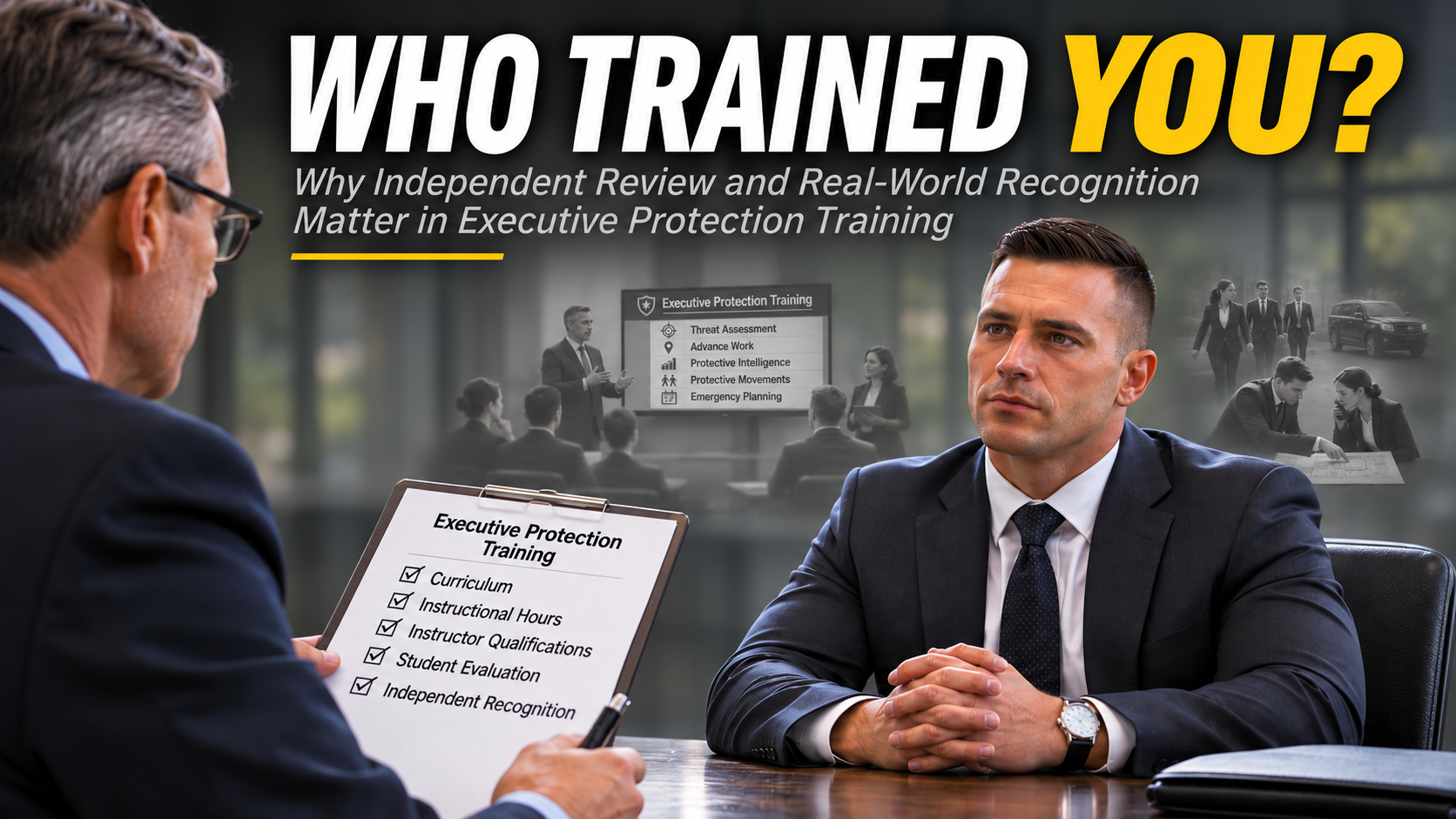
Who Trained You? What an Executive Protection Certificate Really Means to an Employer
Constantine Ioannou asks an important question about executive protection training. A review of decades of professional writing shows why he is right, what other authors have contributed, and 34 questions schools should be prepared to answer.
Executive Protection Training Credibility: By Matthew C. Parker
Chief Executive Officer, Independent Security Advisors LLC
Director of Training, EPTraining.us
Bottom Line Up Front
I recently read an excellent LinkedIn post by Constantine Ioannou titled Who Trained You?. He discusses what he looks for when reviewing an executive protection applicant’s résumé, particularly the importance he places on where the applicant received training. His argument is straightforward: an employer needs to know whether the school behind a certificate has the reputation, instructors, training standards, and professional recognition necessary to give that certificate value.
I agree wholeheartedly with Constantine, and I particularly appreciate that he is raising these questions as someone responsible for employing protective personnel. He isn’t simply recommending his favorite school or telling prospective students to collect more certificates. He is asking whether an employer can trust the training represented by the certificate, and he challenges schools to explain what makes their instruction credible.
I’ve spent much of my professional life developing training programs, supervising instructors, and evaluating students. For the past fifteen years, I’ve also been responsible for developing and managing the executive protection training by Independent Security Advisors. So Constantine’s post caught my attention because the questions he raises are almost identical to those we were trying to answer when we began developing our program in 2011.
What has interested me even more was discovering how many other professionals had been asking similar questions long before Constantine published his post. Some wrote articles specifically about choosing executive protection schools. Others examined training standards, instructor qualifications, accreditation, employment, or the difference between completing a course and being qualified to perform the work.
Several of those professionals became friends and mentors who helped us build ISA’s program. Others published their findings independently, sometimes years after we had already begun addressing the same concerns. All contributed something useful to a discussion that remains important to students, employers, and training providers.
Over the years of reviewing their work, we identified 34 criteria that can help determine the credibility and practical value of executive protection training. I’ll explain where those questions came from, how ISA addressed them, and what an employer should reasonably expect when examining one of our certificates.
Abstract
Executive protection professionals have been questioning the quality of training schools, instructor qualifications, accreditation, and the employment value of certificates for decades. Their work has helped prospective students make better decisions and encouraged training providers to examine whether their programs prepare graduates for actual assignments. Employers have also contributed to that discussion by identifying the qualifications they expect from protective personnel.
This article examines those contributions and explains how several professionals helped influence ISA’s executive protection training. It also considers what an employer should expect from a school named on an applicant’s résumé, using ISA’s curriculum development, independent reviews, and training relationships as examples. The article concludes with 34 questions and answers concerning instructor qualifications, training standards, student evaluation, facilities, outside recognition, and the value of professional training.
Why Constantine’s Question Deserves an Answer
One of the strongest parts of Constantine’s post is his discussion of previous experience and specialized executive protection training. Many people enter this profession from law enforcement, the military, or another part of the security industry. They may bring valuable knowledge and experience, but those qualifications don’t necessarily prepare them for every protective assignment.
A police officer who has spent years conducting criminal investigations may have considerable experience interviewing people and evaluating evidence without ever having conducted a protective advance. A military veteran may understand security, leadership, and emergency response but still need instruction in the laws and operating conditions that apply to private executive protection. The employer needs to determine whether that person’s previous experience and specialized training are appropriate for the assignment.
Constantine also asks who qualifies the people providing executive protection instruction, and I believe that question deserves just as much attention as the subjects being taught. A person can have an impressive operational résumé and still lack the skills necessary to teach. Instructors need to understand how to develop lessons, demonstrate procedures, explain material, conduct practical exercises, and determine whether students have learned what they’re being taught. Those responsibilities require training and experience that may have little to do with the number of protective assignments an instructor has completed. Employers should be interested in those qualifications because the school’s reputation may depend on the people delivering its instruction.
His comments about reputation and recognition are equally important because executive protection schools don’t all operate under the same educational or regulatory requirements. Constantine acknowledges that some schools have earned the respect of the profession through decades of instruction and graduates who have gone on to successful careers. Others have pursued independent accreditation, state training approvals, or recognition through professional organizations. All of that information can be useful, but employers still need to understand what the individual student was taught and what was required to complete the program. A well-known school name may give an employer a reason to examine an applicant more closely, but it doesn’t eliminate the need to evaluate the applicant’s qualifications.
If someone tells Constantine that they attended a particular school, he should be able to learn more than the school’s name and how long the course lasted. Can he examine the curriculum and identify the duties students were trained to perform? Does the school employ qualified instructors, and are students required to pass examinations and practical evaluations? Have government agencies or professional organizations accepted the training for specific purposes, and have established employers used the program?
These are reasonable questions because a training certificate is supposed to provide useful information about the applicant’s education. If the school cannot explain what students learned or how their performance was evaluated, the employer has little reason to rely on the certificate when making a hiring decision.
While reviewing Constantine’s earlier work, I found that he had been addressing these concerns for years. In April 2018, he published Elite Training for an Elite Team, questioning whether companies advertising protective services were providing training suited to the duties their personnel were expected to perform. He also examined instructor qualifications and explained why clients needed more information than a general assurance that security personnel received regular training.
His recent LinkedIn post brings those concerns directly into the hiring process, where an employer must decide whether an applicant’s education and experience are sufficient for a protective assignment. That earlier article helped me understand why Constantine places so much importance on the school behind a certificate.
As I continued reviewing the material, I found that several established executive protection professionals had been asking similar questions long before ISA was established. Their recommendations weren’t always the same, and some approached the problem from the student’s perspective while others were concerned with employers, instructors, or professional standards. But their work provides useful information for anyone trying to determine whether an executive protection school is preparing students for actual assignments.
That earlier research also influenced many of the questions we asked while developing ISA’s program.
The First Question: Did the School Teach the Right Skills?
One of the earliest discussions I found that addressed this problem directly was written by Rick Colliver and published by Harlan “Hucky” Austin through Bodyguard Careers. In February 2009, Colliver wrote a three-part series titled Training to Task, examining how prospective students should select executive protection training. Colliver had experience developing protective instruction for law enforcement and working in corporate security, so he understood that protective assignments could require different skills depending on the employer. An officer assigned to protect a government official might have responsibilities and legal authority different from those of a private agent protecting a corporate executive. His recommendation was that students should understand the work they intended to perform before deciding which school to attend.
Colliver’s argument is directly related to Constantine’s question because an applicant might have completed an excellent training program without being fully prepared for the position being offered. A course developed for law-enforcement personnel may emphasize government protective duties, while corporate protection may require additional instruction involving executive staff, business operations, private-security laws, and client relations.
Both programs can provide valuable training, but the employer needs to know whether the instruction addresses the responsibilities of the job. This also explains why schools should identify their intended students and avoid suggesting that one introductory course prepares graduates for every type of protective assignment.
When ISA began developing its program in 2011, we encountered those same concerns because different organizations were asking us to train personnel with different responsibilities and previous experience.
Colliver was building on an established body of executive protection literature. Philip Holder and Donna Lea Hawley, Dr. Richard W. Kobetz, Robert L. Oatman, and Dale L. June had already published books explaining protective responsibilities, operating methods, and the knowledge necessary to conduct protective assignments. Their publications weren’t all written to evaluate training schools, but they gave practitioners and course developers material they could examine when identifying what students needed to learn.
A school developing an executive protection curriculum should be familiar with the established work in the profession, just as it should examine government training references and applicable legal requirements. Colliver took that discussion further by asking whether the training was appropriate for the specific work the graduate intended to perform.
Hucky Austin expanded these concerns through Bodyguard Careers, which he established in 2006. His articles have helped prospective students understand school selection, employment, networking, professional conduct, and the financial commitment involved in entering executive protection. In December 2025, Austin returned to the employment question in Executive Protection Skills Aren’t Enough: The Biggest Hiring Lie, explaining why technical skills alone don’t establish a successful career.
Agents also need professional relationships, communication skills, reliability, and a reputation for conducting themselves properly. I agree with him because a school can provide instruction and evaluate specific skills, but it cannot give someone years of operational experience or guarantee employment after graduation.
Other authors reinforced that recommendation by examining how education and experience contribute to professional development. Christopher A. Hertig and Chris Richardson addressed career planning in their 2010 contribution to The Professional Protection Officer, while Doc Rogers published practical employment advice through Bodyguard Careers. Robin Barratt combined many of those concerns in his 2014 manual, Finding Work as a Close Protection Specialist, which examined training schools, professional qualifications, résumés, employment opportunities, and the financial realities of entering the profession.
Their recommendations help answer a question students frequently ask before enrolling: Will executive protection training help me get a job? Proper training may improve a person’s qualifications, but employment also depends on experience, professional conduct, and whether the applicant meets the employer’s requirements.
Colliver, Austin, Barratt, and the other career advisers approached the problem primarily from the student’s perspective. They wanted people entering executive protection to understand what training could accomplish and what responsibilities remained after graduation.
Constantine is examining the same issue from the employer’s side, but he needs much of the same information. If a school cannot explain what work its graduates were prepared to perform, the employer has to determine whether the certificate provides any useful evidence of the applicant’s qualifications.
That leads to another question the earlier authors raised: even when a school teaches the appropriate subjects, how do students and employers determine whether the instruction meets a reasonable professional standard?
Tony Scotti Wanted Schools to Explain Their Standards
Tony Scotti spent years encouraging executive protection training providers to explain what students were learning, how their performance was evaluated, and what their certificates actually represented. His advice was particularly useful because it gave prospective students questions they could ask before spending money on training. In April 2016, Tony published EP/Security Driving Training — Certification and Experience, examining the relationship between professional training, credentials, and experience.
He questioned whether students understood what qualifications they were purchasing and whether employers could determine what the certificates represented. A school-issued certificate may be valuable, but students should understand whether it confirms course completion, successful evaluation, or a professional certification awarded under requirements established outside the school.
Tony returned to career development in February 2019 when he and the International Security Driver Association published a 19-point Protective Services Roadmap Checklist. He followed that in June 2019 with an article titled What Training Programs Should I Attend?, examining how students could compare the many executive protection schools being recommended online. Tony explained that the International Security Driver Association had reviewed social-media discussions in which more than seventy executive protection and security-driving training providers had been recommended in less than a month.
Think about that from the prospective student’s position. Seventy schools are being recommended, often by people whose experience with the training is unknown, and the student has to determine which program is appropriate.
Tony offered a more useful way to approach that decision by encouraging students to examine the school’s training standards, instructors, curriculum, evaluations, and graduate outcomes. A recommendation from a friend may be helpful, but it doesn’t establish that the course teaches the skills the student needs. Schools should be prepared to explain what they teach, how students are measured against the requirements, and what must be accomplished before a certificate is issued.
Those questions are also useful to employers because they provide information about what the graduate was actually required to learn. A school that can explain its instructional requirements gives employers more to consider than a list of course subjects and an instructor’s biography.
I thought Tony’s questions were excellent because they gave schools an opportunity to examine their own work. Instead of simply recommending that other organizations adopt his approach, ISA incorporated his recommendations into our year-end review and published the results in January 2020 in Self-Reflection and Evaluation of the ISA Executive Protection Training Program.
We examined our curriculum, instructor qualifications, practical exercises, student evaluations, and training records against the concerns he had raised. The process also encouraged us to identify where additional instruction or revisions might be necessary. Tony was asking schools to explain what stood behind their certificates, while Constantine is asking whether that information gives an employer confidence in the applicant’s preparation.
The People Who Helped Us Develop ISA
Tony Scotti and Joe Autera were important to ISA long before our 2020 review. In March 2011, I attended training with Joe at the Vehicle Dynamics Institute, where he explained how the protective-driving program used established principles of vehicle dynamics and measurable performance standards. I was impressed because the instruction was organized around what students had to accomplish rather than simply what an instructor intended to present. Students weren’t watching someone demonstrate a maneuver and receiving a certificate for attending; they were required to perform the tasks and meet established standards. Joe’s approach reinforced the importance of developing instruction that produced results an instructor could observe and evaluate.
Joe and Tony became friends and mentors as we developed ISA’s program, and our discussions often concerned curriculum development, training standards, outside review, and the problems associated with teaching specialized subjects during one short course. One of those discussions became public in June 2014 when Tony published What Do You Think?, questioning whether protective driving, surveillance detection, emergency medical training, and other specialized skills should be taught as separate programs. I agreed that those subjects needed sufficient instructional time, properly qualified instructors, appropriate equipment, and practical evaluations.
A short introductory course might familiarize students with the material without preparing them to perform the skills professionally. That advice influenced ISA’s development of a broader Executive Protection Studies Program, with additional specialized instruction available beyond the core course.
Dr. Richard W. Kobetz, founder of the Executive Protection Institute, was another friend and mentor whose experience was valuable during our original assessment. His years developing executive protection education helped us examine what was involved in building a professional training program rather than simply arranging for experienced agents to conduct classes. I also want to acknowledge Bob Oatman, Carl Persons, Rik Kirchner, Charles Reinhold, and Robert Mueck, who contributed advice concerning protective operations, instruction, accreditation, and the transition from government to private-sector work.
Other professionals, including Eric Parker, Raffaele Di Giorgio, and instructors from law enforcement and corporate security, who also shared their knowledge and participated in our programs. Their contributions helped us examine subjects that required additional instruction and determine how practical skills should be taught and evaluated.
I discussed some of that history in our December 2023 article, Executive Protection Training: A Little More Transparency Is Good. We didn’t develop ISA’s curriculum entirely from our own experience because there was already a substantial body of professional knowledge available, and experienced instructors had spent years developing effective methods. We examined that work, consulted people with specialized expertise, and incorporated recommendations that helped us prepare students for the duties they would be expected to perform.
The people advising us contributed to the development process, but ISA remained responsible for preparing the lessons, qualifying instructors, evaluating students, and meeting the requirements of organizations reviewing the program.
Other Authors Challenged the Industry to Improve
While ISA was developing its training, other professionals were examining the value of certificates, the qualifications employers expected, and whether traditional courses adequately prepared students for private-sector assignments.
In April 2016, James Cameron published Executive Protection Training Pitfalls, questioning how schools described their credentials and whether students understood what those qualifications represented. Frank Gallagher raised concerns about employment and the importance of experience, which I addressed in Training and Jobs in Executive Protection — Another Perspective, published through Tony Scotti’s website in June 2016.
Both discussions involved questions employers should consider. A certificate should accurately describe the training completed, but it doesn’t replace professional experience or establish that a graduate is qualified for every assignment.
Christian West examined another part of the problem in his June 2018 article, It’s Time to Rethink Executive Protection Training. West questioned whether traditional programs placed enough attention on corporate culture, communication, professional judgment, and the responsibilities agents face when working with private clients. I agreed with much of his argument and published ISA’s response on June 26, 2018, explaining how the subjects he raised related to our curriculum.
An agent may understand protective movements and emergency procedures but struggle to coordinate with an executive assistant, communicate with corporate security, or work within the client’s business environment. Those activities are part of a protective assignment, and schools preparing students for corporate work need to address them.
West continued examining training standards with Jared Van Driessche in their 2018 article, The Executive Protection Industry Lives in a Glass House. Let’s Improve Standardization Instead of Throwing Stones. The following year, West and Brian Jantzen published It’s Time to Talk About Standardization of the Executive Protection Industry, questioning how students and employers could compare schools using different curricula, teaching methods, instructor requirements, and graduation standards.
ISA responded with a peer review in January 2020, supporting efforts to improve training while encouraging participation by employers, instructors, established schools, and organizations responsible for regulating protective services.
I don’t agree with every recommendation made by the authors discussed here, and I wouldn’t expect everyone to agree with ISA’s approach. But the concerns they raised deserve examination because they affect how students evaluate schools and how employers interpret certificates. Two programs may advertise similar subjects while requiring students to complete very different instruction and evaluations.
One school may issue a certificate primarily for attendance, while another requires written examinations and demonstrated practical skills. Employers need that information before deciding what weight to give the qualification, which brings us back to Constantine’s argument about the meaning of the school named on a résumé.
What Employers and Researchers Have Added
The discussion becomes more useful when we examine the work of researchers, employers, and recruiters who are not responsible for promoting a particular executive protection school. In 2018, ASIS International and the Security Industry Association published the Security Industry Career Pathways Guide, developed with McKinley Advisors. The research examined education, experience, and professional qualifications associated with different security careers.
In 2020, the ASIS Executive Protection Council worked with the University of Nebraska Public Policy Center to produce the Executive Protection Professionals Core Competencies Survey Report. Both projects provided useful information about the knowledge and skills associated with protective work, which schools can consider when determining what their students need to learn.
Those studies did not establish that every person claiming a particular skill could perform it, nor did they determine that one school was necessarily better than another. Identifying professional competencies is useful when developing a curriculum, but the school still needs to teach the material and evaluate whether students have met the requirements.
Employers then need to examine whether those qualifications are appropriate for the position being filled. The research helps explain what should be taught, while the school’s lesson plans, practical exercises, and examinations help establish what individual graduates were required to accomplish.
Other authors approached the problem more directly. The World Protection Group questioned poorly developed courses in its 2022 article, Pop-up Schools and Online EP Training, while security recruiters Jerry J. Brennan and Joanne R. Pollock examined employment credentials in Certifications and Your Security Career. Brennan and Pollock’s discussion was particularly relevant because employers decide whether a credential applies to the work and whether the applicant possesses the necessary experience. A school may consider its training excellent, but the employer still has to determine whether it meets the company’s requirements.
Alan Saquella and Jim McConnell examined other responsibilities associated with employment. Saquella addressed personal suitability in The Case for Personality Assessments in Executive Protection, while McConnell’s Executive Protection, Before the EP 101 Class encouraged prospective students to understand the profession before investing in training. Both raised matters that may not be apparent from a certificate.
An applicant can understand protective procedures but still lack the judgment, temperament, communication skills, or professional conduct necessary for a particular assignment. Those are responsibilities the employer must evaluate alongside formal education.
More recent commentary by Jordan Gonzalez, Eric Boyer, Evan Levitt, and other practitioners has continued examining school selection, certification, accreditation, and practical instruction. Some emphasize formal recognition, while others concentrate on whether students can perform the responsibilities employers assign them.
Their discussions reinforce the need for schools to explain their training and for employers to examine whether the qualifications are relevant to the job. Constantine brings those concerns directly to the hiring process by asking what the school’s name tells him about the applicant.
ISA’s experience provides examples of how a training organization can respond to those questions through its curriculum, instructional requirements, outside reviews, and professional relationships.
What We Did With That Advice
When we began developing ISA’s executive protection program in 2011, we were responding to requests from law-enforcement agencies that needed training for officers assigned to protect public officials. We initially developed a 50-hour course, but as we examined the responsibilities of those officers, we realized that the training needed to address considerably more than protective formations, movements, and emergency procedures.
So, before deciding what subjects to add or how many hours to assign them, we used the Instructional Systems Design (ISD) process to examine what protective personnel were expected to accomplish. That required identifying the knowledge and skills associated with their duties, determining what instruction was necessary, and establishing how students would be evaluated. We wanted the curriculum to be based on the work students would perform rather than simply on the subjects individual instructors preferred to teach.
We didn’t rely entirely on our own experience to determine those requirements. We examined existing government and private-sector training, reviewed employment announcements, and spoke with people who would ultimately employ our graduates. Those consultations included corporate executive protection managers, hiring managers, government instructors, experienced agents, regulatory personnel, and people who received protective services.
The hiring managers were particularly useful because they explained what employers expected beyond traditional protective skills. They needed agents who could assess threats, conduct advances, prepare operational plans, communicate with executive staff, coordinate transportation, work with outside agencies, and understand the legal limitations of private protective operations.
Those consultations also helped us understand why a course developed for law-enforcement officers might require changes before being offered to private-sector personnel. Police officers and private agents may use similar protective methods, but they operate under different legal authorities and often have different relationships with the organizations and people they protect.
Corporate employers also expected agents to understand professional communications, executive staff relations, and the operating procedures of their clients. We incorporated those requirements into the curriculum and later conducted a substantial review of our corporate protection material in 2016. That work followed the same principle Colliver had discussed in Training to Task: training should prepare students for the assignments they intend to perform.
We used the information gathered during our assessment to develop individual lessons and evaluations. If an employer expected an agent to conduct an advance, we identified what the student needed to know, developed the instruction, provided opportunities to practice, and established how performance would be evaluated. Simply placing “Advance Work” on a syllabus and assigning several hours to the subject wasn’t enough.
Students needed to examine locations, identify potential problems, prepare plans, explain their recommendations, and demonstrate an understanding of the procedures. We followed the same approach with threat assessments, protective intelligence, communications, transportation planning, and emergency response.
The process took approximately a year and resulted in a larger curriculum with formal lesson plans, learning objectives, practical exercises, and student evaluations. It also required us to use instructors with specialized qualifications instead of assuming that one experienced executive protection agent could adequately teach every subject. The Federal Law Enforcement Training Centers’ Protective Service Operations Training Program provided an important reference, along with other government instructional methods, applicable state requirements, and established private-sector publications.
We examined those resources and used appropriate methods to develop ISA’s own training. Following government instructional methods does not make ISA a federal academy or mean FLETC accredited our program; it means we examined established practices while developing the lessons and evaluations we intended to use.
The curriculum has continued changing as new threats, technology, and operational lessons have emerged. Our later training work in Ukraine provided additional opportunities to examine how protective instruction needed to account for different threats and operating conditions, while our ongoing reviews have addressed subjects such as drones, protective intelligence, and emergency planning.
Those experiences came after our original program was established, but they contributed to our continuing review of the material. Throughout that work, our responsibility has remained the same: identify what students need to accomplish, provide the necessary instruction, and determine whether they can perform the required tasks.
Developing a course we believed was appropriate was only part of that responsibility, however, because employers also needed a way to determine whether the program satisfied requirements established outside ISA.
Why We Invested in Independent Review
I’ve always supported legitimate accreditation and outside review because I don’t believe a training school should be the only organization deciding whether its curriculum, instructors, instructional hours, and student evaluations are acceptable. We wanted organizations responsible for professional training requirements to examine our work and determine whether the program met the standards they had established.
That meant preparing formal lesson plans, documenting instructor qualifications, identifying instructional hours and learning objectives, developing examinations, maintaining student records, and explaining how the courses satisfied applicable requirements. It also required considerable time and money because we spent hundreds of hours beta-testing instruction and evaluating the curriculum while purchasing computers, communications equipment, vehicles, training aids, and other resources needed to conduct the classes.
I discussed those investments in our July 2018 article, Our Marketing Was Lacking, But Until Today We Didn’t Care, explaining why we devoted so much effort to developing the program before making a serious attempt to market it to the broader civilian executive protection industry.
Different employers needed different types of training recognition, so our efforts weren’t limited to obtaining one approval or endorsement. A private protective company might need training accepted for state licensing, while a law-enforcement department might require instruction recognized for officer in-service credit. Other organizations could be interested in educational recognition, professional endorsements, or evidence that established employers had used the training.
Virginia was one of our early successes because the Department of Criminal Justice Services approved ISA in December 2014 as an alternative training provider for its 32E Personal Protection Specialist entry-level and 32I in-service requirements. ISA remains listed on the Virginia DCJS website for those training alternatives, giving employers a way to verify the state’s acceptance of the applicable courses.
That approval serves a practical purpose for companies providing regulated protective services in Virginia. When an employer needs personnel to complete training associated with Personal Protection Specialist registration, it can examine the state’s listing and determine whether ISA offers an accepted alternative. The employer isn’t required to rely entirely on our description of the program, although employees must still satisfy any remaining registration and licensing requirements.
This was one of the reasons we considered independent review so important during the development of our courses. We wanted employers to have information from the agency responsible for establishing the requirement, rather than asking them to accept our word that the training was sufficient.
North Carolina provides another example, while also raising a question about the amount of instruction necessary for professional preparation. The state’s Private Protective Services Board requires at least 40 hours of qualifying training under its Close Personal Protection licensing pathway, including legal instruction and practical exercises. The Board has included two ISA courses on its preapproved training list, allowing students and employers to determine whether those courses satisfy the applicable training requirements.
Our broader seven-day executive protection program includes substantially more material, with the January 2025 syllabus identifying an 84-hour program and approximately 60 to 70 hours of classroom and field participation, along with additional study and preparation. We developed that additional instruction because our assessment identified responsibilities requiring more time to teach, practice, and evaluate, not simply because we wanted to advertise a longer course.
I’ve addressed this concern before, including in our February 2025 article, Executive Protection Training Standards: One Step Above Inadequate. A 40-hour course may satisfy a state’s minimum licensing requirements, and there is nothing improper about providing instruction for that purpose. However, employers may expect their agents to conduct threat assessments, prepare advances, coordinate protective movements, communicate with executive staff, and manage emergencies.
Those responsibilities may require additional instruction beyond the licensing minimum, depending on the student’s previous training and the duties associated with the assignment. More hours don’t automatically make a course better, but the program needs enough time to teach and evaluate the subjects its graduates will be expected to perform. Employers should therefore examine the actual curriculum and graduation requirements rather than select training solely by the number of hours advertised.
Our law-enforcement students presented another need because police departments often require instruction accepted for professional development or in-service credit. The South Carolina Criminal Justice Academy’s 2026 Institutional Provider Catalog lists ISA’s Dignitary and Executive Protection Specialist Course under lesson plan 5365 for 70.5 hours of law-enforcement in-service training.
That recognition gives police departments a way to examine the course’s acceptance for a specific training purpose, particularly when officers are assigned to protect a mayor, judge, elected official, or visiting dignitary. Although those officers may already have substantial police training and operational experience, protective assignments still require specialized preparation. South Carolina’s listing addresses law-enforcement in-service credit, while Virginia’s approval concerns alternative Personal Protection Specialist training and North Carolina’s preapproval concerns its Close Personal Protection licensing pathway.
Each serves a different purpose, and we identify the relevant approval so an employer or agency can determine whether the course satisfies its particular requirements.
We also pursued recognition beyond state licensing and law-enforcement training. ISA’s history includes a 2014 educational credit agreement with Henley-Putnam University and a 2015 recognition-of-prior-learning arrangement involving Industry Qualifications Limited in the United Kingdom. Those former educational arrangements are no longer maintained as current academic agreements, but the work involved taught us how educational organizations examine curricula, instructor qualifications, and student achievement.
The International Foundation for Protection Officers also endorsed ISA’s executive protection training and has publicly acknowledged its relationship with our organization. These relationships contributed to the program’s development and professional history, although their purposes and requirements were not identical. Students should understand which organizations have accepted a particular course and what educational or professional recognition may actually be available.
Independent approvals need to be described accurately because one organization’s acceptance does not automatically establish eligibility under another system. State training approval does not, by itself, mean that a school holds institutional accreditation recognized by the U.S. Department of Education, qualifies for Department of Veterans Affairs education benefits, or meets the requirements for federal education tax benefits.
Those programs have their own eligibility rules, and students should be able to determine which benefits, if any, apply before enrolling. We weren’t pursuing outside review simply to collect impressive names for our website; we wanted to establish that our training could meet requirements developed by organizations independent of ISA.
When an employer sees ISA on an applicant’s résumé, we can identify the curriculum, explain how students were evaluated, and provide information about the organizations that have accepted particular courses. The employer can then examine that information and determine whether the training is relevant to the position being filled.
What Employers Have Done With ISA Training
Independent regulatory recognition provides one way for employers to verify a course’s acceptance, but Constantine’s question also concerns whether companies that employ protective personnel recognize and use the school’s training. We began addressing that issue during ISA’s original curriculum development by consulting hiring managers and corporate security directors about the qualifications they expected from protective agents.
Their recommendations helped us determine what subjects to teach and what skills students needed to demonstrate. As the program developed, those relationships expanded beyond curriculum advice because companies and public agencies began sending employees to our classes, sponsoring training programs, contributing experienced instructors, and working with ISA to provide instruction suited to their personnel. Those relationships are useful because they show how employers have used ISA’s training rather than simply what we claim about our own program.
Our public training history includes examples involving Red Five Security, Samaritan Protective Services, and Axios Security Group, although each relationship developed for a particular professional purpose. In March 2018, Red Five Security sponsored an ISA course hosted by the George Mason University Police Executive Protection Unit. Red Five founder and CEO Kris Coleman visited the program, spoke with students, and shared his professional experience.
In June 2019, Samaritan Protective Services sponsored a course at the Anne Arundel County Police Academy and also offered an ISA training seat as an employment benefit associated with obtaining Virginia Personal Protection Specialist credentials. These examples demonstrate that established organizations have found professional uses for ISA’s training, whether by supporting instruction or helping personnel obtain credentials required for their work.
In 2025, ISA announced a professional relationship with Axios Security Group, and its CEO, Jereme Dozier, later contributed instruction in surveillance and counter-surveillance during a course conducted at the Fulton County Public Safety Training Center. Our training history also includes graduates and personnel associated with private protective companies, corporate security departments, government organizations, and law-enforcement agencies.
Public professional profiles identify ISA training among the credentials of people working for established security employers, including personnel associated with Global Guardian. I consider those examples useful because they help establish that professional organizations have encountered our training, but they don’t necessarily mean that every company formally endorses the entire curriculum.
We should describe those relationships accurately because a company sending employees to a course, sponsoring a class, providing an instructor, or formally endorsing a program are different activities. A person listing ISA on a résumé also doesn’t prove that the employer hired that individual because of our training, and individual examples cannot establish a reliable employment-placement percentage.
For Constantine, or anyone else reviewing an executive protection applicant’s qualifications, the value of this information is that it provides another way to examine the school’s professional history. The employer can determine what the program teaches, what students must accomplish, which outside organizations have accepted the training, and whether established protective-service companies have used it. Together, those records provide a more useful answer than simply presenting a list of companies and suggesting their names establish the school’s reputation.
Thirty-Four Questions Every Executive Protection Training Program Should Be Prepared to Answer
After reviewing Constantine’s article, the earlier publications, professional research, state training requirements, and our own experience, we consolidated the recurring recommendations into 34 questions. I don’t claim that ISA originated all these ideas because many came from the professionals discussed above, while others developed through established instructional methods, regulatory requirements, and the problems we encountered building our own program.
We’ve organized them into questions that students, employers, and training providers can use when examining executive protection education. Rather than publish another checklist and leave everyone else to answer it, I believe ISA should begin by explaining how our program addresses each requirement.
Recognition, Accreditation, and Employer Confidence
Constantine places considerable importance on the school named on an applicant’s résumé, but the value of that name should come from what the school can demonstrate about its training. The first seven questions examine whether an organization is authorized to provide its courses, what outside recognition it has received, and whether employers have used its instruction. Together, those records help determine what an employer can reasonably learn about a school before examining the individual student’s qualifications.
1. Is the school legally authorized to provide the training it advertises?
ISA has operated its executive protection training division since 2011 and conducts courses under the requirements applicable to the training and locations involved. When a course is intended to satisfy a state licensing requirement, we identify the specific program and regulatory approval. A business registration alone doesn’t authorize a company to provide every form of regulated training, and approval in one state doesn’t necessarily apply in another. Students should understand what training the school is authorized to provide, particularly when completing the course is intended to satisfy professional licensing requirements.
2. Have government agencies reviewed and accepted the training?
Virginia’s Department of Criminal Justice Services lists ISA for its 32E Personal Protection Specialist entry-level and 32I in-service training alternatives. North Carolina’s Private Protective Services Board lists two ISA courses for its Close Personal Protection licensing pathway, and South Carolina’s Criminal Justice Academy identifies our 70.5-hour Dignitary and Executive Protection Specialist Course for law-enforcement in-service training. These agencies accepted specific courses for defined purposes, and employers can examine those records to determine whether the recognition applies to the position being filled. We provide that information rather than simply advertise that ISA is recognized by government agencies.
3. Does the school have independent accreditation or other recognized educational approval?
ISA supports independent accreditation and review because schools should be willing to have their work examined against requirements established by outside organizations. We have pursued state course approvals, professional endorsements, law-enforcement training recognition, and educational agreements. Those credentials need to be identified accurately because they don’t all carry the same authority.
State training approval and professional endorsement are not automatically equivalent to institutional accreditation recognized by the U.S. Department of Education. When a school claims accreditation, students should be able to identify the approving organization, the program covered, and whether the recognition remains current.
4. Has a recognized professional organization endorsed the program?
The International Foundation for Protection Officers endorsed ISA’s executive protection training and has publicly acknowledged its relationship with our organization. IFPO’s involvement in professional security education makes that recognition relevant to our training history. The endorsement doesn’t replace state licensing requirements or establish that every graduate is qualified for every protective assignment.
We identify the professional organization and its relationship with ISA so students and employers can determine what was recognized. Schools should explain their endorsements accurately rather than suggest they carry authority that belongs to government regulators or educational accrediting agencies.
5. Have colleges, universities, or educational qualification organizations recognized the training?
We pursued educational recognition because we wanted graduates to have opportunities beyond receiving an ISA certificate. Our history includes a 2014 educational credit agreement with Henley-Putnam University and a 2015 recognition-of-prior-learning arrangement involving Industry Qualifications Limited in the United Kingdom. Those former agreements are part of our training history and are not maintained as current academic arrangements. The work involved taught us how educational organizations examine curricula, qualifications, and student achievement. Students seeking college credit or other educational benefits should confirm the current requirements directly with the institution responsible for accepting the training.
6. Do employers actually recognize or use the school’s training?
This was one of the principal concerns during our original needs assessment. We interviewed hiring managers to understand their requirements and later established training relationships with companies and agencies employing protective personnel. Red Five Security, Samaritan Protective Services, Axios Security Group, and personnel associated with Global Guardian are examples from our public training history. Those relationships don’t guarantee that an individual graduate will be hired, but they demonstrate that professional organizations have used or supported ISA’s training. I would encourage students to ask prospective employers what training they recognize and what qualifications they require for the positions being offered.
7. Does the school have an established history that employers can examine?
ISA has spent fifteen years developing, conducting, and revising executive protection training. Our public history includes state approvals, courses conducted at police academies and universities, instructor development, professional relationships, and articles explaining our approach to training. A long history doesn’t automatically establish that a school is good, but it provides information students and employers can examine.
They can ask how the curriculum has changed, which organizations have used the training, and what improvements have been made. A school should be willing to explain its history rather than expect students to rely entirely on advertising.
Instructor Qualifications and Professional Development
Constantine questions who qualifies executive protection instructors, and I agree with him because a properly developed curriculum depends on people who understand the subjects being taught and possess the skills necessary to teach and evaluate students. Operational experience is important, but it doesn’t replace instructional qualifications or the ability to explain and assess performance. The next four questions examine what schools should expect from the personnel responsible for delivering their programs.
8. Are the instructors formally qualified to teach?
ISA requires instructors responsible for delivering our program to possess verified teaching qualifications, relevant professional experience, and training in instructional methods. An impressive operational résumé doesn’t automatically establish that someone can prepare lessons, demonstrate procedures, and evaluate students. Our instructors are expected to understand adult learning and follow the established curriculum.
We also use guest speakers and subject-matter experts who contribute their experience, but participating in a class is not the same responsibility as serving as the qualified instructor accountable for the instruction and evaluations. Students should know who will actually teach their classes and what qualifications those individuals possess.
9. Have the instructors performed the duties they teach?
We expect ISA instructors to have practical experience in the subjects they’re assigned. Protective movement, threat assessments, emergency medicine, surveillance, and advanced driving involve different skills, and not every executive protection agent is qualified to teach all of them. When specialized instruction is required, we bring in instructors and subject-matter experts who possess the necessary qualifications. Students deserve to learn from people who understand the material and can explain how to apply the procedures under actual operating conditions. Operational experience supports the instruction, while teaching qualifications help establish that the instructor can deliver and evaluate it properly.
10. Are enough qualified instructors available to teach and evaluate students?
Our January 2020 program review described a staffing model involving a master instructor, assistant instructors, and additional specialists, with a target instructor-to-student ratio of one to twelve. Practical exercises may require more personnel because students often work in separate teams and instructors need opportunities to observe individual performance.
An instructor trying to manage an entire field exercise alone may not be able to evaluate every student properly. Staffing should reflect the class size, instructional requirements, and practical activities being conducted. A school should be able to document how a particular program was staffed rather than rely exclusively on an advertised instructor ratio.
11. Are instructors required to maintain and improve their qualifications?
ISA’s instructor-development process includes observation, assistant-instructor duties, supervised primary instruction, and continuing professional development. Our established progression includes forty hours of assistant instruction and eighty hours of supervised primary instruction.
We adopted those requirements because completing an instructor course doesn’t automatically establish that someone is ready to manage a class independently. Instructors need opportunities to practice teaching, receive feedback, and demonstrate that they can evaluate students fairly. We also expect them to remain current on changes in laws, equipment, protective methods, and the subjects they teach. Schools that encourage graduates to continue learning should expect the same commitment from their instructors.
Curriculum Development and Training Standards
Rick Colliver questioned whether training matched the intended job, Tony Scotti asked how performance standards were established, and Christian West examined whether curricula addressed the responsibilities of private-sector agents. These concerns were central to ISA’s original development work because we needed to determine what students should learn before deciding how the lessons would be taught. The next eight questions examine how schools develop curricula, establish performance requirements, and keep instruction current.
12. Was the curriculum developed through a formal instructional process?
We used Instructional Systems Design to develop ISA’s training. We began by examining the duties protective personnel were expected to perform, identifying the knowledge and skills required, and developing lessons and evaluations around those requirements.
The original assessment took approximately a year and involved substantial work by instructors, course developers, and outside specialists. We weren’t interested in building a course by asking experienced agents to prepare presentations on their favorite subjects. We needed to understand what graduates would be expected to accomplish and develop instruction around those responsibilities. That process also gave us a way to examine the curriculum when we later decided to add or change material.
13. Were employers and outside specialists involved in developing the course?
Yes. We consulted corporate hiring managers, executive protection directors, government instructors, experienced agents, regulatory personnel, and people receiving protective services. We also sought advice from Joe Autera, Tony Scotti, Dr. Kobetz, and other established professionals.
Their recommendations helped us identify what employers expected from trained agents and where existing training might not provide adequate preparation. Those discussions influenced subjects such as protective intelligence, advance work, operational planning, client relations, and the legal responsibilities of private protective personnel.
We weren’t seeking endorsements after the program had been completed. We were asking these people to help us determine what students needed to learn before the lessons were developed.
14. Does the school publish its syllabus and maintain formal lesson plans?
ISA publishes its Executive Protection Training Syllabus so students and employers can examine the program before making a decision. The syllabus identifies the subjects, instructional structure, learning objectives, and evaluation requirements. We also maintain lesson plans and supporting materials used to conduct the classes.
A website listing threat assessments, protective movements, and advance work doesn’t explain how those subjects are taught or what students must accomplish. Prospective students should be able to examine the curriculum in enough detail to understand the instruction they’re purchasing. Employers should also be able to compare the course content with the responsibilities associated with the position being filled.
15. Are the learning objectives measurable?
Our January 2025 syllabus identifies 27 course categories, 104 course-learning objectives, 123 terminal learning objectives, twenty practical exercises, five facilitated discussions, and a live capstone. Those numbers describe how the program is organized, but they aren’t the reason the curriculum has value. The important question is whether instructors can determine that students achieved the objectives. If we teach advance work, students should prepare and explain an advance plan.
If we teach threat assessments, students should evaluate information and use it to develop a protective plan. Each objective should lead to a result that can be examined, corrected when necessary, and evaluated against the requirements established for the lesson.
16. Does the program use established professional training references?
During our original assessment, we examined federal protective training, military instructional methods, state requirements, and established executive protection publications. FLETC’s Protective Service Operations Training Program became an important reference for our curriculum, along with training principles and methods used in other government protective programs.
We adopted appropriate material to help establish learning objectives and evaluate student performance. Following a federal instructional model doesn’t make ISA a federal academy or mean FLETC or FLETA accredited our school. Employers should be able to identify the references a school uses and understand how those methods apply to the duties graduates are being trained to perform.
17. Does the curriculum address what employers expect graduates to do?
Our hiring-manager interviews identified responsibilities that went beyond protective formations and immediate-action procedures. Employers wanted agents who could assess threats, conduct advances, prepare operational plans, communicate with executive staff, coordinate transportation, and work within the legal requirements of private protection.
We incorporated those subjects into our curriculum because they reflected responsibilities employers expected their agents to handle. The employer should still compare the course with the particular job being offered.
A program can provide useful training without preparing someone for every specialized assignment. That’s the problem Colliver addressed in 2009, and it remains one of the most important considerations when selecting a school.
18. Is there enough instructional time to teach and evaluate the required subjects?
Our original fifty-hour course expanded because the needs assessment identified additional responsibilities requiring instruction and practical work. ISA’s January 2025 syllabus identifies a seven-day, 84-hour program and describes approximately 60 to 70 hours of classroom and field participation, together with additional study and preparation.
North Carolina’s forty-hour minimum provides a useful comparison because it establishes what the state requires for a particular licensing pathway. An employer may expect considerably more from an agent assigned to complex protective duties.
Additional training hours are worthwhile when they provide necessary instruction, practice, and evaluation. Simply increasing the number of hours printed on a certificate doesn’t establish that the training is better.
19. Does the school review and update its curriculum?
ISA follows a quarterly curriculum-review policy and makes additional changes when new threats, technology, laws, or operational lessons justify them. Over the years, we have revised material involving drones, protective intelligence, threat assessments, advance planning, transportation security, and other responsibilities affecting protective personnel.
We also examine major incidents and government findings to determine whether they identify problems our students need to understand. Reviewing a curriculum means more than changing the date printed on a lesson plan. We need to determine whether the material remains accurate, whether the objectives are appropriate, and whether the exercises continue preparing students for the work they may be assigned.
Teaching Methods, Practical Training, and Student Evaluation
Tony Scotti’s questions about measurable performance are particularly useful when examining how students are taught and evaluated. A school may have an excellent syllabus and experienced instructors, but the employer still needs to know what students learned and whether they can use that knowledge during a protective assignment.
The next six questions examine whether instruction includes opportunities to practice, how students are tested, and what the certificate establishes about successful completion.
20. Does the school use appropriate professional teaching methods?
ISA uses classroom instruction, demonstrations, facilitated discussions, student assignments, and practical exercises because different subjects require different teaching methods. Understanding state law may require classroom presentations and discussions, while advance work requires students to examine a location and prepare a plan.
We expect instructors to understand adult learning and select methods that support the lesson objectives. An experienced agent may have interesting stories about previous assignments, but those stories don’t replace properly organized instruction.
The instructor must explain the subject, give students opportunities to apply what they’re learning, and determine whether they understand the material before moving on.
21. Are students required to perform the skills they are taught?
Our syllabus includes twenty practical exercises requiring students to apply procedures involving operational planning, communications, advances, protective movements, and other responsibilities. Instructors observe their work, identify deficiencies, and provide opportunities for correction. A student who watches someone demonstrate an advance may understand the procedure but hasn’t necessarily demonstrated the ability to conduct one. Employers need graduates who can apply what they learned, which is why practical work is built into the program rather than added only when time permits.
The exercises also give instructors information about which subjects may require additional explanation or changes in how the material is taught.
22. Are the scenarios relevant to actual protective assignments?
We use exercises involving public events, venue assessments, transportation, communications, changing schedules, and other circumstances protective personnel may encounter. Students are required to prepare plans, work with their teams, and respond when conditions change.
The final capstone combines several of those responsibilities in one evaluated exercise. I want students to encounter problems that require them to think and make decisions rather than simply follow a demonstration they have memorized. A scenario should accomplish a learning objective and give instructors an opportunity to evaluate performance.
It shouldn’t exist merely because it looks exciting or provides an opportunity to take photographs.
23. Are students formally tested and evaluated?
ISA uses written examinations, practical evaluations, and a final capstone to determine whether students meet the applicable learning objectives. Written examinations are useful for evaluating knowledge of laws, procedures, and other subjects, but many protective skills require students to demonstrate performance.
A student who can correctly answer questions about advance work hasn’t necessarily established the ability to conduct an advance. We select evaluation methods according to what is being taught and require instructors to identify when students fail to meet the expected level of performance. Employers should be able to understand what successful course completion required.
24. Can a student fail the course?
Yes. ISA’s program includes graduation requirements, testing, and procedures for retesting when students fail to meet a requirement. We don’t intend for successful completion to be automatic simply because someone paid tuition and attended the scheduled classes.
When an evaluation identifies a deficiency, the student must address it and meet the applicable requirements. That’s part of what gives a training certificate value. An employer should have reasonable assurance that graduates were required to demonstrate satisfactory knowledge and performance rather than receive the same credential regardless of how they performed during training.
25. Does the school maintain records of what graduates completed?
ISA maintains records involving attendance, instructional hours, examinations, practical evaluations, and course completion. Those records are particularly important when training is used toward state licensing or law-enforcement in-service requirements. A certificate provides a convenient record of the course, while the supporting documentation can establish what training was completed and which requirements applied.
Employers may need that information when verifying credentials or preparing licensing applications. Schools also have a responsibility to protect individual student records and release information through appropriate procedures. A reliable recordkeeping system helps ensure that certificates can be supported when someone needs to verify them.
Training Facilities, Equipment, and Safety
A professionally developed curriculum requires appropriate classrooms, equipment, and practical-training locations because students need suitable environments in which to learn and demonstrate their skills. These matters don’t always receive much attention in discussions about accreditation or school reputation, but they directly affect the quality of instruction. The next four questions examine whether the school can provide the facilities and support necessary to conduct its advertised training safely and effectively.
26. Are the classrooms suitable for professional instruction?
ISA has conducted courses at police academies, universities, public-safety training centers, and dedicated security training facilities. At MGM National Harbor, for example, we use the facility’s dedicated security training classroom rather than a hotel ballroom.
We select locations based on the instructional requirements, including seating, audiovisual equipment, sanitation, parking, accessibility, and appropriate working space. A hotel meeting room or commercial property isn’t automatically unsuitable, but the school should be able to explain how the facility supports the course.
The classroom should provide a professional environment in which instructors can teach and students can complete their assignments without unnecessary problems.
27. Does the school provide the equipment and training aids required for instruction?
Over the years, ISA has invested in computers, tablets, radios, communications equipment, vehicles, and other training resources. We described many of those purchases in our July 2018 article about developing the training division.
Students conducting advance exercises need access to appropriate information and planning materials, while communications and movement exercises require equipment suitable for the lesson. The equipment should support the objectives established in the curriculum.
A school cannot reasonably claim to teach and evaluate a practical skill if students don’t have access to the resources necessary to practice and demonstrate it.
28. Are practical-training locations suitable for the work being taught?
Executive protection students need opportunities to examine venues, conduct advances, assess routes, and practice team movements in environments that resemble actual assignments. ISA uses locations selected to support those objectives, including police academies, university facilities, public locations where appropriate, and other authorized training sites.
The location must provide enough opportunity for students to perform the assignment while allowing instructors to observe and evaluate their work. Some activities are suitable for public environments, while others require controlled training areas.
We select locations according to what students are expected to learn and demonstrate.
29. Are practical exercises properly supervised and conducted safely?
Our instructors are responsible for planning and supervising exercises with attention to equipment, transportation, physical movement, location hazards, and the safety of students and members of the public.
Practical training requires appropriate supervision, safety procedures, and a clear explanation of the activities students will perform. Realistic scenarios can help students develop judgment and confidence, but an exercise doesn’t become better by exposing people to unnecessary danger.
We expect instructors to consider safety while developing the lesson and to be prepared to modify or stop an activity when circumstances require it. Those responsibilities are part of professional instruction, not something added after the exercise begins.
Independent Accountability, Employment, and Student Value
The final questions return to the employment concerns raised by Constantine, Hucky Austin, Robin Barratt, Tony Scotti, and the other authors. A school may provide useful instruction, but students and employers also need to understand what recognition the program has received, how organizations have used the training, and what happens after graduation.
These questions examine what the school can demonstrate about its professional history and whether students receive reasonable information about the value and costs of their training.
30. Has the curriculum undergone independent review?
ISA has submitted its training for review by state regulatory agencies, law-enforcement training authorities, professional organizations, and educational institutions. Virginia, North Carolina, and South Carolina provide identifiable examples of official recognition for particular purposes. IFPO and our former academic arrangements provide additional history. Each organization examined training according to its own responsibilities, so we identify what was reviewed and what approval resulted. That gives students and employers information they can verify rather than relying entirely on ISA’s opinion of its program. I believe every school should be prepared to explain its outside approvals with the same care.
31. Can the school demonstrate graduate employment or professional advancement?
Our graduates include people already employed in law enforcement, government organizations, corporate security, and private protective companies. Some attended ISA because they needed additional training for existing assignments, while others pursued new opportunities after graduation. Public professional profiles identify ISA training among the qualifications of people working for established security employers.
Those examples are useful, but they don’t prove that someone was hired because of ISA or establish a reliable overall placement rate. Any school publishing employment statistics should explain how the figures were calculated, including whether students were already employed before attending. Employers should evaluate applicants’ experience and qualifications rather than assume the school guarantees professional competence.
32. Have established organizations used, sponsored, or hosted the training?
ISA’s public history includes programs supported by Red Five Security, Samaritan Protective Services, Axios Security Group, police agencies, universities, and professional training facilities. We’ve also trained personnel associated with national security companies and government organizations. These relationships demonstrate that employers and public agencies have found professional uses for ISA’s instruction.
Sponsoring a class, sending employees to training, providing a guest instructor, and formally endorsing a program are different activities, and we should describe each according to what actually occurred. An employer reviewing a certificate can then decide what significance to give that professional history.
33. Does the school explain tuition, fees, and the full cost of attending?
ISA publishes course information and tuition arrangements because students should understand what they’re purchasing. Tuition is only part of the expense. Travel, lodging, meals, equipment, licensing fees, and additional specialized training can increase the total investment.
Robin Barratt and Tony Scotti were right to emphasize financial considerations when recommending how students should select training. The least expensive course isn’t automatically the best value, and the most expensive school isn’t automatically the best either. Students should compare the instruction, qualifications, graduation requirements, and total cost with their professional goals before committing their money.
34. Does the school continue contributing to professional education after graduation?
ISA has published articles about executive protection training, accreditation, instructor qualifications, professional standards, and emerging threats for years. We also maintain a broader Executive Protection Studies Program and encourage students to obtain additional specialized training when appropriate.
That may involve attending another organization with particular expertise in driving, medical care, or other professional subjects. I have always valued the advice and instruction available from established schools, and I don’t believe any single program can provide every qualification an agent may eventually need.
Continuing education should remain part of the graduate’s career, just as curriculum review and instructor development remain responsibilities of the training provider.
What These Answers Mean to an Employer
I’ve spent considerable time explaining ISA’s program because I believe schools should be willing to answer the same questions they recommend to prospective students and employers. We can identify our curriculum, explain how lessons were developed, describe our instructor requirements, and show the outside organizations that have accepted particular courses. We can also identify companies and agencies that have used or supported the training.
Some of that information is available through government websites and professional organizations, while other material involves our instructional policies, course records, and student evaluations. Employers should be able to request appropriate documentation and determine whether the training is relevant to the positions they’re trying to fill.
I also recognize that other executive protection schools may meet many or all these requirements. Some have been operating longer than ISA, while others provide specialized instruction that goes beyond our core program. I have no problem recommending another school when its training is better suited to a student’s needs, and our own development history demonstrates how much we’ve benefited from learning from other professionals.
We should also be willing to identify where the available information is incomplete. ISA has examples of graduates working in the profession and relationships with employers who use our training, but those examples don’t establish a verified employment-placement rate for every graduating class. If we want to make a claim about overall employment outcomes, we need the records necessary to support it.
The same approach should apply to every training provider. If a school advertises accreditation, students should be able to determine who issued it and what it covers. If the school advertises practical instruction, students and employers should be able to examine the skills being taught and how successful performance is evaluated.
If an organization claims its graduates are employed throughout the profession, it should explain the information supporting that statement. For an employer reviewing a résumé, the purpose is to obtain reliable information about the applicant’s training. The certificate may help establish what the person learned, but the employer still has to evaluate experience, judgment, professional conduct, and suitability for the assignment.
What All These Authors Have in Common
After examining the publications discussed in this article, I believe their contributions are easier to understand when we consider the problems they were trying to solve rather than simply the years in which their work appeared. Rick Colliver questioned whether training prepared students for the assignments they intended to perform, while Hucky Austin, Robin Barratt, and other career advisers examined what students should expect from training and what responsibilities remained after graduation.
Their recommendations helped prospective students make better decisions about where to spend their money and what qualifications they needed before seeking employment. They also provide employers with useful questions about whether the education represented by a certificate is relevant to the position being offered.
Tony Scotti questioned the standards schools used and whether students were evaluated against them. Joe Autera demonstrated how measurable instruction could be applied to protective driving, while Dr. Richard Kobetz and other established educators contributed to the development of professional executive protection training.
Christian West, Jared Van Driessche, and Brian Jantzen questioned whether schools were teaching the responsibilities agents actually encountered and whether programs could be compared using reasonable professional requirements.
James Cameron and other writers examined the meaning of training credentials, while Frank Gallagher addressed the importance of experience and the difficulties graduates faced when seeking employment. These discussions weren’t identical, but they addressed matters that training providers should be prepared to explain.
Researchers working with ASIS International, the Security Industry Association, and the University of Nebraska examined the skills and qualifications associated with professional security work. Recruiters Jerry Brennan and Joanne Pollock helped explain what employers consider when reviewing credentials, while other authors examined personal suitability, practical competence, and professional development. These professionals have different backgrounds and don’t necessarily agree about accreditation, certification, course length, or the best methods for preparing protective personnel.
Some approach the problem as instructors, while others examine it as employers, recruiters, researchers, or experienced practitioners. Their combined work provides useful information for students evaluating schools and for employers trying to understand the qualifications applicants present.
Constantine Ioannou has been addressing those concerns for years, and his recent article brings them directly to the employer reviewing an applicant’s résumé. Students deserve to know what they’re paying for, schools should be able to explain what their instruction accomplishes, and employers should have reliable information about the qualifications of the people they’re considering hiring. The question isn’t simply which school is the most popular or which organization has issued the most certificates.
It’s whether the training prepares students for the work and whether the school can explain what its graduates were required to accomplish. That’s the connection between the earlier publications, the questions Constantine has raised, and the standards we believe training providers should be prepared to meet.
Conclusion
I want to thank Constantine Ioannou for raising this subject and for approaching it from the perspective of someone responsible for employing protective personnel. I particularly appreciate that his recent article continues concerns he raised in 2018 about instructor qualifications and whether security personnel receive training appropriate to their duties.
I also want to again recognize the authors who addressed these issues before him because their books, articles, research, and professional discussions have helped students make better decisions, encouraged schools to improve their programs, and given employers useful questions to ask when reviewing training credentials.
I am especially grateful to Joe Autera, Tony Scotti, and Dr. Richard W. Kobetz, whose personal advice contributed substantially to ISA’s development. I also appreciate Bob Oatman, Carl Persons, Rik Kirchner, Charles Reinhold, Robert Mueck, and the other professionals who shared their knowledge and experience with us.
We didn’t develop ISA’s curriculum in isolation. We examined established government training, reviewed professional publications, consulted employers, worked with experienced instructors, and submitted our courses for outside review. Some of that advice confirmed what we were doing, while other recommendations caused us to revise the curriculum, add instruction, develop better exercises, or reconsider how students were evaluated.
After fifteen years, I don’t believe our program should stop changing simply because it has established a reputation or received approval from outside organizations. The profession changes, employers’ requirements change, and new threats create additional training needs. Our responsibility is to continue examining the program and improving it.
The 34 questions presented here bring years of professional advice together and demonstrate how ISA has addressed many of those concerns. I encourage other training providers to answer the same questions and contribute their own recommendations, particularly when they have developed effective methods that other schools could benefit from.
For an employer reviewing a résumé, Constantine’s original question remains the right place to begin. Who trained this person, what was the person taught, and what evidence is available that the training means something?
A school should be able to provide enough information for the employer to make an informed decision, while recognizing that the employer must still evaluate the applicant’s experience, judgment, and suitability for the assignment. Constantine deserves credit for bringing that question back to the attention of our profession, and I hope the discussion encourages better training, better-informed students, and greater confidence among the organizations employing executive protection personnel.
About the Author
Matthew C. Parker is Chief Executive Officer of Independent Security Advisors LLC and Director of Training for EPTraining.us. His experience includes executive and dignitary protection operations, curriculum development, instructor training, and protective-security instruction in the United States and internationally. Since establishing ISA in 2011, he has directed training programs for law-enforcement, government, military, and private-sector personnel, emphasizing qualified instructors, practical evaluations, and independently reviewed training requirements.
Sources and Further Reading
The publications discussed in this article are linked where their contributions are examined. The following references are included so readers can review the principal sources and the official records relating to ISA’s training recognition.
The original question and advice to students: Constantine Ioannou, Who Trained You? and Elite Training for an Elite Team; Rick Colliver, Training to Task; Harlan “Hucky” Austin, Executive Protection Skills Aren’t Enough; and Robin Barratt, Finding Work as a Close Protection Specialist.
Training standards and instructor qualifications: Tony Scotti, EP/Security Driving Training — Certification and Experience and Protective Services Roadmap Checklist; Christian West and Brian Jantzen, It’s Time to Talk About Standardization of the Executive Protection Industry; and ISA’s Self-Reflection and Evaluation of the ISA Executive Protection Training Program.
Employer qualifications and professional research: ASIS/SIA Security Industry Career Pathways Guide; University of Nebraska Executive Protection Professionals Core Competencies Survey Report; Jerry Brennan and Joanne Pollock, Certifications and Your Security Career; and Jim McConnell, Executive Protection, Before the EP 101 Class.
ISA’s curriculum and official training recognition: ISA Executive Protection Training Syllabus; Virginia DCJS Training Alternatives; North Carolina PPSB Approved Close Personal Protection Courses; South Carolina Criminal Justice Academy; and International Foundation for Protection Officers.
#ExecutiveProtection #ExecutiveProtectionTraining #CloseProtection #SecurityTraining #TrainingStandards #ExecutiveProtectionCareers #Accreditation #ProfessionalDevelopment #EmployerRecognition #ProtectiveServices #EPTraining