
 E-mail us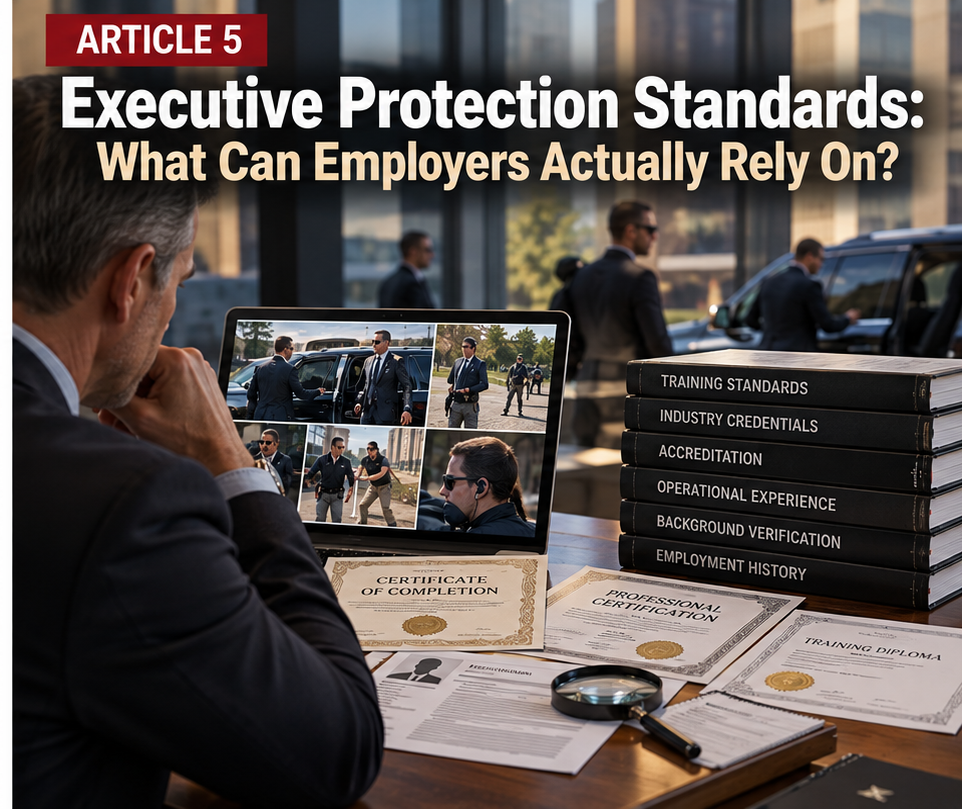
Executive Protection Standards: What Can Employers Actually Rely On?
Understanding the Benefits, Limitations, and Legal Recognition of Professional Standards
From Paper to Proof — Article 5 of 6
By Matthew C. Parker
Independent Security Advisors LLC (ISA) | EPTraining.us
Abstract
Professional executive protection standards can help employers establish hiring requirements, evaluate security providers, develop procedures, and manage protective programs. They may also offer useful guidance on workplace safety, security budgets, insurance, legal responsibilities, and international operations.
However, a professional standard does not automatically establish compliance with government regulations, provide tax benefits, reduce insurance costs, or grant permission to conduct protective operations in another country.
Drawing on my experience in executive protection operations, training, and security program development, I examine what employers can reasonably expect from professional standards, what those standards actually establish, and what employers still need to verify for themselves.
Bottom Line Up Front
A professional standard can help an employer make better security decisions, but it does not automatically carry the authority of law.
Employers need to understand what a standard requires, whether those requirements are appropriate for their protective operations, and whether there is evidence that following them produces the promised benefits. They must also distinguish between professional guidance, government requirements, and the actual abilities of the personnel they hire.
The Value of a Professional Standard
Executive protection is receiving more attention from corporations and employers responsible for protecting executives, their families, and other individuals facing threats. As employers spend more on protective services, they need reliable information about the services they are purchasing and the qualifications of the people providing them.
The industry now has published executive protection standards from ASIS International and the Board of Executive Protection Professionals (BEPP). Recent discussions about these publications, including BEPP’s eight-part series examining the benefits of ANSI/BEPP EPS-2026, have raised important questions about hiring, training, workplace safety, security budgets, insurance, taxation, legal liability, and international operations.
I support the development of professional standards. Properly written standards can help employers understand what to expect from a protective program and identify the responsibilities of the people providing the services. They can also give employers and security contractors a common reference when discussing procedures, qualifications, and performance.
However, there is a difference between what a standard recommends, what it requires, and what an employer can reasonably expect it to accomplish. A professional standard approved through ANSI’s voluntary consensus process is not automatically a government regulation. Its approval does not grant professional licensing or establish that a protective program is effective.
That distinction does not diminish the value of a standard. It helps employers understand how the standard should be used and what additional information they need before making decisions.
A Growing Market Needs Reliable Guidance
Executive protection is becoming a more visible expense for major corporations, and there is evidence that some companies are increasing the amount they spend on executive security.
In April 2025, Equilar published research examining security benefits reported by 208 S&P 500 companies that had filed proxy statements by April 2. Among those companies, the percentage reporting executive-security benefits increased from 23.1% in 2022 to 31.3% in 2024. Median reported spending increased from $40,917 to $94,276 over the same period.
These figures show an increase in reported executive-security benefits among the companies studied. They do not tell us whether the companies providing those benefits had better protective programs or whether the money was being spent effectively.
An employer may increase its security budget because threats have changed, an executive is traveling more frequently, or additional protective services are needed. Higher costs may also result from increased personnel expenses, new equipment, transportation, or expanded operations.
Spending more money does not necessarily mean providing better protection. An employer still needs to understand what those expenditures accomplish and whether the services are appropriate for the assignment.
Professional standards may help employers review staffing, transportation, communications, equipment, and other parts of a protective program. They can also help management ask questions that might otherwise be overlooked.
However, a published standard cannot determine how much protection an executive needs without considering the actual circumstances. That requires an assessment of the threats, the person being protected, the operating environment, and the resources available.
Hiring and Training: What Does the Applicant Actually Know?
One area where professional standards can help employers is hiring. Throughout my career, I have evaluated the qualifications of people working in protective services and reviewed the training needed to prepare personnel for assigned duties. I have also encountered the difficulties that arise when an applicant’s stated qualifications do not match the work that needs to be performed.
Executive protection applicants come from different backgrounds. Some have years of operational experience, while others have completed a training course but have little experience working on protective details. Military or law-enforcement service may provide valuable experience, but an employer still needs to determine whether that experience is relevant to the specific protective assignment.
A professional standard can help an employer identify the duties associated with a position and the skills an applicant should possess. It may also help distinguish between the responsibilities of a protective agent, advance agent, detail leader, and security program manager. For example, an employer hiring an advance agent should know whether the applicant can inspect a location, identify security concerns, coordinate an arrival and departure, communicate with the protective detail, and prepare a useful advance report.
Listing those duties in a professional standard helps describe the position. But it does not establish that the person applying for the job can perform them. Employers must still verify training, examine work history, check references, and determine whether the applicant has the necessary skills. A written examination may establish knowledge of a subject, but practical duties should also be evaluated through appropriate exercises or evidence of actual experience.
The same distinction applies to training certificates. A student may complete a course that claims to follow a professional standard. That tells an employer something about the subjects the school intended to cover, but it does not necessarily establish what the student learned or demonstrated.
I would want to know what practical exercises the student completed, how those exercises were evaluated, and whether the student met the required level of performance. Those questions matter more than the appearance of the certificate. Government training and licensing requirements create another consideration.
Virginia and North Carolina, for example, establish legal requirements for regulated protective services. Their authorized agencies determine which training satisfies those requirements. A private training provider cannot replace them simply by adopting a national professional standard.
Federal law-enforcement agencies also establish training and qualification requirements. The Federal Law Enforcement Training Accreditation organization (FLETA) accredits eligible federal law-enforcement training academies and programs. A private course does not receive that accreditation merely because it follows an American National Standard.
Federal personnel may receive recognition for certain outside training when the employing agency accepts it. The Office of Personnel Management establishes qualification policies that federal agencies must consider, but the recognition of a particular course depends on the applicable rules and the agency’s decision.
For employers, the lesson is straightforward. A professional standard may help identify the qualifications needed for a position, but it does not replace background investigations, qualification verification, practical evaluation, or government licensing requirements.
Workplace Safety: What Does OSHA Require?
Professional standards may also help employers review workplace safety and establish protective procedures. Consider a corporation whose chief executive has received credible threats. The company needs to examine those threats, determine what protective measures are appropriate, and decide how those measures will be carried out.
A professional executive protection standard may provide useful guidance on threat assessments, protective planning, communications, and other security responsibilities. It may help the employer organize the work and document the decisions made. However, the Occupational Safety and Health Administration (OSHA) enforces requirements established by federal law and applicable regulations.
Under the Occupational Safety and Health Act’s General Duty Clause, employers are responsible for addressing recognized workplace hazards that are causing, or are likely to cause, death or serious physical harm when feasible and useful measures are available to correct them.
OSHA has explained that voluntary industry standards may provide evidence that a hazard was recognized or that precautions were available. That does not make every provision of a privately developed standard an enforceable OSHA requirement.
An employer may use an executive protection standard when developing procedures for an executive facing threats. That decision may help show how the company considered professional practices when planning its security measures. However, adopting the standard does not automatically establish OSHA compliance. The employer must still examine the actual circumstances, determine which legal requirements apply, and implement appropriate precautions.
There is also a difference between the safety responsibilities an employer owes its employees and the duties a protective company owes its clients under contracts and other applicable laws. A professional standard may help both organizations establish procedures, but it cannot replace those legal responsibilities.
Security Budgets and Insurance: Can Standards Save Money?
Anyone who has managed a protective program understands the importance of explaining security expenditures. A security director may need additional personnel, vehicles, communications equipment, training, or other resources. Corporate management will reasonably want to know why those resources are necessary and what the company will receive in return.
A professional standard can help support those discussions by identifying recognized practices and providing a common reference for security requirements. If the standard addresses protective transportation, advance planning, communications, or personnel responsibilities, it may help the security director explain why particular resources are recommended. However, the standard does not establish that every employer needs the same equipment, number of agents, or operating procedures.
A multinational corporation with executives traveling in several countries may require extensive protective support. A smaller company protecting one executive may need a much more limited program. The appropriate budget depends on the threats, operating conditions, and services required.
Insurance raises similar questions. An insurance company may consider an employer’s security procedures, risk assessments, and other precautions when reviewing risk or determining coverage. A well-managed protective program may provide useful information during that review. However, I would not tell an employer that adopting a particular executive protection standard will automatically reduce insurance premiums.
That claim should be supported by information from insurers showing how the standard affects their decisions. I have not identified published evidence establishing that adoption of an executive protection standard alone guarantees insurance savings.
A standard may help employers organize their protective programs, explain security expenditures, and document their efforts to manage risk. Whether those measures produce financial savings must be established through actual results.
Executive Security and Federal Tax Treatment
Federal tax treatment is another subject that requires careful explanation. Some companies provide security-related transportation and other protective benefits to their executives. Under certain circumstances, federal tax law allows specific security-related expenses to receive favorable treatment.
Internal Revenue Code Section 132 and Treasury Regulation 26 CFR § 1.132-5(m) address certain security-related transportation benefits. Depending on the circumstances, qualifying security measures associated with transportation may be excluded from an employee’s taxable income. However, the employer must meet the conditions established by Treasury.
Those conditions concern genuine business-related security concerns, the protective arrangements involved, and the documentation supporting the company’s decisions. Depending on the circumstances, the employer may need an overall security program or an independent security study meeting specific requirements.
There is also an important distinction between the cost of additional security measures and ordinary personal transportation expenses. The regulation does not make all transportation expenses tax-free simply because an executive has security concerns. A professional executive protection standard may help a company organize its security assessment and document the measures it adopts. It may provide a useful reference when establishing procedures or reviewing protective transportation arrangements.
But adopting that standard does not create a federal tax benefit. An employer cannot simply adopt an ANSI-approved executive protection standard and assume that its transportation arrangements qualify for favorable tax treatment. The tax rules must be satisfied, and the company’s circumstances must support the treatment being claimed.
Companies considering these arrangements should obtain advice from qualified tax professionals. A professional standard may assist with planning and documentation, but the applicable tax law determines which benefits qualify.
Legal Liability: Does Following a Standard Protect an Employer?
Professional standards may become important when an employer’s security decisions are questioned following an incident. Consider a corporation that hires a protective company to provide security for an executive. The company promises to follow a particular professional standard as part of its contract. If an incident occurs, investigators, attorneys, insurers, or a court may examine what the protective company agreed to provide and whether it fulfilled those responsibilities.
The professional standard may help explain the procedures the company was expected to follow and the practices considered appropriate within the industry. It may also provide evidence of the measures the company took to prepare and supervise its personnel. However, adopting a voluntary standard does not automatically protect an employer or contractor from legal liability.
Courts consider the applicable laws, contracts, circumstances of the incident, and other relevant evidence. A professional standard may be part of that examination, but it does not automatically determine the outcome. The same standard that helps a protective company explain its procedures may also be used to question its performance if the company failed to follow requirements it had promised to meet.
For that reason, employers and contractors should understand a standard before incorporating it into a contract. They need to know what the requirements mean, whether they can meet them, what resources will be necessary, and how their performance will be documented.
There are examples of private security standards receiving formal government recognition.
ANSI/ASIS PSC.1, a management-system standard for private security companies, was recognized through Department of Defense contracting requirements. Contractors performing covered private security functions under those requirements must provide evidence of compliance with an accepted standard.
That is a useful example because it shows how government recognition actually works. The Department of Defense established specific contracting requirements and identified the standards it would accept. The recognition did not automatically extend to every ANSI American National Standard.
A professional standard may help an organization demonstrate that it followed recognized practices. However, government requirements, contractual obligations, and legal responsibilities still have to be examined separately.
International Recognition: Can an American Standard Be Used Overseas?
Executive protection frequently involves international travel and assignments. Employers may operate in several countries, hire protective personnel overseas, or arrange security for executives visiting foreign locations. A professional standard may help an international company establish consistent expectations for its protective teams.
However, an ANSI American National Standard does not automatically become an international standard or authorize security services in another country. ANSI represents the United States in the International Organization for Standardization (ISO). And american standards have contributed to international work, including ISO 18788, which addresses management systems for private security operations.
However, ISO has its own development and approval procedures, and ANSI approval alone does not make an American standard an ISO standard. The same distinction applies to licensing and professional qualifications.
The United Kingdom and Commonwealth
The United Kingdom regulates close protection through the Security Industry Authority (SIA). The SIA establishes licensing requirements and specifies which training and qualifications it accepts. Britain also has its own close protection standards, including BS 8507-1:2008, which provides guidance on the management, staffing, and operation of close protection services within the United Kingdom. That publication predates the recent American executive protection standards.
An American training provider may offer instruction covering similar subjects, but that does not automatically make its course acceptable for an SIA license. Applicants must meet the requirements established by the British authorities. Those requirements also change. For example, beginning April 1, 2026, the SIA required a refresher qualification for individuals renewing a close protection license.
ISA has direct experience examining the British qualification system. In May 2015, we entered a recognition agreement with Industry Qualifications Limited (IQ), a British awarding organization, while exploring the United Kingdom’s close protection training and qualification framework. That experience reinforced an important distinction. A professional standard, a training qualification, and a government license serve different purposes. One should not be confused with another.
The Commonwealth presents another issue. Countries such as Canada, India, and South Africa are independent nations with their own laws and regulatory requirements. The British SIA does not regulate private security throughout the Commonwealth.
An American professional standard may be useful to an employer working in those countries, but it does not automatically replace their licensing requirements.
The European Union
The European Union has its own legal framework, but it does not provide one license that authorizes private executive protection throughout every member country. Private security services are excluded from the general scope of the EU Services Directive, 2006/123/EC. Individual countries maintain their own requirements for private security activities.
An employer arranging protective services in Europe must determine which laws apply in each country where those services will be provided. Those laws may address licensing, employment, firearms, privacy, and the legal authority of protective personnel.
A professional standard can help a company establish consistent operating procedures, but it cannot authorize activities that local laws restrict.
International Trade Agreements
International trade agreements do not automatically remove these restrictions. The World Trade Organization’s Agreement on Technical Barriers to Trade primarily addresses products and related requirements. It does not provide a general licensing system for executive protection personnel.
The General Agreement on Trade in Services allows countries to recognize certain foreign professional qualifications professional under appropriate conditions. However, it does not require countries to accept every American standard or training certificate.
A company conducting protective operations overseas must comply with the laws of the country where the services are provided. A professional standard may help establish consistent practices, but it cannot replace the necessary government authority to conduct regulated security work.
How Do We Establish the Value of a Standard?
I have always believed professional standards are essential, for one reason they may help employers prepare contracts, evaluate applicants, review security programs, and establish reasonable expectations for protective personnel. However, when an organization claims that its standard produces additional benefits, we should be able to examine the evidence supporting those claims.
If a standard improves hiring, what has changed in the employer’s selection process? Are applicants better qualified, and how does the employer establish that?
If it improves protective operations, what practical results support that conclusion? Are procedures clearer, are agents performing their duties more effectively, and has the organization identified measurable improvements?
If the standard reduces security costs or insurance premiums, where are the documented savings? If a government agency recognizes it, which agency made that decision, and what exactly did it recognize?
The same questions apply to claims of pending or actual international acceptance. Which country, regulatory authority, or professional organization accepted the standard, and for what purpose?
These are reasonable questions to ask of any standards developer. They do not challenge the intentions of the people involved or dismiss the work required to produce a professional standard. They concern the difference between a benefit that is expected and one that has actually been demonstrated.
I would apply the same expectations to ISA. When we describe the value of our training, we should be prepared to explain what we teach, how students are evaluated, which authorities have recognized our programs, and what evidence supports those statements.
I also believe there is room for different standards addressing different parts of executive protection. One standard may concentrate on managing protective programs, another may address operational procedures, and another may identify individual skills and competencies. Employers need to understand those differences before selecting a standard for their organizations.
A well-written professional standard should help employers make informed decisions. Its value should come from the usefulness of its requirements and the results they produce, not simply from the name or designation on its cover.
Conclusion: What Can Employers Actually Rely On?
I hope it is clear I support the development of professional executive protection standards. Clear guidance can help employers understand protective duties, evaluate security companies, and establish procedures for their protective programs. However, employers must understand what they are relying on.
Now remembering ANSI approval confirms a standard has completed the voluntary consensus process, it does not automatically establish compliance with OSHA, provide favorable tax treatment, reduce insurance premiums, determine legal liability, or grant professional licensing.
The same applies internationally. American standards may influence professional practices overseas, but foreign governments and regulatory authorities determine which requirements they recognize.
Employers should examine the requirements of a standard, determine whether those requirements are appropriate for their operations, and verify the qualifications of the people responsible for meeting them. They should also expect standards developers to explain the benefits they claim and provide evidence supporting those claims.
I recognize the considerable effort involved in developing professional standards, and I believe that work deserves serious consideration. But employers are ultimately responsible for the decisions they make, the protective services they purchase, and the qualifications of the people they employ.
A professional standard can help an employer make better decisions. It cannot make those decisions for the employer.
About the Author
Matthew C. Parker is Chief Executive Officer of Independent Security Advisors LLC (ISA) and Director of Training for EPTraining.us. His professional experience spans more than three decades and includes military service, executive and dignitary protection operations, law-enforcement instruction, international security advising, and protective program development.
Parker is a U.S. Army/Department of Defense Master Instructor. During his military career, he served as a senior enlisted department head at the U.S. Army Chemical Warfare School, where he supervised, mentored, and evaluated instructors and managed instructional programs. He also taught military science at Virginia Tech.
Before retiring from the U.S. Army in 2011, Parker conducted protective operations involving senior U.S. military leaders and trained U.S. and Iraqi protective-security personnel.
Since establishing ISA in 2011, he has directed executive protection operations in the United States, provided protective services for corporate and private clients, and developed training programs for law-enforcement and private protective-services personnel.
His international experience includes protective-security instruction and advisory work in Iraq and Ukraine, including training for Ukrainian Judicial Protection Service personnel and other protective teams.
Sources and Related Reading
Industry Standards and Research
- BEPP — Eight-Part Series on the Benefits of ANSI/BEPP EPS-2026, September 2026.
- BEPP — Regulatory Landscape: Duty of Care and OSHA.
- BEPP — Human Resources Impact.
- BEPP — Justifying the Program: Budget, Personnel and Equipment.
- BEPP — Tax Treatment of Security Benefits Under IRC Section 132, September 21, 2026.
- BEPP — Why an ANSI Standard Is More Legally Defensible, September 23, 2026.
- BEPP — Short-Term and Long-Term Impact of EPS-2026, September 25, 2026.
- ANSI — Board of Standards Review.
- Equilar — Executive Security Spending Shifts From Perk to Priority, April 18, 2025.
U.S. Government Requirements
- OSHA — Voluntary Consensus Standards and the General Duty Clause.
- OSHA — Elements Necessary for a General Duty Clause Violation.
- Treasury Regulation 26 CFR § 1.132-5(m).
- Virginia DCJS — Personal Protection Specialist.
- North Carolina General Statutes — Chapter 74C.
- FLETA — Procedures and Standards Manual, 2025 Edition.
- OPM — General Schedule Qualification Policies.
- Department of Defense — Private Security Contractor Standards.
International Requirements
- UK Security Industry Authority — Close Protection Training Requirements.
- UK Government — Close Protection Operative, Regulated Professions Register.
- SIA — Changes to Training and Refresher Qualifications.
- BSI — BS 8507-1:2008, Close Protection Services Within the UK.
- ISO 18788:2015 — Management System for Private Security Operations.
- EU Directive 2006/123/EC — Article 2(2)(k).
- WTO — Agreement on Technical Barriers to Trade.
- WTO — General Agreement on Trade in Services, Article VII.
Series: From Paper to Proof — Article 5 of 6
#ExecutiveProtection #ExecutiveProtectionStandards #CorporateSecurity #ProtectiveServices #ProfessionalStandards #SecurityManagement #ExecutiveProtectionTraining #SecurityRiskManagement #DutyOfCare #ASIS #ANSI #IndependentSecurityAdvisors #EPTraining