
 E-mail us
BEPP EPS-2026: Examining the November White Paper’s Legal and Financial Claims
Insurance, Hiring, Courtroom Evidence, Tax Benefits, International Recognition, and the Cost of Maintaining an ANSI Standard
BEPP November 2026 white paper: By Matthew C. Parker
Chief Executive Officer, Independent Security Advisors LLC
Director of Training, EPTraining.us
November 12, 2026
Abstract
On November 3, 2026, the Board of Executive Protection Professionals (BEPP) published a white paper describing the legal, financial, and operational benefits of ANSI/BEPP EPS-2026, its recently approved executive protection standard. The publication makes significant claims involving courtroom liability, hiring, training, workplace safety, insurance, federal tax treatment, international recognition, and protective operations.
But the benefits being claimed for EPS-2026 must be supported by evidence. The question is whether BEPP’s November white paper can demonstrate the specific legal, financial, and operational advantages it claims to accompany its publication.
This article examines those claims against applicable laws, established insurance practices, government protective procedures, and professional literature published decades before EPS-2026.
Bottom Line Up Front
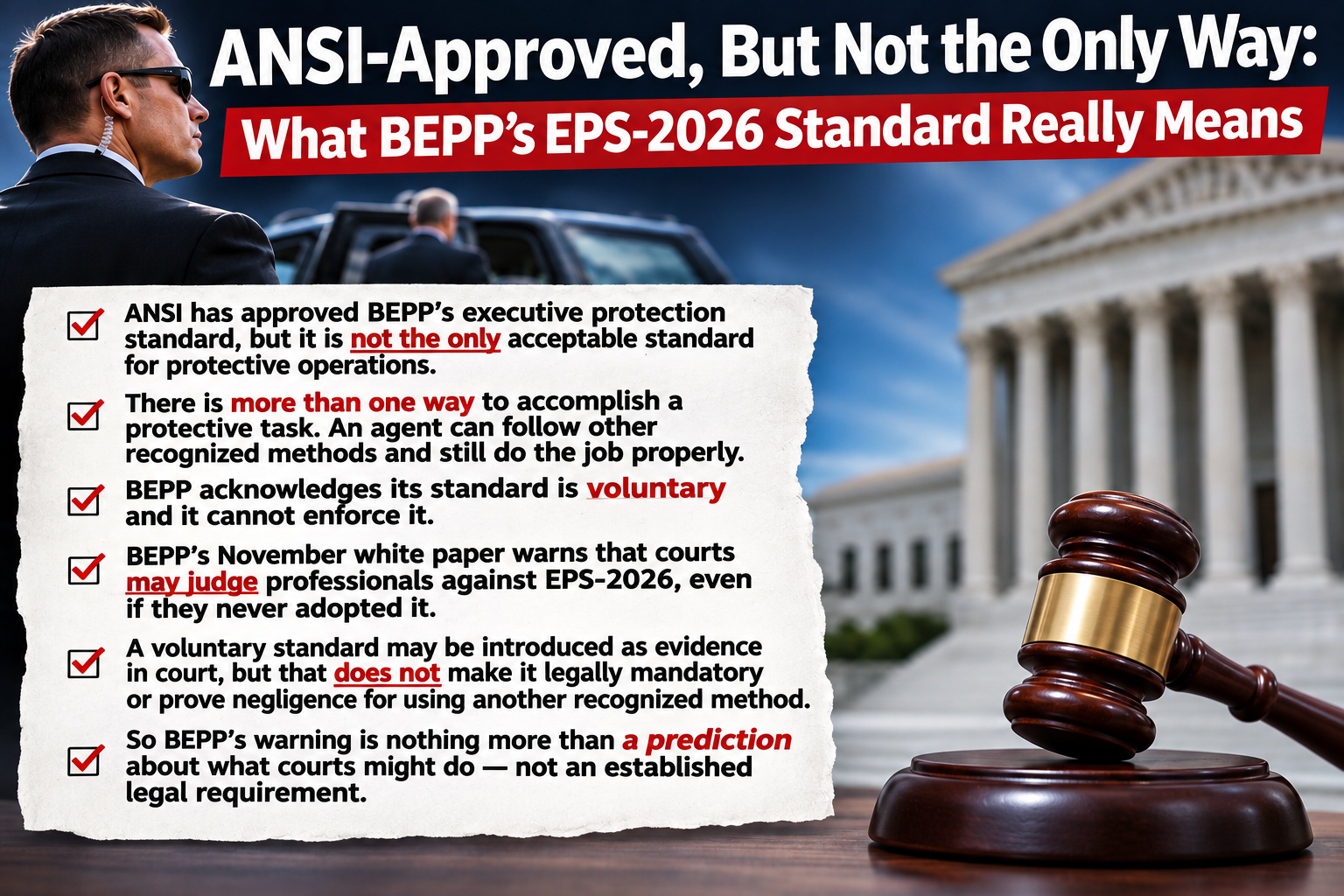
ANSI approval does not turn a voluntary professional standard into law. That is important because BEPP’s November white paper goes beyond describing its new standard. It tells executive protection professionals that courts may judge their conduct against EPS-2026, even if they never agreed to follow it.
On June 8, 2026, BEPP received ANSI approval for its Standard for Providing Executive Protection, designated ANSI/BEPP EPS-2026. That was a significant accomplishment. Developing and maintaining a professional standard requires substantial work, and I recognize that effort.
Unfortunately, the November 3rd white paper goes considerably further than just announcing a professional standard. BEPP discusses possible favorable insurance terms, stronger hiring practices, a potentially better position in litigation, help with existing tax rules, international recognition, and improved protective operations.
Its most concerning claims involve the courts. BEPP tells executive protection professionals to expect their conduct to be compared against EPS-2026 in litigation, even if they never adopted the publication. That warning deserves some attention because agents, employers, and training providers may interpret that as legal advise or a warning.
Now, it is well known voluntary standards may be considered in litigation. That is an established legal principle. But BEPP has not shown that EPS-2026 may / has become the accepted courtroom measure of professional conduct in executive protection. And the same situation applies to its other claims. BEPP has made claims about insurance, and tax-compliance benefits. And those deserve a look, they may be possible. But claiming a benefit may exist doesn’t make it happen.
BEPP can publish a standard and recommend its adoption. Whether that publication produces the legal, financial, and operational benefits BEPP describes is a separate question requiring evidence.
Some problems are direct conflicts with published rules. Others are gaps between what BEPP says in its FAQ and what it tells practitioners in the white paper. Still others are benefits it predicts without showing the results. I am not calling all of those things contradictions. But every one of them deserves a clear answer before the profession is told to treat EPS-2026 as its benchmark.
BEPP’s Courtroom Warning: What Does the Evidence Establish?
No court decision cited in BEPP’s white paper involved an executive protection assignment under EPS-2026. Yet BEPP warns that professionals may be judged against its standard, even if they never adopted it. Before agents treat that warning as a legal obligation, they deserve to know what the courts have actually decided.
On printed page 8 of its November white paper, BEPP declares that EPS-2026 has changed how executive protection professionals may be judged in court. It tells practitioners to expect their conduct to be compared against its publication, even if they have never adopted it. In a LinkedIn post promoting the white paper, BEPP stated, “In most U.S. courts, the answer is YES,” when discussing whether practitioners may be held to standards they never adopted. But the white paper doesn’t provide a executive protection case in which a court has actually applied EPS-2026, or any case involving executive protection.
Where is the evidence supporting that warning?
BEPP’s FAQ, under Market Acceptance, says an ANSI standard can become legally enforceable through a law, a contract, or its use in a court case. Those are different legal situations. A law or contract may require someone to follow particular rules. A court allowing a voluntary standard into evidence does not, by itself, make that standard legally binding on everyone.
On printed page 8 of its November 3 white paper, BEPP tells every practitioner to assume their work may be compared with EPS-2026 in a lawsuit. It also says, “A practitioner who rejects the Standard is not exempt from it.” But on that same page BEPP acknowledges, “Admissibility is not liability,” and explains that a court may find a departure from a voluntary standard reasonable.
Well ok then, that’s clear.
Getting Deeper
An agent may follow protective procedures taught by FLETC, the State Department, or another established training program rather than the methods BEPP recommends. That does not automatically mean the agent did anything wrong. So, if an incident results in a lawsuit, the question is whether the agent acted reasonably, followed applicable laws, and used procedures appropriate for the assignment.
Anyone arguing that the agent should have followed EPS-2026 would need to explain why that particular requirement mattered. ANSI approved BEPP’s executive protection standard, but that approval does not make EPS-2026 the only acceptable standard for protective operations or give its requirements preference over established procedures.
There is more than one way to accomplish a protective task. A consensus committee may select one method, but that does not make other recognized methods wrong or unsuitable. An agent can follow established protective procedures that differ from those in EPS-2026 and still perform the assignment properly. And let’s be clear: BEPP acknowledges that its standard is voluntary and that it cannot enforce it.
So BEPP’s warning is little more than a prediction about what courts might do. It is not an established legal requirement.
BEPP also acknowledges in its FAQ that schools may use curricula that do not follow EPS-2026 and that BEPP itself cannot enforce compliance. In the white paper, however, it says a practitioner who rejects the standard is not exempt from it. Those statements can both be true in the limited sense that courts may consider a voluntary standard as evidence. But they do not answer the question BEPP has raised for the rest of us.
If an agent follows established government training that uses a different protective procedure, what evidence would justify giving BEPP’s procedure preference in court?
Has BEPP identified a protective case in which a judge actually made that choice?
**The earlier legal questions and court decisions have already been addressed in my October 29 and November 6 articles. There is no need to repeat that entire analysis here.
Not Every Page of BEPP’s Book Is Part of the ANSI-Approved Standard
BEPP’s own public-review instructions say that certain parts of its book are not ANSI-approved requirements. That matters when someone uses the publication to determine what an agent or employer is expected to do. The approved requirements and the additional guidance are not the same thing.
BEPP’s own public-review instructions make another point clear: not everything published in its standards manual is part of the ANSI-approved requirements. They identify sections of its publication that are excluded from the requirements of the American National Standard. Those sections include the cover, notices and disclaimer, foreword, glossary, and appendix.
BEPP says those sections contain extra information and recommendations. Readers may find them useful, but they do not have to follow that advice to meet the requirements of EPS-2026. And ANSI’s procedures permit a standards publication to include additional information outside the approved sections, provided that material is properly identified.
There is nothing wrong with including additional guidance in an appendix. The good idea fairy comes at all hours and you may need to drop a few lines of advice into an appendix. But, if someone relies on a recommendation from the appendix to evaluate an agent’s work, they should understand it is not an ANSI-approved requirement. The same is true for employers and training providers.
The standards developer may add advisory material but that does not make the material a mandatory requirement. And an approved requirement does not automatically become a legal obligation for every protective professional either.
When BEPP tells practitioners that courts may judge their work against EPS-2026, how will it distinguish the approved requirements from the additional advice in the same publication?
If Several Protective Methods Work, Why Should One Become the Standard?
There is more than one way to accomplish a protective task. A standards committee may select one procedure, but its decision does not automatically make other established methods wrong. Agents need procedures that work for the assignment, the threat, the resources available, and the laws under which they operate.
Executive protection professionals frequently accomplish the same objective through different procedures. The methods may depend on the threat, location, available resources, legal authority, and size of the protective team. Consider protective advance work. One organization may use a detailed paper checklist. Another may use a digital advance-management system. A third may use a government reporting format developed through years of protective operations.
If each method identifies the necessary hazards, routes, emergency facilities, access points, and contingency arrangements, the relevant question is whether the method provides the information the protective team needs.
A standards committee may select a particular procedure because consistency, safety, compatibility, or other technical considerations justify it. That is part of developing a professional standard. But a committee’s agreement does not establish that every other method is unsafe, inadequate, or professionally unacceptable. That matters when both government or private sector protective methods are applied to executive protection operations.
If there are two procedures that can accomplish the same protective objective, there should be a sound operational reason for making one the standard over the other. That is why identifying the technical sources behind a standard matters. Readers should be able to understand where a procedure originated, why it was selected, and what conditions make it appropriate.
A consensus vote establishes agreement within the standards-development process. It does not establish that every alternative method is unacceptable.
Executive Protection Had Established Authorities Decades Before BEPP
Executive protection did not begin in 2026. Government agencies, experienced instructors, and professional authors had already spent decades developing and documenting protective procedures. Their work matters because anyone evaluating a new standard needs to understand what was already available.
Before examining what BEPP’s publication contributes to the profession, we should recognize the people who helped establish its existing body of knowledge.
Dr. Richard W. Kobetz and H. H. A. Cooper published Target Terrorism: Providing Protective Services in 1978. Kobetz subsequently edited Providing Executive Protection, Volumes I and II, published in 1991 and 1994. These works addressed protective planning, personnel selection, threat assessment, transportation, advance work, and the responsibilities of protective specialists.
I knew Dr. Kobetz personally and considered him a friend. His contributions are also documented through his professional publications and government records. In 2003, the Detroit City Council cited his Providing Executive Protection volumes when considering qualifications for personnel assigned to its Executive Protection Unit. So, are you going to evaluate me by EPS-2026 or by Dr K’s well known and respected Providing Executive Protection, Volumes I and II.
Dale L. June, a former Secret Service agent, published Introduction to Executive Protection in 1998. The publication was subsequently revised, with a fourth edition prepared with Elijah Shaw in 2021. June’s work addressed protective methods, professional responsibilities, and the development of qualified protective personnel. Dale also helped establish Henley-Putnam University, an institution that later worked with ISA and is now involved in BEPP’s academic outreach.
Jerry Glazebrook and Nick Nicholson published the Executive Protection Specialist Handbook in 1994, followed by a revised edition in 2003. Their work provides practical procedures and checklists addressing route surveys, transportation, airports, hotels, restaurants, hospitals, site security, and crisis planning.
Robert L. Oatman contributed The Art of Executive Protection in 1997 and Executive Protection: Rising to the Challenge in 2009. His publications addressed corporate protective operations, executive risk, management responsibilities, and the development of professional security programs.
Duke Speed published the Advance Agent Planning Guide in 2016, providing detailed procedures and checklists for conducting protective advances. Speed brought extensive military and federal instructional experience to the development of protective training.
Tony Scotti developed professional security-driving methods addressing vehicle control, hazard recognition, emergency maneuvers, and the responsibilities of protective drivers. His work has influenced government and private-sector protective transportation for decades.
Another major reference is Just 2 Seconds: Using Time and Space to Defeat Assassins, published in 2008 by Gavin de Becker, Tom Taylor, and Jeff Marquart. The book examines attacks against public figures and the relationship between threat recognition, positioning, time, distance, and protective response.
These authors approached executive protection from different backgrounds. Some concentrated on government protection, others on corporate operations, transportation, advance work, or the analysis of actual attacks.
Together, they established a substantial body of professional knowledge long before BEPP published EPS-2026.
Duke Speed’s November 2026 Publication
Reminder; ANSI approval does not automatically give BEPP’s procedures preference over those published by other experienced executive protection professionals.
In November 2026, Duke Speed announced Modern Executive Protection: From Advance Operations to Intelligence-Driven Security Integration. His new manual addresses protective intelligence, threat and risk assessment, advance planning, and other subjects also covered by BEPP’s EPS-2026 standard.
Duke, brings decades of military, federal, and protective-security experience to his work. His book does not carry ANSI approval, but neither does BEPP’s approval make its procedures legally mandatory or automatically superior to those published by Speed or the other experienced professionals. All these publications can serve as professional references. Their value depends on the quality of their information, the procedures they recommend, and how well those procedures work in actual protective assignments.
BEPP has obtained ANSI approval for its standard through a consensus process. That approval does not establish that its protective procedures deserve preference over those developed and published by other qualified professionals.
Whose Work Are Practitioners Being Measured Against?
Publishing a new standard does not mean creating every procedure it contains. Many of the protective methods addressed by EPS-2026 existed long before BEPP. So, if practitioners may someday be judged against this publication, they deserve to know where its requirements originated, what BEPP changed, and why those changes should be preferred.
BEPP’s courtroom warning raises another question. If the organization believes its newly published standard may be used to judge protective professionals who never adopted it, whose work actually established the methods those professionals would be expected to follow?
BEPP’s own Frequently Asked Questions explain that executive protection professionals contributed to the development of its standard. Its public-review instructions also acknowledge that some specialized subjects are already covered by existing standards and established professional practices. Those acknowledgments matter because threat assessment, advance work, protective intelligence, transportation planning, site security, emergency response, and protective movements were being taught and documented long before BEPP existed.
The Secret Service, Diplomatic Security Service, Federal Law Enforcement Training Centers, U.S. Marshals Service, military protective-service programs, and established private-sector instructors developed and used protective methods over decades.
A professional standard may compile those methods, select among alternatives, and establish consistent requirements. That work can be useful. But identifying the sources used in developing those requirements would allow readers to examine the original material, understand how the methods developed, and determine what BEPP changed or added.
A complete technical bibliography would help. So would a comparison identifying the source of each major requirement, the reason it was selected, and how it differs from previously established protective procedures.
If BEPP considers its procedure preferable to an established government or private-sector method, what evidence supports that preference? Was the difference examined through research, field experience, practical testing, or some other process?
ANSI approval establishes that the published standard satisfied the applicable development requirements. It does not independently establish that every procedure selected by BEPP is technically superior to an earlier method. A committee can organize existing information into a new standard. That work does not make the underlying knowledge new.
Before the profession is told that it may be judged against BEPP’s publication, practitioners deserve a clear explanation of what the publication adds to the methods they have already been using.
What Did ANSI Actually Approve?
ANSI approval is not a field test of the methods in the book. BEPP’s white paper argues that an ANSI-accredited publication is more defensible than a non-accredited reference. But ANSI’s Board of Standards Review says it reviews the standards-development process, not the technical content of the proposed standard.
The review confirms that required procedures were followed; it does not establish that each protective formation or response method is better than the alternatives. BEPP’s own explanation of the ANSI process also describes review of the process and whether due process was followed.
Yet printed page 9 of the white paper calls its competency framework “externally validated,” and printed page 14 argues for greater legal weight based on accreditation. The source of that approval matters: ANSI did not independently test the skill categories or field procedures.
What operational testing, research, or comparison has BEPP published to support the procedures it selected?
If BEPP wants employers and courts to give those procedures greater weight, where is the technical evidence supporting that preference?
Does Filing With ANSI Give BEPP Control Over Competing Standards?
Filing an ANSI project notice does not give BEPP exclusive control over executive protection standards.
BEPP’s FAQ says its Project Initiation Notification System (PINS) filing effectively prevents another developer from creating a similar or competing ANSI standard. Its earlier written FAQ makes the same claim more directly. But ANSI’s own 2023 training presentation, slide 27, expressly states that a PINS filing does not prevent another developer from developing a similar standard. ANSI’s Essential Requirements provide for discussions and attempts to resolve conflicting or overlapping projects, not automatic ownership of a subject.
A Former BEPP board member made a related claim in a February 2025 article, saying ANSI had awarded standard development to BEPP after a dispute with ASIS. But I found no published ANSI decision in the materials reviewed giving BEPP exclusive rights to develop executive protection standards.
BEPP asks employers, courts, and regulators to trust the authority of its ANSI-approved process, and on printed pages 13–14, the white paper argues that ANSI accreditation gives EPS-2026 greater legal credibility than non-accredited guidance. Those claims don’t appear to be supported by the evidence.
Why does BEPP tell practitioners that its PINS filing prevents a competing ANSI standard when ANSI says otherwise? Is BEPP relying on a separate written ANSI decision granting exclusive development rights? If so, what is that decision and where can the public read it? If not, will BEPP correct its FAQ?
BEPP’s November white paper argues that EPS-2026 provides an external reference for executive protection hiring, training, and operations that the profession previously lacked.
But ASIS International published its own Executive Protection Standard in September 2025, before BEPP received ANSI approval. The ASIS publication addresses many of the same professional responsibilities.
BEPP’s publication carries ANSI approval, while the ASIS executive protection standard does not. That does not establish that BEPP’s requirements are better or that employers should automatically prefer them.
What does EPS-2026 provide that the ASIS standard does not?
What evidence establishes that BEPP’s requirements are more effective, or should be given greater weight when evaluating a protective professional’s work?
What Does This Established Executive Protection Library Cost?
An agent does not have to spend $595 to study established executive protection methods. Recognized authors have published detailed instruction covering advances, transportation, threat assessment, and protective operations for decades. The cost comparison matters because BEPP is encouraging practitioners to obtain its publication while warning that courts may consider its requirements.
BEPP lists its printed EPS-2026 publication at $595, with another $25 for shipping within the continental United States, bringing the advertised domestic purchase price to $620 before applicable taxes.
The price is relevant because on printed page 8 of its November white paper BEPP encourages agents to know EPS-2026, train to it, and document that they follow it. This comparison does not claim eight instructional books are the same as an ANSI-approved consensus standard. It asks what additional value a practitioner receives from the publication that BEPP says may be used to judge professional conduct.
For comparison, I examined the cost of assembling a collection of established executive protection references addressing foundational protective methods, planning, corporate operations, transportation, and the analysis of actual attacks.
Executive Protection Reading List — November 2026
| Author and publication | Advertised price |
|---|---|
| Dr. Richard W. Kobetz — Providing Executive Protection, Volume I | $12.00 |
| Dr. Richard W. Kobetz — Providing Executive Protection, Volume II | $15.00 |
| Dale L. June and Elijah Shaw — Introduction to Executive Protection, fourth edition | $32.82 |
| Jerry Glazebrook and Nick Nicholson — Executive Protection Specialist Handbook | $35.00 |
| Robert L. Oatman — Executive Protection: Rising to the Challenge | $49.00 |
| Duke Speed — Advance Agent Planning Guide | $41.86 |
| Gavin de Becker, Tom Taylor, and Jeff Marquart — Just 2 Seconds | $49.79 |
| Tony Scotti — Professional Driving Techniques, fifth edition | $18.98 |
| Combined advertised price | $254.45 |
Prices were identified through publisher and bookseller listings reviewed November 8, 2026. Some titles were offered through used-book listings. Prices and availability may change. Taxes and shipping are excluded, and the books are not sold as a single package.
The eight-book collection has an advertised combined price of $254.45, compared with BEPP’s $595 printed publication.
ASIS International also published an Executive Protection Standard in September 2025. Using its $90 nonmember price, adding that standard to the eight-book collection brings the combined figure to $344.45, still $250.55 below BEPP’s advertised book price.
Duke Speed’s newly released Modern Executive Protection is not included in these calculations. A confirmed retail price was not available for this comparison.
Comparative Price Scale
Each block represents approximately $30.
| Publication selection | Cost | |
|---|---|---|
| Eight established executive protection books | $254.45 | |
| Eight books plus ASIS standard | $344.45 | |
| BEPP EPS-2026 printed standard | $595.00 |
These publications serve different purposes and involve different development costs. Historical instructional books are not interchangeable with a current consensus standard, and older procedures must be examined against present laws, technology, and operating conditions.
But the comparison demonstrates that substantial professional knowledge is available through recognized authors for considerably less than the price of BEPP’s publication.
It also raises a fair question about accessibility. Someone entering executive protection may already be paying for training, licensing, equipment, professional clothing, travel, and other expenses. Another substantial professional reference is a meaningful additional cost.
New practitioners should study the established literature whether or not they purchase EPS-2026. Those publications explain where many protective methods originated, how they were developed, and what earlier professionals learned through actual operations.
A new standard should contribute to that knowledge rather than replace the need to understand it.
If BEPP expects protective professionals to learn EPS-2026 because courts might consider it, what does its publication add beyond the established references, and what evidence supports that added value?
Government Protective Methods: What Has the Federal Government Actually Endorsed?
BEPP’s November white paper points to federal policy and Department of Defense recognition of another ANSI standard to support the credibility of EPS-2026. But that doesn’t establishes that the federal government has adopted BEPP’s executive protection requirements or considers them superior to existing government procedures.
On printed page 5, BEPP cites federal policy encouraging agencies to use voluntary consensus standards. That policy exists, but it does not require every federal agency to adopt EPS-2026. Nor does it establish that a procedure selected by BEPP is better than one already used by the Secret Service, Diplomatic Security Service, Federal Law Enforcement Training Centers, U.S. Marshals Service, or Department of Defense. Those agencies developed their own protective training and procedures long before BEPP published its standard.
BEPP also cites the Department of Defense’s recognition of ANSI/ASIS PSC.1, a standard addressing private security contractor operations. That example demonstrates that a government agency can formally recognize a voluntary standard. But again, it does not establish that the Department of Defense has adopted EPS-2026.
This brings us back to the central question. BEPP has obtained ANSI approval for its publication, but federal protective agencies already use established procedures supported by their own training programs and operational experience. So….
Which federal protective agency has adopted EPS-2026?
Where has a government authority determined that BEPP’s requirements should take preference over its existing protective procedures?
And what evidence demonstrates that BEPP’s selected methods produce better results?
Hiring and Personnel Qualifications: What Did BEPP Introduce?
Putting EPS-2026 into a job description does not prove an employer hired a qualified protective agent. Employers must still examine experience, training, background, and suitability for the assignment. That becomes particularly important when BEPP suggests that adopting its standard may provide an advantage in defending negligent-hiring claims.
On printed page 9 of the white paper, BEPP presents EPS-2026 as an externally developed framework that employers can use for job descriptions, hiring, vetting, and promotion decisions. Using them BEPP argues may provide employers a stronger legal position if their hiring requirements are reviewed because they will be based on its standard rather than informal internal procedures. Now, A documented set of qualifications can assist an employer, but the issue here is what BEPP is claiming isn’t proven.
Employers were screening applicants, checking professional backgrounds, evaluating experience, and establishing protective-service requirements long before EPS-2026. Government agencies and private employers have also maintained their own training requirements and qualification procedures. BEPP’s publication may provide another reference for employers preparing job descriptions or reviewing their hiring practices. But using that reference does not automatically establish that an employer made reasonable hiring decisions.
A negligent-hiring or negligent-retention case would still depend on the circumstances. The court would examine the employer’s responsibilities, what information was available, how personnel were selected and supervised, and whether the alleged conduct contributed to the harm. Bottom line, the white paper identifies no executive protection case in which adopting EPS-2026 produced the favorable legal result BEPP describes.
BEPP’s FAQ also says executive protection schools may continue teaching curricula that do not follow EPS-2026. Yet the white paper encourages employers to use EPS-2026 compliance when choosing training providers. So a training center needs to buy a $500.00 book to be in compliance with a voluntary standard with no oversight, no enforcement and no authority?
An employer may voluntarily use that requirement when they determine where to send their agents for training, but it does not prove that other programs who don’t spend the $500.00 teach inadequate protective methods.
Does BEPP consider a properly licensed, state-approved training program inadequate simply because it teaches a recognized procedure that differs from EPS-2026?
If so, what performance evidence supports that judgment?
Personnel Experience Levels: What Do They Prove?
Years on the job do not, by themselves, establish that someone is qualified for a particular protective assignment. On printed page 9 of its November 3 white paper, BEPP groups professional competencies by role and experience: intermediate practitioners with one to five years, managers with five to ten years, and senior leaders with ten or more. It says employers can use these categories when writing job descriptions, hiring personnel, and considering promotions.
BEPP describes the categories as an “externally validated” framework on printed page 9 of its white paper. Of course the white paper does not identify an independent auditor or assessment validating the experience categories vs. on-the-job performance, or provide hiring results showing that employers using the framework select better personnel or reduce negligent-hiring claims.
If these categories are to be used as a benchmark, how will the claimed competencies be evaluated, and what evidence shows they lead to better hiring decisions?
An employer still needs evidence that an applicant can actually do the job. Employers still have to examine actual assignments, training, performance, applicable licensing, and the requirements of the job. Because you claim 10 years of executive protection experience that does not elevate you to supervisor.
What practical evaluation has proven that a practitioner in one of BEPP’s experience categories can actually perform the assigned duties? Has BEPP documented any completed assessment linking its categories to protective performance?
The same issue arises in training procurement. BEPP encourages employers to ask whether a training provider’s curriculum meets the requirements of EPS-2026. What requirements? Is there a chapter on training requirements for schools?
Truth is an employer may choose EPS-2026 to assess training centers, but BEPP’s publication does not override applicable state training regulations or establish that every program developed before EPS-2026 is deficient. ISA’s January 2025 executive protection syllabus identifies 27 classes, 104 course learning objectives, 123 terminal objectives, 20 practical exercises, and a seven-day instructional schedule.
Our program has also received specific state regulatory and law-enforcement training approvals. The Virginia Department of Criminal Justice Services lists ISA as an approved alternative training provider for specified Personal Protection Specialist entry-level and in-service requirements. These are existing regulatory and instructional requirements, independent of BEPP’s publication.
BEPP may recommend additional requirements. Employers may consider them. But the white paper does not demonstrate that existing training programs or hiring methods become inadequate because they were developed under different recognized authorities.
Insurance: Where Are the Financial Benefits?
BEPP’s November white paper says a protective program built around EPS-2026 “could” potentially receive more favorable insurance terms. Employers need to know whether an insurer has evaluated this standard and actually offered different premiums or coverage.
On printed page 11, the white paper calls EPS-2026 a reference that an underwriter could evaluate, “potentially supporting more favorable terms.” That is a possibility, not a reported insurance result. There is a real underwriting process to consider first.
For example, General Star’s security-company insurance application asks about licensing, employee screening, training, contracts, claims history, and the share of work involving bodyguard or executive protection services. Its form predates EPS-2026 and illustrates the information one insurer requests; it does not establish requirements imposed by every carrier.
There is also an established way for documented risk controls to affect pricing in some markets. Under Washington Administrative Code 284-24-100, an insurer using a schedule-rating plan for specified commercial coverages may consider employee training, supervision, and safety programs when applying documented rate adjustments. That rule does not mention EPS-2026 or require a credit for following any particular standard. Other jurisdictions and insurers may use different rules.
BEPP’s FAQ, when discussing a proposed future certification program, mentions possibly lower insurance premiums. Its Novembers white paper it discusses potentially favorable terms for a protective program built around the standard. Certification of an individual and compliance with a company program are not the same thing. Which, if either, has an insurer evaluated, and under what criteria? Neither statement reports an actual EPS-2026 insurance discount.
How Would an Insurer Verify Compliance?
A written standard is not proof that a company follows it. The insurer would have to decide what evidence matters for its own coverage and underwriting rules. An underwriter can examine the applicant’s services, licenses, training records, screening, contracts, and loss history. Whether it also wants an audit or other proof of EPS-2026 compliance is the insurer’s decision.
Which insurer has evaluated EPS-2026, for which policy, using what evidence, and with what actual effect on premiums or coverage? BEPP’s November white paper provides no documented example. Until one is identified, favorable insurance terms remain a possible benefit, not a demonstrated result.
Workplace Safety and Duty of Care: Existing Law Still Controls
Employers had legal responsibilities for workplace safety long before EPS-2026 was published. Those obligations do not disappear or change simply because an organization adopts a voluntary standard. Protective employers need to know which requirements come from the law and what additional guidance a professional publication provides.
BEPP connects EPS-2026 with workplace safety and an employer’s duty of care. Those responsibilities are important. Protective personnel face hazards involving fatigue, transportation, violence, environmental conditions, and emergency response. Employers must take reasonable steps to address applicable risks and comply with the laws governing their operations. But those legal duties do not originate with BEPP.
Under OSHA’s General Duty Clause, employers must address recognized serious workplace hazards when the applicable legal conditions are satisfied. Professional guidance may help an employer identify appropriate controls. But adopting a written standard does not automatically establish that the employer has satisfied OSHA’s requirements.
BEPP also refers to responsibilities involving protectees and members of the public. Those duties may arise under different legal rules depending on the assignment, property, contractual relationships, and jurisdiction.
The white paper cites premises-liability principles, including Section 344 of the Restatement (Second) of Torts. But, those principles do not establish that adopting EPS-2026 satisfies every obligation owed by an employer, property owner, or protective company.
California’s workplace-violence prevention requirements provide another example. Covered employers must establish appropriate plans, train employees, address hazards, and maintain specified records under California law. Those obligations exist independently of BEPP.
The white paper also discusses federal policy encouraging agencies to consider voluntary consensus standards. That policy does not establish that the federal government has adopted EPS-2026 or made it mandatory for federal protective operations. A voluntary standard may help an employer develop safety procedures. Whether those procedures satisfy legal requirements depends on the law and what the employer actually does.
BEPP’s white paper treats an ANSI-approved standard as potentially useful evidence of workplace-safety practices. That is different from saying OSHA has adopted EPS-2026.
Which OSHA regulation or enforcement decision specifically recognizes this new standard, and what proof is there that an employer following it has met the duties imposed by law?
Corporate Budgets and Federal Tax Treatment
A new professional standard does not create a federal tax benefit. Nor does it eliminate the need to justify a corporate security budget. BEPP discusses both advantages, but employers must still support their spending decisions and meet the requirements of existing tax law.
BEPP’s white paper, under Justifying the Program: Budget, Personnel, and Equipment on printed pages 10–11, argues that EPS-2026 can give managers a recognized reference when requesting protective resources. That is what BEPP says. The problem is whether that reference establishes the resources a particular assignment actually requires. I’m not sure it can considering the questions about resources, procedures and risk mitigation is a part of the threat assessment process.
A threat and risk assessment must come first. It identifies the threats, the people or places exposed, the likely consequences, and the measures needed to reduce those risks. That assessment provides the basis for deciding how many personnel are needed, what equipment is necessary, and what the proposed protection will cost. Management can then weigh those findings against available resources and approve a budget.
A standards manual may help organize the proposed protective measures, but it cannot establish the need for a particular number of agents, vehicles, or other expenses without the underlying risk analysis. ASIS International’s 2025 Executive Protection Standard makes that sequence explicit: an organization determines the need for protection through a comprehensive security risk assessment, then establishes the scope and resources of the program.
The white paper also cites increases in corporate security spending that occurred before EPS-2026 was approved. Those figures may demonstrate greater attention to executive protection, but they do not show that EPS-2026 caused the spending or established what any particular executive needed.
How can BEPP’s standard justify a request for staffing and equipment without first identifying the threats and risks those resources are supposed to address? What evidence shows that budgets based on EPS-2026 lead to better protective decisions than budgets based on a properly conducted risk assessment?
BEPP’s discussion of federal tax treatment raises a separate issue. Treasury Regulation 26 CFR §1.132-5(m) establishes conditions governing certain employer-provided security benefits and qualifying independent security studies. A consultant may choose to use EPS-2026 as one professional reference when conducting a security assessment, but the regulation does not require or prefer it.
BEPP’s white paper identifies no IRS ruling or tax decision granting preferential treatment to a security assessment because it followed EPS-2026. Employers still must satisfy the regulation itself, regardless of which professional reference they use.
The IRS regulation requires an independent assessment under specified conditions; citing a consensus manual is not a substitute for the independence of the person conducting it.
What IRS ruling or official tax guidance gives an assessment using EPS-2026 greater standing than one using another established method?
Which EPS-2026 provision addresses the separate IRS requirements for an independent security study,
and how would an employer demonstrate that it followed those requirements?
International Recognition: Discussions Are Not Adoption
ANSI approval in the United States does not require another country to recognize EPS-2026.
International protective operations remain subject to the laws and licensing requirements of the country where the work takes place.
That matters when a standards developer discusses international recognition without identifying a government that has formally adopted its requirements.
BEPP points to the development of ANSI/ASIS PSC.1 and its relationship to ISO 18788 as examples of how American standards can gain international acceptance. And those standards have an established history of adoption and recognition. But, BEPP’s November white paper does not identify a comparable formal decision giving EPS-2026 authority within an international standards system or foreign regulatory framework.
On printed page 16 of its November white paper, under The WTO Framework for Recognizing Foreign Standards, BEPP relies on the World Trade Organization’s Agreement on Technical Barriers to Trade to support the international standing of EPS-2026. But the agreement itself, in Annex 1, excludes services. Its rules cover products and related technical requirements. Executive protection is a service, and this agreement does not require a foreign government to recognize or adopt EPS-2026.
Protective assignments conducted internationally remain subject to the licensing, operating, and legal requirements of the country where the work takes place. BEPP’s efforts to develop relationships with international organizations and regulatory authorities is great, but presenting their publication to a government agency is not the same as having that agency formally adopt its requirements.
Why does BEPP rely on an agreement that excludes services to explain the international standing of EPS-2026?
What other law, international standards process, or official agreement supports its argument?
Has any foreign regulator formally adopted EPS-2026? If so, which authority made that decision, and where is it published?
Academic Partnerships and the United Kingdom: Familiar Ground
An agreement with a university is not a government license.
Academic credit, professional qualifications, and regulatory authorization serve different purposes.
ISA encountered those differences through its earlier relationships with Henley-Putnam University and Industry Qualifications Limited, making BEPP’s current academic announcements worth examining.
The November white paper argues that a named standard helps employers evaluate training and qualifications. That is different from academic credit, professional recognition, or a government license. BEPP has separately announced an academic relationship with Henley-Putnam School of Strategic Security at National American University and described plans to align elements of its executive protection material with academic programs. The academic announcement is separate from the November white paper; it is included here only to make clear what this kind of recognition does and does not establish.
I welcome those efforts because higher education can provide useful recognition of legitimate professional instruction. The announcement also brings back some familiar history. In 2014, ISA entered into an educational credit agreement with Henley-Putnam University for our Dignitary and Executive Protection Training Program. The program subsequently received recognition for specified college-credit purposes. Henley-Putnam later became part of National American University.
It is encouraging to see BEPP pursuing an academic relationship with the same institution more than a decade after ISA established its own agreement. The arrangements are different, but the underlying objective is familiar. Universities can provide an outside educational framework, examine professional instruction, and help students apply relevant training toward academic qualifications. Those opportunities were valuable when ISA pursued them, and they remain valuable today.
Our experience also extended to the United Kingdom. Beginning in May 2015, ISA worked with Industry Qualifications Limited (IQ), a British awarding organization operating within the SIA-recognized qualification system. The arrangement provided a Recognition of Prior Learning pathway through which ISA graduates could receive recognition toward an IQ Level 3 close-protection qualification. The difference between IQ and the United Kingdom’s Security Industry Authority matters.
The SIA establishes requirements for private-security licensing and specifies the qualifications associated with licensed occupations. Awarding organizations develop qualifications within that framework and approve and quality-assure training providers.
ISA’s historical agreement was with IQ, not a direct grant of regulatory authority from the SIA. That experience demonstrated the value of outside qualification systems while reinforcing the difference between training, academic credit, professional qualifications, and government licensing.
The United Kingdom’s system also provides a useful example of how independent oversight can work. Its awarding organizations establish assessment requirements, approve training providers, and monitor the delivery of qualifications used for licensing. That framework is more than a professional publication. It involves defined qualifications, assessment, and oversight.
BEPP should be encouraged to pursue similar institutional relationships. But each arrangement must be described according to what the participating organizations have actually agreed to recognize. An academic partnership is not regulatory adoption. Recognition of prior learning is not a government license. A standards-development agreement is not proof that every protective professional meets the requirements described.
Those rules mattered when ISA pursued its agreements in 2014 and 2015, and they still matter when examining BEPP’s current initiatives.
Will EPS-2026 Improve Protective Operations?
Two protective teams do not become capable of working together simply because they own the same manual.
They still have to communicate, assign responsibilities, coordinate movements, and prepare for emergencies.
BEPP suggests its standard can improve those operations, but the important question is whether that improvement has been demonstrated.
BEPP’s white paper describes potential benefits involving communications, coordination, reporting, protective-team management, and program evaluation. These are legitimate concerns. Anyone who has managed a protective assignment involving multiple organizations understands the difficulties created by inconsistent terminology, unclear responsibilities, or inadequate coordination.
A common professional reference may help establish expectations. But possessing the same manual does not mean teams can automatically work effectively together. They must still establish communications, assign responsibilities, coordinate movements, rehearse emergency procedures, and understand the capabilities and limitations of the participating organizations.
BEPP suggests that its publication can reduce coordination risks and improve operational consistency. The white paper provides no comparative exercises, incident findings, or other results demonstrating that protective teams using EPS-2026 experience fewer coordination failures than teams following established alternative procedures.
It also presents standardized reporting as a foundation for future industry-wide data collection. Common reporting procedures may assist research, but reliable industry-wide information requires actual participation, consistent definitions, appropriate records, and careful analysis.
Publishing a reporting requirement does not itself create the resulting dataset.
If EPS-2026 improves protective performance, that improvement should be demonstrated through implementation and evaluation. A procedure becomes more valuable when an instructor or employer can explain what changed and show that the results improved.
Public Confidence: What Has the Standard Changed?
A standards manual does not earn a client’s confidence by itself. Under Public Trust After a High-Visibility Incident on printed page 17 of its November white paper, BEPP argues that its independently approved standard gives clients and the public a stronger way to judge whether a protective program is qualified. That matters to clients, but it is an expected benefit, not proof that confidence has increased.
The white paper also discusses the December 2024 killing of UnitedHealthcare executive Brian Thompson. The attack drew attention to executive security, but it does not establish that EPS-2026 would have prevented the killing or that adoption has since increased public confidence. Neither result should be claimed without evidence.
Clients need to know whether a protective company can assess threats, plan assignments, select qualified personnel, and respond when something goes wrong. If BEPP wants to show that EPS-2026 has increased confidence, it should identify actual adoption, independent client feedback, or other documented results. The materials reviewed describe the expected benefit; they do not demonstrate that it has occurred.
James Cameron made a more direct claim in a public statement following the September 2025 killing of Charlie Kirk. He described the incident as a direct consequence of the industry’s lack of protective standards while also saying he was not blaming the protective detail. That statement was made before EPS-2026 received ANSI approval. An attack is not proof that a particular unpublished standard would have prevented it.
What investigation established that the absence of BEPP’s standard caused this attack? Which protective failure would EPS-2026 have prevented, and what evidence supports that conclusion? Those questions need answers before a tragic incident is offered as proof that adopting this standard improves protection.
Short-Term and Long-Term Benefits: What Has Actually Happened?
A possible benefit is not a demonstrated result. On printed pages 17–19 of its November 3 white paper, BEPP says employers can refer to EPS-2026 in requests for protective-service proposals, insurers and auditors can use it when reviewing programs, and common procedures and terminology immediately reduce coordination risks between protective teams. That is important because BEPP describes some possible uses alongside operational improvements it presents as immediate results.
An employer can choose to require a voluntary standard in a contract. An auditor can use one as a reference. But those possibilities do not establish that insurers are offering better terms or that teams following EPS-2026 have fewer operating problems. Those claims need evidence from employers, insurers, and protective teams actually using the standard.
For the longer term, BEPP points to ANSI/ASIS PSC.1 and ISO 18788 as examples of security standards that gained wider recognition. Those examples show that adoption can happen. They do not establish that EPS-2026 has been adopted by foreign regulators, will receive the same treatment, or will carry a particular weight in court.
What would demonstrate progress? An official decision adopting EPS-2026, an insurer documenting how it affects underwriting, an employer reporting measurable improvements, or a properly evaluated protective exercise showing better results. BEPP is entitled to describe what it hopes to accomplish. Readers should not confuse those plans with benefits that have already been established.
The white paper says shared terminology and procedures immediately reduce coordination risk between different teams. That is a testable claim. What joint exercises, incident reviews, or comparisons has BEPP conducted to show an actual reduction? Which teams were studied, what changed, and how were the results measured?
The Five-Year Review: Can BEPP Maintain Its Commitment?
Promising to review a standard every five years does not guarantee that the review will be completed. Keeping protective procedures current requires experienced personnel, funding, and the willingness to make changes when necessary.
Organizations relying on EPS-2026 have a legitimate reason to ask how BEPP intends to maintain it.
On printed page 17 of its November white paper, BEPP presents the five-year review cycle as a reason EPS-2026 will stay current. Its FAQ says the standard must be reviewed and updated every five years.
Here is what ANSI’s rules actually allow: after a review, the committee can change the standard or keep it as it is. It does not have to rewrite the book every five years. BEPP’s own ANSI process page also says a review can lead to reaffirmation, revision, or withdrawal. That is different from its FAQ’s promise that the standard must be “reviewed and updated” every five years. A scheduled review is not proof that the material will improve or that someone will respond promptly when a new threat appears.
That matters because threats do not arrive on a five-year schedule. Protective teams may need guidance on drones, new technology, or changes in the law long before the next formal review.
The September 2026 GAO report offers a useful example of why a review requirement alone is insufficient. GAO found that eight of 22 selected Secret Service protective policies had not been reviewed or updated within the agency’s required four-year period. The Secret Service had a review requirement, but that requirement alone did not ensure every review was completed.
At ISA, our Training Division reviews its curriculum at least quarterly and makes additional changes when laws, threats, technology, or protective methods require them. Curriculum maintenance and formal ANSI standards maintenance are different processes, but both depend on people who understand the material and have the resources and responsibility necessary to keep it current.
A five-year review has value only if BEPP carries it out and deals with real changes in protective work. BEPP can decide to keep an existing procedure when it still works. The point is to show that somebody checked.
Why does BEPP’s FAQ promise a review and update when ANSI permits a standard to be reviewed and kept unchanged?
If a new threat appears next year, who will decide whether EPS-2026 needs to change, how will the proposed changes be tested, and how soon would agents receive them?
What Protective Professionals Should Take From This Examination
No standards manual can replace applicable law, sound training, and competent protective work. Employers and agents may find value in EPS-2026, but they still have to decide which procedures are appropriate for their assignments and whether personnel can perform the required duties.
An agent entering executive protection needs to understand the legal authority required for the work, the qualifications expected by employers, and the skills necessary for actual protective assignments.
Employers need to determine whether personnel can perform those duties. Training providers must explain what students are taught, how they are evaluated, and what successful completion establishes.
A voluntary professional standard may help organize these responsibilities. But purchasing a publication does not prove competence, and following a written procedure does not automatically establish that an employer acted reasonably.
A company may choose to use EPS-2026, the ASIS standard, established government procedures, or other recognized professional references. Whichever method it adopts, the employer must determine whether those procedures are suitable for the assignment and consistent with applicable law.
The same responsibility applies to training providers. An instructional program should explain the methods it teaches, the conditions under which those methods are appropriate, and how students are evaluated.
The profession already has decades of established literature, government protective training, operational experience, and outside regulatory requirements available for that purpose.
BEPP’s publication adds another reference to that body of knowledge. Its value should be examined by what its requirements contribute and whether the benefits attributed to them can be demonstrated.
Conclusion
BEPP has published an American National Standard. That accomplishment is real. What has not been established is that EPS-2026 deserves preference over existing protective methods or that adopting it provides the particular legal, financial, and operational benefits promoted in the November white paper.
BEPP has published an American National Standard for executive protection, and that publication may provide useful guidance for practitioners, employers, and training providers.
Its efforts to develop professional requirements and obtain academic recognition deserve consideration. But executive protection did not begin with EPS-2026.
Dr. Richard Kobetz, Dale June, Jerry Glazebrook, Nick Nicholson, Robert Oatman, Duke Speed, Tony Scotti, Gavin de Becker, Tom Taylor, Jeff Marquart, and many other professionals documented protective methods decades before BEPP existed.
Those contributions have not stopped. Duke Speed’s November 2026 publication is another example of experienced professionals continuing to examine and document protective operations. His book is newer than EPS-2026, but the value of either publication must be determined by its actual contents and the usefulness of the methods it presents.
Government protective agencies also established training and operational procedures that continue to influence the profession.
The established literature remains available. Our price comparison found that eight recognized executive protection references could be assembled from identified listings for approximately $254.45 before shipping and taxes, compared with BEPP’s $595 printed publication.
The publications have different purposes, but the comparison raises a reasonable question about professional access and the additional value a newer standard provides.
ISA also pursued academic and international recognition years earlier, including its 2014 educational credit agreement with Henley-Putnam University and its 2015 work with Industry Qualifications Limited in the United Kingdom.
Those experiences demonstrated the value of outside review and recognition while showing why academic credit, professional qualifications, and government licensing cannot be treated as the same thing.
That history matters because BEPP’s November white paper connects its newly published standard to benefits that the profession, employers, and government agencies have been working to establish through different methods for decades.
The white paper’s court decisions do not establish that EPS-2026 is the accepted measure of professional conduct in executive protection. Its insurance discussion identifies no demonstrated underwriting discount and no established program verifying that protective companies consistently follow its requirements.
Its tax arguments establish no special IRS preference, and its international claims do not demonstrate that foreign governments have formally adopted the publication.
The operational benefits described in the white paper also require evidence from actual implementation, training, and evaluation.
BEPP has not demonstrated that EPS-2026 deserves preferential authority over decades of established protective doctrine, training, and professional experience. There is also a problem with the way BEPP explains its own authority. Its PINS claim conflicts with ANSI’s published instructions. Its FAQ describes legal possibilities, while its white paper tells practitioners to expect EPS-2026 to be used against them in court. Its discussion of international recognition invokes a trade agreement that does not govern protective services. These are specific matters BEPP can address with documents, corrections, and evidence.
When a standards developer asks the profession to rely on its publication, it should first be able to explain accurately what ANSI approved, what the law requires, and what its standard has actually accomplished. Has BEPP done that? The record reviewed here leaves important questions unanswered.
I am not asking the profession to reject BEPP’s publication. I am asking agents, employers, instructors, regulators, and insurers to examine what the document actually requires and what evidence supports the benefits attributed to it.
BEPP is welcome to identify additional evidence supporting its claims. If its procedures improve protective performance, insurers recognize them, regulators adopt them, or courts give them particular weight, those findings deserve examination and should become part of the discussion.
Until then, publishing a professional standard and demonstrating its practical, legal, and financial value remain two different accomplishments.
Frequently Asked Questions
Does ANSI approval make EPS-2026 legally binding?
No. ANSI approval establishes that a standard satisfied applicable voluntary standards-development procedures. A standard may become mandatory through applicable law, regulation, or contractual adoption, but ANSI approval alone does not impose its requirements on all protective professionals.
Can EPS-2026 be used in litigation against an agent who never adopted it?
Possibly. Relevant voluntary standards may be considered in litigation, but whether they are admitted and what weight they receive depends on applicable law, the evidence presented, and the circumstances of the case. BEPP’s white paper identifies no court that has already applied EPS-2026 to determine the professional responsibilities of an executive protection agent.
Does a PINS filing prevent another organization from developing a similar ANSI standard?
No. BEPP’s FAQ says its PINS filing effectively prevents a competing ANSI standard, but ANSI’s 2023 PINS training materials expressly say a project filing does not prohibit development of a similar standard. ANSI has procedures for addressing overlap and objections; it does not automatically award exclusive development rights.
Does an ANSI-approved standard have to be rewritten every five years?
No. Under ANSI’s rules, a standard can be reviewed and kept unchanged when the existing requirements still serve their purpose. BEPP’s FAQ describes review and updating as mandatory. BEPP should clarify the difference between carrying out a review and issuing a revised standard.
Does every page of the BEPP book carry ANSI consensus approval?
No. BEPP’s published public-review instructions identify the appendix and certain other sections as material outside the requirements of the American National Standard. Advisory material may be useful, but it does not acquire the same consensus status merely by appearing in the same book.
Does adopting EPS-2026 provide protection against negligent-hiring claims?
Adopting written hiring requirements may help an employer document its practices. Whether those practices satisfy the employer’s legal responsibilities depends on the circumstances. BEPP’s November white paper does not identify an executive protection negligent-hiring decision in which adoption of EPS-2026 produced a favorable legal result.
Can adopting EPS-2026 reduce insurance premiums?
An insurer could choose to recognize particular procedures or qualifications in its underwriting. BEPP’s November white paper does not identify an insurer currently granting a specific EPS-2026 discount or provide evidence demonstrating reduced losses attributable to adoption.
Does ANSI approval mean a protective company has been audited?
No. Approval of a standard and verification that a particular organization follows that standard are separate matters. An insurer or other organization could establish its own compliance-review requirements, but ANSI approval does not demonstrate that protective companies have been independently examined.
Does EPS-2026 establish OSHA compliance?
No. OSHA requirements arise from applicable federal law and regulations. A professional standard may help employers develop appropriate procedures, but adopting it does not automatically demonstrate compliance.
Does EPS-2026 provide special federal tax benefits?
Treasury Regulation 26 CFR §1.132-5(m) establishes conditions governing certain employer-provided security benefits and independent security studies. It does not require or give preference to EPS-2026.
Has BEPP obtained government endorsement of EPS-2026?
BEPP received ANSI approval and participated in a September 2026 GAO study. GAO did not endorse or recommend EPS-2026. Government adoption would need to be established through the relevant authority’s official decision.
Does EPS-2026 have international regulatory authority?
ANSI approval does not make EPS-2026 a mandatory standard outside the United States. Foreign governments and regulatory authorities determine which professional requirements they recognize and enforce.
What is ISA’s historical relationship with Henley-Putnam and Industry Qualifications Limited?
ISA entered into an educational credit agreement with Henley-Putnam University in 2014 and established a Recognition of Prior Learning arrangement with IQ in the United Kingdom beginning in 2015. The agreements concerned educational credit and qualifications; neither granted ISA authority to issue government licenses.
What does Duke Speed’s new book contribute to the discussion?
Duke Speed announced Modern Executive Protection in November 2026. His description emphasizes protective intelligence, risk assessment, advance planning, and integration with broader security operations. The publication adds another current professional reference to an established body of executive protection literature. Its date of publication does not establish that its procedures should take precedence over other recognized methods.
Sources and References
BEPP White Paper and Professional Standards
BEPP — Executive Protection Industry White Paper: ANSI/BEPP EPS-2026, The Industry Benefit of the Standard, November 3, 2026, printed pages 1–21.
BEPP — Frequently Asked Questions, including voluntary compliance, industry adoption, and professional standards.
BEPP — EPS-2026 Public Review and Comment, including identification of supplementary material outside the requirements of the American National Standard.
BEPP — EPS-2026 Printed Standard and Pricing, price and shipping.
BEPP — Official website, including claimed client-confidence benefits.
ANSI — Board of Standards Review, limits of the Board’s review of technical content.
ANSI — Essential Requirements, especially PINS and maintenance requirements.
ASIS International — Executive Protection Standard, September 2025.
Government Protective Operations and Training
Government Accountability Office — GAO-26-108455, Secret Service: Protection Policies Should Be Consistently Updated to Better Ensure Protectee Safety, September 3, 2026.
Federal Law Enforcement Training Centers — Protective Service Operations Training Program.
Los Angeles Police Department — Dignitary Protection Training Course, Expanded Course Outline 1850-33020, November 10, 2021.
ISA — Executive Protection Training Syllabus, January 2025.
Virginia DCJS — Independent Security Advisors Training Alternatives.
Insurance, Workplace Safety, and Taxation
General Star — Security Guard, Patrol and Detection Services Application, form PC002 4 22 (2022), pages 1–2, including executive protection classification, hiring, training, and claims information.
Washington Administrative Code 284-24-100 — Schedule Rating Plan Rules, subsection (5), insurer rating factors including training, supervision, and safety programs.
ASIS International — Executive Protection Standard, 2025, discussion of threat and risk assessment as the foundation for determining protection resources.
Occupational Safety and Health Act — Section 5, Employer Duties.
California Division of Occupational Safety and Health — Workplace Violence Prevention in General Industry.
Treasury Regulation 26 CFR §1.132-5 — Working Condition Fringes.
International Standards and Qualifications
United States Trade Representative — WTO Technical Barriers to Trade, agreement scope.
ISO 18788 — Management System for Private Security Operations.
UK Security Industry Authority — Close Protection Licensing and Training.
Historical Executive Protection Publications
Dr. Richard W. Kobetz and H. H. A. Cooper — Target Terrorism: Providing Protective Services, 1978.
Dr. Richard W. Kobetz, editor — Providing Executive Protection, Volumes I and II, 1991 and 1994.
Dale L. June — Introduction to Executive Protection, 1998; fourth edition with Elijah Shaw, 2021.
Jerry Glazebrook and Nick Nicholson — Executive Protection Specialist Handbook, 1994; revised 2003.
Robert L. Oatman — The Art of Executive Protection, 1997, and Executive Protection: Rising to the Challenge, 2009.
Duke Speed — Advance Agent Planning Guide, 2016, and Modern Executive Protection: From Advance Operations to Intelligence-Driven Security Integration, November 2026.
Gavin de Becker, Tom Taylor, and Jeff Marquart — Just 2 Seconds: Using Time and Space to Defeat Assassins, 2008.
Tony Scotti — Professional Driving Techniques, fifth edition.
Related ISA Research
ISA — A Standard’s Value Must Be Demonstrated, Not Simply Declared, October 29, 2026.
ISA — A Standards Developer Calls It an Industry Benchmark. Who Has Accepted It?, October 30, 2026.
ISA — BEPP’s Courtroom Warning: What the Evidence Actually Shows, November 6, 2026.
ISA — Executive Protection Standards: What Can Employers Actually Rely On?, October 2026.
Additional Sources for the Public-Statement Questions
BEPP — Frequently Asked Questions, sections on enforcement, two ANSI standards, training curricula, market acceptance, and international recognition.
BEPP — Original Five-Page FAQ, question 3 concerning competing standards.
ANSI — ANS Process: Forms, 2023 Training Slides, slide 27 on what a PINS filing does not do.
ANSI — Essential Requirements, sections 2.4 and 2.5 on conflicting projects and standards development.
ANSI — Board of Standards Review, limits on technical review.
James Cameron — Comparative Standards Review, July 13, 2026.
Kevin Dye — ASIS v. BEPP et al, February 18, 2025; personal commentary, not an official BEPP statement.
BEPP — Public Detail Leader Answer, published on BEPP’s LinkedIn account.
U.S. Army — FM 19-10, Chapter 19, historical protective-services assignments.
ASIS — Announcement of Executive Protection Standard, September 23, 2025.
BEPP — Board Certification Project Updates.
James Cameron — Public Statement About Protective Standards, September 2025.
WTO — Agreement on Technical Barriers to Trade, Annex 1 distinguishing products and services.
About the Author
Matthew C. Parker is Chief Executive Officer of Independent Security Advisors LLC (ISA) and Director of Training for EPTraining.us. His professional experience spans more than three decades and includes military service, executive and dignitary protection operations, law-enforcement instruction, international security advising, and protective program development.
Parker is a U.S. Army/Department of Defense Master Instructor. During his military career, he served as a department head at the U.S. Army Chemical Warfare School, where his responsibilities included supervising instructors, developing and reviewing lesson plans, managing instructional programs, and evaluating instructor performance. He also taught military science at Virginia Tech.
Since establishing ISA in 2011, Parker has directed executive protection operations, developed and evaluated professional training programs, and provided protective-security instruction and advisory services in the United States and internationally, including Iraq and Ukraine.
Author’s disclosure: Parker directs an executive protection training organization and has a professional and commercial interest in the development and adoption of industry standards. He previously reviewed a BEPP draft, provided technical comments, and offered to support further discussion of the proposed requirements.
#ExecutiveProtection #ExecutiveProtectionStandards #BEPP #EPS2026 #ANSI #ProtectiveServices #CorporateSecurity #SecurityRiskManagement #LegalLiability #DutyOfCare #SecurityInsurance #ProtectiveIntelligence #ExecutiveProtectionTraining #ProfessionalStandards #SecurityIndustry #DignitaryProtection #IndependentSecurityAdvisors #EPTraining