
 E-mail us
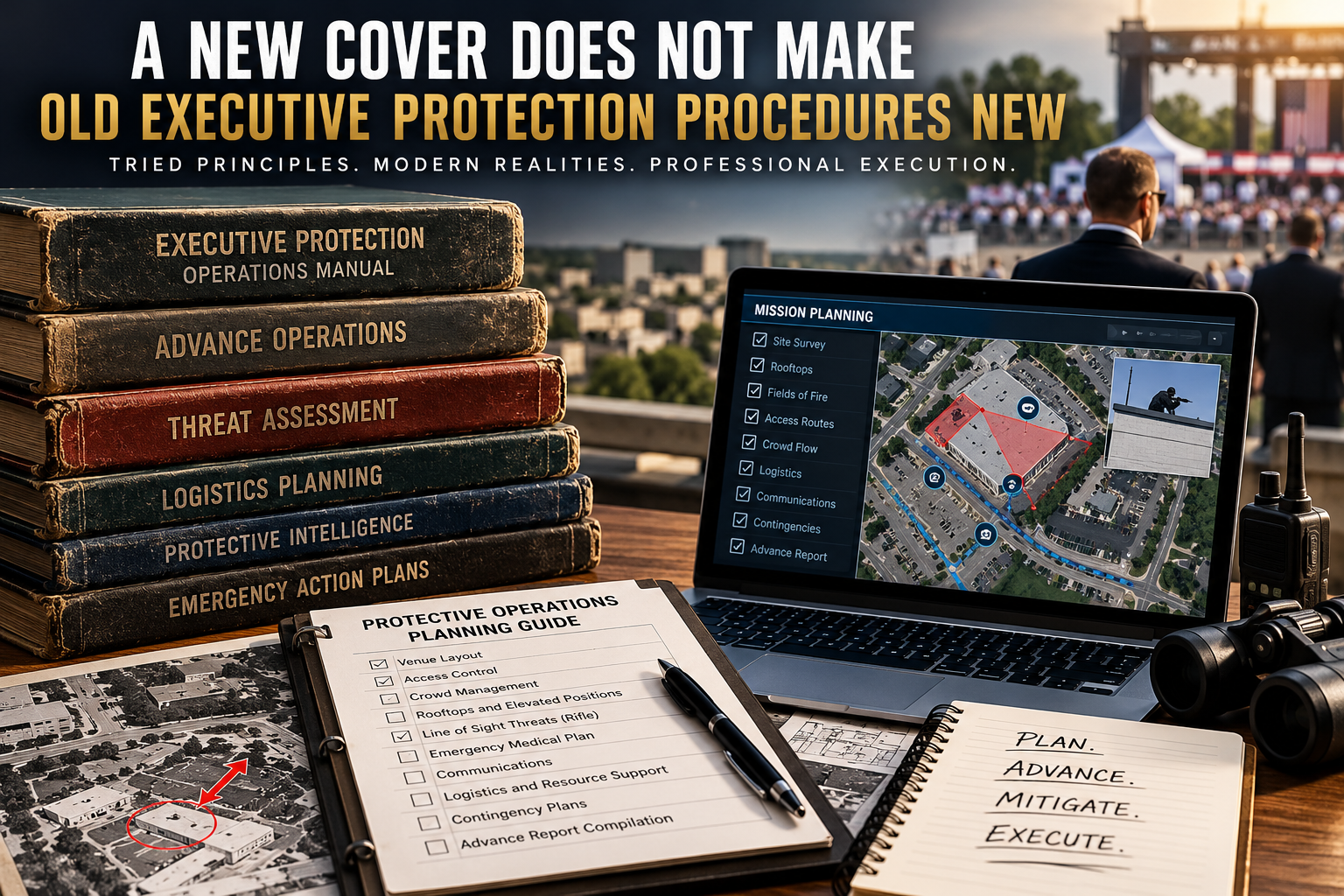
A New Book Cover Does Not Make Old Executive Protection Procedures New Again
Fifty Years of Protective Planning, Modern Technology, and Why No Single Guidebook Has All the Answers
Executive Protection Planning
By Matthew C. Parker
Chief Executive Officer, Independent Security Advisors LLC (ISA)
Director of Training, EPTraining.us
Abstract
Executive protection professionals have been using protective advance checklists, logistics guides, and operational manuals for nearly fifty years. A recent advertisement for another executive protection logistics guide got me thinking about how much of the information is actually new and whether today’s publications address the technology and threats we encounter in modern protective operations. I value checklists, particularly when preparing advance reports and mission plans, but I also believe that experienced agents should understand their responsibilities without depending on a book to explain every step. We need references that help us organize our work, recognize changes in the profession, and select procedures appropriate to the client, the threat, and the assignment.
An Advertisement That Got Me Thinking
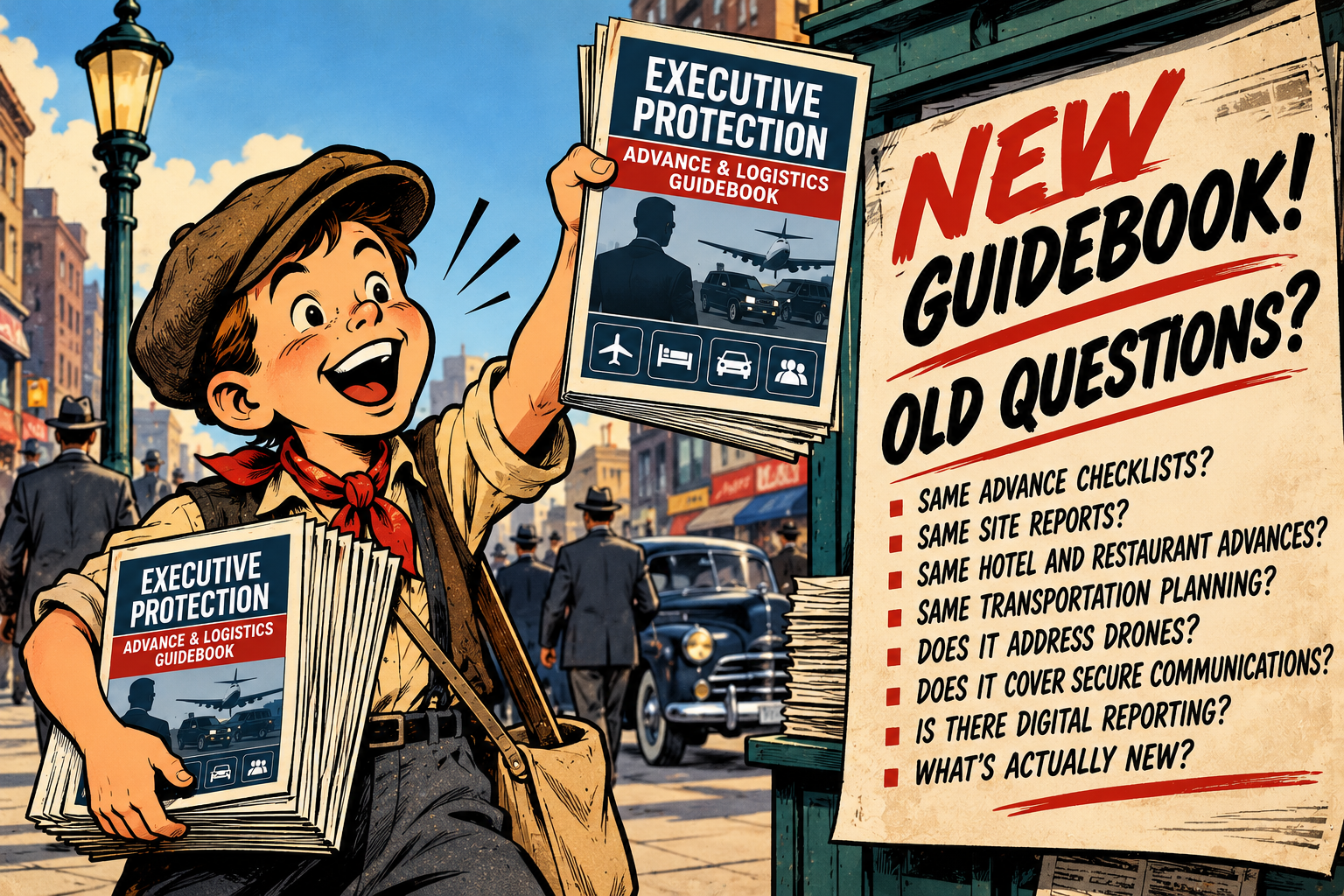 I recently came across an advertisement for the Board of Executive Protection Professionals (BEPP) Executive Protection Advance & Logistics Guidebook, Version 2.0. I have collected and used executive protection books, government manuals, and operational references for many years, so I am always interested in seeing what other practitioners are publishing. The publisher describes a 130-page pocket guide covering operational plans, restaurant advances, aircraft and vessel advances, site reports, short-notice movements, protective-team assignments, terminology, and briefings. These are all useful subjects, and I can understand why an agent would appreciate having them organized in a convenient reference.
But as I read through the advertised contents, I found myself thinking about how much of this information has already been published. We have been teaching protective advances, site surveys, transportation planning, hotel security, emergency arrangements, and the organization of protective teams for decades. Government agencies, professional authors, and training organizations have produced extensive material covering these responsibilities. Many of those publications remain useful, and experienced agents probably have several of them sitting on their bookshelves.
There is nothing wrong with bringing established information together in another book. A smaller guide may be easier to carry, the forms may be better organized, and the presentation may make the information more useful in the field. Those are legitimate contributions, but they are different from introducing new protective procedures. When I see another publication advertised as a comprehensive resource, I want to know what it adds to the information already available and whether that additional material addresses the conditions under which protection agents operate today.
The advertisement also raised another question. We now have commercially available encrypted communications, digital advance reports, tablets capable of exchanging annotated site photographs, drones, artificial intelligence, and electronic systems that were unavailable or far less capable when many traditional executive protection references were written. If we are publishing updated logistics guides in 2026, I would expect those developments to receive attention wherever they affect protective planning. The purpose of this article is not to criticize another author for publishing a book. It is to examine what we should expect from professional references and how we can make better use of the material already available.
1. Executive Protection Checklists Are Not New
Fifty Years of Protective Planning References
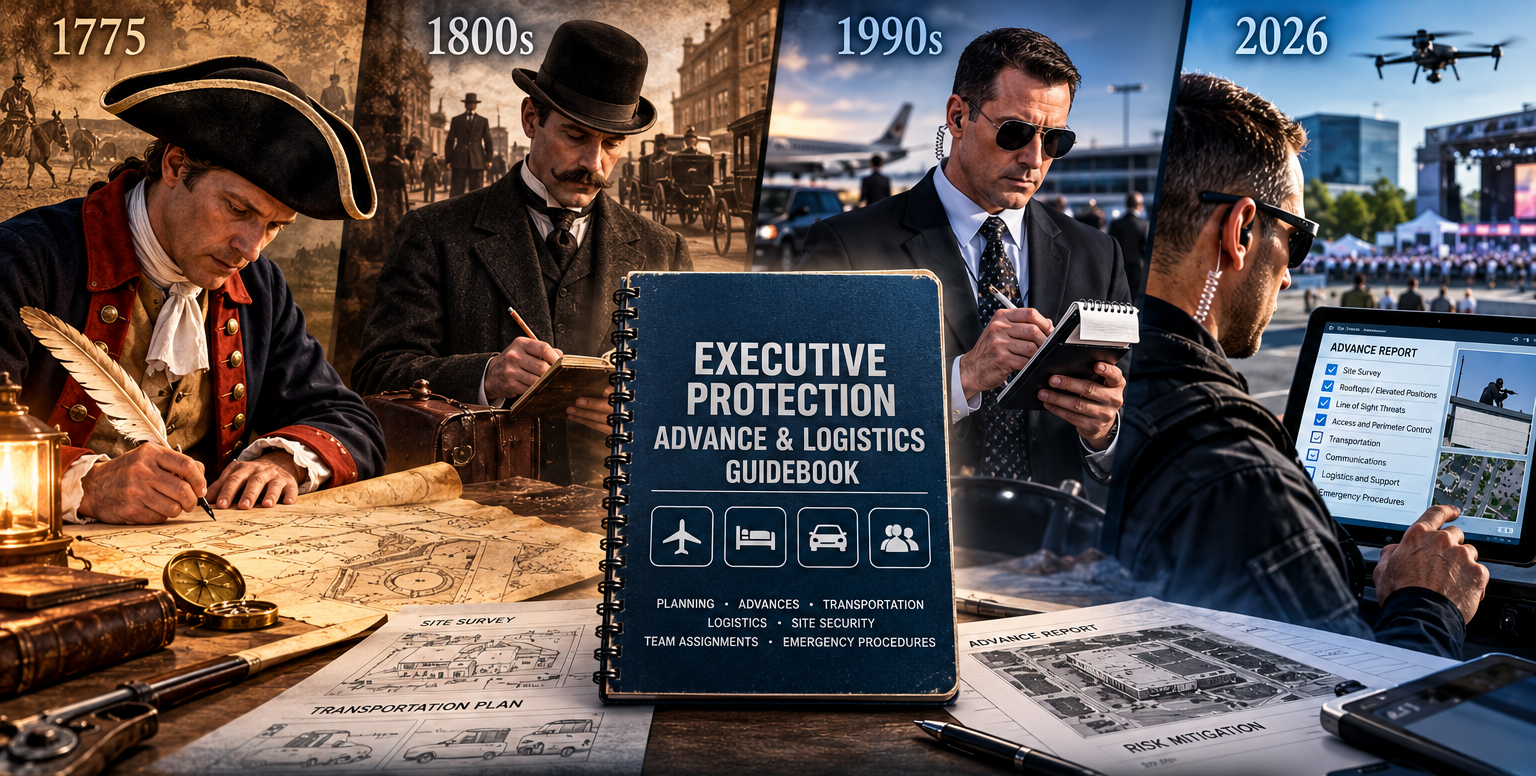 One of the earlier examples is the California State Police manual Protective Services Operations, preserved in the U.S. Department of Justice’s National Criminal Justice Reference Service archives. The 65-page publication, which dates from the earlier period of modern state protective program development, addressed the organization of protective teams, emergency procedures, equipment, security surveys, protective checklists, and security driving. It was intended to help personnel organize and conduct the protection of public officials, including arrangements involving several agencies and contingency protective teams.
Dale L. June’s Introduction to Executive Protection provides another example of how extensively these subjects have been documented. The first edition appeared in 1999, followed by an expanded second edition in 2008. June included a detailed Protective Agent Advance Checklist and a separate Transportation Advance Checklist, covering such subjects as hotels, airports, restaurants, routes, outdoor events, command post equipment, site security, and protective-team briefings. These are many of the same responsibilities we continue to discuss when teaching protective advances and logistics today.
Duke Speed’s Advance Agent Planning Guide, published in 2016, concentrated specifically on planning and conducting protective advances. The book was developed for personnel working in government, law enforcement, military, and private-sector security operations, and it provided practical planning procedures and checklists. Other authors, including Philip Holder, Donna Lea Hawley, and Robert L. Oatman, have contributed useful material, while organizations such as LaSorsa & Associates have distributed specialized advance planning references.
These publications are not identical, nor were they intended to accomplish precisely the same thing. Some explain the principles behind protective operations, others concentrate on particular responsibilities, and some provide forms and checklists for use in the field. Together, however, they demonstrate that the executive protection profession already has a substantial collection of material explaining how to plan an assignment, conduct an advance, organize transportation, examine a facility, prepare for emergencies, and coordinate protective personnel.
If another book collects that information into a more convenient format, it may be useful. But we should recognize what the publication is contributing. The basic responsibilities of protective planning have remained remarkably consistent over the years, even though the equipment, communications, and threats have changed. What interests me is whether a new reference helps the agent perform those responsibilities more effectively or simply presents familiar procedures under another cover.
An Experienced Agent Should Know How to Conduct an Advance Without a Checklist
I value checklists and logistics guides. We use them at ISA, and I have used them throughout my professional career. But I believe an experienced executive protection agent should be able to conduct an advance without carrying a checklist around to explain what needs to be examined. The agent should already understand the responsibilities involved, know what information is needed, recognize potential security concerns, and understand how those findings relate to the client’s safety.
The same applies to mission planning. An experienced agent should understand transportation requirements, personnel assignments, communications, emergency arrangements, medical support, and the other logistical responsibilities involved in preparing for a protective operation. That does not mean an agent should refuse to use a reference during an advance. There may be unusual facilities, complex transportation arrangements, or specialized requirements that justify consulting additional material. Experience should provide the knowledge needed to perform the work, not create a reason to disregard useful tools.
Where I find checklists especially valuable is when the agent returns from the advance and begins preparing the final report. During a site visit, the agent may collect information from building management, local law enforcement, transportation providers, security personnel, and other individuals involved in the assignment. The agent may also have photographs, site diagrams, notes about access arrangements, emergency contacts, and observations concerning matters that require additional attention. All of that information must eventually be organized into a mission plan that the rest of the protective team can understand and use.
A good advance report does considerably more than describe the location. It should identify the relevant security concerns, explain what arrangements have been made, establish who is responsible for completing particular tasks, and identify matters that remain unresolved. If the agent has identified a problem with an entrance, transportation arrangement, or exposed location, the report should explain what mitigation has been recommended, who is responsible for carrying it out, and whether the necessary arrangements have been confirmed. A standardized checklist helps organize that information and allows another agent or supervisor to determine whether the plan is complete.
This becomes particularly important when several agents or outside agencies are involved. The person reviewing the report may not have conducted the original advance and may know very little about the facility. A well-organized report should allow that person to understand the location, the proposed arrangements, the responsibilities assigned to different personnel, and any problems that still require attention. The checklist does not replace the experienced agent, but it provides a consistent format for recording the agent’s findings and identifying missing information before the protective operation begins.
Charlie Kirk: The Difference Between Identifying a Threat and Addressing It
The September 10, 2025, assassination of Charlie Kirk at Utah Valley University provides an example of why I place considerable value on properly prepared advance reports. We examined the incident in two earlier EPTraining.us articles, What Changed at Utah Valley? Charlie Kirk’s Protection Failures and What UVU’s Independent Review Adds to the Charlie Kirk Case Study. Those articles compared the security Kirk received at earlier appearances with the arrangements available when his traveling protection team arrived at Utah Valley University.
At several previous events, Kirk’s detail had received substantial assistance from law enforcement agencies with experienced leadership, additional personnel, and resources that supported the protective operation. At Utah Valley, the security arrangements were different, and concerns involving elevated locations had not been adequately resolved. The independent review commissioned by Utah Valley University and released in September 2026 found that the event lacked a comprehensive written security assessment or event action plan. It also identified shortcomings involving elevated-position assessments, coordination, and the failure to conduct a joint pre-event security walk-through.
Now consider how a properly prepared advance report could have helped. An agent reviewing the report reaches the section concerning nearby elevated positions and potential lines of sight to the protectee. The location has been identified, but the section describing the mitigation measures is incomplete. Who is responsible for examining the position? What security arrangements have been requested? Has the host agency agreed to provide the necessary support, and has anyone confirmed that those arrangements will actually be in place?
Those questions should not disappear because the issue was discussed during a meeting or mentioned during a site visit. A properly prepared report should make an unresolved concern visible to the agent, the detail leader, and anyone else responsible for reviewing the operation. I am not suggesting that a checklist would necessarily have prevented Kirk’s assassination, because the problems involved planning, coordination, and the implementation of protective measures. But a good report can make it much harder for an identified threat to remain unresolved without someone recognizing that the plan is incomplete.
This is why I value logistics guides and checklists. The advance agent collects the information, evaluates the circumstances, and recommends appropriate measures. The report records those findings, identifies the responsibilities, and helps the team determine whether the required arrangements have been completed. A checklist is not a substitute for experience, but it can be an outstanding tool for organizing the work and identifying problems that still require attention.
Can a Chapter in a Book Replace Professional Training?
One of the promotional comments associated with the new logistics guide suggested that people were using individual chapters to develop courses costing hundreds of dollars. The comment also mentioned hotel advances, fixed-base operator facilities, motorcade operations, and other specialized subjects, suggesting that the book could provide material that might otherwise be obtained through separate courses. I believe there is a reasonable way to interpret that statement, and I do not think we should assume the person intended to suggest that reading a chapter makes someone qualified to perform a protective responsibility.
A professional book may contain excellent material for developing instructional programs. I have used government manuals, professional textbooks, and other references when preparing instruction throughout my career, and I would expect qualified instructors to do the same. In fact, the publisher’s description of the guidebook acknowledges the importance of the practitioner’s experience and training. I agree with that position, and I do not believe the advertisement should be interpreted as an attempt to replace professional instruction.
There is still an important distinction between providing source material for a course and actually developing and delivering that course. A chapter on hotel advances may explain the responsibilities involved, but it cannot establish that a student knows how to conduct an advance. Proper training requires a qualified instructor, clear instructional objectives, practical application, and an opportunity to evaluate whether the student can perform the work. A student who can describe a hotel advance during a classroom discussion is not necessarily prepared to conduct one under actual operating conditions.
I also have no objection to a qualified instructor charging hundreds of dollars for a properly developed course. There is considerable work involved in preparing instruction, conducting practical exercises, evaluating students, and maintaining course material as requirements change. The value of the training comes from those activities, not simply from the number of chapters available in a reference book. A good publication can support the instructor, but it cannot replace professional training, practical experience, or the work required to develop and maintain a credible training program.
2. What Should an Executive Protection Logistics Guide Address in 2026?
The publisher’s description of Version 2.0 identifies several additions, including an operational plan outline, restaurant and aircraft advances, site reports, and protective briefings. A separate promotional comment refers to electronic countermeasures, medical planning, and major events. Those are relevant subjects, but the publicly advertised additions do not specifically identify encrypted communications, secure sharing of advance photographs between tablets, fillable digital reporting, artificial intelligence, or drone-related planning. I am not claiming that those subjects are absent from the publication, because I have not examined its complete contents. I am asking whether an updated logistics guide should explain how agents use these technologies and account for their limitations during actual protective operations.
Secure Communications: What Agents Should Understand About Available Systems
Protective agents routinely exchange information that should not be available to people outside the operation. Client itineraries, hotel arrangements, advance reports, emergency contacts, transportation schedules, and photographs of locations may all contain sensitive information. An agent needs to understand not only how to transmit that material but also who is authorized to receive it, how it will be stored, and what happens when access must be withdrawn. These are practical communications responsibilities that affect nearly every protective assignment.
Several commercially available services provide capabilities worth understanding. Signal offers end-to-end encrypted messaging, voice and video calls, group communications, and the exchange of photographs and files. Proton Mail provides end-to-end encrypted email between Proton Mail users and offers methods for securely communicating with recipients using other email providers. Proton Drive allows documents and photographs to be shared with selected recipients, with options for controlling access, using password-protected links, establishing expiration dates, and withdrawing sharing permissions.
These products provide useful capabilities, but the differences between them matter. For example, an ordinary message sent from Proton Mail to a non-Proton email provider is not automatically end-to-end encrypted. The sender must use an appropriate option, such as a password-protected message or properly configured PGP encryption, when that level of protection is required. Similarly, placing a sensitive document in encrypted storage does not prevent someone with authorized access from downloading it, copying it, or sending it to an unintended recipient.
I am not suggesting that every protective detail should use Signal, Proton, or any particular commercial service. The appropriate choice depends on the client’s requirements, the equipment available, organizational security policies, the sensitivity of the information, and applicable recordkeeping requirements. What concerns me is whether agents understand those differences and can select an appropriate means of communicating without exposing the client’s information unnecessarily.
A modern logistics guide should help agents think through those decisions. For example, an advance agent preparing for an international trip may need to send an itinerary, hotel photographs, and transportation information to several people in different locations. The communications plan should identify the approved service, the authorized recipients, the procedure for confirming that everyone received the current material, and the method for removing access when the assignment ends. Simply including a box marked Communications does not provide enough information to address those responsibilities.
Tablet-to-Tablet Sharing and Digital Advance Reports
Tablet computers have changed how agents can collect, organize, and distribute advance information. An agent conducting a hotel advance can photograph entrances, record access arrangements, prepare a site diagram, and insert the information into a digital report while still at the location. The report can then be transmitted to the detail leader or other authorized agents through an approved secure messaging or file-sharing system. A colleague who did not conduct the advance can review the photographs, examine the diagram, and identify questions that need to be answered before arriving at the facility.
Consider an agent conducting an advance at a conference hotel. The agent photographs the entrance, records the transportation arrangements, identifies emergency access points, and prepares a report containing the information needed by the protective team. During a later discussion with hotel management, an access arrangement changes, requiring the agent to revise part of the report. The updated information must then be distributed to the agents who received the earlier version, and everyone must be able to identify which report contains the current arrangements.
This is where digital reporting requires more than the ability to fill out a form on a tablet. A useful procedure should establish how reports are named, how revisions are identified, who is authorized to make changes, and how obsolete information is withdrawn from operational use. It should also address the handling of sensitive photographs and whether documents are stored on personal devices, organization-managed equipment, or approved shared systems. Those details affect the accuracy of the information available to the team and the confidentiality of the client’s arrangements.
A fillable PDF can be an excellent format for preparing an advance report because it allows agents to organize information consistently and insert photographs or supporting documents. But a PDF is not automatically secure simply because it is electronic. The security of the report depends on the device, the storage system, the sharing method, and the access permissions established by the organization. If a contemporary logistics guide provides digital forms, I would want to know whether it also explains how those forms should be updated, protected, distributed, and maintained during an assignment.
The same principle applies to communications failures. An encrypted messaging application may be useful for distributing reports and photographs, but it should not automatically become the only means of communicating during a protective movement or emergency. Agents should consider cellular coverage, internet availability, radio communications, alternate contact methods, and the procedures to follow when the primary system fails. The planning process should confirm that personnel can communicate where they are expected to operate rather than assume that the technology will work because it performed well somewhere else.
Electronic Countermeasures and the Limits of Private-Sector Authority
The promotional discussion of the guide also mentions electronic countermeasures. That subject deserves careful attention because the term can describe several different technologies, and private-sector protection agents do not have the same authority to use all of them. There is an important distinction between detecting a drone, examining information that is lawfully available, and electronically interfering with an aircraft’s operation. A private agent who overlooks those differences could create serious legal problems for the client and the organization.
The Federal Communications Commission regulates the radio-frequency spectrum, and the Federal Aviation Administration regulates aviation safety and the use of national airspace. The FCC has made clear that an individual cannot lawfully operate an unauthorized signal jammer merely because the equipment is being used on private property. Jamming drone control signals, interfering with navigation signals, or electronically taking control of an aircraft generally falls outside the authority of an ordinary private security company. Depending on the equipment and its operation, even some electronic detection methods may raise communications interception or other legal questions.
Congress expanded certain counter-drone authorities through the SAFER SKIES Act, enacted in December 2025, with implementing regulations taking effect in July 2026. Those provisions establish a framework for qualifying state, local, tribal, and territorial law enforcement and correctional agencies to conduct specified operations under federal conditions. They do not provide a general authorization for private protection companies or property owners to operate drone jamming equipment. The authorities remain subject to restrictions involving training, certification, approved technology, communications spectrum, and coordination with the appropriate federal agencies.
This creates a practical planning problem for private protection teams. Imagine a corporate executive attending an outdoor event on privately owned property where the threat assessment identifies unauthorized drone observation as a concern. The property owner may want the protection team to prevent drones from approaching the venue, but ownership of the property does not give the agents authority to jam communications or force an aircraft from the sky. The advance agent needs to determine what lawful observation or detection capabilities are available, which authorities should be contacted, and whether changes to the venue or protective arrangements are necessary.
A contemporary logistics guide should help agents understand these limits and prepare an appropriate response plan. That plan should identify who receives reports of suspicious drone activity, which agency has jurisdiction, what resources may be available through authorized personnel, and how the protective team will respond if the concern cannot be resolved. Merely listing electronic countermeasures as a subject does not explain the legal authority required to use the equipment or how a private team should plan around those restrictions.
Drones: Why Older Planning Procedures Need Another Look
Drones also illustrate how traditional protective procedures must be reviewed as technology changes. An agent conducting an advance fifty years ago examined buildings, rooftops, access points, parking areas, and transportation routes because those locations could affect the client’s safety. Those responsibilities remain important, but commercially available drones have created additional possibilities for aerial observation and information collection. The equipment is relatively accessible, and its capabilities have improved considerably, creating concerns that older planning references could not have addressed in the same way.
At ISA, we began incorporating drones into our training in 2015. We recognized that they could provide useful capabilities in certain lawful protective applications while also presenting new problems that agents would need to understand. As the technology developed, the information we taught had to change as well. Drones are no longer an unusual subject that can be discussed separately from routine protective planning when the circumstances of the assignment make them relevant.
An advance agent preparing for an outdoor event should consider whether authorized drone activity is expected in the area, whether the venue is subject to relevant airspace restrictions, and what procedures exist for reporting suspicious activity. If the host agency has lawful detection or other authorized capabilities, the protective team should understand who is responsible for coordinating those resources. The team also needs to recognize that detecting a drone does not establish its intent and that an unfamiliar aircraft may be operating lawfully.
This is the kind of material that should be considered when evaluating a contemporary planning reference. We do not need another checklist that simply repeats the responsibility to examine a site. We need useful information that helps agents understand how current equipment, new threats, and legal restrictions affect the procedures they already know.
Why ISA Updates Its Curriculum Frequently
At ISA, reviewing and revising instructional material is part of maintaining our executive protection program. Our curriculum is reviewed at least quarterly, and additional changes can be made whenever significant developments justify them. Those developments may involve new technology, protective incidents, changes in law or policy, instructor observations, or problems identified during practical training. We do not wait for an author to publish another edition of a textbook before deciding whether our instruction needs attention.
Our use of drones is one example of how this process works. We began addressing the technology in 2015, but what was appropriate to teach then is not necessarily sufficient for an agent operating in 2026. The capabilities of commercial drones have changed, the legal environment has developed, and protective personnel have encountered circumstances that provide additional lessons. As those developments become relevant to the work our students are expected to perform, we examine the existing material and make changes where necessary.
The same applies to artificial intelligence, secure communications, digital reporting, and other technology. We can continue using an older reference for a protective planning principle while supplementing that instruction with more recent guidance on a particular system or threat. There is no contradiction in using material that is ten or twenty years old alongside a manual that has been revised five or six times and updated within the last year. The important question is whether the information remains appropriate and whether newer material provides something the older reference did not address.
We also recognize that not every incident requires changing the curriculum. Sometimes our existing instruction already addresses the issue, or the lessons from an incident do not apply to the duties being taught. But those conclusions should result from examining the information rather than assuming that established procedures remain complete. That is one of the reasons I believe an organization should maintain a regular review process and make revisions whenever the need becomes apparent.
The GAO report provides a useful comparison because it demonstrates the problems that arise when organizations fail to connect operational experience with written guidance. ISA’s approach is to examine the subjects we teach, review significant developments, and revise material when those developments affect the responsibilities of the protection agent. Our students need to understand not only established procedures but also the ways those procedures must be applied when technology, threats, or available resources change.
Artificial Intelligence and the Reliability of Protective Information
Artificial intelligence has become another subject that protective agents need to understand because it affects both the collection of information and the reliability of what they receive. An agent can use an AI-assisted system to organize reports, compare documents, summarize publicly available information, or help identify subjects requiring further examination. Those capabilities may save time, particularly when preparing for an assignment involving numerous locations, public events, or a large amount of background information. However, the agent remains responsible for determining whether the information is accurate and relevant.
Consider an agent researching a venue before a public appearance. An AI system produces a summary claiming that an earlier event at the location involved a serious security incident. Before that information influences the threat assessment, the agent should locate the original report, confirm the date and circumstances, and determine whether the incident has any relevance to the present assignment. AI can produce convincing material that contains errors, combines unrelated events, or refers to incidents that never occurred. A professional threat assessment cannot rely on such information without verification.
Artificial intelligence can also be used to create false photographs, videos, audio recordings, and written statements involving a client. A fabricated statement attributed to an elected official or corporate executive may circulate widely before the information is corrected, potentially contributing to hostility or attracting unwanted attention. Agents who conduct protective intelligence work need to recognize that the material they encounter may have been manipulated and that the accuracy of a source must be examined before conclusions are drawn.
There is a separate concern involving the information protective teams provide to AI systems. Entering client itineraries, residential information, advance reports, or protective plans into an unapproved service may expose material the client expects the organization to safeguard. The agent needs to understand the organization’s rules concerning these systems, what information may be submitted, and whether the service is appropriate for the material involved. A contemporary logistics guide does not need to explain every AI product, but it should address how these tools affect information collection, confidentiality, and the preparation of protective plans.
3. Why ISA Uses Multiple Executive Protection References
Government Manuals, Professional Books, and Different Operating Environments
ISA uses material developed by the Federal Law Enforcement Training Centers, Department of State protective guidance, appropriate military instructional references, and professional publications written by experienced practitioners. We use these sources because they address protective responsibilities from different perspectives and because the procedures appropriate to one organization may not be suitable for another. A federal protective detail, a private corporate team, and an agent protecting a family may perform similar basic duties while operating under very different conditions.
Federal protective training material provides useful information about coordination, communications, staffing, operational planning, and the responsibilities of protective personnel. Department of State guidance, including its Protection Handbook, offers another perspective on diplomatic assignments, international travel, and coordination with government authorities. Military instructional references can provide useful information about planning, leadership, communications, risk management, and emergency procedures. My experience as a professor of military science and in instructional management reinforced the importance of teaching personnel why procedures exist and how to apply them under different circumstances.
But understanding a government procedure does not mean that a private protection team should automatically adopt it. A federal detail may have specialized communications equipment, intelligence support, substantial staffing, established relationships with other agencies, and legal authorities unavailable to a private agent. A corporate protection agent operating with one or two colleagues may need to coordinate with commercial transportation providers, hotel management, local police, and private security personnel, sometimes in another country where the laws and available resources are very different. Those differences should influence which procedures the agent selects and how the assignment is planned.
The purpose of using government manuals and other professional references is not to copy every procedure they contain. It is to understand the principles, examine how different organizations apply them, and determine what is appropriate for the assignment at hand. A government manual may provide excellent guidance on coordinating several agencies, while a private-sector reference may offer more practical information about commercial travel or assignments involving limited personnel. Both can be valuable without either becoming the only source an agent should consult.
Dale June, Duke Speed, and Respecting Different Approaches
I consider Dale June and Duke Speed friends, and I have the utmost respect for both men and their contributions to the executive protection profession. Their books and instructional materials reflect considerable professional experience, and I have used their work while developing training programs and supporting protective operations. I have also learned from numerous other authors and practitioners whose backgrounds and operational experiences differ from my own.
But even with those friendships and the respect I have for their work, I would never suggest that either author’s publication should be the only reference an agent uses. I would say exactly the same thing about my own material, including the ISA study guide. Every author brings a different background, different experiences, and a different point of view to the subject. Those differences influence which problems receive the greatest attention and which procedures the author considers especially important.
Dale may place greater importance on one aspect of protective planning because of circumstances he has encountered. Duke may emphasize something else because of his professional experience, while I may approach the same problem differently based on what I have seen during my own protective assignments. None of those differences automatically makes one approach right and the others wrong. There may be several effective ways to accomplish the same protective responsibility, and the most appropriate approach depends on the client, the threat, the resources available, and the circumstances of the assignment.
This is why I encourage our students and operational personnel to consult multiple references rather than become attached to one author’s preferred methods. Read government manuals, study professional textbooks, examine specialized publications, and compare the recommendations. When the references disagree, try to understand why. An agent who knows several approaches and understands their advantages and limitations is better prepared to make an informed decision than someone who has memorized one book without understanding the reasons behind its procedures.
No Single Manual Can Address Every Assignment
Consider three different protective assignments. A federal protective detail involving several government agencies, a corporate executive traveling internationally, and a private family requiring residential protection all involve executive protection planning. However, the resources available, the legal authority of the agents, the staffing, communications, and the threats they face can be considerably different. Even when the agents are performing similar duties, they may need to approach those duties differently because of the circumstances surrounding the assignment.
A federal protective detail may have access to government intelligence, specialized communications equipment, established law enforcement relationships, and personnel who can provide additional security at an event. A private-sector agent protecting a corporate executive may have none of those resources. That agent may need to coordinate with hotel management, commercial transportation providers, private security personnel, and local law enforcement, sometimes in another country where the laws and available support are very different. A residential protection assignment presents another set of concerns, including the family’s daily activities, visitors, household employees, privacy, and the need to provide security without unnecessarily interfering with normal family life.
This is why I encourage our students and operational personnel to use several professional references rather than rely on one publication. A federal manual may explain interagency coordination and government protective procedures in considerable detail, while a private-sector reference may provide more useful information about commercial transportation, hotels, and assignments involving limited personnel. A specialized communications reference may address encrypted messaging, digital information security, and the exchange of advance reports between agents. Each publication may contribute something useful, but the agent must determine which information is appropriate for the actual assignment.
I am not suggesting that agents should disregard established procedures or allow everyone on a protective detail to operate according to personal preference. Quite the opposite. Once the protective team has evaluated the assignment and selected the appropriate procedures, everyone needs to understand their responsibilities and follow the agreed plan. What I disagree with is the idea that one author’s preferred method should automatically become the procedure for every assignment, regardless of the client, the threat, or the resources available. We should be teaching agents how to evaluate those differences and make informed decisions, not simply how to follow instructions printed in a book.
There is more than one way to conduct a protective operation, and experience has taught me that a procedure that works well in one environment may be inappropriate in another. That is why ISA uses government manuals, professional textbooks, specialized guides, and our own operational experience when developing training and preparing for assignments. No single publication contains every answer, including the ISA study guide. The purpose of using multiple references is to give agents the knowledge to select and apply procedures that best address the client, the threat, and the circumstances of the operation.
Conclusion: The Value of a New Guide Is What It Contributes
I welcome new executive protection publications, and I have no objection to another book that organizes established procedures into a convenient reference. The profession benefits when experienced practitioners share knowledge, prepare useful planning tools, and provide material that helps agents perform their responsibilities. A well-designed logistics guide can assist with collecting advance information, preparing reports, organizing responsibilities, and identifying matters that require attention before the protective operation begins.
The Charlie Kirk case illustrates why that process matters. An agent may recognize a security problem during an advance, but recognizing the problem does not mean it has been resolved. A properly prepared report should identify the concern, explain the proposed mitigation, establish who is responsible, and make it clear when the necessary arrangements remain incomplete. A checklist is useful because it helps organize that information and allows supervisors and other agents to examine the plan before the operation begins.
At the same time, I believe we should expect contemporary professional references to address the conditions under which agents operate today. The profession already has decades of material covering hotel advances, transportation planning, site surveys, team assignments, and emergency arrangements. Modern agents also need to understand secure communications, digital reporting, the exchange of photographs and site diagrams, drones, artificial intelligence, and the legal limitations affecting certain security technologies. These are practical responsibilities that deserve attention whenever they are relevant to a protective assignment.
I also encourage agents to retain their older references and continue learning from different authors. Some procedures have remained useful for generations, while others must be revised as technology, threats, and professional requirements change. No one author, instructor, or organization has every answer, including ISA. We should be willing to learn from established government manuals, experienced private-sector practitioners, newer publications, and lessons from actual protective operations.
A new cover does not make old executive protection procedures new, but a new publication can still make a worthwhile contribution. What matters is whether it improves the agent’s ability to plan the assignment, organize the information, communicate with the team, address the threat, and protect the client. That is the standard I would apply to any professional guide, including our own.
About the Author
Matthew C. Parker is Chief Executive Officer of Independent Security Advisors LLC (ISA) and Director of Training for EPTraining.us. His professional experience spans more than three decades of military service, executive and dignitary protection operations and training, international security advising, and protective program development.
Before retiring from the U.S. Army in 2011, Parker conducted protective operations involving senior U.S. military leaders and trained U.S. and Iraqi protective-security personnel. He also managed military instructional programs and taught military science at Virginia Tech.
Since establishing ISA in 2011, Parker has directed executive protection operations in the United States for international government officials and trade delegations, provided protective services for corporate and private clients, and developed protective programs for financial institutions, insurance companies, and private families.
His international experience includes security-advisory and protective assignments in Ukraine, training for Ukrainian police and Judicial Protection Service personnel, and advisory work concerning international commerce, diplomatic protection, and democracy-support initiatives.
Website: https://www.eptraining.us
References and Further Reading
- California State Police. Protective Services Operations. National Criminal Justice Reference Service, NCJ 35057. U.S. Department of Justice archival record.
- Dale L. June. Introduction to Executive Protection. First edition, 1999; second edition, CRC Press, 2008.
- Duke Speed. Advance Agent Planning Guide: The Executive Protection Specialist’s Guide for Conducting Advance Operations. 2016. International Security Driver Association publication announcement.
- Philip Holder and Donna Lea Hawley. The Executive Protection Professional’s Manual. 2006.
- U.S. Department of State. Protection Handbook, 12 FAH-2, and associated Diplomatic Security Service protective guidance.
- Federal Law Enforcement Training Centers. Federal law enforcement and protective operations training resources.
- U.S. Government Accountability Office. Secret Service: Protection Policies Should Be Consistently Updated to Better Ensure Protectee Safety. GAO-26-108455, September 3, 2026. Full report.
- Utah Valley University. Independent External Review of the September 10, 2025, Assassination of Charlie Kirk. September 2026. Independent review and findings.
- Matthew C. Parker. What Changed at Utah Valley? Charlie Kirk’s Protection Failures. EPTraining.us. Original case study.
- Matthew C. Parker. One Day Later: What UVU’s Independent Review Adds to the Charlie Kirk Case Study. EPTraining.us. Follow-up analysis.
- The Executive Protection Advance and Logistics Guidebook, Version 2.0. Publisher’s description.
- LinkedIn. Original promotional discussion concerning the guidebook, October 2026.
- Cybersecurity and Infrastructure Security Agency. Mobile Communications Best Practice Guidance. CISA guidance.
- Signal. Official website and encrypted communications information.
- Proton. Email encryption guidance and secure file-sharing guidance.
- Federal Communications Commission. Enforcement guidance concerning the prohibition on unauthorized signal jamming.
- Federal Aviation Administration. UAS detection and mitigation information.
- U.S. Department of Justice and Department of Homeland Security. Counter-UAS Authority for State, Local, Tribal, and Territorial Law Enforcement and Correctional Agencies. Effective July 1, 2026. Federal Register.
#ExecutiveProtection #ExecutiveProtectionTraining #ExecutiveProtectionChecklists #ProtectiveOperations #ProtectiveAdvances #AdvancePlanning #AdvanceReports #ExecutiveProtectionLogistics #SecurityPlanning #ThreatAssessment #RiskMitigation #ProtectiveIntelligence #SecureCommunications #EncryptedMessaging #Signal #ProtonMail #ProtonDrive #DigitalSecurity #SecurityTechnology #ArtificialIntelligence #AIinSecurity #DroneSecurity #CounterUAS #DignitaryProtection #CorporateSecurity #LawEnforcementTraining #ProfessionalStandards #IndependentSecurityAdvisors #EPTraining #MatthewCParker