
 E-mail us
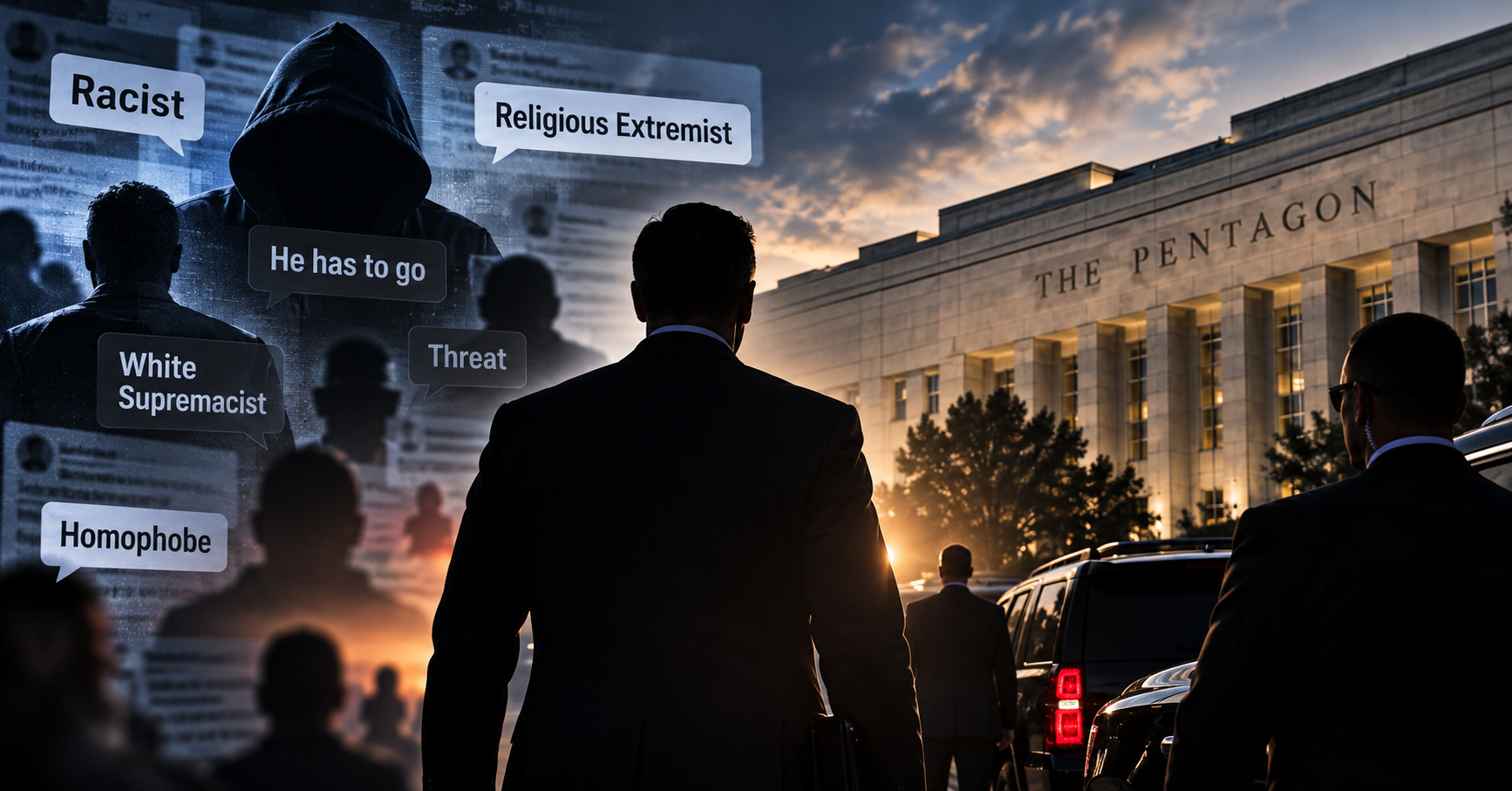
Ryan Higgins, the Pentagon, and the Danger of Becoming a Political Target
Ryan Higgins
When Political and Religious Controversy Becomes an Executive Protection Concern
By Matthew C. Parker
Chief Executive Officer, Independent Security Advisors LLC (ISA)
Director of Training, EPTraining.us
ISA Defending Democracy Initiative
October 27, 2026
Abstract
Ryan Higgins, a senior adviser to Secretary of Defense Pete Hegseth, became the subject of national controversy on October 27, 2026, following an investigation into his political and religious statements. The reporting described comments about race, immigration, homosexuality, women, and religion that many Americans would consider extreme or discriminatory. His position at the Pentagon makes the controversy particularly significant because it raises questions about whether his personal beliefs influence matters affecting military personnel.
There is another issue that deserves attention. National publicity can change how people recognize and respond to an individual, particularly when that person becomes associated with deeply divisive political or religious beliefs. The assassination of Charlie Kirk and documented threats against Candace Owens demonstrate that public disagreements can sometimes become personal security concerns. This article examines how Higgins’s growing public recognition could affect his security and why protection professionals must consider both what is known about an individual and what others believe about that person.
Bottom Line Up Front
Ryan Higgins has become more recognizable because of reporting that associates him with controversial political and religious views. Some important details of his position and activities are independently documented, while much of the account of his earlier statements comes from CNN’s October 27 investigation. Whether every public characterization of Higgins is accurate does not necessarily determine how someone who strongly opposes his reported beliefs will react.
An individual who already holds a serious political or religious grievance may accept the most damaging descriptions of Higgins and begin viewing him as a representative of something that individual believes must be stopped. That possibility does not establish that Higgins faces a credible threat or that an attack is likely. It does, however, explain why a change in public exposure deserves attention during a protective-security assessment. The responsibility of executive protection professionals is to distinguish ordinary public criticism from behavior that indicates someone may be moving toward harassment, threats, or violence.
Ryan Higgins and the Controversy at the Pentagon
On October 27, 2026, CNN published an investigation into Ryan Higgins, a senior adviser to Secretary of Defense Pete Hegseth. The report examined years of social media posts, videos, and other public statements attributed to Higgins, including comments concerning Muslims, immigrants, homosexuality, abortion, women, and American politics. Some of those statements were particularly inflammatory. CNN reported that Higgins had referred to LGBTQ people in religiously hostile terms, expressed opposition to same-sex marriage, made offensive comments about immigrants, and questioned the separation of church and state. The investigation also examined his influence over the Secretary of Defense’s religious messaging and policy priorities.
These are serious matters because Higgins is advising the leadership of an institution whose personnel represent different races, religions, political beliefs, and personal backgrounds. A private citizen has considerable freedom to express religious and political opinions, including opinions others consider offensive. A government adviser also has constitutional rights, but his professional responsibilities create additional questions about how personal beliefs may affect official actions. The military must comply with applicable laws and regulations protecting service members from unlawful discrimination, and the public has a legitimate interest in knowing whether senior advisers are respecting those obligations.
Higgins’s role involving religious matters at the Pentagon predates the October investigation. Earlier reporting described his engagement with representatives of the Jewish military community, including Rabbi Elie Estrin of the Aleph Institute. Estrin spoke favorably about Higgins’s interest in religious liberty and his willingness to address concerns affecting Jewish service members. That account presents a different side of Higgins’s professional activities without resolving the controversy over his other statements. The Pentagon has also defended his work, describing him as a valued adviser who has focused on the spiritual needs of military personnel and the establishment of the Office of Religious Affairs.
The establishment of that office was separately reported by the Associated Press. It provides an example of the increased attention being given to religious matters within the Department of Defense, although the existence of the office does not establish how much influence Higgins personally exercised over its creation or subsequent decisions. These distinctions are important when evaluating his professional responsibilities. They are also important in understanding the difference between what Higgins actually does and what members of the public may believe he does.
The controversy has introduced Higgins to a much larger audience, including people who may be strongly opposed to the beliefs attributed to him. That increased recognition is where the issue moves from questions about government accountability into the field of protective security.
When Public Perception Becomes a Security Concern
A person does not have to be a nationally recognized politician or celebrity to become the focus of political hostility. Public attention can develop quickly when an individual becomes associated with a controversial issue, particularly when the person holds a government position. Higgins may have been relatively unknown to most Americans before the investigation, but the national coverage connects his name and position with allegations concerning racism, homophobia, religious intolerance, and political extremism.
Some people may now regard Higgins as a white supremacist, racist, homophobe, or religious extremist exercising influence over the military. Those descriptions are serious, and they should not be accepted as established facts merely because they appear in public commentary. Much of the detailed account of Higgins’s past statements remains dependent on CNN’s reporting rather than separately authenticated original material. Nevertheless, the public can form strong opinions about an individual without examining the underlying evidence or considering information that might present a more complete picture.
From a protective standpoint, this distinction matters because someone considering violence may respond to the person he believes Higgins to be rather than the person Higgins actually is. An individual who already has strong feelings about religion in government, racial discrimination, immigration, or LGBTQ rights may interpret the reporting as evidence that Higgins represents everything the individual opposes. The person’s anger may originally concern a broad political or social issue, but the publicity supplies a recognizable individual to associate with that grievance.
Most people who disagree with Higgins will never threaten or attack him. They may criticize his statements, call for his removal, protest government policy, or express their opposition through lawful political activity. Those are normal parts of public debate. The concern arises when a particular individual begins focusing personally on Higgins and demonstrates behavior that goes beyond disagreement. That may include threatening communications, repeated unwanted attempts to contact him, efforts to approach him, or indications that the person is preparing for violence.
Understanding how an individual becomes the focus of a personal grievance is especially important when the person’s public identity has changed rapidly. Higgins’s position has not necessarily changed because of the investigation, but the number of people familiar with his name and the issues associated with him may have increased considerably. A responsible protective assessment must consider whether that increased exposure has produced any actual threatening behavior.
The Monster Engine and the Person Behind the Political Label
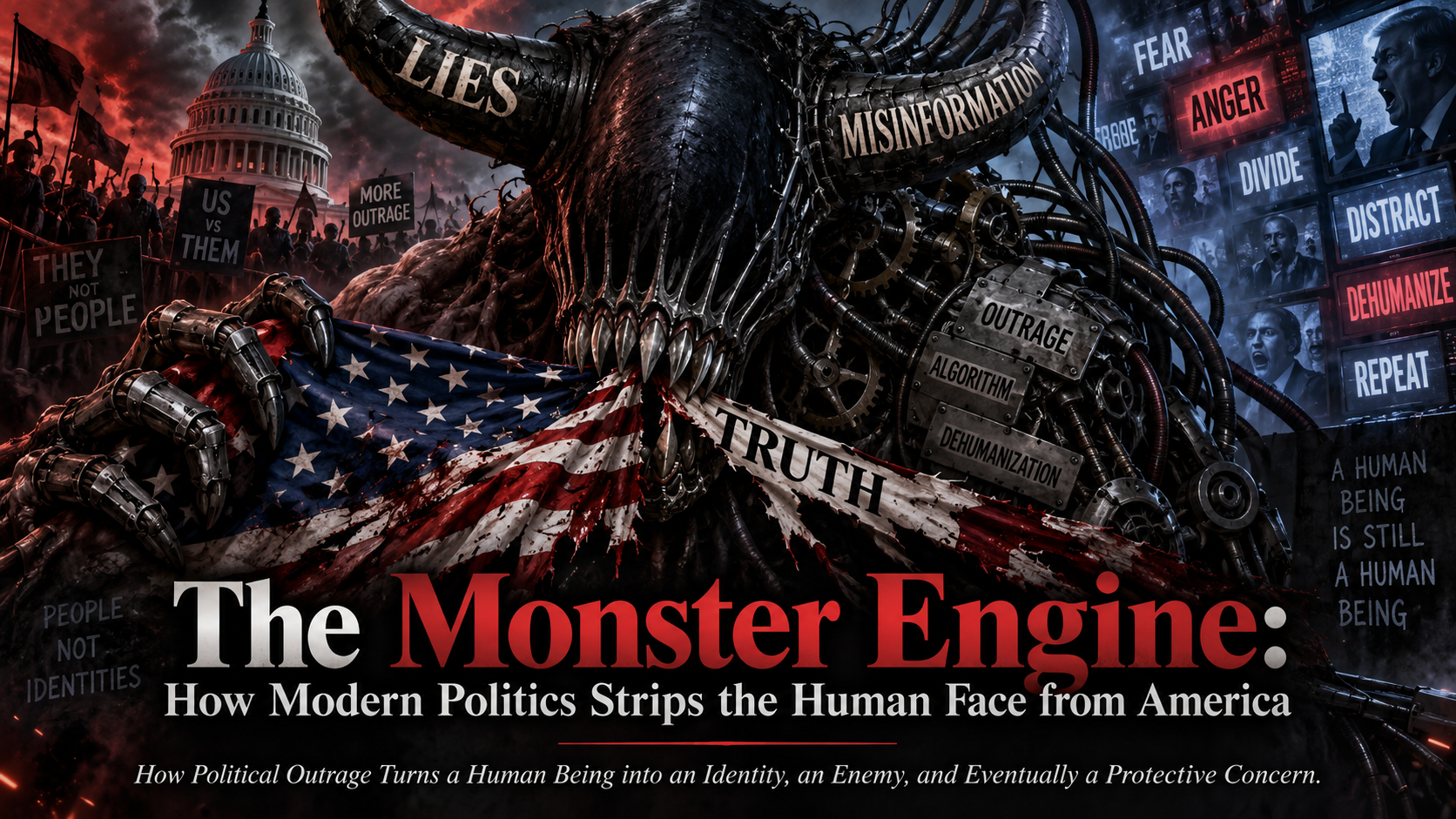
In September 2026, I wrote The Monster Engine: How Modern Politics Strips the Human Face from America. That article examined how political arguments, public accusations, media coverage, and social media can gradually replace a human being with a political label. Instead of considering what a person actually believes or has done, audiences begin seeing that person as a representative of a political movement, religion, or social position they oppose.
The problem is not confined to any particular political party or news organization. A report may begin with legitimate facts and important questions, but repeated commentary can add assumptions, exaggerations, and personal judgments until the public image becomes more important than the original information. People who already hold strong opinions may accept descriptions that reinforce those beliefs while dismissing anything that presents a different picture. Over time, a person may become associated with grievances and accusations that extend well beyond his actual conduct.
Higgins’s situation illustrates why the Monster Engine is relevant to executive protection. Someone who views him as a religious extremist influencing the Pentagon may not distinguish his personal opinions from official government policy. That individual may believe Higgins has authority over decisions that are actually made by others or that he is responsible for a broader movement the individual opposes. The resulting hostility may be directed toward Higgins personally, even though the original grievance concerns matters much larger than one government adviser.
This does not make the news media responsible for every reaction to legitimate reporting. Journalists have an important responsibility to investigate people who exercise influence over public institutions, and those individuals should expect scrutiny. The protective concern is what happens when reporting becomes part of a wider public argument and someone begins turning political disagreement into a personal grievance against an identifiable individual.
That possibility deserves attention because people who become targets do not always control the public image that motivates the person threatening them.
The Lone Actor and the Danger of Personal Grievances
One of the concerns in protecting controversial public figures is the individual who develops a personal grievance and decides to act without direction from an organized group. Such a person may be influenced by political movements, religious arguments, online discussions, or news coverage, but may ultimately make the decision to threaten or attack someone independently. The motivation may involve a single issue or several grievances that have developed over time.
For Higgins, the concern would involve someone who accepts the allegations about his beliefs and begins treating him as personally responsible for a larger perceived injustice. An individual angry about religious influence in government might regard him as a symbol of that issue, while someone concerned about racism or the treatment of LGBTQ Americans might focus on the statements attributed to him. These are possible ways a grievance could develop, not evidence that such individuals are currently threatening Higgins.
The U.S. Secret Service’s National Threat Assessment Center emphasizes the importance of examining behavior rather than relying on stereotypes about potential attackers. A person’s political views, religious beliefs, appearance, or membership in a particular movement do not provide a dependable basis for predicting violence. More useful information involves threatening statements, fixation, attempts to approach a target, preparations, and other behavior that may indicate a developing intention to cause harm.
A protective assessment must therefore focus on identifying actual persons of concern and evaluating what they are doing. Anger expressed on social media is not automatically a threat, and a controversial person does not automatically require a protective detail. However, when publicity makes an individual more recognizable, protection professionals should consider whether it has also changed the person’s exposure and whether any new threatening behavior has emerged.
The importance of this distinction becomes clearer when examining cases in which political or religious disputes have resulted in actual violence or criminal threats.
Charlie Kirk: When Political Disagreement Ends in Violence
Charlie Kirk was a nationally recognized conservative political activist whose public work included debates and speeches about Christianity, marriage, abortion, gender identity, and American politics. His views attracted considerable support and opposition, and his appearances frequently brought him into direct contact with people who disagreed with him. On September 10, 2025, Kirk was shot and killed while participating in a public event at Utah Valley University.
Prosecutors have alleged that Kirk’s political positions were relevant to the accused attacker’s motivation. The precise motive and criminal responsibility remain matters for the judicial proceedings, and those allegations must be distinguished from facts already established. What is clear is that Kirk was killed while engaged in the public political activities for which he was widely known.
ISA examined the security circumstances surrounding the killing in What Changed at Utah Valley? Charlie Kirk’s Protection Failures; Utah Valley Exposed. The article considered the protective responsibilities associated with public appearances, the relationship between the protective team and venue security, and the importance of advance planning. A subsequent ISA article, One Day Later: What UVU’s Independent Review Adds to the Charlie Kirk Case Study, examined the university’s findings and their relevance to the earlier protective assessment.
Kirk’s circumstances were different from Higgins’s. Kirk was already a national political figure who regularly appeared before large audiences, while Higgins is a government adviser whose public recognition has increased through reporting about his earlier statements. Nevertheless, the comparison is relevant because it illustrates the consequences when a politically controversial individual becomes the victim of violence. It also demonstrates why protection professionals must look beyond the individual’s beliefs and examine the circumstances in which that individual may be exposed to someone willing to cause harm.
Candace Owens: When Religious Disagreement Becomes a Criminal Threat
Candace Owens provides another example involving a prominent conservative commentator whose public positions on religion, race, and politics have attracted strong criticism. In September 2024, Haim Braverman of New Jersey threatened a political commentator after becoming angry about remarks concerning a deceased rabbi whom he respected. Braverman posted threatening statements and a video in which he held a bat while expressing his willingness to kill the commentator. Owens subsequently identified herself publicly as the person targeted.
The Department of Justice announced on May 6, 2025, that Braverman had pleaded guilty to transmitting threats in interstate commerce. Unlike ordinary public criticism, the conduct involved explicit statements threatening lethal violence. The case demonstrates how a dispute involving religion and public commentary can become a personal confrontation serious enough to require criminal investigation and prosecution.
The significance for executive protection is the difference between disagreement and threatening behavior. Owens’s remarks generated controversy, but the relevant security issue was not simply that people were angry with her. It was that an identifiable individual made threats to kill her. That evidence justified law enforcement attention and provided a clear basis for assessing the danger.
Higgins’s circumstances should be considered with the same distinction in mind. The existence of hostile commentary does not establish that anyone intends to harm him, but the appearance of specific threats or concerning behavior would change the assessment. A professional protection program must be prepared to recognize that difference and respond accordingly.
Why Higgins’s Pentagon Position Matters
The controversy surrounding Higgins is not limited to his personal religious beliefs. His position near the Secretary of Defense gives those beliefs additional public significance because people may associate him with decisions affecting military personnel. Someone who strongly disagrees with the views of a private commentator may react differently when the same views are attributed to a person advising the leadership of the Department of Defense.
The Pentagon’s new Office of Religious Affairs has brought additional attention to the role of religion in military policy. Supporters may consider the office an important means of protecting religious accommodation and supporting military chaplains, while critics may be concerned about the possibility that particular religious beliefs could receive preferential treatment. Those questions involve legitimate government policy debates and should be addressed through evidence, law, and public discussion.
Higgins’s association with religious matters at the Pentagon may cause some people to assume that he is personally responsible for policies or decisions they oppose. His actual influence and responsibilities may be more limited or different from what those individuals believe. For protective-security purposes, both the reality of his position and the way it is perceived are relevant, particularly if someone begins developing a personal grievance against him.
This is why a threat assessment must examine the individual within the circumstances surrounding him. The same statements that generate ordinary disagreement when made by a private commentator may attract a different level of attention when attributed to someone associated with senior government leadership. That additional attention does not establish danger by itself, but it can change the conditions that protection professionals need to understand.
What Protection Professionals Should Examine
The first responsibility in assessing Higgins’s security is to establish the actual circumstances rather than relying on public controversy. That means understanding his official activities, his exposure during public appearances and travel, the security resources already available, and whether any specific threatening communications or concerning behavior have been reported. A protective assessment should also consider whether an identifiable person has demonstrated unusual interest in Higgins, attempted unwanted contact, or taken steps suggesting preparation for a confrontation.
Those questions require coordination, professional judgment, and reliable information. A protection professional should not recommend an extensive protective detail merely because someone has attracted negative publicity, nor should legitimate threats be dismissed because the person receiving them holds unpopular beliefs. Appropriate protection depends on the nature of the threat, the person’s vulnerability, available resources, and the measures needed to address documented concerns.
This approach is consistent with the principles discussed in ISA’s Executive Protection Training: Mastering the Threat Assessment Process. Threat assessment is not a prediction based on someone’s reputation or political views. It is a continuing process of gathering information, examining circumstances, identifying vulnerabilities, and making informed decisions.
For Higgins, the immediate lesson is the importance of understanding how public exposure and perception can affect an individual’s security circumstances. A person who was previously known mainly within government and political circles may become recognizable to a much wider audience after national reporting. The protective issue is whether that change produces identifiable threats or makes existing vulnerabilities more important.
Professional Protection Is Not Political Agreement
Protective personnel are sometimes assigned to individuals whose political opinions, personal conduct, or religious beliefs they do not share. That is part of the profession. An agent may disagree strongly with a principal, but personal disagreement cannot determine whether legitimate threats are taken seriously or whether established protective responsibilities are performed.
During my military career and subsequent work in executive and dignitary protection, professional discipline has remained an essential part of training and operations. The protection professional’s responsibility is to assess the security environment, prepare for foreseeable problems, coordinate the necessary resources, and respond appropriately when danger develops. Those duties do not change because the principal is a controversial government adviser, political activist, religious leader, or public official.
The principle also applies to the public’s right to criticize. Someone may lawfully protest Higgins’s appointment, challenge his statements, or argue that he should be removed from government service. Such actions should not be treated as evidence of a violent threat. The distinction changes when an individual engages in threatening behavior, stalking, or preparation for violence. A professional assessment must be capable of recognizing both the right to political disagreement and the responsibility to protect against unlawful harm.
The ISA Defending Democracy Initiative examines these issues because intimidation and violence can affect who participates in public life and how officials perform their responsibilities. Protecting individuals against credible threats is not an endorsement of their political beliefs. It is a professional responsibility grounded in the principle that disagreements should be resolved through lawful means rather than violence.
Closing Conclusion
Ryan Higgins has become the subject of national controversy because of statements attributed to him, his political and religious beliefs, and his position advising the Secretary of Defense. Those matters deserve public scrutiny, and legitimate questions about his conduct and professional responsibilities should be examined. At the same time, the public image created by a controversy does not necessarily provide a complete understanding of the person involved.
The protective concern is that someone who strongly opposes Higgins’s reported beliefs may accept the most damaging descriptions of him and begin treating him as a symbol of a much larger political or religious grievance. That does not mean Higgins faces an imminent threat, and publicity alone cannot establish that someone intends to attack him. It does mean that his increased recognition and the way he is now perceived are circumstances a responsible protection professional should understand.
The assassination of Charlie Kirk and the threats against Candace Owens demonstrate how serious the consequences can become when ideological disagreement moves into personal violence or criminal threats. Their cases do not establish that Higgins will experience similar treatment, but they provide relevant lessons for those responsible for recognizing and assessing developing threats.
The larger lesson is the one I raised in the Monster Engine article. When people stop seeing an individual as a human being and begin seeing only a political or religious enemy, public disagreements can become dangerously personal. Our responsibility as executive protection professionals is to recognize when that change is accompanied by threatening behavior and to make decisions based on evidence rather than political opinions.
We do not protect people because we agree with them. We protect them because their lives and safety matter.
Frequently Asked Questions
Who is Ryan Higgins, and why has he become controversial?
Ryan Higgins is a senior adviser to Secretary of Defense Pete Hegseth who has worked on religious matters within the Pentagon. An October 27, 2026 CNN investigation attributed controversial statements about religion, race, immigration, women, and LGBTQ people to Higgins. His government position makes those statements a matter of public interest because of the military’s obligations to personnel of different religions and backgrounds. The resulting publicity also raises questions about whether someone who strongly opposes his reported beliefs could begin treating Higgins as a personal target.
Does national media attention automatically increase the risk of violence?
National attention can increase an individual’s visibility and make that person recognizable to people who otherwise would not know who he is. However, increased visibility is not the same as evidence of a credible threat or an increased likelihood of attack. A proper assessment must also examine whether identifiable individuals are making threats, developing a fixation, attempting unwanted contact, or demonstrating preparation for violence.
Why are Charlie Kirk and Candace Owens relevant to the Higgins case?
Charlie Kirk was killed during a public political appearance in September 2025, and prosecutors have alleged that his political views were relevant to the accused attacker’s motive. Candace Owens publicly identified herself as the target of criminal threats made by Haim Braverman, who pleaded guilty in May 2025. Both cases demonstrate how political and religious controversy can become a personal-security issue, although neither establishes that Higgins faces a comparable threat.
What is a lone-actor threat?
A lone actor is someone who plans or carries out violence without direct operational direction from an organized group. Such individuals may nevertheless be influenced by political arguments, religious beliefs, online material, or personal grievances. Threat assessment focuses on identifiable behavior, circumstances, and evidence of preparation rather than assuming that a person will become violent because of a particular ideology.
How does the Monster Engine relate to executive protection?
The Monster Engine describes how political reporting, public accusations, and repeated commentary can cause people to see an individual primarily as a political or ideological symbol. That becomes relevant to protective security when someone develops a personal grievance against the person behind the label. Protection professionals must understand both the principal’s actual circumstances and the perceptions that may motivate a person of concern.
Should controversial government advisers receive executive protection?
Protective measures should be determined by the documented threat environment, exposure, vulnerabilities, and available resources rather than political popularity. A controversial position does not automatically justify a dedicated protective detail, but neither should strongly disputed beliefs prevent professionals from responding to credible threats. The same standards should apply to government advisers, political activists, religious leaders, and other public figures.
About Independent Security Advisors and EPTraining.us
Independent Security Advisors LLC (ISA) provides executive and dignitary protection training, protective-security education, and advisory services through EPTraining.us. Its programs serve military, law enforcement, government, and private-sector security personnel and emphasize threat assessment, protective intelligence, advance planning, operational preparation, and the practical skills needed to conduct protective assignments. ISA’s training uses documented incidents and historical case studies to examine how security failures occur and how protective operations can be improved.
The ISA Defending Democracy Initiative examines threats, intimidation, and violence involving elected officials, public servants, political figures, and other individuals whose public responsibilities may expose them to danger. Its work emphasizes professional preparation and the principle that public participation should not be controlled through threats or violence. The initiative also provides case-study material for executive protection students examining how political controversy can affect security requirements.
About the Author
Matthew C. Parker is Chief Executive Officer of Independent Security Advisors LLC (ISA) and Director of Training for EPTraining.us. His professional experience spans more than three decades of military service, executive and dignitary protection operations and training, international security advising, and protective program development.
Before retiring from the U.S. Army in 2011, Parker conducted protective operations involving senior U.S. military leaders, trained U.S. and Iraqi protective-security personnel, managed military instructional programs and taught military science at Virginia Tech.
Since establishing ISA in 2011, he has directed executive protection operations in the United States for international government officials and trade delegations, provided protective services for corporate and private clients, and developed protective programs for financial institutions, insurance companies and private families.
His international experience includes security-advisory and protective assignments in Ukraine, training for Ukrainian police and Judicial Protection Service personnel, and advisory work concerning international commerce, diplomatic protection and democracy-support initiat
Sources and References
1. CNN, October 27, 2026. Investigation into Ryan Higgins’s previous statements and his position as a senior adviser to Secretary of Defense Pete Hegseth. CNN News Central transcript.
2. CNN, October 27, 2026. Additional reporting and Pentagon response to allegations concerning Higgins’s public statements. The Situation Room transcript.
3. Jewish News Syndicate, April 13, 2026. Advocates, Service Members Push for U.S. Military to Better Understand Jewish Needs. Reporting on Higgins’s work with Jewish military advocates and Rabbi Elie Estrin. Read the article.
4. Associated Press, October 2026. Reporting on the creation of the Pentagon Office of Religious Affairs. Read the report.
5. United States Department of Justice, May 6, 2025. Morris County Man Admits to Transmitting Death Threats Against Political Commentator. Official documentation of Haim Braverman’s guilty plea. Read the DOJ announcement.
6. Jewish Telegraphic Agency, May 16, 2025. Candace Owens Says She Was Victim of Death Threats by Man Who Ran ‘Real Jewish’ Group Chat. Read the article.
7. U.S. Secret Service, National Threat Assessment Center, October 2024. Behavioral Threat Assessment Units: A Guide for State and Local Law Enforcement to Prevent Targeted Violence. Read the official report (PDF).
8. Independent Security Advisors, September 2026. The Monster Engine: How Modern Politics Strips the Human Face from America.
9. Independent Security Advisors, September 2026. What Changed at Utah Valley? Charlie Kirk’s Protection Failures; Utah Valley Exposed.
10. Independent Security Advisors, September 2026. One Day Later: What UVU’s Independent Review Adds to the Charlie Kirk Case Study.
11. Independent Security Advisors. Executive Protection Training: Mastering the Threat Assessment Process.
12. Independent Security Advisors. Defending Democracy Initiative: Protecting Public Officials.