
 E-mail us
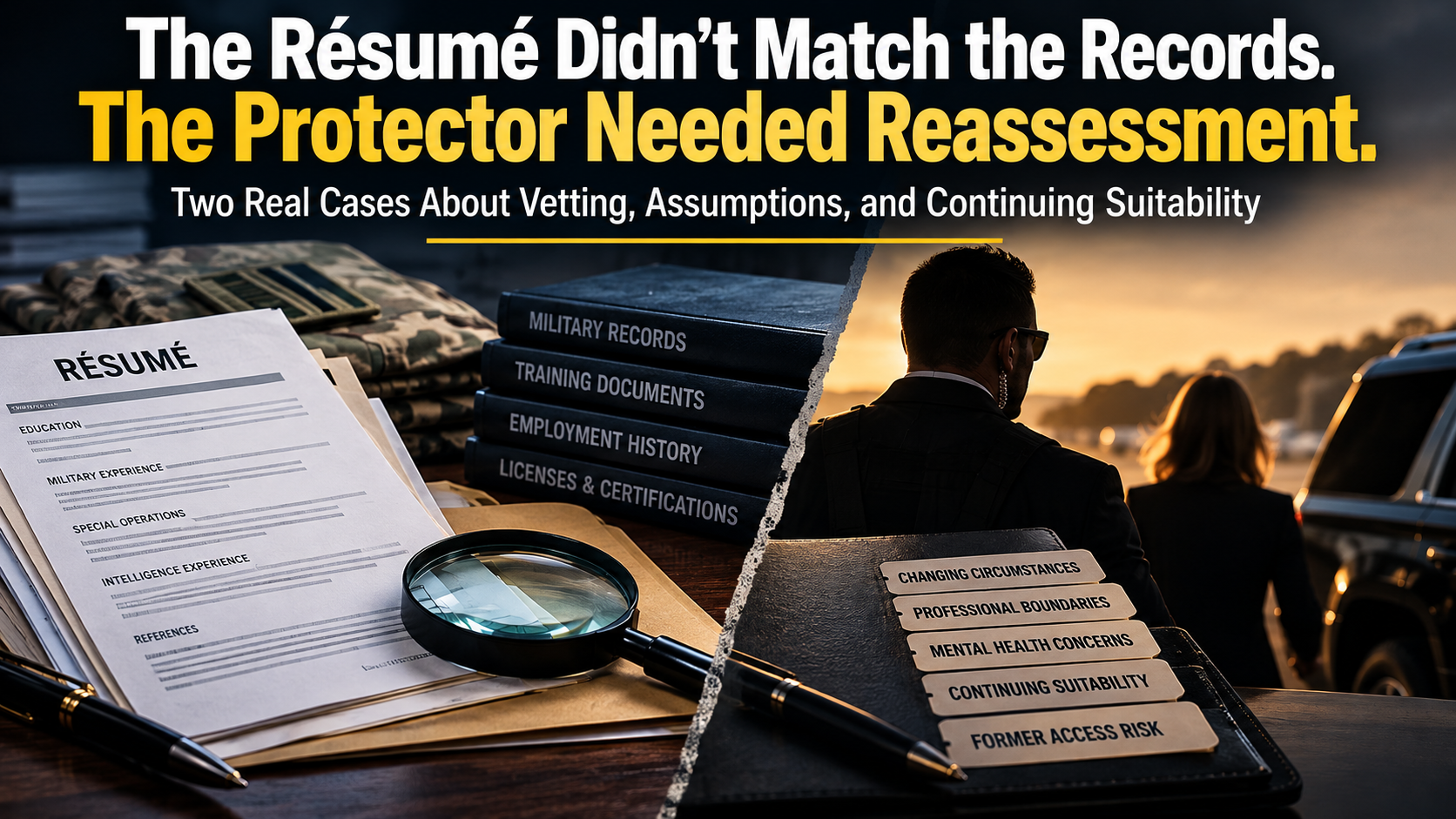
The Résumé Didn’t Match the Records. The Protector Needed Reassessment.
Executive Protection Vetting
Two Real Cases About Vetting, Assumptions, and Continuing Suitability
By Matthew C. Parker
CEO, Independent Security Advisors LLC (ISA)
Director of Training, EPTraining.us
October 2026
Abstract
 Two real cases show two different problems in security vetting.
In the first, a senior investigator built a professional reputation around claims of intelligence, counterintelligence, special-operations, and other experience that were not supported by the military records reviewed. Those claims were repeated by employers, professional organizations, and others until they began to look verified. The records reviewed did not support several important claims. Years later, questions about his background became part of professional discipline and federal litigation.
In the second, Matthew Ammel entered protective work with legitimate military experience and became part of Kyrsten Sinema’s security team. His problem was not his résumé. The problem was what happened after he was hired. His relationship with Sinema became personal and then sexual, mental-health concerns were already being discussed, and he remained inside the protective environment as those circumstances changed. Later came criminal cases, court findings about his credibility, alleged threats, weapons concerns, and allegations involving Sinema’s home.
One case raises serious questions about how professional claims were checked before authority was given. The other shows why a protector’s changing circumstances may require a new assessment, even when the original hiring decision was reasonable.
Bottom Line Up Front
Both cases raise important questions about vetting, but the problems are different. In the first case, several significant claims about military and intelligence experience were not supported by the records reviewed. Those claims had already appeared in material published by employers, professional organizations, and others. It is possible that too much confidence was placed in the résumé, referrals, and the reputation the individual had built. What cannot be established from the available evidence is exactly what every employer or organization checked before accepting those claims.
Matthew Ammel’s case raises a different concern. He entered protective work with legitimate military experience, but his circumstances changed while he remained assigned to Kyrsten Sinema. Their relationship became personal and sexual, mental health was being discussed, and the normal professional relationship between principal and protector had changed. The public record does not establish what internal reviews were conducted, but the circumstances raised questions that a responsible security manager should have considered.
A referral, a good reputation, or an earlier background investigation cannot answer every question about a person. Important claims need to be checked against records, and new information may require another look. That is especially true when someone has access to a principal’s home, family, schedule, private information, and security arrangements.
I have spent much of my career working with people who were trusted with the safety of others. I have hired them, trained them, evaluated them, worked beside them, and reviewed the backgrounds of people being considered for sensitive positions. One thing I learned a long time ago is that a good résumé and a good referral are not the same thing as a good background investigation.
The same applies after someone has been hired. Passing a background investigation once does not answer every question about that person for the rest of his career. People change, relationships change, problems develop, and new information becomes available. When those changes affect a person’s judgment, honesty, conduct, access, or ability to do the job safely, the security organization needs to consider whether another review is necessary.
These two cases reached that problem from different directions. Case One raises questions about the verification of professional claims before someone receives senior authority. Case Two concerns changes that occurred after a qualified protector had already entered the security environment.
Case One: When a Professional Reputation Grows Beyond the Records
 For this case study, I am calling the first individual Daniel Mercer. I have also changed the names of his former employer, professional association, media organizations, and several other organizations. His identity is not necessary to explain the professional issues involved.
The dates, military-record issues, disciplinary history, and court proceedings discussed here are based on the underlying case. Where a matter was disputed, it remains identified as disputed. Where a court ruled on a legal issue without deciding whether an allegation was true, that distinction remains important.
Mercer had legitimate military service. He also had legitimate experience in private investigations and later held positions with considerable responsibility. This is not a case about someone who invented an entire career. The concern is that portions of his professional biography described experience that was much broader than the military and training records reviewed could support.
What the Military Records Showed
The military material reviewed in connection with Mercer showed National Guard service beginning in 2007 and ending in 2012. The records reviewed did not list military-intelligence training or a military security clearance. They also did not document the special-operations service suggested by some later professional descriptions.
That does not mean Mercer could not have developed useful civilian investigative or intelligence skills. Many people leave the military and become capable investigators, analysts, instructors, or security professionals through later education and employment. The problem begins when later civilian experience is described in a way that makes it difficult to distinguish from military service.
Military intelligence is not the same thing as civilian investigative work. Working with special-operations personnel does not mean someone served in special operations. Taking intelligence-related courses does not automatically establish that someone held a military-intelligence assignment. Those distinctions matter when the claims are being used to establish professional credibility.
The Dates Raised Questions
One professional biography associated with Mercer claimed more than 17 years of counterintelligence and undercover counterintelligence experience by 2019. That would place the beginning of the claimed experience around 2002, while the National Guard service reviewed did not begin until 2007. The records reviewed also did not document military-intelligence training that would explain the claim through his military service.
Other professional material described more than 15 years of experience working with foreign nationals and diplomats and more than 12 years involving targeting and ISR-related work. Those descriptions also raised questions when compared with the service and training history available for review.
The differences do not automatically establish that every claim was false. There may have been civilian work or other experience that was not reflected in the military records. If so, that experience should be identified and verified through the appropriate sources.
If the work was civilian, the employer should be able to determine where it took place. If it involved another company, that company may be able to confirm the duties and dates. If the claim concerns training, the issuing organization may be able to confirm what was completed. The purpose is to establish what the experience actually was rather than accept a description that could mean several different things.
When Repetition Begins to Look Like Verification
The professional claims associated with Mercer appeared in more than one place. Employers, professional organizations, training material, and other industry sources repeated descriptions of his experience. As those descriptions circulated, they helped establish his professional reputation.
I have seen this happen in security before. An employer publishes a biography supplied by an employee. A professional association uses the employer’s biography, a conference uses the association biography, and a media outlet later finds several sources describing the same qualifications. What looks like independent confirmation may simply be the same information repeated.
That does not mean every organization involved acted improperly or failed to conduct checks. Their individual verification procedures are not established by the available evidence. The concern is that repeated information can create confidence even when the original source has not been independently confirmed.
A referral can be useful. Association membership can be useful. A recommendation from another employer can also be useful. None of those things should replace checking the records that support important professional claims.
The Professional Association Added Credibility
Mercer was active in an international association of investigators and security professionals, which I am calling the Global Foundation of Detectives. Association publications described him as a former intelligence operator and later promoted a broad range of intelligence, investigative, instructional, and professional qualifications. He also held responsibilities within the organization.
That kind of recognition can strengthen someone’s professional standing. An employer considering the person for a sensitive position may view association membership, published biographies, and leadership responsibilities as favorable information.
Those are reasonable considerations, but they do not independently establish every qualification described in promotional material. A professional association may publish information supplied by a member or another organization. Unless the association explains what it verified, an employer should not assume that every statement in the biography has been independently checked.
The question I would ask is straightforward: which claims were actually verified, and what records support them?
Questions About the Background Later Became Part of Litigation
Mercer left the company I am calling Northbridge International Investigations in February 2022. His former employer later alleged problems involving his employment history, professional qualifications, investigative capabilities, and other claims. Mercer disputed those allegations, and the disagreement became part of federal litigation.
The employer’s allegations are not findings of fact. A lawsuit does not establish that an accusation is true, and a court allowing a claim to continue does not mean the plaintiff has proved it.
My concern is that important questions about professional experience were being raised after Mercer had already held a senior investigative position. A senior investigator may supervise cases, review evidence, interview witnesses, approve reports, brief clients, communicate with attorneys and law enforcement, and direct other investigators. His work may affect another person’s reputation, employment, business, finances, or legal position.
That is why I place so much importance on checking significant qualifications before assigning someone that level of responsibility. The more authority a person receives, the more important it becomes to understand what his experience actually supports.
The Professional Association Later Disciplined Him
In June 2022, four members of the professional association filed a six-part ethics complaint involving Mercer. The allegations covered several subjects, including disclosure of earlier litigation, conduct during an investigation, professional behavior, fiduciary and ethical issues, property damage, and licensing requirements.
Those were allegations when filed. The association later completed its disciplinary process and did not sustain every allegation. Two of the six allegations resulted in adverse findings. Mercer was reprimanded and barred from holding association office for five years.
He was not expelled from the association for five years. The sanction involved a reprimand and a restriction on holding office, and that is the distinction that matters.
Professional discipline does not automatically mean someone can never work again. It does mean a prospective employer should consider the findings, the conduct involved, the person’s response, and whether the matter affects suitability for the position being offered.
The Federal Court Proceedings
Mercer and his company filed federal litigation against his former employer and others in November 2022. His former employer filed a separate federal case in March 2023.
In March 2024, a federal court allowed part of a breach-of-fiduciary-duty claim to continue where it was based on alleged misrepresentations made during Mercer’s employment. The court did not determine that every disputed credential was false. It was deciding whether the allegations, if later proven, could support the legal claim.
Mercer later brought another federal action in Ohio against numerous people and organizations. In March 2025, the court dismissed the claims in that action with prejudice. The decision also discussed the professional-association proceedings and legal protections applying to statements made through that process.
These decisions should not be treated as findings about every disputed statement in Mercer’s professional history. They establish what the courts decided in the particular cases before them.
For me, the larger professional concern remains the same. When an investigator’s qualifications become the subject of serious disagreement, the employer needs reliable records that show what was checked and what was established.
When Questions Remain About an Investigator’s Background
The issue becomes more serious when the person being evaluated is himself an investigator. An investigator’s work can affect someone’s reputation, employment, business, litigation, or relationship with law enforcement. That makes the investigator’s own qualifications and credibility important to the client.
A separate federal case concerned investigative information produced while Mercer held a senior role. Court records show that investigative findings were supplied to a law-enforcement-oriented media organization in 2021, followed by negative reporting about the subject of that investigation.
In March 2026, a federal judge allowed one intentional-interference claim to continue toward trial while dismissing other theories. The case was later reported settled before a jury decided the remaining claim.
That ruling was not a finding that Mercer had intentionally produced false investigative work. It does illustrate the consequences that can follow when investigative information is used by other organizations and later becomes disputed.
Before giving someone the authority to investigate other people, I want to know that the important parts of his own background have been properly checked.
What I Take From Case One
The military records, dates, training history, and professional descriptions raised questions that could be examined through ordinary background work. The records reviewed did not support several significant claims as they were presented. That does not establish what every employer or professional organization knew or checked, but it does establish why independent verification matters.
A background investigation is not supposed to prove that an applicant is dishonest. It is supposed to tell me what I can verify. If something important cannot be confirmed, I want that uncertainty identified before the person is placed in a position where clients, attorneys, other investigators, or the public may rely on his professional judgment.
That is the lesson I take from Case One. A professional reputation may be valuable, but it should never be allowed to replace the records that support it.
Case Two: Matthew Ammel and the Need for Continuing Reassessment
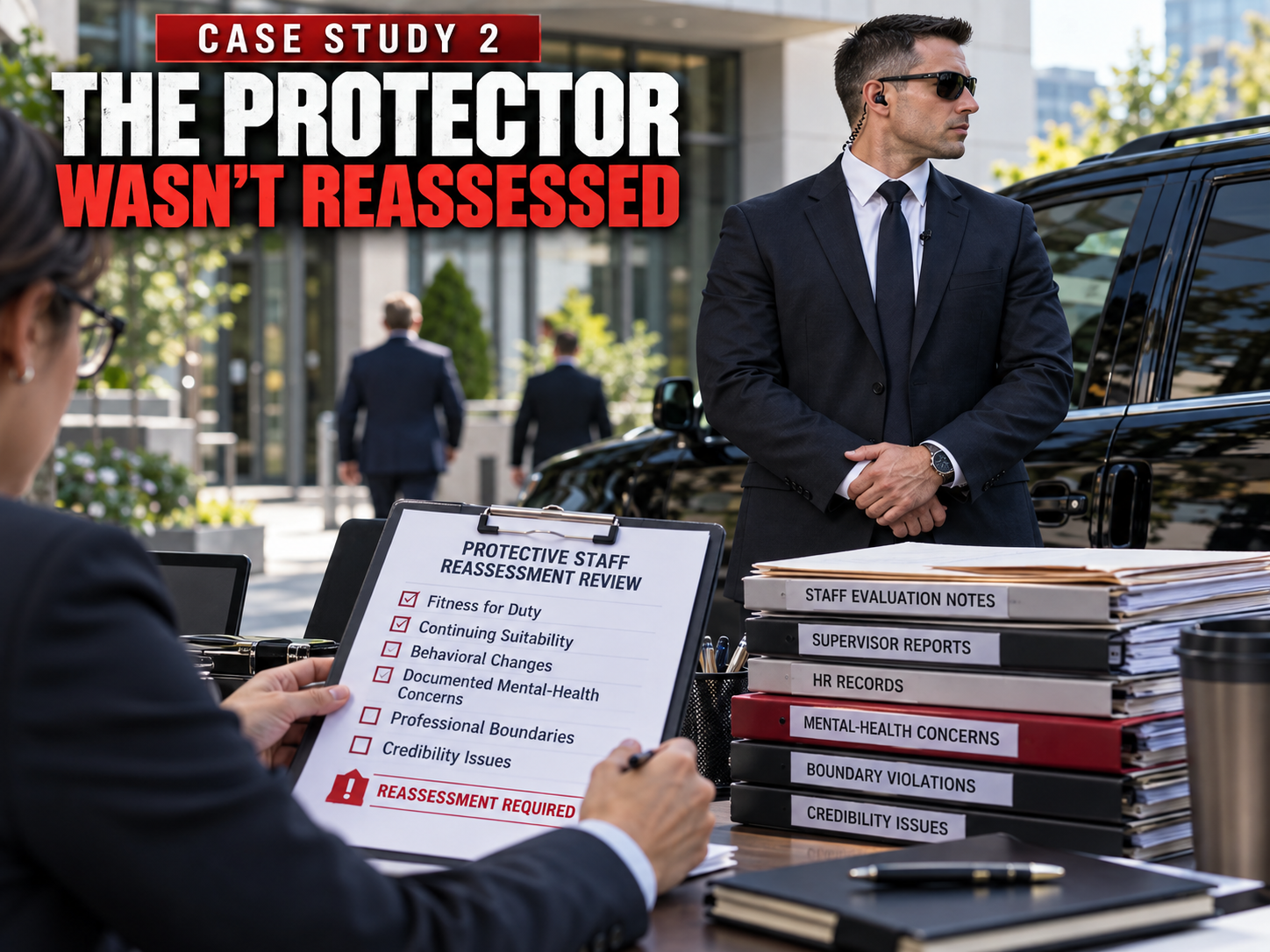
Matthew Ammel’s case is different. His military background was legitimate, he retired from the Army, and he entered protective work with real experience. The concern was not whether he had
invented military service or built a career around an unsupported résumé.
The concern developed after he was already inside the protective environment.
Federal court records show that TOA Group hired Ammel in April 2022 while the company was providing security for then-Senator Kyrsten Sinema. Ammel met Sinema in August 2022, following his retirement from the military. In October 2023, he moved to Kinsaker Security Group, which assumed responsibility for Sinema’s security.
In June 2024, Ammel also became a W-2 employee of the United States Senate working for Sinema while continuing his employment with Kinsaker. The federal court found that Ammel remained part of Sinema’s security team from August 2022 through November 2024, with responsibilities involving the movement and security of Sinema and her staff.
That position provided significant access to the principal and her activities.
What a Protector Learns
People outside executive protection sometimes underestimate how much a protector learns about a principal. The agent may know where the principal lives, which entrances are normally used, where vehicles are parked, what routes are preferred, who has access to the residence, where family members live, and how movements are planned.
The agent also learns things that never appear in a written security plan. He may know family problems, medical concerns, personal relationships, staff disagreements, travel habits, routines, and weaknesses in the protective arrangements. He may also know when the principal does not follow the security plan.
That knowledge is necessary to do the job. It also means that the person receiving the information must remain suitable for the responsibility.
The Relationship Began to Change
Federal court records show that Ammel and Sinema traveled alone together to Napa Valley during the fall of 2023. Around the same period, he traveled with her to Colorado as part of the security detail. By December 2023, they were communicating through Signal with messages set to disappear after eight hours.
There is nothing automatically improper about using encrypted communications. Government officials, executives, security personnel, and others handling sensitive information have legitimate reasons to use them.
The concern is the larger change in the relationship between principal and protector while the protective assignment continued. Their relationship was becoming personal, and that development raised questions about supervision, professional boundaries, and whether the existing assignment remained appropriate.
Mental Health Was Part of the Discussion
The federal record identifies a January 2024 communication from Sinema about helping Ammel with his mental health. It also describes a later message in which Sinema asked Ammel to bring MDMA on a work trip so she could guide him through a psychedelic experience. The record establishes the existence of that communication. It does not establish that Ammel brought or used the drug.
Mental-health treatment does not automatically make someone unfit for executive protection. PTSD does not make a person violent, traumatic brain injury does not automatically make someone unsafe, and seeking counseling should not end a security career.
I have worked with veterans for too many years to accept that kind of thinking. The proper question is whether a person’s condition or behavior affects the ability to perform the job safely and reliably. A security manager should be concerned with judgment, safe firearm handling, driving, reliability, professional boundaries, and the ability to carry out essential duties.
A security manager does not diagnose an employee. When credible information raises a genuine fitness question, the organization should seek an appropriate assessment from someone qualified to answer it.
The Professional Relationship Changed
According to the federal court record, their physical relationship continued during the summer and included another documented sexual encounter in October 2024, while Ammel remained part of her security environment.
I am not interested in judging anyone’s marriage or personal morality. The issue is what happens when the person assigned to protect a principal also becomes the principal’s romantic partner.
That creates a conflict for both people. The protector may no longer be able to give fully independent advice. The principal may have difficulty judging his performance objectively, and a security manager may find it harder to reassign or remove the agent if the principal objects.
Those are management and security concerns. They are reasons to examine whether the assignment should continue under the same conditions.
Why the Earlier Vetting Could Not Answer Every Question
By June 2024, Ammel had been working around Sinema for almost two years. His security employer had changed, he had become a Senate employee, his relationship with the principal had become personal and sexual, and mental health had become part of their communications.
The public record does not establish whether TOA, Kinsaker, the Senate, or another responsible organization conducted a formal fitness-for-duty or continuing-suitability review. It would be wrong to say that no review occurred without evidence supporting that conclusion.
What can be said is that the circumstances had changed enough to raise reasonable questions about continuing suitability.
A person may have been qualified when hired and may have performed well for years. That history matters, but it does not answer every question about the present. When the relationship with the principal changes so substantially, an independent review may be necessary to determine whether the same assignment remains appropriate.
The Principal Cannot Be the Only Person Deciding
Trust between a principal and protector is normal. A good agent may spend more waking hours with the principal than the principal spends with family. The agent sees things other people do not see and hears conversations other people do not hear.
That trust can be necessary, but professional oversight still matters. Once a protector becomes romantically involved with the principal, somebody outside the relationship needs to remain able to make decisions about the assignment.
A security manager should be able to reassign an agent, seek a fitness review, or recommend removal when circumstances justify it. The principal’s personal relationship with the protector should not be the only factor determining whether he remains suitable.
The Protective Role Ends, but the Knowledge Remains
The federal court identifies November 2024 as the end of Ammel’s continuous service on Sinema’s security team. That date matters because later events should not be used to claim that an employer in 2022 could have predicted everything that followed.
Good threat assessment depends on the facts available at the time.
By the end of 2024, however, the circumstances were substantially different from those that existed when Ammel was first hired. The relationship had become intimate, professional boundaries had changed, employment arrangements had changed, and mental health had become part of the discussion.
Those changes were relevant to continuing suitability, regardless of whether the original hiring decision had been reasonable.
What Happened After the Assignment
In November 2025, Ammel was involved in a serious incident at a North Carolina medical facility following an involuntary mental-health commitment. Public reporting describes criminal proceedings arising from that incident, including a later guilty plea and probation.
The incident occurred after the period in which the federal court identified Ammel as continuously serving on Sinema’s security team. It does not establish that he was unfit when first hired or throughout the earlier assignment.
The later events matter for a different reason. A former protector may retain extensive knowledge of the principal and the protective system, and that knowledge can become important if later conduct raises security concerns.
Credibility Became Part of the Court Record
Civil litigation involving Ammel’s former wife and Sinema later produced direct findings about credibility. In September 2026, a federal judge addressed problems with Ammel’s earlier testimony, including his admission that he had lied under oath about his relationship with Sinema.
Credibility matters in executive protection because the profession depends on accurate reporting. A supervisor may have to rely on an agent’s account of surveillance, a possible weapon, an incident involving the principal, or a mistake made during an operation. Law enforcement, attorneys, and the principal may also rely on the agent’s statements.
That is why honesty is part of professional suitability. It affects whether other people can rely on the protector’s observations and decisions.
August Through October 2026: The Threat Picture Changes
Arizona authorities allege that in August 2026, Ammel caused more than $200,000 in damage at Sinema’s Cave Creek residence. The allegations include damage to artwork and other property inside the home. Ammel later publicly described the incident as occurring during a stress-induced mental-health crisis.
He was arrested in September 2026. Prosecutors later alleged that he violated release conditions involving contact with Sinema and restrictions on weapons. Authorities also alleged conduct involving a large hunting knife at a firearms store and reported information concerning attempts to obtain firearms or tactical equipment.
At an October 2026 hearing, prosecutors presented alleged threatening communications involving Sinema and others. Ammel’s attorney challenged the state’s position, including the timing of some communications.
Ammel pleaded not guilty to the Arizona criminal-damage charge. As of October 2026, the judge had increased his bond to $100,000 cash-only, with house arrest and electronic monitoring if released. Trial was scheduled for February 9, 2027.
The Arizona criminal-damage allegations and related release-condition allegations had not been resolved at trial when this article was prepared. They should not be presented as proven conduct.
They remain relevant to a current protective-security assessment because Ammel had previously worked inside Sinema’s protective environment. His former access and knowledge would be important considerations for anyone responsible for assessing the principal’s security.
Offboarding Is Part of Protection
Security organizations spend considerable time deciding who receives access, but they also need to think about what happens when that access ends. Most former agents leave professionally, move to other assignments, respect confidentiality, and never become a security concern.
Their knowledge does not disappear when they leave. A former protector may remember residential procedures, vehicle locations, staff names, preferred routes, family routines, emergency arrangements, travel habits, and weaknesses in the protective plan.
If a former protector later develops a serious grievance, makes threats, engages in unwanted contact, violates a court order, or shows other concerning behavior, the previous access becomes relevant to the assessment. The person may know things that an ordinary outsider would not know.
Depending on the facts, the protective team may need to change access credentials, review residential security, brief staff, limit travel information, adjust routines, document unwanted contact, and coordinate with law enforcement.
That is not retaliation against a former employee. It is normal protective work when the facts change.
What Both Cases Have in Common
The facts in these cases are different. Case One concerns professional claims that were not supported by the military and training records reviewed. Case Two concerns a person with legitimate qualifications whose circumstances changed after he was already working inside the protective environment.
Both cases show why assumptions can create problems.
An employer may place too much confidence in a referral. A professional association’s reputation may make a biography appear more reliable than it is. Years of good performance may create confidence that an earlier assessment remains sufficient. A principal’s personal trust may also make it harder to ask difficult questions.
Those possibilities do not establish what any particular employer actually checked or failed to check. They do explain why independent verification and continuing review are important.
Security is a profession built heavily around reputation and referrals. Those relationships are valuable, but they should support a background investigation rather than replace it.
What I Expect From Vetting
My standard is not complicated. If military service matters to the job, verify it. If someone claims military intelligence, determine the occupational specialty, schools, assignments, and actual duties. If special-operations experience is claimed, establish what the person actually did. If a license is required, check with the regulator. If a certification matters, confirm the issuing organization and what the credential represents.
Dates also matter. If a résumé claims fifteen or twenty years of specialized experience, the employment and training history should reasonably account for that time. If the dates do not fit, ask for an explanation and determine whether it can be verified.
References should be treated the same way. I want to know whether the person giving the reference actually worked with the applicant and observed the work. I want to know what the applicant did, whether there were problems, and whether the reference would hire him again.
The purpose is not to catch somebody. The purpose is to know who we are trusting.
Continuing Suitability Requires Another Look When Facts Change
Once somebody is hired, the organization needs to recognize when new information may require another review. Professional discipline, documented dishonesty, violent conduct, serious boundary violations, loss of a required license, credible threats, and significant changes in behavior may all justify reassessment.
Health information may also require attention when there is a genuine concern about the safe performance of essential duties. A diagnosis alone should not be treated as proof that someone cannot work safely. The question is how the person is functioning and whether the job can still be performed reliably.
A reason to reassess is not a finding of guilt, and it does not automatically mean termination. It means the earlier information may no longer be enough to make a current decision.
Mental Health Should Be Handled Professionally
The Ammel case can easily lead people to the wrong conclusion about mental health. The lesson is not that a veteran with PTSD should not work in executive protection, that somebody receiving counseling should lose a job, or that traumatic brain injury makes a person violent. Those assumptions are not supported and can discourage people from getting help.
A security manager’s responsibility is to recognize credible concerns involving judgment, emotional control, firearm safety, driving, reliability, or other essential duties. When those concerns arise, the organization should obtain an appropriate assessment from someone qualified to make it.
Protectors are not psychiatrists, and security managers are not psychiatrists. Our job is to recognize when a genuine fitness question exists and make sure it is addressed properly.
Professional Boundaries Matter
The relationship between Ammel and Sinema also raises a straightforward management issue. A romantic relationship between an assigned protector and principal creates conflicts that can affect independence, supervision, and judgment. That is not a moral judgment. It is a security concern.
The agent may find it difficult to remain objective, the principal may have difficulty evaluating his performance, and the security manager may lose control over decisions about the assignment. If the personal relationship later ends badly, the former partner may also have detailed knowledge of the protective system.
Those are reasons to maintain clear professional boundaries and independent supervision.
Conclusion
The lesson from these two cases is that a person’s qualifications and suitability need to be supported by facts, not assumptions. An impressive résumé, a respected referral, a professional association, or another company’s approval may all provide useful information, but none should replace verification.
The responsibility continues after hiring. If meaningful facts change, the security organization needs to decide whether another assessment is necessary. Years of good service do not mean that circumstances cannot change, and a principal’s personal trust cannot replace professional oversight.
The responsibility also continues when someone leaves. A former protector may still know the principal’s residence, routes, staff, family routines, and weaknesses in the security plan. If that person later becomes a security concern, the previous knowledge and access need to be considered.
We spend our careers looking for changes around the people we protect. We also have to notice changes in the people standing beside them.
Frequently Asked Questions
Why is the person in Case One not identified?
The individual in Case One has an extensive history of litigation, and his identity is not necessary to explain the professional issues. The military-record questions, dates, association discipline, and court proceedings are based on the underlying case. Using a pseudonym does not guarantee anonymity, but it keeps the article focused on the professional lessons.
Does a referral replace a background investigation?
No. A referral can be valuable because it provides another source of information, but it does not replace records or independent verification. A respected person recommending a candidate should be one part of the process, not the entire process.
Does a good background investigation at hiring mean the person remains suitable?
No. A background investigation addresses the information available at the time. Serious new information involving conduct, credibility, judgment, professional discipline, health affecting essential duties, threats, or other major changes may require reassessment.
Does PTSD or mental-health treatment disqualify someone from executive protection?
No. PTSD, traumatic brain injury, counseling, medication, or other treatment do not automatically make someone unsuitable for protective work. The proper question is whether the person can safely and reliably perform the essential duties of the assignment.
Why does a romantic relationship between the agent and principal matter?
It can affect supervision, independence, judgment, and the ability to remove or reassign the agent. If the personal relationship later ends badly, the former partner may also have detailed knowledge of the principal and the protective system.
Why should a former protector remain part of the security picture?
Most former protectors will never become a concern. When one does, previous access matters because the person may know the principal’s residence, routines, routes, staff, family, security procedures, and weaknesses that an ordinary outsider would not know.
Sources and Documentation
Case One: The underlying research includes military-service material, professional biographies and promotional material, association records, and federal court decisions. The military material reviewed showed National Guard service from 2007 through 2012 and did not list military-intelligence training or a security clearance in the records or systems checked. The investigative material also identified professional claims involving seventeen years of counterintelligence experience and other intelligence-related work that raised questions when compared with the available service and training history.
The March 2024 federal decision addressed allegations involving professional qualifications and employment representations without finding every allegation true. The March 2025 Ohio decision addressed a separate lawsuit and discussed the professional-association proceedings. Later federal litigation concerned investigative information supplied to a media organization.
The complete identifying source material is retained separately rather than linked in this public version because Case One uses a pseudonym.
Case Two: The September 2026 federal decision concerning Matthew Ammel and Kyrsten Sinema documents Ammel’s protective employment, relationship timeline, communications, and credibility issues. Public reporting and Arizona court proceedings through October 2026 document the later criminal-damage case, alleged threats, release-condition issues, bond decision, not-guilty plea, and scheduled trial.
The article distinguishes between court findings, reported guilty pleas, and allegations that remained unresolved as of publication.
About the Author
Matthew C. Parker is CEO of Independent Security Advisors LLC (ISA) and Director of Training for EPTraining.us. His experience includes more than three decades of military service, instruction, curriculum development, executive and dignitary protection operations, protective-security training, and international security advising.
Since retiring from military service in 2011, Parker has continued to develop, manage, and evaluate executive-protection training and protective programs in the United States and overseas. His work has included government officials, private clients, law-enforcement personnel, military personnel, and international security organizations.
His approach to personnel security is based on verifying important claims, separating allegations from findings, and reassessing suitability when meaningful facts change.
Hashtags:
#ExecutiveProtection #ExecutiveProtectionTraining #BackgroundInvestigations #PersonnelSecurity #ProtectiveIntelligence #SecurityManagement #ProfessionalStandards #RiskManagement #InsiderThreat #EPTraining
Author: Matthew C. Parker
Organization: Independent Security Advisors LLC
Training Program: EPTraining.us
Article Type: Executive Protection Case Study
Publication Date: October 2026