
 E-mail us
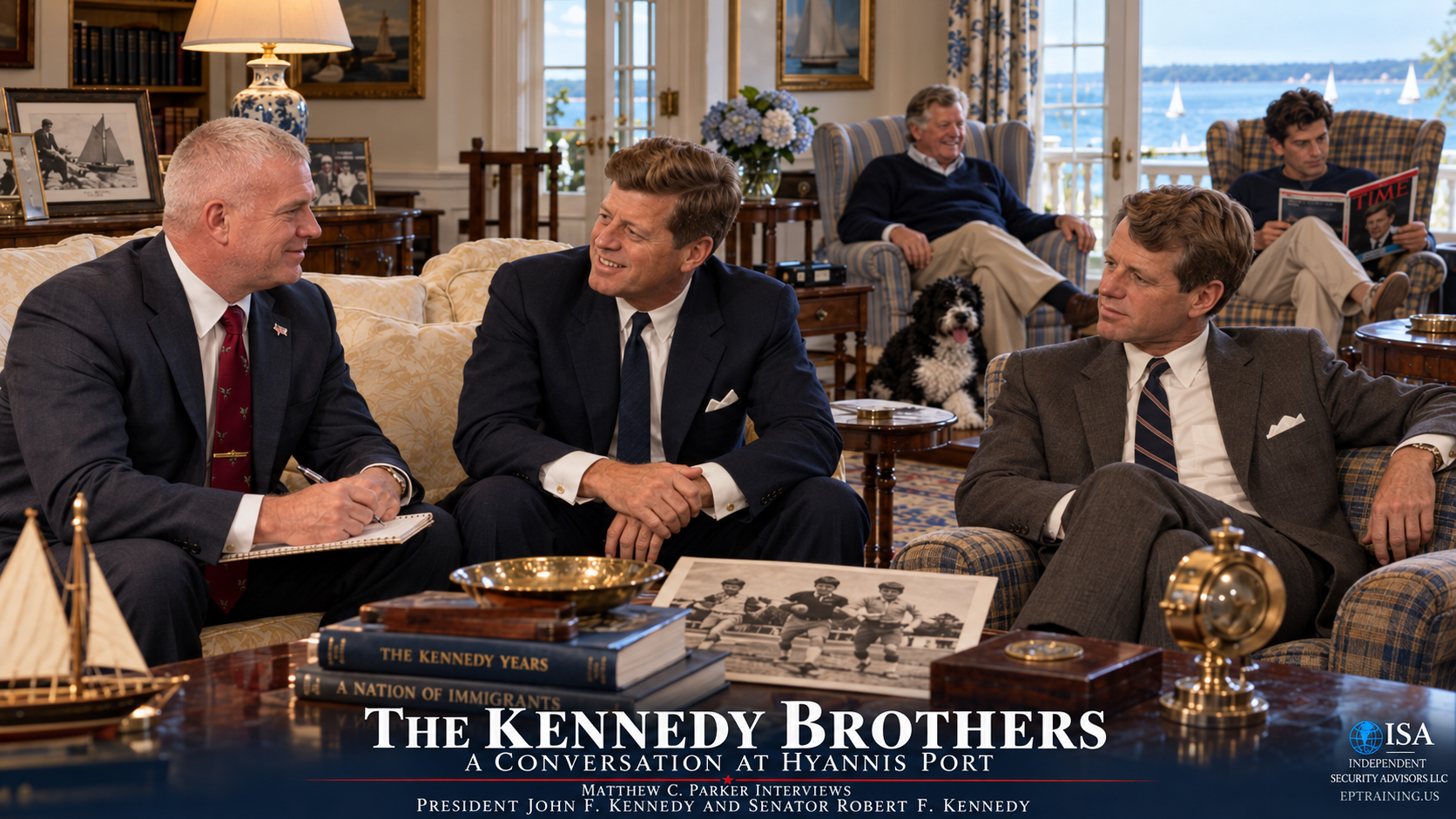
The Kennedy Brothers: An Afternoon at Hyannis Port
Executive Protection History: Matthew C. Parker in Conversation with President John F. Kennedy and Senator Robert F. Kennedy
Independent Security Advisors LLC | EPTraining.us Historical Interview Series
About this historical interview: The setting and dialogue are based on personal research assisted by an AI reconstruction of the participants. The questions are informed by the historical record, and the reconstructed responses reflect documented positions, circumstances, and testimony where available. They are, of course, not verbatim statements by the Kennedys. Historical findings and source references appear in the after-action report. Special thanks to the JFK Presidential Library.
An Afternoon at the Kennedy Compound
It was a pleasant afternoon on Cape Cod. A breeze moved through the open windows of the Kennedy family home at Hyannis Port, carrying the familiar scent of salt water from Nantucket Sound.
President John F. Kennedy was sitting comfortably near a window, his younger brother Robert Kennedy in a chair nearby. Neither wore a jacket. Jack seemed particularly relaxed, while Bobby had been leafing through a few photographs from the family collection.
One showed the Kennedy brothers playing football on the lawn. It had prompted a disagreement about who had been responsible for a particularly rough tackle.
In an adjoining sitting room, Senator Edward Kennedy was relaxing in a high-backed chair, dressed casually for an afternoon at the Cape. His Portuguese Water Dog, Splash, rested near his feet. John F. Kennedy Jr. occupied another chair, wearing a casual shirt and trousers, with a copy of the July 19, 1999, issue of Time magazine.
Matthew Parker had been invited to spend the afternoon with the family. He had brought several pages of notes, although the atmosphere was anything but formal.
Jack noticed the folder as Parker sat down.
President Kennedy: Matthew, you’ve brought quite a few papers with you.
Parker: Yes, sir. I’ve been doing some reading about both of you. There are a few things I’ve always wanted to ask.
Bobby Kennedy: Jack, I think he’s been investigating us.
President Kennedy: Wouldn’t be the first time.
The brothers laughed.
Parker: Nothing political, gentlemen. I’m interested in how you approached your personal security. You both had quite a reputation for getting out among the people, and I was curious about how you worked with those assigned to look after you.
President Kennedy: Well, Bobby might be the better person to ask about that.
Bobby Kennedy: I thought we were going to blame everything on Jack.
Parker: I’ll try to divide the questions fairly.
A Kennedy Family Trait?
Parker: I was looking at those photographs of the family playing football here at Hyannis Port. From everything I’ve read, those games could get pretty spirited.
President Kennedy: Bobby took them rather seriously.
Bobby Kennedy: That’s because Jack didn’t like to lose.
Parker: I’ve heard that about both of you.
Parker smiled.
Parker: I’ve also watched the old films of both of you meeting people. Mr. President, you seemed to enjoy stopping the motorcade and greeting people along the street. Senator, you were famous for working your way right into a crowd, shaking hands with almost everyone you could reach.
Is that something you grew up doing? This willingness to get right into the middle of things? Or is it just a Kennedy family trait?
President Kennedy — reconstructed: We grew up in a family where competition and personal relationships were important. Politics was always part of our lives. Meeting people came naturally.
Bobby Kennedy — reconstructed: I enjoyed talking with people. You learn a great deal when you meet them personally, particularly during a campaign.
Parker: Did either of you ever stop to think about what your security people must have thought when you decided to walk into a crowd?
President Kennedy — reconstructed: I’m sure we made their work more difficult at times. But being accessible was part of the job.
Parker: Did the agents ever tell you that directly?
President Kennedy — reconstructed: They had their responsibilities, and I had mine. We occasionally had different ideas about how to manage an appearance.
Parker: Senator, how about you? Did Bill Barry ever tell you he wished you’d make his job a little easier?
Bobby Kennedy — reconstructed: Bill understood the way I campaigned. He knew I liked to meet people.
Parker: Did you ever have disagreements about that?
Bobby Kennedy — reconstructed: There were differences of opinion about security arrangements, certainly.
Parker: Who usually won?
Bobby looked toward Jack.
Bobby Kennedy: You can probably guess.
Jack laughed.
The President and His Secret Service Detail
Parker: Mr. President, I’d like to ask about the Secret Service. You spent a great deal of time traveling, and your agents must have become familiar faces to you.
Did you develop close relationships with the men assigned to your protection?
President Kennedy — reconstructed: When people work around you every day, you come to know them. I trusted the Secret Service to carry out its responsibilities.
Parker: Did you ever become frustrated with the precautions they wanted you to follow?
President Kennedy — reconstructed: There were times when security requirements could interfere with what I was trying to accomplish. That’s a difficulty every president faces.
Parker: Were there particular precautions you disliked? Having agents standing too close, for example, or limiting your contact with people?
President Kennedy — reconstructed: I preferred not to have unnecessary barriers between myself and the public. Privacy was also important when traveling with family or guests.
Parker: I understand. Did you ever ask the agents whether they were comfortable with the arrangements, or did you generally leave those decisions to them?
President Kennedy — reconstructed: I expected them to make their recommendations. I also expected them to understand the requirements of the presidency.
Parker: I’d like to ask about the limousine. You frequently traveled in an open automobile, and it certainly made you visible to the crowds.
Was that your personal preference?
President Kennedy — reconstructed: I preferred arrangements that allowed the public to see the President. A motorcade serves little purpose if people cannot see whom they came to greet.
Parker: Did you ever discuss the advantages and disadvantages of an enclosed automobile with your agents?
President Kennedy — reconstructed: We discussed security arrangements as circumstances required. I can’t identify a particular discussion about every available vehicle.
Parker: Were you aware that the removable clear top on the presidential limousine offered no real protection against gunfire?
President Kennedy — reconstructed: I understood that the automobile was not designed to withstand every kind of attack.
Parker: Did you ever consider having a vehicle built with greater protection, even if it meant sacrificing some visibility?
President Kennedy — reconstructed: That would have involved balancing security with the public responsibilities of the office.
Parker: You once made an observation about how difficult it would be to stop someone with a rifle positioned in a tall building. Kenneth O’Donnell later recalled that conversation.
Was that something you thought about often when traveling?
President Kennedy — reconstructed: It was an obvious possibility. A person determined to harm the President could choose circumstances that made prevention very difficult.
Parker: Did you ever raise that particular concern with your Secret Service detail?
President Kennedy — reconstructed: I cannot point to a specific discussion with the agents about that scenario.
Parker: When you traveled through a city, how much did you know about the work the advance agents had done before you arrived?
President Kennedy — reconstructed: I knew they coordinated with the local authorities and made arrangements for our movements. I did not personally supervise their advance work.
Parker: Did they ever sit down with you before a visit and explain particular concerns they had about a location?
President Kennedy — reconstructed: They provided information when there were matters requiring my attention. Most routine arrangements were handled by the staff.
Parker: And if an agent had come to you and said he was uncomfortable with a particular route or public appearance, would you have wanted him to say so?
President Kennedy — reconstructed: Certainly. I would expect him to tell me.
Bobby and His Security Arrangements
Parker: Senator, your circumstances were rather different. You had Bill Barry, who had been with the FBI, but you didn’t have anything comparable to the President’s Secret Service detail.
How did you come to rely on Bill?
Bobby Kennedy — reconstructed: I knew Bill and trusted his judgment. He understood the work I was doing and the way I traveled.
Parker: Was he someone you generally listened to when he had concerns?
Bobby Kennedy — reconstructed: Yes. He was someone whose advice I valued.
Parker: Did Bill ever suggest bringing in additional people to help him?
Bobby Kennedy — reconstructed: Security was discussed during the campaign. We had people who helped, although it wasn’t organized like a presidential detail.
Parker: I understand Rosey Grier was often around, and Rafer Johnson was another close friend and supporter.
Bobby Kennedy — reconstructed: Both were good friends.
Parker: I remember Rosey from his football career. He was a big man. Did his presence make you feel more comfortable in a crowd?
Bobby Kennedy — reconstructed: I trusted the people around me. Their friendship meant more to me than their size or athletic backgrounds.
Parker: Did you ever discuss getting a professional team together, perhaps several former agents or police officers, rather than relying so heavily on Bill?
Bobby Kennedy — reconstructed: There were discussions about personal security. I can’t give you a complete account of every proposal or arrangement.
Parker: Did the police ever offer assistance that you felt was unnecessary?
Bobby Kennedy — reconstructed: I wasn’t always comfortable with a conspicuous police presence. I didn’t want people to feel they couldn’t approach me.
Parker: Did you worry that a line of police officers might send the wrong message during a campaign?
Bobby Kennedy — reconstructed: Yes. I wanted people to feel welcome.
Parker: Jack, did you ever give Bobby any advice about his security after you became President?
President Kennedy — reconstructed: Bobby knew the demands of public life. I would have wanted him to take reasonable precautions, as I would any member of the family.
Parker: Senator, did you ever discuss your security arrangements with Ethel? Was she comfortable with the way you traveled and met the public?
Bobby Kennedy — reconstructed: Ethel understood the demands of the campaign. I wouldn’t want to put particular words into conversations we had privately.
Parker: I understand. Some things should remain within the family.
Dallas and the Question of Public Contact
Parker: Mr. President, there is something I’ve wondered about your motorcades.
Whenever you saw people standing along the route, particularly children or people holding signs, you seemed reluctant to pass them without acknowledging them.
Was that an important part of the experience for you?
President Kennedy — reconstructed: People often waited a long time for a brief opportunity to see the President. I appreciated that.
Parker: Did you sometimes decide to stop without warning the agents beforehand?
President Kennedy — reconstructed: There were occasions when I wanted to greet people and the agents had to respond accordingly.
Parker: Did anyone ever ask you not to do that?
President Kennedy — reconstructed: The agents preferred arrangements they could plan in advance.
Parker: That makes sense. Bobby, I imagine you were much the same way.
Bobby Kennedy — reconstructed: I liked meeting people personally. I wasn’t inclined to walk past someone who wanted to speak with me.
Parker: And I suppose neither of you particularly enjoyed someone telling you that you couldn’t.
Jack and Bobby exchanged smiles.
President Kennedy: Matthew, you’ve apparently been talking to people who knew us.
Parker: I’ve read a great deal of their testimony.
Parker: Mr. President, I’d also like to ask about Mrs. Kennedy. She traveled with you on a number of public appearances. Did you and Jacqueline discuss security arrangements, or was that something you generally left to the Secret Service?
President Kennedy — reconstructed: Jackie understood the public obligations of the presidency. The arrangements were generally handled by the people responsible for them.
Parker: Did she ever express a preference for a particular way of traveling, perhaps something more private?
President Kennedy — reconstructed: Like anyone, Jackie valued her privacy. But she also understood what was expected of the First Lady.
Parker: You both attracted tremendous crowds. I imagine traveling together made those appearances particularly popular.
President Kennedy — reconstructed: Jackie was very popular with the public. That was certainly apparent during our travels.
The Ambassador Hotel
Parker: Senator, I’d like to ask about the Ambassador Hotel. You had a tremendous crowd there for the California primary, and the evening must have been hectic.
After you finished speaking, who was normally responsible for getting you from one location to the next?
Bobby Kennedy — reconstructed: The campaign staff coordinated the schedule and movements, with Bill helping on security.
Parker: Would someone ordinarily explain the route to you beforehand, or would you simply follow the staff member leading the way?
Bobby Kennedy — reconstructed: During a busy campaign event, there were often people directing us where we needed to go.
Parker: Did you know that you would be passing through the kitchen area that evening?
Bobby Kennedy — reconstructed: I can’t establish exactly when I learned the route.
Parker: Did you have any preference about using a public hallway rather than a service corridor?
Bobby Kennedy — reconstructed: My principal concern would have been getting to the next scheduled appearance.
Parker: Were you accustomed to meeting hotel employees as you moved through those areas?
Bobby Kennedy — reconstructed: Certainly. I tried to acknowledge people wherever I encountered them.
Parker: Even if you were in a hurry?
Bobby Kennedy: Particularly if they had been working hard all evening.
Jack smiled.
President Kennedy: That sounds like Bobby.
Parker: Did you ever have trouble keeping track of Bill Barry in a large crowd?
Bobby Kennedy — reconstructed: Bill did his best to stay close, but a busy campaign event involved many moving parts.
Parker: If Bill had asked you to stop for a few moments while he checked where you were going, would that have bothered you?
Bobby Kennedy — reconstructed: I trusted Bill’s judgment. I can’t say how I would have responded in every particular circumstance.
Parker: Would you have preferred that Bill make those decisions himself, or did you want the final say?
Bobby Kennedy — reconstructed: I valued his advice. The campaign also had schedules and other people making arrangements.
Parker: Jack, when you were President, did your agents have a better understanding of who was in charge of your movements?
President Kennedy — reconstructed: The Secret Service had established responsibilities, and the White House staff coordinated with them. There could still be competing demands.
Parker: Bobby, did you ever wish you had a similar arrangement?
Bobby Kennedy — reconstructed: More organization might have been useful. But the circumstances were different.
Looking Back
Parker paused and closed his folder.
Parker: Gentlemen, I’ve been asking a great many questions about your security arrangements. There is one thing I’m curious about.
If you had the opportunity to speak with the people who were responsible for your protection, is there anything you would want to ask them?
Jack considered the question.
President Kennedy — reconstructed: I would want to know whether they believed they had the resources and information necessary to do their jobs.
Parker: And you, Senator?
Bobby Kennedy — reconstructed: I would want to know whether they were able to speak freely when they believed something needed to be changed.
Parker: Were either of you difficult to persuade once you’d made up your mind?
Bobby looked at Jack.
Bobby Kennedy: He was.
President Kennedy: Bobby was worse.
All three laughed.
Parker: That seems to answer my question.
A Question About John Jr.
Parker: Mr. President, before we finish, there’s something I’d like to ask you about John.
President Kennedy: My son?
Parker: Yes, sir. I understand he enjoyed flying and had been working toward his instrument rating.
Were you interested in flying yourself?
President Kennedy — reconstructed: My Navy service gave me an appreciation for aviation. I understood that flying requires training and judgment.
Parker: Bobby, did you have much interest in flying yourself, apart from the amount of traveling you did?
Bobby Kennedy — reconstructed: I spent a great deal of time aboard aircraft, especially during campaigns, but that is quite different from being the pilot.
Parker: John seems to have enjoyed the challenge. Do you recognize that in him?
President Kennedy — reconstructed: He certainly inherited some of the family’s enthusiasm for doing things himself.
Parker: There was a flight he made to Martha’s Vineyard that has always interested me. He had his pilot’s license but hadn’t yet completed his instrument qualification.
One of his instructors reportedly offered to accompany him. I wonder whether either of you would have encouraged him to accept the offer.
President Kennedy — reconstructed: I would have wanted him to make a careful decision about the conditions and his experience.
Bobby Kennedy — reconstructed: If someone with greater experience offered to help, I would hope he considered it seriously.
Parker: I think I’ll ask John about it when we’re finished.
President Kennedy: You should. He’s in the next room.
An Old Massachusetts Connection
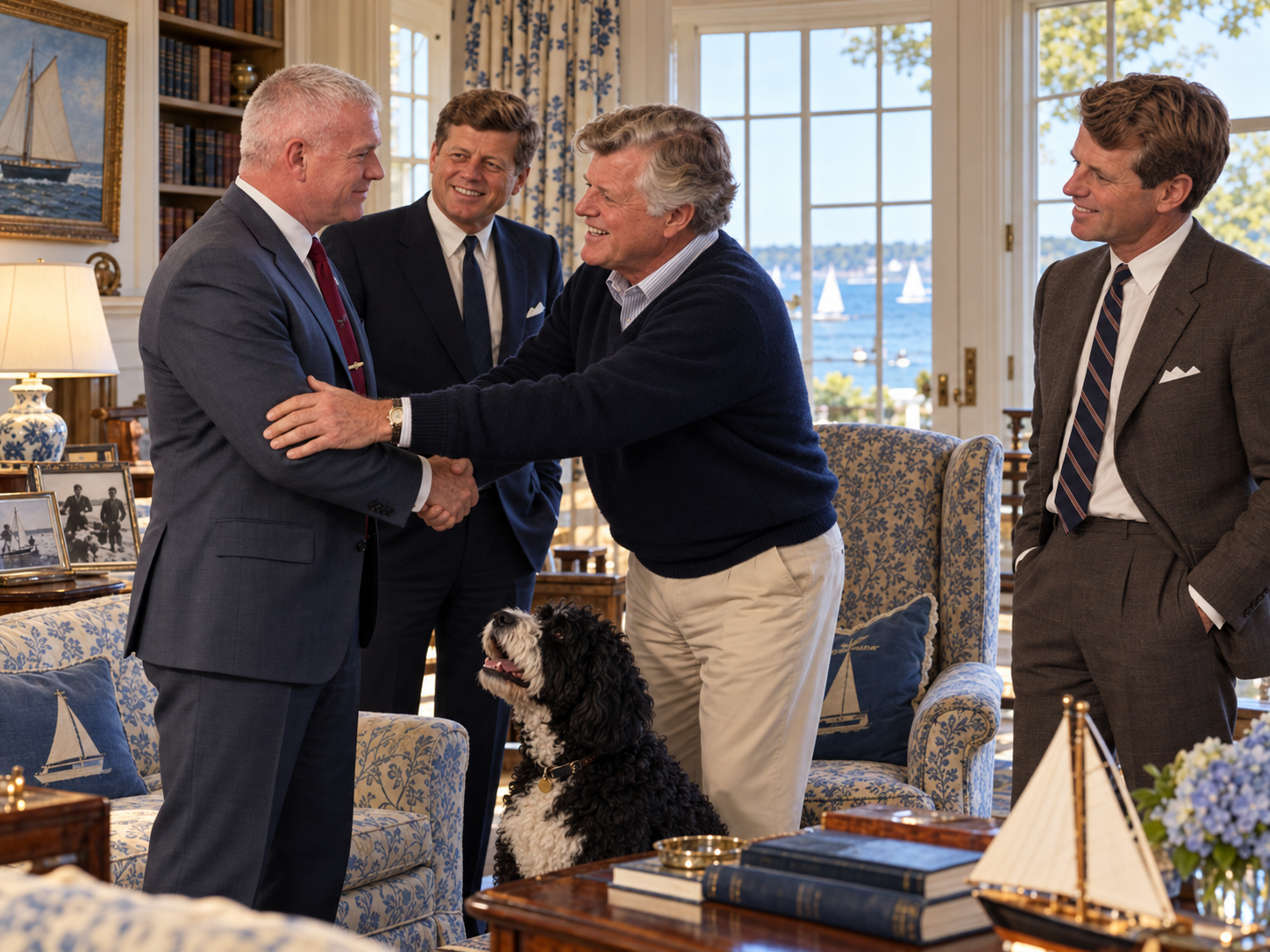
As the interview concluded, President Kennedy stood and offered Parker his hand.
President Kennedy: Matthew, I appreciate your questions. Before you leave, I’d like you to meet my brother Ted and my son John.
Parker: Thank you, Mr. President. I’d be delighted to meet John, although Ted and I have met.
President Kennedy: Is that right?
Parker: I was an intern at one of his local offices in Massachusetts. I had the opportunity to meet him on several occasions.
My grandfather knew Ted, too. When my grandmother was ill, Ted came by the family home to visit her. That meant quite a bit to the family.
President Kennedy: Well, then, you have an old acquaintance to renew.
They entered the adjoining room, where Edward Kennedy was resting comfortably in his chair. Splash lifted his head as the men approached.
Ted Kennedy : Matthew! It’s good to see you.
Parker stepped forward, extending his hand. Ted greeted him warmly, drawing him into an embrace.
Parker: It’s good to see you again, Senator.
Ted: Matthew, we’re at the Cape. You can call me Ted.
Parker: Old habits are hard to break.
They spoke for several minutes about Massachusetts, Parker’s grandfather and the family visit during his grandmother’s illness. Jack listened with interest, while Bobby joined in with memories of growing up at Hyannis Port.
John Jr. had put down his magazine and was standing beside his chair.
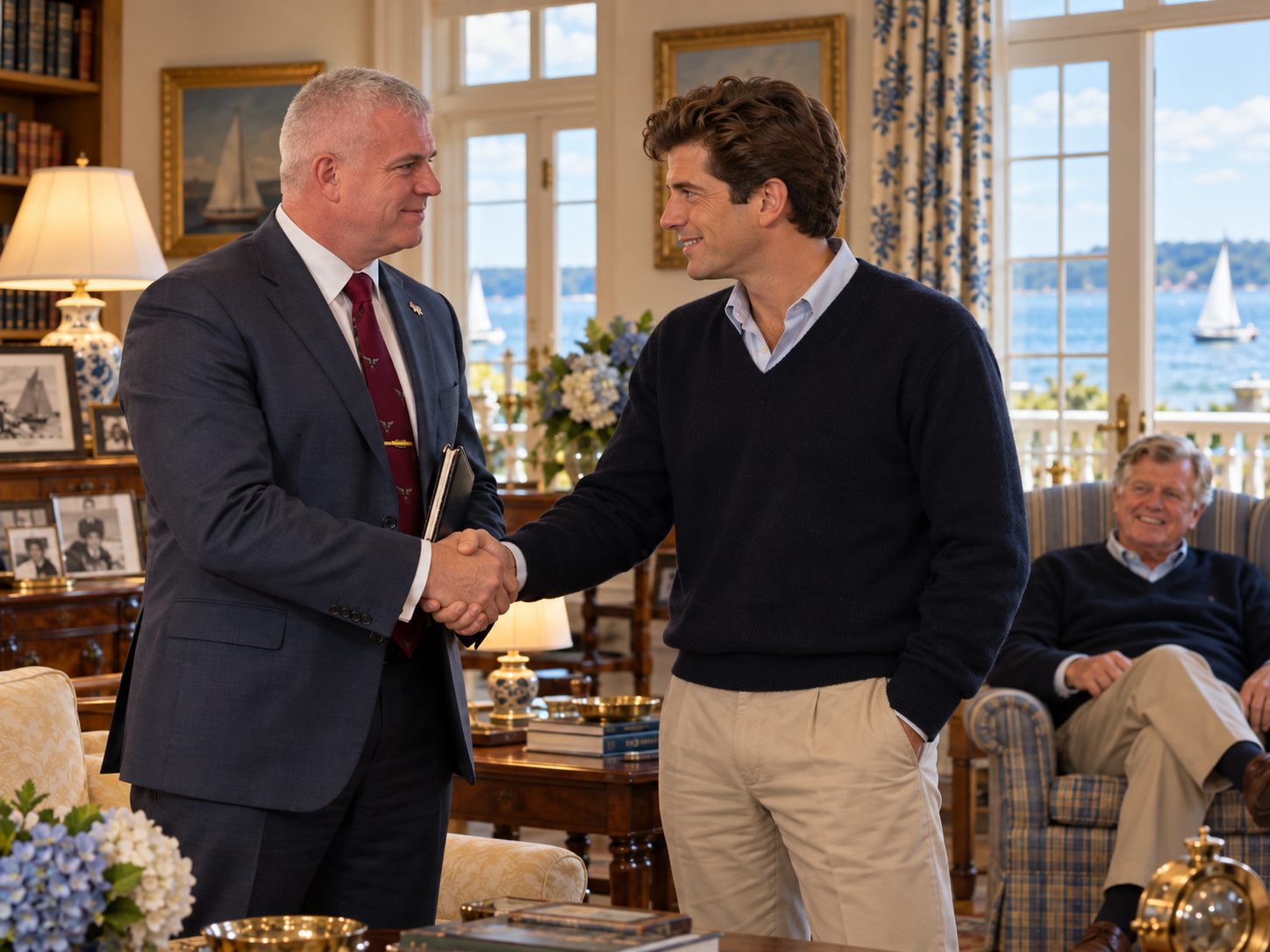 Parker: John, would you have a moment for a question?
John F. Kennedy Jr. : Of course.
Parker: I’ve always been interested in your flying. I know you had earned your private pilot’s license and were working toward your instrument rating.
How did you find the transition to the Piper Saratoga?
John Jr. — reconstructed: It was a more capable and complex aircraft than some of the airplanes I’d previously flown. I was continuing to gain experience with it and receiving instruction.
Parker: Did you enjoy flying at night?
John Jr. — reconstructed: I had flown at night and was comfortable enough with it to continue doing so, although I was still building experience.
Parker: There’s something I’ve wondered about that trip toward Martha’s Vineyard. An instructor reportedly offered to go along with you. Why did you decide to fly without him?
John Jr. — reconstructed: I apparently believed I could complete the flight under the conditions I expected. I had flown the general route before and was working toward becoming a more experienced pilot.
Parker: Were you expecting the visibility over the water to become as difficult as other pilots later described?
John Jr. — reconstructed: I can’t establish exactly what I anticipated at every point in the flight. I had obtained weather information beforehand, but conditions over water can be different from what a pilot expects.
Parker: Did you ever feel pressure to complete a trip because people were expecting you somewhere?
John Jr. — reconstructed: There were commitments at the destination. Whether those commitments affected my decisions on that occasion isn’t something I can establish.
Parker: You were working toward an instrument rating. Did you feel you were getting close to being ready for it?
John Jr. — reconstructed: I was making progress, but I hadn’t yet earned the rating.
Parker: Thank you, John. I appreciate your answering those questions.
John shook Parker’s hand.
John Jr.: You’re welcome, Matthew.
As Parker prepared to leave, Ted began telling a story about the family’s football games. Jack interrupted to correct the details, Bobby insisted that Ted’s version was closer to the truth, and John laughed at the familiar argument.
For a moment, the years seemed to fall away. They were simply the Kennedy brothers and a son together at Hyannis Port, enjoying an afternoon on Cape Cod.
Parker said his goodbyes, thanked the family for their hospitality and stepped outside toward the lawn.
He had arrived with questions about history. He left with a clearer understanding of the personal relationships and decisions that deserved closer examination.
Matthew C. Parker’s After-Action Review
The Kennedy Brothers: Public Accessibility, Personal Decisions and Protective Responsibilities
The conversation at Hyannis Port is imagined. The questions it raises can nevertheless be examined against the historical record.
Three subjects warrant separate evaluation: President Kennedy’s Secret Service protection, Robert Kennedy’s campaign-security arrangements, and John Kennedy Jr.’s aviation decisions. The circumstances differ, and it would be incorrect to treat them as evidence of a common Kennedy family disregard for personal safety.
President John F. Kennedy — Dallas, November 22, 1963
President Kennedy was assassinated while traveling in an open limousine through Dallas. Jacqueline Kennedy was seated beside him. The presidential party was accompanied by Secret Service agents and supported by local law-enforcement personnel.
Kennedy’s preference for public accessibility was well documented. During the Dallas motorcade, he directed the limousine to stop on two occasions to greet spectators. The Warren Commission concluded that these unscheduled stops created unnecessary danger, although it found that the agents responded appropriately to the circumstances.
Kenneth O’Donnell later described a conversation in which Kennedy acknowledged the difficulty of preventing an attack by a rifleman firing from an elevated building. The significance of this statement is not that Kennedy anticipated the specific attack. Rather, it demonstrates awareness of a general threat that protective planners also needed to consider.
The Warren Commission criticized aspects of the Secret Service’s preparations, including its procedures concerning buildings along motorcade routes. The later House Select Committee on Assassinations likewise identified shortcomings in protective intelligence and preparedness.
These findings must be distinguished from the actions of individual agents responding to the attack. The House committee recognized that agents performed professionally within the instructions and procedures they had received.
There is insufficient evidence to attribute the assassination simply to Kennedy’s preference for an open automobile. The protective planning, route, intelligence procedures, building access and other arrangements require separate examination.
Principal sources: Warren Commission, Chapter 8; House Select Committee on Assassinations, findings concerning protection.
Senator Robert F. Kennedy — Los Angeles, June 5, 1968
Robert Kennedy was shot at the Ambassador Hotel in Los Angeles shortly after midnight and died on June 6, 1968.
His security arrangements were significantly different from those provided to his brother as President. Former FBI agent William Barry played a central role in his personal protection, while campaign associates and other personnel helped manage crowds and movements.
The historical record shows that Rosey Grier and Rafer Johnson assisted during the immediate response to the attack. Their actions should not, however, be mistaken for the existence of a comprehensive professional protective detail.
Kennedy’s movement through the hotel’s kitchen pantry deserves particular attention. A protective movement through a crowded service area requires a clear understanding of the intended route, the people who have access to it, the placement of personnel, and who has authority to modify or stop the movement.
The FBI’s investigative records include accounts from witnesses who saw Sirhan Sirhan at the hotel before the shooting and described his interest in Kennedy’s whereabouts and security. These reports provide important evidence for examining access to the hotel and the circumstances preceding the attack.
The record also contains accounts of Kennedy’s reluctance to accept a conspicuous police presence at certain campaign appearances. Such evidence is relevant, but does not justify an unsupported conclusion that Kennedy personally rejected every available form of protection.
Principal sources: FBI Robert F. Kennedy assassination investigation; California State Archives witness and investigative records.
John F. Kennedy Jr. — Atlantic Ocean, July 16, 1999
John F. Kennedy Jr. was piloting a Piper Saratoga toward Martha’s Vineyard when the aircraft crashed into the Atlantic Ocean, killing him, his wife Carolyn Bessette Kennedy, and her sister Lauren Bessette.
The National Transportation Safety Board determined that Kennedy lost control because of spatial disorientation during a nighttime descent over water. Haze and darkness contributed to the accident.
The NTSB reported that Kennedy was a private pilot who was not instrument-rated. He had approximately 310 total flight hours, including 55 hours at night, and relatively limited night experience in the accident aircraft.
Evidence that an instructor offered to accompany him is relevant to the examination of his preflight decisions. It does not, by itself, establish what Kennedy believed about the conditions or his ability to complete the flight.
Unlike the cases involving President Kennedy and Senator Kennedy, this was not an executive protection incident. It is relevant to the interview because it raises questions about personal judgment, experience, environmental conditions and the willingness to accept assistance.
Principal source: National Transportation Safety Board, investigation NYC99MA178.
Professional Conclusions
The Kennedy cases demonstrate the importance of examining a principal’s preferences without allowing those preferences to become a substitute for evaluating the organization or individual responsible for safety.
President Kennedy valued public accessibility. Robert Kennedy also sought direct contact with the people he represented. Those preferences were consistent with their political responsibilities, but they created circumstances that protective personnel needed to address.
The evidence supports examining how protective recommendations were developed, communicated and implemented. It does not support assigning personal blame solely because the principals preferred close contact with the public.
The two assassinations also demonstrate different organizational problems. President Kennedy was protected by a permanent federal agency, but official investigations identified serious deficiencies in parts of its preventive system. Senator Kennedy relied upon a far less comprehensive security arrangement, with multiple people involved in coordinating movements and public appearances.
John Kennedy Jr.’s accident presents a separate issue. The NTSB’s findings provide a basis for evaluating pilot experience, weather conditions, flight planning and spatial disorientation, without attributing the accident to an inherited family trait.
The professional value of these historical cases lies in distinguishing documented decisions from assumptions, examining the responsibilities of everyone involved, and identifying precautions that could reasonably have been considered at the time.
Matthew C. Parker
Chief Executive Officer, Independent Security Advisors LLC
Director of Training, EPTraining.us
Historical dialogue is reconstructed for educational purposes. The fictional conversations must not be presented as authentic Kennedy family statements or testimony. The Parker family connection with Senator Edward Kennedy is included as supplied by Parker and is not independently verified.
#JohnFKennedy #RobertFKennedy #JFK #RFK #KennedyBrothers #ExecutiveProtection #SecretService #PresidentialProtection #ProtectiveIntelligence #AdvanceWork #SecurityHistory #ExecutiveProtectionTraining #EPTraining #IndependentSecurityAdvisors