
 E-mail us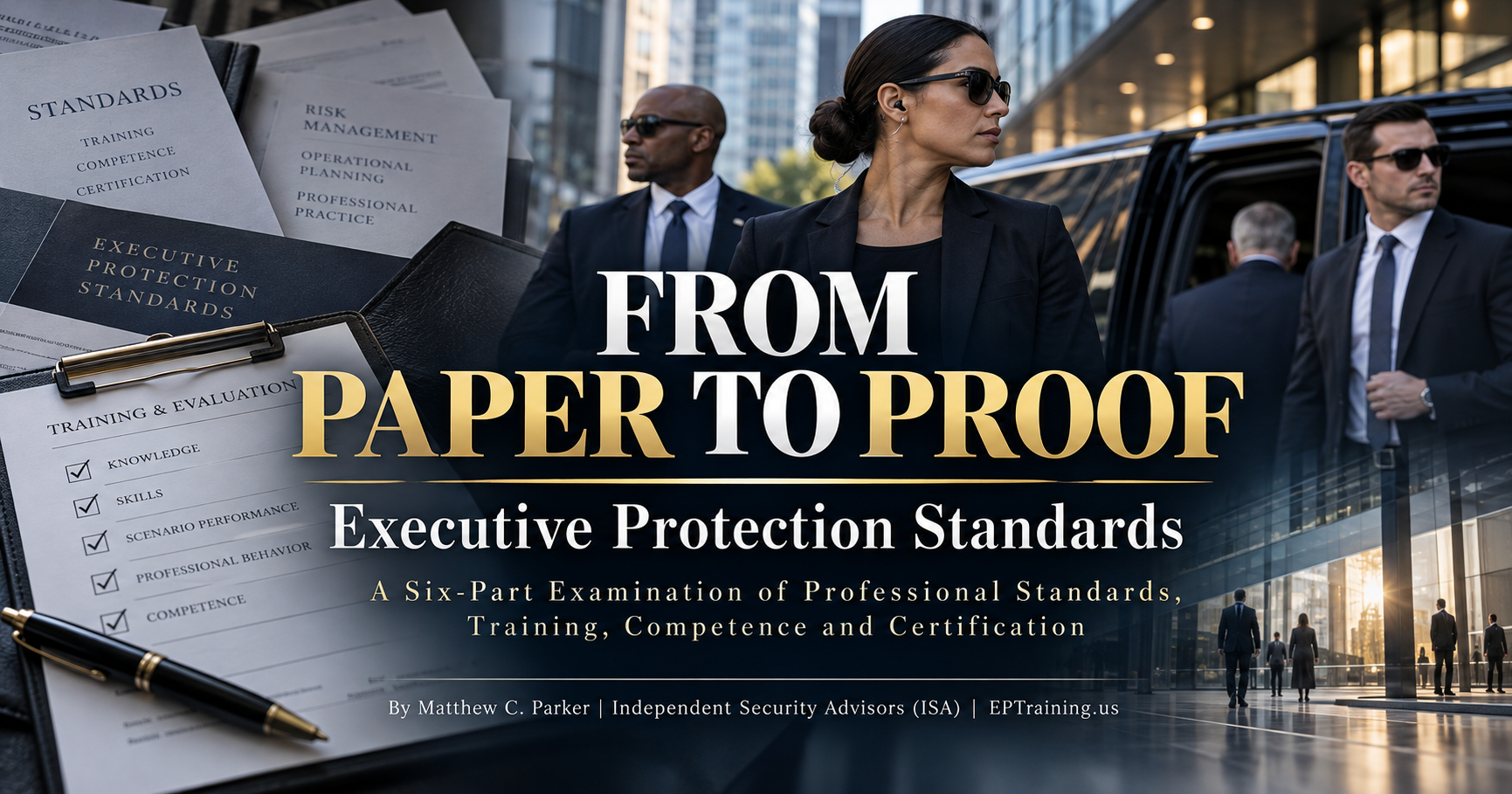
From Paper to Proof: An Open Letter on Executive Protection Standards
Executive Protection Standards: A Six-Part Examination of Professional Standards, Training, Competence and Certification
By Matthew C. Parker
Independent Security Advisors (ISA) | EPTraining.us
Introduction
Executive protection now has two prominent professional standards. ASIS International published its Executive Protection Standard in 2025, and the Board of Executive Protection Professionals (BEPP) introduced ANSI/BEPP EPS-2026, approved as an American National Standard in 2026.
Both represent efforts to establish professional requirements for executive protection. Both require serious examination.
The question is no longer simply whether executive protection in the private sector needs professional standards. We have them. The question is whether those standards establish practical, measurable requirements that improve protective operations and professional competence.
Beginning October 12, 2026, Independent Security Advisors will publish From Paper to Proof, a six-part examination of these issues. One article will be released each day through October 17.
Why This Examination Is Necessary
For years, the executive protection profession has debated training requirements, occupational qualifications and national standards. The publication of the ASIS and BEPP standards gives us an opportunity to move that discussion forward.
We need to examine what these documents require, how their requirements can be implemented and what evidence supports their effectiveness. ANSI recognition, professional consensus, state training approval, completion certificates and independent occupational certification are different things. They should not be presented as interchangeable evidence of competence.
ISA has spent more than fifteen years developing and evaluating executive protection instruction under military, government and private-sector training requirements. This experience in the private sector follows my two decades in the US Military, with service as an instructor, curriculum and course writer/evaluator, professor of military science and training department head allows me some insight into the importance of establishing measurable objectives, evaluating student performance and revising instruction when necessary. It has also reinforced a basic principle: a requirement has limited practical value if we cannot determine whether it has been met.
I am publishing this series to examine those distinctions, assess the available research and consider how professional standards can be applied, evaluated and improved.
The Six Articles
Part 1 — Executive Protection Standards: What Makes a Standard Credible?
October 12, 2026
I examine ISA’s training-development work beginning in 2011, including instructional design, external review and state training requirements. The article addresses what makes a standard credible and why publication alone does not establish its effectiveness.
Part 2 — Two Executive Protection Standards: The Question Joe LaSorsa Asked
October 13, 2026
With standards published by both ASIS and BEPP, which should the profession use? I examine their respective purposes, the meaning of ANSI recognition and the distinction between consensus approval and demonstrated operational effectiveness. I also address why foundational professional standards should be freely available to individual practitioners and students.
Part 3 — Executive Protection Competency Survey: The Odd Man Out
October 14, 2026
The 2020 occupational-competency research associated with ASIS and the University of Nebraska identified knowledge and skills considered important by participating professionals. It did not establish whether individual protection agents possessed those competencies. I examine that distinction and its implications for professional qualifications.
Part 4 — Can We Teach It, Test It and Trust the Result?
October 15, 2026
A professional standard must be capable of practical application. I examine how its requirements can be translated into instruction, evaluated through performance testing and assessed through operational experience. The article also considers independent implementation trials and continuing evaluation.
Part 5 — Executive Protection Certification: An ASE Model
October 16, 2026
I revisit ISA’s earlier proposal for independent occupational certification modeled on the National Institute for Automotive Service Excellence. The article examines how experience, knowledge, demonstrated skills and continuing qualification could provide a consistent method of evaluating executive protection personnel, regardless of where they received their training.
Part 6 — Beyond the ANSI Designation: What Does BEPP EPS-2026 Actually Establish for Employers?
October 17, 2026
BEPP has published an eight-part discussion of the potential business benefits of its standard. I examine claims concerning hiring, workplace safety, budgets, legal defensibility, tax treatment and international recognition. The article considers which benefits are supported by available evidence and which require further substantiation.
An Invitation to the Profession
These articles are intended for executive protection agents, detail leaders, employers, security managers, instructors, government personnel and standards developers.
I welcome informed disagreement. If a requirement has been independently tested, identify the results. If a training method has demonstrated measurable improvements in performance, provide the evidence. If ISA’s own practices deserve criticism, they should be examined by the same standards.
This series is not a clause-by-clause technical audit of any one standard. It examines published research, development processes, instructional principles and public claims. Where evidence is incomplete, I will identify that limitation.
Professional standards should be open to professional examination. Their value should be established through their application, not merely their publication.
The objective of From Paper to Proof is straightforward: determine what executive protection standards accomplish, how we can measure their effectiveness and what the profession must do to improve them.
Matthew C. Parker
Chief Executive Officer, Independent Security Advisors LLC
Director of Training, EPTraining.us
Author: Matthew C. Parker
Author Organization: Independent Security Advisors LLC (ISA)
Training Academy: EPTraining.us
Publisher: Independent Security Advisors LLC
Publisher Website: https://www.eptraining.us/
Author Profile: https://www.eptraining.us/instructors/matthew-parker/
Publication Date: October 11, 2026
Article Type: Professional Commentary / Series Introduction
Article Series: From Paper to Proof — Introduction
Primary Category: Executive Protection Standards
Additional Category: Executive Protection Training
Social Media Hashtags: #ExecutiveProtection #ExecutiveProtectionTraining #SecurityStandards #ProtectiveServices #SecurityManagement #ProfessionalCertification
Internal Links and Series Navigation
Author Biography: https://www.eptraining.us/instructors/matthew-parker/
Executive Protection Curriculum: https://www.eptraining.us/executive-protection-training-curriculum/
Training Syllabus: https://www.eptraining.us/executive-protection-training-syllabus/
Part 1 — Existing URL: https://www.eptraining.us/executive-protection-training-standards-are-they-credible/blog/
Part 2 — Existing URL: https://www.eptraining.us/asis-vs-bepp-executive-protection-standards/blog/
Part 3 — Existing URL: https://www.eptraining.us/executive-protection-core-competencies-survey-standards/blog/
Part 4 — URL: Add actual permalink after publication.
Part 5 — Existing URL: https://www.eptraining.us/executive-protection-certification-ase-model/blog/
Part 6 — URL: Add actual permalink after publication.
Article Visibility: Public
Featured Image: Approved From Paper to Proof series cover image.
Article Publication Date: October 11, 2026