
 E-mail us
One Day Later: What UVU’s Independent Review Adds to the Charlie Kirk Case Study
Charlie Kirk UVU review
Matthew Parker’s September 24 Executive-Protection Analysis Compared with Utah Valley University’s September 25 Independent Review
Operational Complacency, Normalized Dependency, or Failure of Initiative.
By Matthew C. Parker
CEO & Director of Training, Independent Security Advisors LLC
EPTraining.us | Defending Democracy Initiative
Article Excerpt
One day after Matthew Parker published his executive-protection case study examining what changed when Charlie Kirk arrived at Utah Valley University from his previous visits to other campuses, UVU released its independent external review. Here we compare the two records and examine what the university’s findings add to questions about planning, coordination, elevated threats, host-agency support, and the responsibility to verify that protective measures are actually in place.
Abstract
On September 24, 2026, I published What Changed at Utah Valley? Charlie Kirk’s Protection Failures; Utah Valley Exposed. The article analyzed the September 10, 2025 assassination of Charlie Kirk from a different perspective.
Instead of beginning with the fatal shot and asking what happened or what equipment might have prevented it, I worked backward through Kirk’s previous university appearances. I wanted to examine the levels of support and the security measures provided at those events by campus and local law-enforcement agencies, as well as the experience and leadership behind those agencies. I also wanted to examine what Kirk’s detail had already experienced at previous events and what changed when the same principal and much of the same security operation arrived at Utah Valley University.
One day later, UVU released the independent external review it had commissioned to examine the university’s planning, preparedness, response, and recovery. That report gave us facts, records, communications, and internal findings that were not available when the original case study was written. This supplemental does not rewrite the first article. It places the September 24 analysis beside what UVU released the following day and looks at what the independent review confirms, what it adds, what it makes more precise, and what questions it still does not answer.
The Value of a Report Released One Day Later
The timing gives us a useful way to test the original case study because my article was already public before UVU released its findings. The September 24 article was based on the public record, Kirk’s previous events, statements from people involved, the capabilities of law-enforcement agencies that had supported earlier events, and what could be reconstructed about the Utah Valley operation.
UVU’s reviewers conducted 70 interviews, had access to people, records, communications, video, dispatch information, university policies, and other internal information I did not have. If that information contradicts something I wrote, it should be noted. If it adds information that was unavailable, it should be incorporated. When an issue raised in the original case study also appears in UVU’s independent findings, we now have an outside review identifying the same concern.
The case study and the UVU report are not the same. UVU examined its university, police department, event planning, emergency response, and what it believes needs to change. My case study examined the protective measures and operations surrounding Kirk, including the law-enforcement agencies and leadership that supported his detail at previous events, what those agencies provided, what the detail had already experienced, and what changed when much of that support did not follow Kirk to Utah.
What the Original Case Study Was Trying to Answer
The September 24 article began with a question that had been largely missing from the immediate discussion after the assassination. Kirk had appeared at difficult college events before Utah Valley. His detail had worked large crowds, outdoor events, indoor events, protests, and locations where campus and local police carried substantial responsibility outside the immediate area around him. I wanted to know what those agencies had done, what experience their leadership brought to the operation, and what was different when Kirk arrived in Utah.
The earlier events showed that Kirk’s detail was only one part of his protection. At previous locations, police agencies had provided site planning, building and rooftop checks, access control, cameras, additional officers, intelligence, aerial observation, and other capabilities beyond the immediate area controlled by the detail. The purpose of comparing those events was never to claim they were attack-proof. The comparison showed what support Kirk’s detail had previously received and what its agents had already seen host agencies provide.
That history led to one of the central questions in the original case study. If repeated success with stronger host agencies caused the detail to become accustomed to those agencies filling the same gaps, did that create normalized dependency? If the next host lacked the same resources, planning, experience, or initiative, did the detail recognize the difference early enough and adapt?
UVU’s report does not use those terms. It does, however, give us much more information with which to examine the question.
UVU Adds a Much Clearer Timeline Before September 10
One of the most useful additions in the independent review is its timeline. The security issues surrounding the event did not suddenly appear on the morning Kirk was shot.
The event originated with a July 2025 request from UVU’s TPUSA student chapter to use the Fountain Courtyard. On August 21, TPUSA projected approximately 600 attendees and reported no security concerns. Four days later, university participants were already discussing concerns involving the outdoor location, anticipated attendance, protest activity, crowd management, and access control, and alternative locations were suggested. TPUSA wanted to remain in the courtyard and preferred to manage its own ticketing, and the university allowed those arrangements. During later security coordination, UVUPD did not have reliable ticket totals from TPUSA’s ticketing process.
Approximately 3,000 people ultimately attended. That is not a small difference in an estimate. Crowd size affects staffing, entrances, movement, emergency evacuation, medical response, observation, and the amount of ground security personnel have to control. A security operation cannot be accurately planned around attendance information that is materially wrong or unavailable.
The timeline also shows that direct communication between UVUPD and TPUSA began on September 3. UVU says TPUSA security raised a concern on September 8 about access to the elevated Hall of Flags pedestrian walkway above the area where Kirk would speak and requested access controls. The concern was raised again on September 10. Chief Long told them officers would arrive to address it, and UVUPD later cleared the area immediately above the speaking location and blocked access with police tape.
That information corrects any suggestion that UVU Police simply received the concern and ignored it. They acted on the specific location that had been identified.
What UVU Independently Confirmed
Several issues raised in the September 24 case study now appear in UVU’s independent findings. The event did not have a comprehensive written security assessment or Event Action Plan. Planning did not adequately formalize elevated vantage points, building access, and other problems created by the outdoor venue. TPUSA security and UVUPD did not complete a joint pre-event briefing and security walk-through, responsibilities between the university and outside organizations needed greater clarity, and outside public-safety agencies needed to be incorporated earlier into major-event planning.
UVU also found that existing security technology was not being used as effectively for real-time awareness as it could have been, reinforcing the larger concern that available protective capabilities were not always being turned into active security measures.
Those findings matter because these issues are no longer based only on my outside review of what happened. UVU’s own independent reviewers identified them.
The Missed 11:00 Meeting May Be the Most Important New Fact
The independent review gives us a clearer picture of the Hall of Flags issue and the coordination that was supposed to follow it. UVU says TPUSA security raised the concern on September 8 and again on September 10. Harpole describes the origin somewhat differently in his interview, saying the information initially came from students and was then forwarded through his side to Chief Long. Those accounts do not necessarily conflict. The concern could have originated with students and then been raised formally with UVU by TPUSA security.
Chief Long proposed meeting TPUSA security on the walkway at approximately 11:00 a.m. That meeting did not occur. UVU’s reviewers found that both TPUSA security and UVUPD failed to ensure that the joint briefing and security walk-through took place and described the missed walk-through as a critical opportunity to identify security concerns, clarify responsibilities, and coordinate protective measures.
That finding goes directly to the verification problem raised in the September 24 case study. Harpole’s explanation was that his detail had raised the elevated concern, received an assurance from a command-level police professional that the area would be handled, and relied on that assurance while the detail focused its personnel closer to Kirk.
The UVU report now tells us that another opportunity existed to make sure the two organizations were working from the same plan. The police chief and the detail were supposed to meet at the site and look at the environment together. They did not, and UVU’s investigators placed responsibility for making sure that meeting occurred on both organizations.
The unanswered executive-protection question is what the detail did after it knew the meeting had not happened. That is where the new UVU evidence makes the original verification argument stronger.
Recognition, Assignment, and Verification
The September 24 case study already addressed Harpole’s explanation for relying on UVU Police after the elevated-area concern had been raised. Two statements from his interview are worth repeating here because UVU’s independent review now gives us additional information with which to evaluate them.
Harpole asked, “What else am I to do when a command level uh person from an accredited police department says I’ve got this area?” Later, while discussing whether he should have gone back and confirmed that the responsibility had actually been carried out, he asked, “Do I need to call a grown ass man and and and say, ‘Hey, are you doing your job? Do I need to do that?’”
Those questions were important in the original case study because they went directly to the difference between assigning a protective responsibility and verifying that the protective measure actually exists. The UVU report now makes those quotes even more important.
UVU found that some planning had taken place before the event, but there was no comprehensive written security assessment or Event Action Plan. Responsibilities were not sufficiently formalized, elevated positions and building access were not adequately addressed through the planning process, and the final joint briefing and security walk-through between TPUSA security and UVUPD never occurred.
The independent reviewers described that missed walk-through as a critical lost opportunity to identify security concerns, clarify responsibilities, and coordinate the protective measures that were supposed to be in place.
In that context, Harpole’s questions take on greater significance. The problem was not that a protection professional should automatically distrust a command-level police officer or assume that another professional will fail. Executive protection depends on other professionals every day. The problem is allowing another professional’s assurance to become the end of the protective process when the planning, documentation, coordination, and final verification that should support that assurance are missing or incomplete, and you know they are missing or incomplete.
My answer to Harpole’s question remains yes, you do verify. You verify because the consequence of the required protective measures not being in place directly effect’s the principal.
If the detail recognized an elevated threat as it should, assigned responsibility for part of that threat to the police department, and intended to rely on the police, someone still had to establish exactly what UVUPD had agreed to, how it would be handled, who was responsible, and whether the agreed measure was actually in place before Kirk entered the courtyard.
That is the difference between recognition, assignment, and verification. The threat was recognized. Responsibility for at least one identified elevated area was assigned. UVUPD acted on the Hall of Flags concern. But UVU’s own review now shows that the broader process for coordinating and verifying the security operation was incomplete. That is on the detail. You do this everyday, multiple campuses a year. You should know when the campus police have not asked the right questions.
UVU’s corrective actions reinforce the point. The university is now requiring more formal security assessments, written Event Action Plans, clearer documentation of responsibilities, advance briefings, site walk-throughs, and day-of coordination. Those changes are designed to prevent an assurance such as “I’ve got this area” from leaving a threat unaddressed. The assurance has to be connected to a plan, an assigned responsibility, an implemented protective measure, and a final check that confirms the protection actually exists.
The Hall of Flags Warning Was Real, but It Was Not the Firing Position
The specific concern raised before the event involved the Hall of Flags walkway. UVUPD cleared that location and posted officers there. The fatal shot came from the Losee Center, and there is no evidence that Kirk’s detail identified the exact Losee Center firing position before the attack.
That distinction matters because the lesson is not that somebody should have predicted exactly which roof a shooter would eventually use. Once the detail had identified elevated exposure around the courtyard as a security problem, the planning needed to expand beyond the first walkway that generated a concern. The surrounding elevated locations with useful lines of sight needed to be identified, responsibilities assigned, and the resulting security measures verified.
After the July 2024 Butler attack involving Donald Trump, the threat created by an elevated firing position was hardly theoretical. Kirk’s detail did not need a later UVU report to explain why surrounding high ground mattered. The more useful question is what the detail did with that knowledge once it arrived at Utah Valley and saw the site for itself.
The Written Security Plan Was Missing
UVU found that the event lacked a comprehensive written security assessment and Event Action Plan. The report also found that responsibilities, elevated vantage points, building access, staffing, communications, and other concerns were not brought together through the kind of structured planning process UVU now intends to require for major events.
A written plan does not protect anyone simply because it exists on paper. Its value is that it forces the organizations involved to answer operational questions before the event begins. The plan should establish who is responsible for the buildings and elevated positions, how the crowd will be managed, what observation systems will be used, where emergency routes are located, what outside resources are available, and what remains unresolved.
Kirk’s detail did not need to wait for a university Event Action Plan before determining what it needed to protect its principal. Harpole says his personnel arrived early, assessed the venue, conducted their own advance, and identified problems. If the university did not have the planning structure the detail expected, that should have been treated as a limitation of the environment that had to be addressed before Kirk entered the event.
A security problem is not solved merely because someone accepts responsibility for it. The protection has to exist in the real environment when the principal arrives.
The Detail Could Not Make Police Do Their Job, but It Still Had to Do Its Own
There is an important difference between performing a police department’s statutory responsibilities and making sure the protective requirements of your own principal have been addressed. Kirk’s detail could not order UVUPD officers onto rooftops, exercise police authority it did not possess, or command another police department to deploy personnel or equipment.
Those jurisdictional limitations did not end the detail’s responsibility to Kirk. If the detail determined that an elevated position, route, crowd area, building, or other condition presented a threat, the detail had to continue working the problem until there was a lawful protective solution. If UVUPD agreed to supply that solution, the detail still needed to know what was being provided and verify that it was actually in place.
That might have meant an officer supplied by UVUPD, assistance requested from another police agency, one of the detail’s own personnel in a lawful observation position, a different position for the principal, additional personnel, a change in venue, or another surveillance method. The detail did not have to become the police department, but it still had to do the job for which it was there: protect the principal.
The Previous Campus Comparison Becomes More Important, Not Less
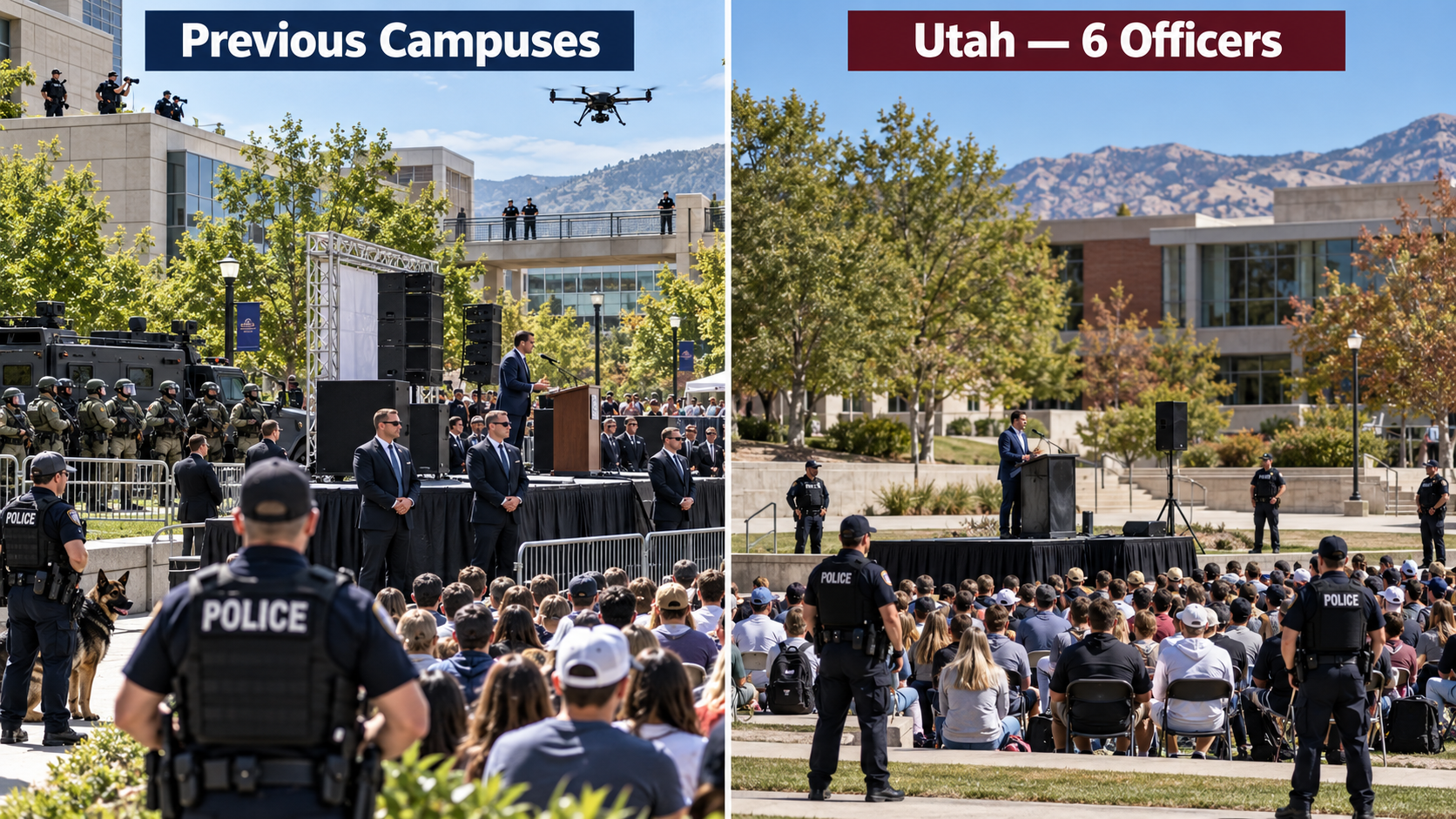 UVU’s review strengthens the reason the original case study compared Utah Valley with Kirk’s earlier appearances. UVU now says future security assessments should consider the speaker, location, attendance, potential concerns, law-enforcement information, relevant public online activity, and lessons from similar events.
That is essentially what the September 24 case study did. It looked backward to determine what other agencies had provided, what worked, and what Kirk’s detail had already experienced. At Illinois State, Chief Aaron Woodruff reviewed the security plan with Kirk’s people, conducted a site walk, and used cameras to monitor surrounding buildings and rooftops. At Wyoming, Chief Josh Holland contacted previous universities that had hosted Kirk, used a partner law-enforcement agency, restricted bags, and had officers check access that could lead to roof areas. Shortly before Utah, law enforcement supporting Kirk’s Visalia appearance used substantial manpower and a drone to observe surrounding rooftops.
The purpose of those comparisons was never to argue that UVUPD should copy another police department officer-for-officer or piece-for-piece. Different venues require different solutions. The important fact is that Kirk’s detail had already seen several ways experienced host agencies addressed the environment outside the close-protection area, and that experience went to Utah with the detail even though the earlier police chiefs, officers, equipment, and local resources did not.
The Atmospheric Survey Should Have Identified the Difference
An advance is not limited to walking the physical site. The detail also needs to understand the people and organizations it is going to depend on. That is part of the atmospheric survey.
Before relying on a host police department, an experienced detail should know the department’s relevant experience, staffing, available technology, special-event capability, relationships with neighboring agencies, and experience supporting executive or dignitary protection. It should know whether the host has enough officers for the expected crowd, whether it has observation capability, what neighboring agencies can assist, and what the department learned from previous comparable events.
Chief Jeffrey Long had extensive law-enforcement and military experience. The original case study did not argue otherwise. The narrower question was whether UVUPD had the same protection-specific experience, planning structure, staffing, and technical capabilities the detail had encountered at several previous locations.
If the answer was no, that did not automatically make UVUPD incompetent. It meant Utah was a different operating environment, and an experienced detail should have identified those limitations during the advance and adjusted its plan accordingly.
The Attendance Problem Adds Another Layer
UVU’s review adds another warning that was not developed as clearly in the original case study. TPUSA projected approximately 600 attendees on August 21. University officials later raised concerns about attendance, the outdoor venue, protest activity, crowd management, and access, while approximately 3,000 people ultimately attended. UVUPD also lacked reliable ticket totals during later security coordination.
A crowd growing from roughly 600 to approximately 3,000 changes the operation. Staffing requirements change, crowd movement becomes harder to manage, observation becomes more difficult, emergency routes become more important, and the number of people security personnel must monitor increases substantially.
This was not solely a UVUPD problem. Kirk’s detail could see the crowd developing in front of it. An operating environment that materially changes requires the protection plan to change with it.
The Drone Issue Needs to Be Kept in Its Proper Place
Harpole said his detail had drone capability but believed it could not lawfully use its own drones because of the airspace restrictions he understood to apply around the location. He also identified Orem Police Department as an agency with an active drone unit and said he believed a mutual-aid relationship existed between Orem and UVU.
UVU’s independent review describes the formal relationship differently. The university now says it needs to complete a mutual-aid agreement with Orem Police Department and strengthen agreements with other nearby agencies. The supplemental therefore should not state as established fact that a completed formal agreement already existed on September 10.
The more important protective question is what happened after Harpole determined that his own drone was unavailable. The detail may not have possessed authority to order another police department to deploy, but it could still make inquiries, determine what capability existed, put the requirement back in front of UVUPD, and ask the agency with jurisdiction to request the resource.
If UVUPD did not make the call, an experienced detail still had a problem to solve. You make the calls necessary to determine what is available, who has authority to request it, and whether the capability can be brought into the operation. If a drone cannot be provided, you identify another lawful observation method instead of allowing the absence of the preferred tool to end the discussion.
Do Not Allow Someone Else’s Limitation to Become Your Failure
Every host agency has limitations. One agency may lack personnel, another may not have a drone, and another may have little executive-protection experience. A meeting may fail to occur, a planned resource may not arrive, or a written security plan may not exist. Those limitations are conditions the detail has to recognize and work around.
The protective requirement does not disappear because the host cannot provide the preferred solution. If the detail cannot use its own drone, it looks for another observation method. If the police department lacks manpower, the detail raises the problem and seeks additional resources. If the host does not have the expected planning structure, the detail conducts its own assessments, documents what it needs, and pushes unresolved issues back into the planning process before the principal enters the site.
That does not mean violating the law or pretending the detail possesses police authority. It means refusing to allow another organization’s limitation to become the detail’s failure.
Utah provides a practical example. The detail had already identified elevated exposure as a concern. Even if a counter-sniper position was unavailable and a drone had not been obtained, one of the detail’s own trained agents could have been placed in a lawful elevated observation position, including the controlled walkway above the immediate event area, with binoculars or other observation equipment. That would not have guaranteed detection of the shooter, but it could have provided another opportunity for early warning from the very environment the detail had already identified as dangerous.
The larger point is not that binoculars were the single answer. The point is that an experienced detail should have seen the limitations of the host environment, recognized the weaknesses in the planning process, conducted its own assessment of the remaining threat, and found another lawful way to perform the protective function.
What the UVU Review Adds
The independent review makes several parts of the September 24 analysis more precise. UVUPD did act on the Hall of Flags concern, so that specific concern was not simply ignored. The exact Losee Center firing position was not identified beforehand. University personnel had raised concerns about the outdoor location, attendance, protest activity, crowd management, and access before the event. TPUSA preferred the Fountain Courtyard and controlled its own ticketing. Both TPUSA security and UVUPD failed to ensure the final briefing and walk-through occurred.
The report also goes beyond the original case study by examining emergency leadership, communications, alerts, recovery, first-responder support, and the response of outside agencies after the shooting. My September 24 article was primarily concerned with what happened before the shot, so those broader institutional findings are important but are not the primary focus of this supplemental.
What UVU Does Not Answer
UVU’s review is about UVU. It examines the university’s policies, police department, event planning, emergency response, technology, communications, and corrective action. It does not fully answer what previous operations had taught Kirk’s detail or how those experiences affected decisions made in Utah.
That remains important because Harpole had described earlier incidents involving compromised extraction routes and another event where expected law-enforcement support did not materialize. Kirk’s detail had therefore seen both sides of the problem. It knew what strong host support looked like because it had repeatedly benefited from it, and it knew what weak or failed support looked like because Harpole says the team had experienced that as well.
At Utah Valley, the detail needed to determine which kind of environment it had entered and adapt accordingly. The independent review gives us much more information about the weaknesses inside the UVU operation, but it still does not explain why the detail did not compensate more aggressively once those weaknesses became visible.
Did Previous Success With Stronger Hosts Create Apathy?
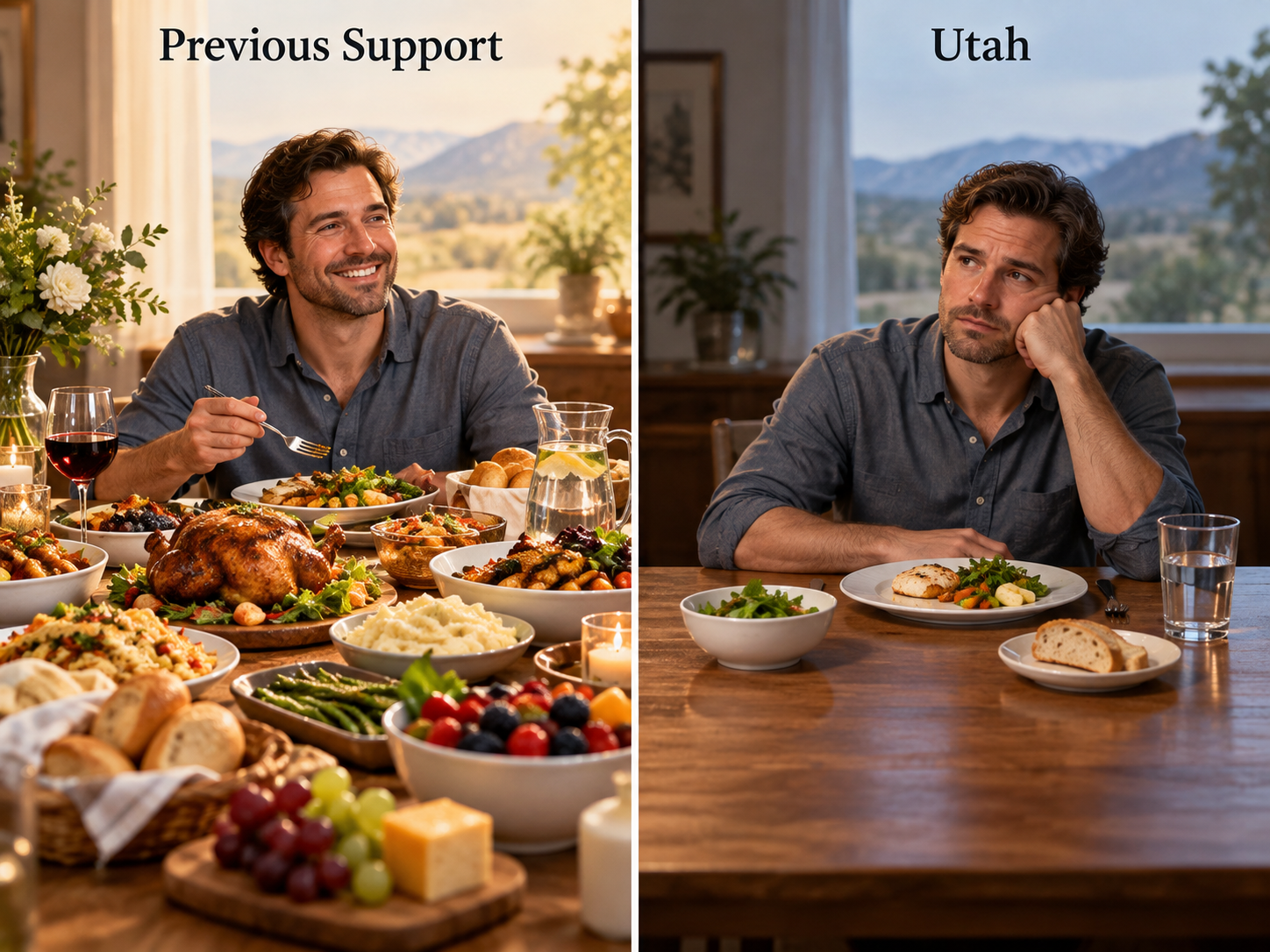 This is where the original discussion of normalized dependency remains relevant. Repeated successful support from capable host agencies can create an expectation that the next agency will provide the same functions. Nobody needs to consciously decide to become dependent on that support for the expectation to influence the way an operation is conducted.
UVU’s review now documents several signs that Utah was different. There was no comprehensive Event Action Plan, the joint briefing and security walk-through did not occur, elevated positions and building access were not adequately formalized in the planning, attendance information was unreliable, existing technology was not being used as effectively for real-time awareness as it could have been, and outside resources needed to be incorporated earlier.
Those facts do not prove that members of Kirk’s detail were apathetic, and neither the UVU review nor I can tell you what anyone was thinking. They do allow us to ask whether repeated success with stronger host agencies created a level of operational apathy or normalized dependency in which the detail did not react aggressively enough when Utah’s limitations became visible.
The detail knew what strong support looked like. It also knew from earlier operations what happened when support failed. The question is whether success with better-equipped and more proactive hosts made the detail less sensitive to the warning signs when the next host was not providing the same planning, manpower, observation, or coordination.
That is an operational question based on what the detail did, not an accusation about anyone’s motives.
Where the UVU Review Does Not Support Going Further
The independent review does not establish that the Losee Center firing position was known beforehand. It does not say Kirk’s detail was solely responsible, and it does not say UVUPD was solely responsible. It also does not adopt my terminology of operational complacency, normalized dependency, apathy, or failure of initiative. Those remain part of my executive-protection analysis based on the pattern of previous events and the decisions made at Utah.
The report also does not establish that any one additional measure would have prevented Kirk’s assassination. An elevated observer might have seen suspicious movement, a drone might have detected something, another officer might have changed the attacker’s behavior, or a different venue might have removed the line of sight. We cannot know which measure, if any, would have changed the outcome.
That uncertainty does not remove the obligation to ask why reasonable protective measures were not used after the underlying vulnerabilities had already been recognized.
No Bad Faith Does Not Mean No Security Failure
UVU’s reviewers found no evidence that a university employee or agent acted in bad faith or with willful and wanton disregard for safety. The same review nevertheless identified substantial problems involving planning, implementation, coordination, technology, threat investigation, staffing, and emergency management. Those conclusions can exist together.
The same standard should be applied to Kirk’s detail. I would not argue that Brian Harpole was lazy, did not care about Kirk, or deliberately ignored a threat. The record does not establish those things, and those accusations add little to the professional discussion.
The concern is operational. The detail recognized problems, had experience showing that outside support could fail, and had worked with stronger host agencies that provided substantial support. At Utah, the final walk-through did not happen, the written planning structure was incomplete, elevated exposure had been identified as a concern, the crowd greatly exceeded the earlier estimate, and alternative observation resources were not fully developed.
Those facts are enough to examine whether operational complacency, normalized dependency, apathy toward host limitations, or failure of initiative played a role without making unsupported claims about anyone’s motives.
What the Two Reviews Tell Us Together
The September 24 case study and the September 25 UVU independent review should not be presented as identical documents or as one proving everything in the other. However, they do show a failure of follow-through. Threats had been recognized, responsibilities had been discussed, and some protective assignments had been made, but the process did not consistently continue through final verification.
The problem was not simply whether someone identified a concern or agreed to handle it. The mission depended on making sure the required measures were actually in place and working before Kirk entered the courtyard. Both the case study and the UVU report show they were not.
The September 24 case study examined the protective measures and operations surrounding Kirk, including the law-enforcement agencies and leadership that supported his detail at previous events, what those agencies provided, the experience Kirk’s detail brought with it, and what changed at Utah Valley. It shows a wide disparity in what the detail had received in the past, and what was available in Utah. But we also see a lack of concern by the detail.
- UVU’s review examined the university’s own planning, police operations, policies, technology, emergency response, and coordination with TPUSA security and outside agencies.
Together, the reports show that UVUPD did act on the specific Hall of Flags concern, but the larger elevated environment remained a planning issue. The detail recognized the exposure but did not establish a comparable observation capability of its own.
- The detail says its own drone could not be used, while another nearby agency had drone capability that might have been explored through the appropriate channels.
- A joint meeting was planned, but when it failed to happen, the event still moved forward without the final coordination that UVU’s reviewers now say was critically important.
That is where the September 25 report strengthens the September 24 case study. Utah Valley was clearly different from several previous locations. The harder question is whether Kirk’s detail recognized those differences early enough and did enough to compensate for them.
Previous success with stronger host agencies may have made that support feel normal. If that created normalized dependency or a level of apathy toward the limitations of the next host, then the detail did not react strongly enough when the same capabilities were missing in Utah. The record cannot tell us what anyone was thinking, but it does allow us to examine what the operation did and what it failed to do.
Bottomline
A host agency’s limitations cannot simply be transferred to the protectee. The detail has to recognize the limitation, determine what protective requirement remains, assign responsibility for it, verify that it has actually been handled, and, when the answer is no, find another lawful way to accomplish the protective function.
That is what the advance is supposed to accomplish, and that is the lesson the combined record leaves for executive protection.
About the Author
Matthew C. Parker is the CEO of Independent Security Advisors LLC and Director of Training for EPTraining.us. He is an executive- and dignitary-protection specialist, international adviser, instructor, and curriculum developer whose work has included protective-service operations and the evaluation of protective organizations.
Parker’s protection experience includes service in the U.S. Army and private sector, followed by advisory and instructional responsibilities involving government protective organizations in Iraq and Ukraine. He has more than two decades of experience designing and teaching executive- and dignitary-protection programs for law-enforcement, military, government, private-security, and corporate professionals.
Parker also leads the Defending Democracy Initiative, which examines threats, intimidation, political violence, and the security requirements necessary to allow elected officials, judges, and other public officials to continue performing their public duties.
Primary Documents
The principal documents for this supplemental are Matthew C. Parker’s September 24, 2026 EPTraining.us case study, What Changed at Utah Valley? Charlie Kirk’s Protection Failures; Utah Valley Exposed, and Utah Valley University’s independent external review released September 25, 2026. Additional factual context comes from the Utah Department of Public Safety’s September 10, 2025 incident information, Brian Harpole’s November 17, 2025 interview on The Shawn Ryan Show, and the supporting primary and public sources cited in the original case study.
Original Parker Case Study — EPTraining.us:
What Changed at Utah Valley? Charlie Kirk’s Protection Failures; Utah Valley Exposed
Read the original Parker case study
Utah Valley University — Independent External Review:
Learning from September 10 — Independent External Review
Read the UVU Independent External Review
Utah Department of Public Safety:
Updates on Charlie Kirk Shooting at UVU — September 10, 2025
Read the Utah DPS incident update
Brian Harpole — The Shawn Ryan Show, SRS #254:
Groundbreaking Evidence From Charlie Kirk’s Head of Security — November 17, 2025
Primary-source interview discussing Kirk’s detail, the Utah Valley advance, previous incidents, elevated-area concerns, drones, and coordination with law enforcement.
Watch/read SRS #254 with Brian Harpole
#CharlieKirk #UtahValleyUniversity #UVU #ExecutiveProtection #DignitaryProtection #ExecutiveProtectionTraining #ProtectiveOperations #AdvanceWork #ThreatAssessment #ProtectiveIntelligence #CampusSecurity #LawEnforcementCoordination #EventSecurity #ProtectiveSecurity #SecurityPlanning #SecurityFailures #CaseStudy #BrianHarpole #DefendingDemocracy #PublicOfficialSecurity #EPTrainingUS