
 E-mail us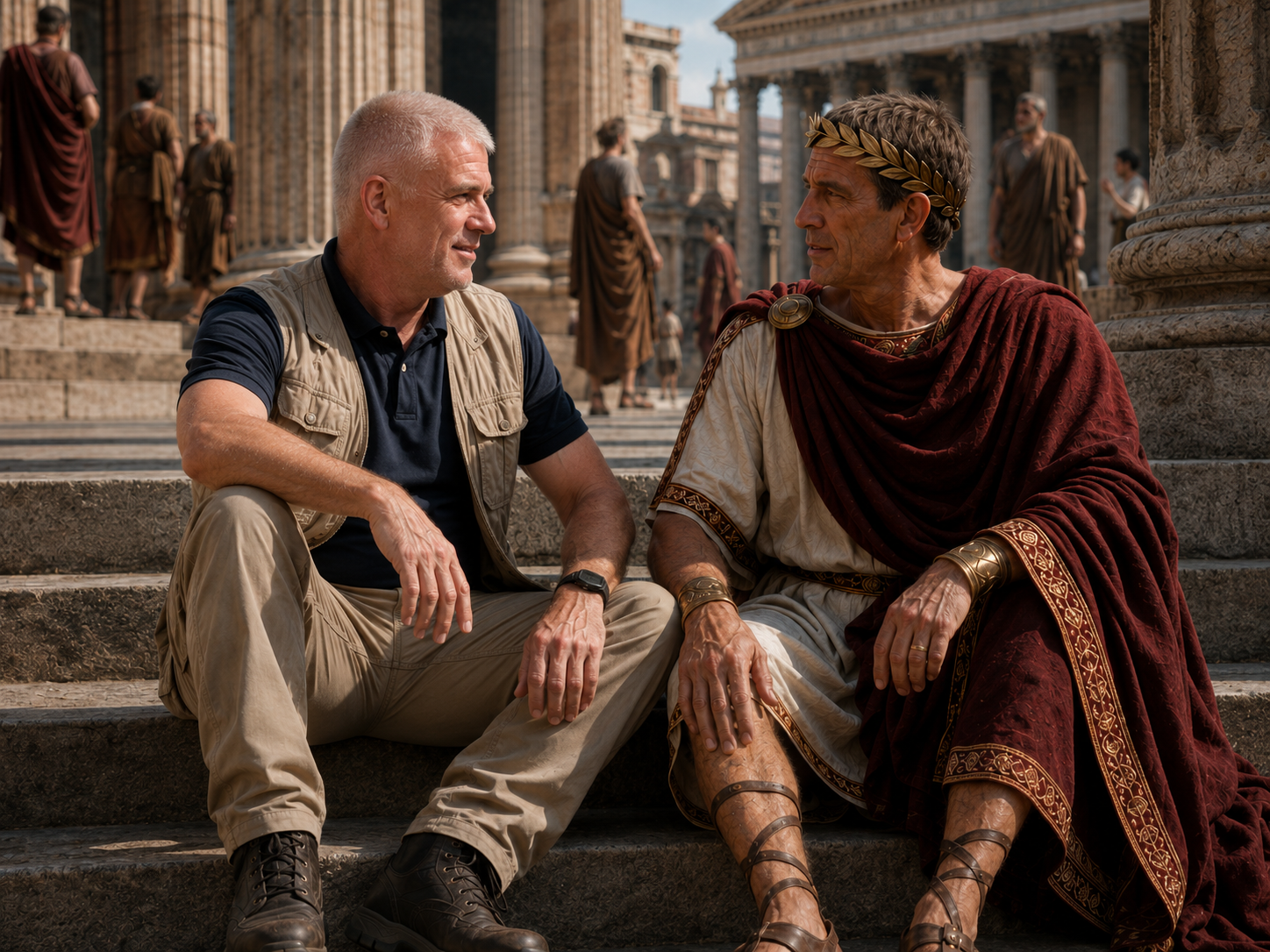
Matthew Parker in Conversation with Augustus Caesar
Julius Caesar, the Ides of March, Protective Intelligence, Political Access, Family, and the Security of Power
Rome – A historically reconstructed conversation across the Roman Forum
Julius Caesar’s assassination was not simply a failure at knife range. This historical case study examines the dismissed bodyguard, Calpurnia and Artemidorus warnings, legitimate insider access, Augustus’s security choices, the Praetorian problem, and what modern executive protection can learn from Rome.
Why This Historical Executive Protection Case Still Matters
Julius Caesar was not killed because Rome lacked armed men. Suetonius records that Caesar had dismissed an armed bodyguard of Spanish soldiers. Plutarch preserves Calpurnia’s urgent plea that he stay home and a separate attempt by Artemidorus to place a written warning of the conspiracy directly into Caesar’s hands. The men who ultimately surrounded him were not strangers who had broken through a perimeter. They were senators whose rank, relationships, and political office gave them legitimate access.
For a protection professional, that sequence is more useful than the first dagger. By the time the attack began, several of the difficult problems had already been solved for the conspirators: the principal’s protective posture had been reduced, the meeting and route were predictable, warning information had not changed the operation, political pressure favored attendance, and the attackers belonged in the environment. The final assault was close-range violence, but the protective failure developed earlier.
Augustus makes the case more complicated. He lived with the lesson of Caesar’s death and used dedicated guards, troops, intelligence, household management, and political control more deliberately. Yet he also understood that protection itself could damage legitimacy if Rome saw the ruler surrounded by an occupying army. Later emperors would discover another danger when the Praetorian Guard became powerful enough to influence succession. The Roman record therefore presents both sides of the modern protection problem: too little security can leave the principal exposed; security without institutional limits can become a threat to the mission it was created to protect.
Historical Simulation and Editorial Note
This is a historically grounded fictional conversation, not a transcript. Augustus is reconstructed from ancient accounts and from the political record of his long rule. Julius Caesar’s assassination, the armed bodyguard he had dismissed, Calpurnia’s warning, the attempted warning attributed to Artemidorus, later Roman security arrangements, and the conspiracies Augustus himself faced provide the historical foundation. Matthew Parker serves as the modern protection interviewer. His professional background informs what he notices and asks, but Augustus, Caesar, and Rome remain the subjects of the conversation.
Ancient sources often disagree, preserve later literary traditions, or report events long after they occurred. Where the record is uncertain, this case study preserves that uncertainty rather than turning a disputed story into fact. The Curius-Fulvia example belongs to the Catilinarian conspiracy, not the conspiracy against Julius Caesar; it is included only to show how conspiratorial information can leak through personal relationships.
Reader Navigation – Choose How You Want to Read This Case Study
This case study can be read two ways. Part I preserves the reconstructed historical interview; Part II can be read independently by students and practitioners who want the consolidated protective findings without reading the full conversation.
Case Snapshot: Caesar, the Ides, and the Protective Problem
On 15 March 44 BCE, Julius Caesar attended a meeting of the Senate at the Curia of Pompey and was killed by a group of conspirators drawn from the Roman political elite. Their access was not accidental. They were senators, magistrates, associates, and men whose presence close to Caesar did not automatically look abnormal.
Before the assassination, ancient sources preserve several warnings and protective changes. Suetonius reports that Caesar had dismissed an armed bodyguard of Spanish soldiers and gives differing explanations for that decision. Plutarch says Calpurnia was distressed by dreams and omens and that Caesar initially decided to postpone the Senate before Decimus Brutus Albinus persuaded him to attend. Plutarch also recounts Artemidorus attempting to deliver a written disclosure of the conspiracy, while preserving a variant tradition in which the warning did not reach Caesar.
Augustus inherited the political consequences of Caesar’s death and faced conspiracies of his own. Suetonius describes forces assigned to the defense of the city and Augustus’s person, periods in which Calagurritan and German bodyguards attended him, and a limit of no more than three Praetorian cohorts in Rome without a permanent camp. The comparison is not between no protection and perfect protection. It is between different attempts to balance access, warning, armed protection, public legitimacy, institutional control, and continuity.
PART I – The Historical Interview
Prefer the operational analysis? Skip the reconstructed historical interview and go directly to the Protective After-Action Review.
The Forum
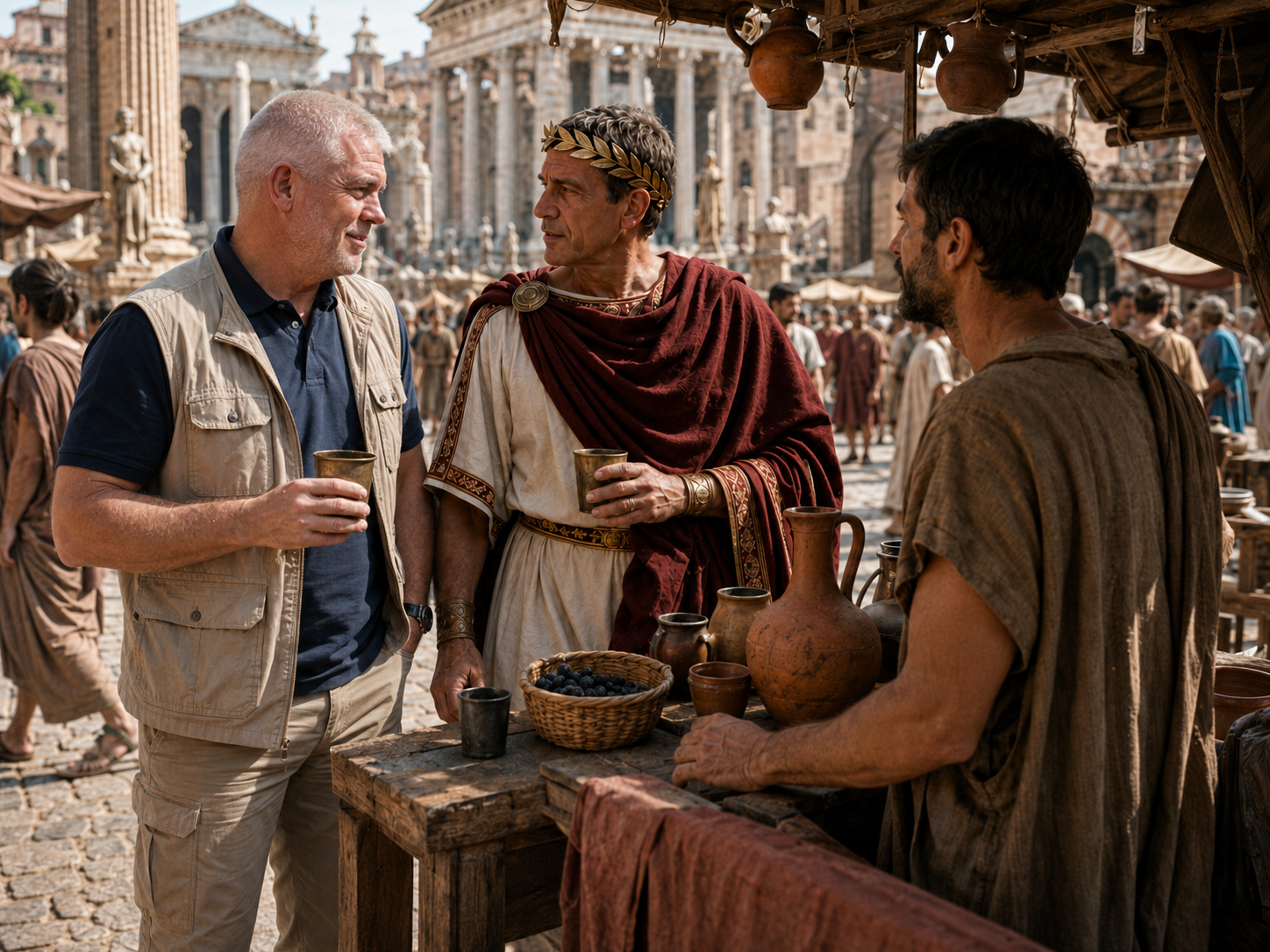 The Forum was already full when Augustus and Matthew Parker began walking. Senators crossed between temples and public buildings. Clients waited for patrons. Petitioners watched for officials they might approach. Merchants, freedmen, soldiers, servants, foreign visitors, and ordinary Romans filled the same public space in which political business was being conducted. There was no modern sterile zone separating government from the people. Rome governed in public.
Augustus noticed that Parker’s attention kept moving past him rather than resting on him.
AUGUSTUS: You look at the crowd more often than you look at me.
PARKER: I know where you are. I am trying to understand what is changing around you. The principal is usually the easiest person in the environment to locate.
Augustus gave him a measured look, more amused than offended.
AUGUSTUS: Caesar was very good at knowing where his enemies were when they stood across a battlefield. He was less fortunate when they stood close enough to greet him.
PARKER: That is exactly where I wanted to begin. Not with the first knife, but with the decisions and conditions that made the knives possible.
Augustus slowed his pace.
PARKER: You were eighteen when Caesar was killed. What did his death teach you that you could not have understood in the same way beforehand?
AUGUSTUS: That power and security are not the same thing. Caesar had conquered armies and survived civil war. The men who killed him did not have to defeat a legion or break a city gate. They were men of rank. They belonged where they were. They had access, standing, proximity, and enough confidence that his presence among them did not look like a security failure until it was already one.
PARKER: That is what makes the case so useful. By the time the first dagger appeared, the conspirators had already solved most of the difficult problems. They knew the place, the time, the principal, the people around him, and what they intended to do. Caesar did not possess the same information.
The Guard Caesar Sent Away
AUGUSTUS: And he had dismissed the armed Spaniards who had attended him.
PARKER: Suetonius preserves that point very clearly. He also gives more than one explanation for it. One tradition says Caesar trusted the Senate’s pledges concerning his safety. Another says he preferred to expose himself to danger rather than live perpetually anxious and guarded. I cannot tell you which motive mattered most on his last morning. But from a protection standpoint, I can say what the decision did: it removed a layer.
AUGUSTUS: You would have kept them.
PARKER: I would have wanted Caesar to understand what risk he was accepting by sending them away. A bodyguard was not a guarantee. The conspirators could have adapted, excluded them from the chamber, delayed the attack, or selected another location. Protection does not make a principal invulnerable. It increases the number of problems an attacker must solve and gives the principal more opportunities to receive warning or escape.
Augustus looked ahead toward the Senate buildings.
AUGUSTUS: Caesar would have argued that living permanently behind armed men carried a political cost. Romans had expelled kings. He did not wish to advertise fear or monarchy every time he crossed the Forum.
PARKER: And that is a serious consideration, not an excuse. A protection plan that prevents a leader from governing has failed in another direction. The question is whether we can reduce vulnerability without destroying the mission or the political legitimacy that gives the mission meaning.
AUGUSTUS: You make the protector sound less like a guard and more like a man forever negotiating between dangers.
PARKER: That is close to the job.
Historical note: Suetonius reports that Caesar dismissed an armed bodyguard of Spanish soldiers and preserves differing explanations for that choice, including reliance on senatorial assurances and Caesar’s aversion to living permanently on guard. Suetonius, Life of Julius Caesar 86.
Calpurnia and a Warning That Did Not Look Like Intelligence
PARKER: On March 15, Caesar also faced warnings. Calpurnia begged him not to go.
AUGUSTUS: Because of her dreams and the omens.
PARKER: Yes, and I want to separate two things. I would not call a dream intelligence merely because we know what happened later. That would be hindsight pretending to be analysis. But Calpurnia’s alarm was still a change in Caesar’s environment. She knew him, his routine, the political atmosphere, and his usual attitude toward danger. According to Plutarch, she was distressed enough that he initially decided to postpone the Senate.
AUGUSTUS: Until Decimus Brutus persuaded him that the senators would take the delay as an insult and another sign that Caesar thought himself above them.
PARKER: Which makes the decision more recognizable to me, not less. Now the principal has competing advice. His wife says stay. A trusted political associate says go. The Senate is waiting. Optics matter. The schedule matters. Authority matters. Security is one factor in a decision the principal experiences as much larger than security.
AUGUSTUS: What would you have done with Calpurnia’s warning?
PARKER: I would have used it as a trigger to reassess the day. Not, “A dream says cancel.” I would ask what else has changed. Have there been threats or rumors? Has anyone made unusual inquiries? Is the meeting composition normal? Are there people with access whose behavior has changed? Has anyone attempted to learn the route? Can the meeting be delayed, shortened, moved, or attended with a stronger protective posture? A warning does not have to arrive in the language of a security officer to deserve evaluation.
Augustus’ expression became more thoughtful.
AUGUSTUS: I am not certain I would mock Caesar for listening to a dream. At Philippi I was ill and intended to remain in my tent. A friend’s dream persuaded me to leave it. The camp was taken, and men stabbed the litter because they believed I was still inside.
PARKER: Which would make you especially sensitive to the difference between accepting superstition and using an unusual warning to justify a temporary precaution.
AUGUSTUS: Do not make me sound superstitious.
PARKER: I was going to say cautious.
That produced the faintest smile.
Historical note: Plutarch says Calpurnia pleaded with Caesar to remain home and that Caesar initially resolved to postpone the Senate before Decimus Brutus Albinus persuaded him to attend. Suetonius and Plutarch also preserve traditions that Augustus responded to dreams affecting his own safety, including the Philippi episode. Plutarch, Caesar 63-64; Suetonius, Augustus 91.
The Warning in Caesar’s Hand
PARKER: There was also a very different warning, one that looks much more like intelligence. Plutarch describes Artemidorus attempting to give Caesar a written disclosure of the conspiracy.
AUGUSTUS: And Caesar carried it with him without reading it.
PARKER: According to Plutarch, he tried to read it and was repeatedly interrupted by the press of people around him. Another tradition said Artemidorus never reached him at all. That uncertainty matters. I do not need to decide which version is perfect to see the protective problem.
AUGUSTUS: Which is?
PARKER: Access creates volume. A public leader receives petitions, warnings, complaints, letters, invitations, requests, and advice constantly. Somewhere inside all of that may be the one piece of information that changes the day. The problem is not simply collecting information. Someone has to recognize significance, prioritize it, and get it to a person who can change the operation before the opportunity closes.
AUGUSTUS: So the danger may be known to someone and still remain unknown to the man whose life depends upon it.
PARKER: Exactly. Information becomes protective intelligence only when it changes understanding or action. A warning that never reaches the right person in time is still a warning, but it is not yet protection.
Historical note: Plutarch recounts Artemidorus attempting to deliver a written warning to Caesar, while acknowledging a variant tradition in which Artemidorus was crowded away. Plutarch, Caesar 65.
What Conspirators Tell the People Close to Them
Augustus glanced toward a knot of men talking privately beside a column.
AUGUSTUS: Rome had learned before Caesar that conspiracies leak through people as often as through spies.
PARKER: The Catilinarian conspiracy is the cleanest example, provided we do not confuse it with the Ides of March. Sallust describes Quintus Curius boasting to Fulvia, a woman with whom he had a long-standing affair. She learned enough to spread warning of Catiline’s conspiracy, and Curius later became a source to Cicero through her.
AUGUSTUS: A man who cannot keep quiet before a lover is a poor conspirator.
PARKER: People have not improved greatly in that respect. They tell spouses, lovers, friends, servants, colleagues, people they want to impress, and people they believe will agree with them. They complain. They hint. They boast. Sometimes the first useful threat information comes from a relationship the formal security organization was not watching at all.
AUGUSTUS: And you are not suggesting that Fulvia knew anything about the conspiracy against Caesar.
PARKER: No. That distinction matters. Curius and Fulvia belong to Catiline, not Caesar. Their case shows that conspiratorial information can escape through a personal relationship; it does not prove that the conspiracy against Caesar was exposed that way.
Historical note: Sallust says Curius boasted to Fulvia, who revealed what she had learned of Catiline’s conspiracy; later Curius passed information to Cicero through her. This is a separate conspiracy and should not be presented as evidence about Caesar’s assassins. Sallust, Bellum Catilinae 23, 26, 28.
The Person Who Belongs There
A group of senators approached. Parker’s eyes moved briefly to their hands, then to the distance between Augustus and the nearest doorway, then back to the men themselves.
AUGUSTUS: You did it again.
PARKER: More people entered the space. That changes the problem.
AUGUSTUS: You looked at their hands before their faces.
PARKER: Faces help me interpret. Hands tell me when interpretation has become action. But around Caesar, the harder question was not how to identify a stranger. It was how to manage people who were supposed to be there.
AUGUSTUS: Senators.
PARKER: Senators, magistrates, friends, aides, household members, soldiers, anyone whose office or relationship creates legitimate access. You cannot govern if every trusted associate is treated as an enemy at every encounter. But legitimate access is not the same thing as harmless intent.
AUGUSTUS: Then how would you protect Caesar in a Senate meeting without humiliating the Senate?
PARKER: By changing the geometry and the system rather than pretending I have unlimited authority. How many people approach at once? Where do they stand? Who controls the doors? Who observes the room instead of staring only at Caesar? Where are the exits? Who can move him if the room changes? What indicators have been reported about the people with access? The principal must trust people. The protective system should not depend on trust alone.
AUGUSTUS: Trust, but never as the only wall.
PARKER: Exactly.
Augustus’s Answer: Protection Without Occupation
PARKER: You inherited more than Caesar’s name. You inherited the knowledge that political violence could reach the most powerful man in Rome through the people around him. Yet you did not simply surround yourself with every soldier you could find.
AUGUSTUS: Because a ruler has to consider what soldiers in the city mean as well as what they can do.
PARKER: Suetonius says you retained dedicated guards, including Spaniards from Calagurris for a time and later Germans, and organized troops for the defense of the city and of your own person. But you also refused to keep more than three Praetorian cohorts inside Rome at once, and even those had no permanent camp.
AUGUSTUS: Rome had endured enough armies marching through its politics. Security that looked like occupation would have created its own danger.
PARKER: Then the guards themselves had political meaning. They could deter an attacker and still create another problem if Rome saw them as an army of occupation around a king.
AUGUSTUS: I was careful with appearances because appearances become political facts if they are repeated long enough.
PARKER: Yet Suetonius also says your morning receptions were open even to ordinary citizens, that you often moved through the streets on foot when consul, and that you lived in a comparatively modest house on the Palatine. You did not solve Caesar’s problem by disappearing from public life.
AUGUSTUS: A ruler whom no one can approach eventually governs information delivered entirely by people who already possess access. That is another kind of blindness.
PARKER: So your solution was layered and political at the same time: dedicated protection, controlled military visibility, intelligence, household management, and continued public accessibility.
AUGUSTUS: I would not describe it with your neat categories. But yes, I preferred caution that still allowed government to function.
Historical note: Suetonius says Augustus employed troops for the defense of the city and of his own person, retained Calagurritan and German bodyguards for periods, and kept no more than three Praetorian cohorts in Rome at a time, without a permanent camp. He also describes open morning receptions and relatively modest living arrangements. Suetonius, Augustus 49, 53, 72.
Augustus Was Not Safe Either
PARKER: The temptation is to make you the man who learned Caesar’s lesson and solved the problem. The record does not permit that either.
AUGUSTUS: No ruler solves it.
PARKER: Suetonius lists repeated conspiracies and attempts during your reign: Lepidus the Younger, Murena and Caepio, Egnatius Rufus, others, even a man discovered near your bedroom at night with a hunting knife. Velleius describes Murena and Caepio as plotting to assassinate you. Whatever we think about individual accusations, the broader point is that your security system still had to deal with recurring political violence.
AUGUSTUS: Caesar’s death did not remove the reasons men kill for power. It merely showed them what such an act could unleash.
PARKER: Did those plots make you more restrictive with everyone around you?
AUGUSTUS: They made me more attentive. If every threat produces only another guard at the shoulder, soon the ruler cannot move and the guard becomes the government. Sometimes punishment is necessary. Sometimes a man must be isolated. Sometimes the more useful question is why he has allies at all.
PARKER: Then your guards could reduce an attacker’s opportunity, but they could not remove the political conditions producing enemies around you.
AUGUSTUS: Nor should guards be asked to solve politics with weapons. That produces another civil war wearing a different uniform.
Historical note: Suetonius lists multiple conspiracies against Augustus and an armed intruder found near his bedroom. Velleius Paterculus describes Murena and Caepio as having plotted to assassinate him. Suetonius, Augustus 19; Velleius Paterculus 2.91.
Livia: Family Member, Adviser, and Part of the System
PARKER: Caesar’s story gives us Calpurnia as the spouse whose concern was easy for later readers to dismiss because it came through a dream. Your household gives us a different example. Livia was not merely someone to be protected.
AUGUSTUS: Certainly not.
PARKER: Cassius Dio preserves a later story in which, after another conspiracy, you discussed with Livia whether repeated executions were actually reducing the danger. In Dio’s version, she argues for clemency toward Cornelius Cinna, and you follow that advice. I would treat the scene carefully because Dio wrote long after you, but the political idea is important: sometimes the person beside the principal contributes to threat reduction rather than merely receiving protection.
AUGUSTUS: Livia understood that fear can produce obedience for a time and enemies for much longer. A household that hears only what the ruler wishes to hear is poorly defended, even if every doorway has a soldier.
PARKER: That is why I would not reduce family security to assigning guards to spouses and children. Some family members are public figures. Some influence decisions. Some hear things the principal does not. Some have independent threat profiles. And all of them may become routes through which pressure is applied to the principal.
AUGUSTUS: Family is rarely private for a ruler.
PARKER: Which creates both strength and vulnerability.
Historical note: Cassius Dio preserves a lengthy literary dialogue in which Livia advises Augustus to show clemency toward Cornelius Cinna after a conspiracy. The scene is useful as evidence of the tradition that Livia acted as a political adviser, but its verbatim dialogue should not be treated as a stenographic record. Cassius Dio 55.14-22.
Family, Succession, and Continuity
AUGUSTUS: You speak of family as though it belongs in a protection plan.
PARKER: For a national leader, it often does, especially when family and succession overlap. Caesar’s death did not simply remove one man. It created uncertainty over authority, inheritance, command, political allegiance, and what came next. You were his adopted heir, but you were not standing in Rome with a functioning succession system ready to absorb the shock.
AUGUSTUS: I was in Apollonia and had to decide whether accepting his name would also mean accepting his enemies.
PARKER: Exactly. Caesar’s death shows that continuity cannot be separated from protection of a national leader. Who can decide if the principal is incapacitated? Who follows him? Which family members become exposed because they represent succession, leverage, or revenge?
AUGUSTUS: Rome made family political whether the family desired it or not.
PARKER: An enemy can make the same calculation in any age. The threat does not necessarily stop at the ruler’s body if a spouse, heir, child, or adviser offers leverage over him or over what happens next.
When the Protectors Become Political
Several Praetorians were visible farther down the Forum. Parker watched them for a moment.
AUGUSTUS: You approve of a dedicated guard, but I suspect you are about to tell me what my successors allowed it to become.
PARKER: Eventually the Praetorian Guard became powerful enough to influence imperial succession. That is the opposite side of the protection problem. A protective organization possesses weapons, access, information, proximity, and enormous ability to shape movement. If the protectors begin deciding who deserves to rule, they have stopped being protectors and become political actors.
AUGUSTUS: Then the guard becomes another faction.
PARKER: Exactly. Professional protection has to be institutionally disciplined. In an elected system, an agent protects the office and lawful continuity regardless of whether he agrees with the politics of the person occupying it. Personal loyalty can motivate courage. It cannot become authority to choose the principal.
AUGUSTUS: That is an interesting warning to give the man who created the institution you are criticizing.
PARKER: I am not criticizing the need. I am pointing out the governance risk created by the capability. A necessary security measure can become dangerous if nobody defines its limits.
AUGUSTUS: On that point, Rome would eventually prove you right.
What Was the Real Target?
They reached a place where the Forum opened beneath them.
PARKER: Caesar’s assassination also matters because the principal was not necessarily the ultimate target. The conspirators wanted to change Rome by killing one man.
AUGUSTUS: They believed removing Caesar would restore the Republic.
PARKER: Instead, his death contributed to another cycle of civil war and to the system you built afterward. Political violence often uses a human being as the mechanism for attacking something larger: succession, military command, public confidence, an election, policy, or the constitutional order itself.
AUGUSTUS: Then the principal may be only the point at which the blow is delivered.
PARKER: Exactly. The actual target may be what the attacker expects to happen next. That is why protecting national leaders is not merely personal security. It is sometimes continuity of government.
Augustus looked over the Forum for several moments before answering.
AUGUSTUS: Caesar’s killers learned that removing the man did not restore the world they wanted. They killed the person and misjudged the system around him.
PARKER: Which is something both attackers and protectors can misjudge.
The Hindsight Test
AUGUSTUS: Let me ask the question people always ask after a famous death. If you had been with Caesar that morning, would you have saved him?
Parker took his time before answering.
PARKER: I do not know.
AUGUSTUS: You admit that rather easily for a man who works in protection.
PARKER: Because certainty after the event is cheap. On March 16, everyone knows the Senate meeting was dangerous. The profession has to recognize danger on March 14, when the outcome is unknown and every warning competes with a dozen ordinary reasons to continue the schedule.
He glanced back toward the Senate house.
PARKER: I would want a reassessment of Caesar’s threat environment, the warnings, his reduced protective posture, the people attending, the route, the meeting space, the exits, and any available reporting about plots. If the indicators justified it, I would recommend postponement or a materially different way of attending. But anyone who promises he certainly would have saved Caesar is using history to advertise himself.
AUGUSTUS: You prefer uncertainty stated plainly.
PARKER: I prefer uncertainty managed honestly. There is no perfect protection. There are stronger and weaker systems, earlier and later warning, deliberate and accidental risk.
AUGUSTUS: Caesar feared that excessive security would prevent him from living.
PARKER: Then the answer was not simply more men against his shoulder. It was a better system around him: information before the meeting, advance work before arrival, controlled access, observation, movement planning, alternate options, medical contingency, and close protection as the final layer rather than the entire plan.
AUGUSTUS: A guard asks, “How do I defend the ruler if the attack begins?” Your system asks, “How do I make it harder for the attack to reach that moment?”
PARKER: That is the difference.
The Last Question
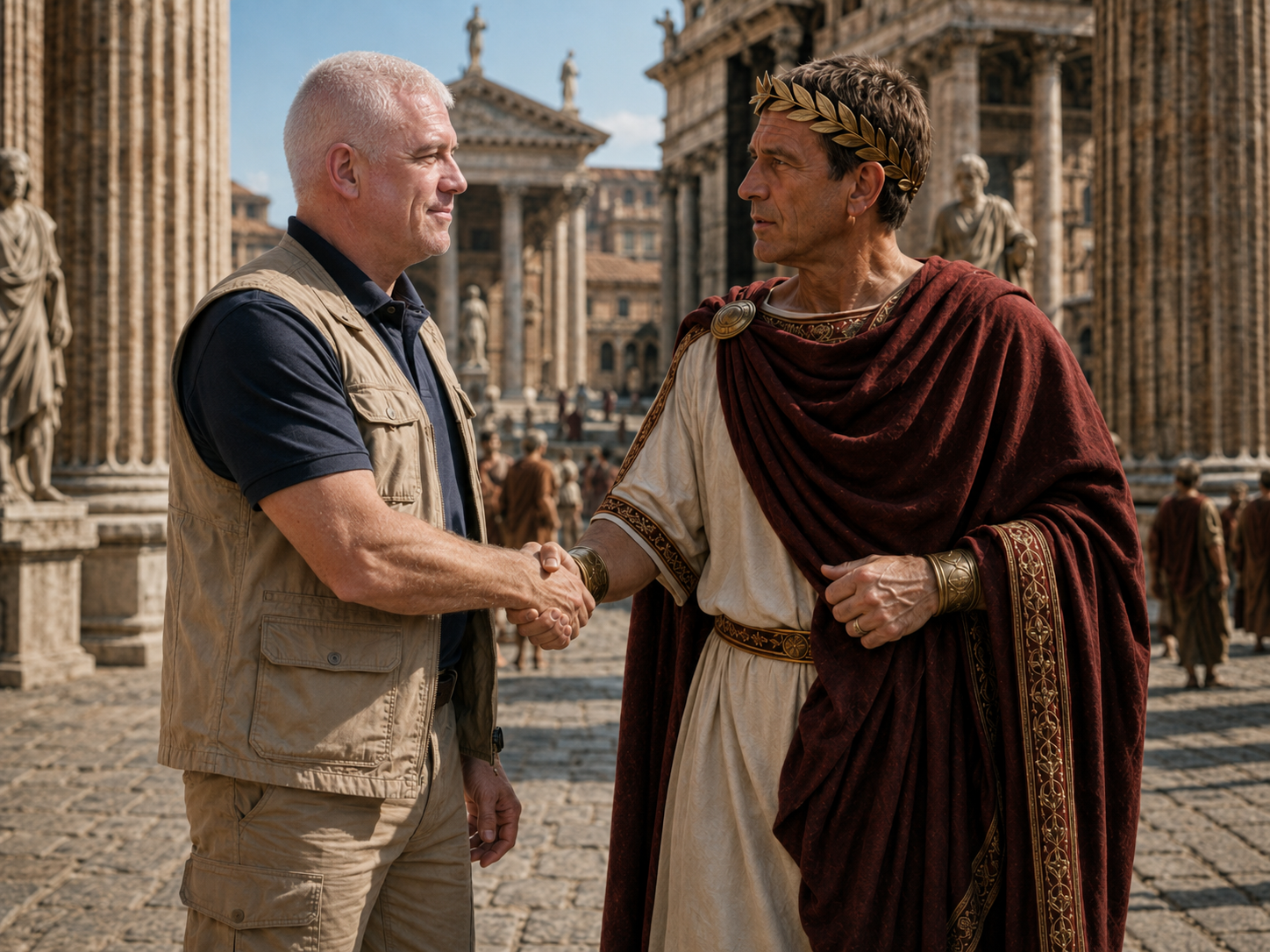 Augustus looked again toward the Senate house, then back at Parker.
AUGUSTUS: If you could speak to Caesar the night before his death, knowing only what could reasonably have been known then, what would you tell him?
PARKER: I would tell him not to confuse power with security, and not to wait for the knife before deciding whether the environment has changed. I would tell him that a warning can be imperfect and still deserve evaluation, that legitimate access is not proof of harmless intent, and that removing protection for political reasons is still a risk decision even when the political reason is understandable.
Augustus waited.
PARKER: Then I would tell the people around him that the man beside the principal is not the whole protective system. The system begins earlier, with information, planning, access, movement, and the ability to change the plan before proximity turns everything into reaction.
AUGUSTUS: Caesar and I learned the matter differently. A ruler who ignores security may die. A ruler who displays nothing except security may eventually cease to govern effectively. The difficult art is not eliminating danger. It is knowing which dangers belong to the duty and which are merely carelessness.
PARKER: I think that may be the distinction I came here looking for.
AUGUSTUS: Caesar would have found you irritating.
PARKER: Most principals eventually do.
Augustus finally laughed.
AUGUSTUS: Then perhaps irritation, properly measured, is another layer.
They resumed walking through the Forum. Augustus moved among the institutions he had spent a lifetime reshaping, while Parker’s attention returned to the people, entrances, distance, and movement around him. The emperor noticed and did not mention it again.
PART II – Protective After-Action Review and Lessons Learned
The Caesar-Augustus case is a collision between legitimate access, protective intelligence, political legitimacy, family, continuity, and physical protection. By the time the first dagger appeared, the conspirators already had proximity, timing, numbers, knowledge of the meeting, and accepted status inside the political environment.
The warnings before the Ides also show why hindsight is dangerous. Calpurnia’s alarm, Artemidorus’s reported written warning, political pressure to attend, and trusted access all competed before the outcome was known. Augustus then adds the opposite risk: protection so visible or politically powerful that it changes the legitimacy or governance of the system it is supposed to preserve.
1. Legitimate Access May Be the Attack Path
The conspirators did not need to defeat a conventional outer perimeter because many of them already belonged inside Caesar’s political environment. Rank, friendship, office, and routine access reduced the barriers they had to overcome. Modern protective planning has the same problem whenever the people closest to a principal are also the people the principal must meet, trust, or work with.
The lesson is not to treat every insider as hostile. It is to avoid treating legitimate access as proof of harmless intent. Protective intelligence, behavioral reporting, room geometry, observation, access sequencing, team placement, and emergency movement all matter most when the person of concern does not look out of place.
2. A Protective Posture Is Also a Mission Decision
Caesar’s decision to dismiss armed protection had political logic. Roman leaders had to think about monarchy, fear, military visibility, and how armed men around a ruler would be interpreted. Those political considerations were real, but they did not erase the operational consequence: a protective layer was gone.
Modern principals make similar choices when they reject visible agents, barriers, screening, route changes, or other precautions because of image, accessibility, convenience, or mission. Protection has to explain the risk clearly, adapt where possible, and preserve the legitimate purpose of the principal’s activity without pretending that preference has no security effect.
3. Imperfect Warnings Must Reach a Decision Point in Time
Calpurnia’s dream is not modern protective intelligence, and hindsight should not convert it into one. Her unusual alarm was nevertheless a reason to reassess the day. Artemidorus’s reported written warning presents an even clearer intelligence problem: information may exist and still fail to change an operation because it is not recognized, prioritized, delivered, or acted upon before the opportunity closes.
The professional task is therefore larger than collection. Someone must evaluate reliability, corroboration, significance, timing, and who has authority to change the plan. A warning that remains in a hand, a file, a crowd, or a disconnected relationship has not yet become protection.
4. Family Can Be Source, Adviser, Target, and Continuity Concern
Calpurnia appears in the record as the spouse whose distress influenced Caesar’s decision-making. Livia appears in later tradition not merely as someone protected by Augustus, but as an adviser whose political judgment could influence how he handled threats. Family members around national leaders can therefore occupy several operational roles at once.
They may hear information the principal does not, shape decisions, carry independent public profiles, become leverage against the principal, or become central to succession and continuity. Family security is not simply assigning another agent to a spouse. It is understanding how the household fits into the larger protective and institutional system.
5. Security Can Create Political Risk, and Protectors Need Institutional Limits
Augustus’s arrangements show the other side of the problem. Dedicated protection and troops could reduce vulnerability, but an overt military presence around the ruler could also communicate monarchy, domination, or occupation. Later Praetorian influence over imperial succession demonstrates what can happen when a protective organization accumulates weapons, access, information, and political power without sufficient limits.
Professional protection must remain subordinate to lawful authority. The protector’s job is to preserve the principal, the office, and lawful continuity – not to choose who governs. Capability without institutional discipline can turn a necessary protective organization into another political faction.
6. Political Violence May Target the System Through the Person
Caesar’s assassins intended consequences larger than the death of one man. They expected his removal to change Rome. Instead, the assassination contributed to another cycle of civil war and to the political order Augustus later built. The principal was the point of impact, but the intended target included succession, authority, policy, and the structure of government.
That is why protection of a national leader cannot end at personal survival. Continuity, decision authority, family and successor exposure, communications, movement, and the ability of institutions to keep functioning all belong in the protective analysis. Protection is a system around the principal and the mission, not simply a guard beside the principal.
Frequently Asked Questions: Julius Caesar Assassination and Executive Protection
Did Julius Caesar dismiss his bodyguard before his assassination?
Suetonius reports that Caesar dismissed an armed bodyguard of Spanish soldiers who had formerly attended him. Suetonius preserves more than one explanation: one tradition connected the decision to Caesar’s trust in senatorial pledges concerning his safety; another said he preferred exposure to living in constant anxiety and guard. The source does not prove which motive controlled his final decision.
What warning did Calpurnia give Julius Caesar?
Plutarch says Calpurnia was deeply disturbed by dreams and omens and begged Caesar not to go out on the Ides of March. In Plutarch’s account, Caesar initially decided to postpone the Senate meeting before Decimus Brutus Albinus persuaded him to attend. The case study treats her alarm as a trigger for reassessment, not as modern intelligence simply because the assassination later occurred.
Who was Artemidorus and what warning did he try to give Caesar?
Plutarch describes Artemidorus as a teacher of Greek philosophy who had contact with members of the conspiracy and attempted to give Caesar a written disclosure. Plutarch says Caesar tried to read it but was repeatedly interrupted by the crowd, while also preserving a variant tradition in which Artemidorus did not reach him. The protective lesson is the importance of triage and timely dissemination, not certainty about every detail of the surviving tradition.
Did information about Julius Caesar’s assassination leak through a romantic relationship?
The source used in this case study does not establish that. Sallust’s account of Quintus Curius and Fulvia concerns the earlier Catilinarian conspiracy. Curius disclosed information through Fulvia, who helped warning reach Cicero. That episode demonstrates that conspiratorial information can leak through personal relationships, but it should not be presented as evidence that Caesar’s assassins were exposed in the same way.
How did Augustus approach personal security differently from Julius Caesar?
Suetonius describes Augustus using forces for the defense of the city and his own person, retaining Calagurritan and German bodyguards for periods, and limiting the visible concentration of Praetorian cohorts in Rome. He also maintained public accessibility. The historical comparison suggests a layered approach that tried to balance protection with political legitimacy rather than relying only on a guard at the ruler’s shoulder.
What does the Praetorian Guard teach modern executive protection?
The later Praetorian Guard demonstrates the governance risk created when a protective organization possesses arms, proximity, information, and influence but becomes politically independent. Modern protection requires clear legal authority, institutional neutrality, professional discipline, and limits that prevent protectors from becoming political actors.
Why is Julius Caesar’s assassination relevant to modern executive protection?
The case combines legitimate insider access, a reduced protective posture, warning triage, predictable movement and meeting space, principal-driven risk, family input, political violence, and continuity. Those are recognizable modern protection problems even though Roman institutions, law, technology, and security organizations were very different from today’s.
Would a bodyguard have guaranteed Caesar’s survival?
No. A bodyguard could have forced conspirators to solve additional problems, changed proximity, improved warning or reaction time, or pushed the attack to another place or method, but no protective layer guarantees survival. The professional objective is to increase barriers, improve detection, preserve options, and prevent the entire system from depending on one final reaction at close range.
The Bottom Line
Julius Caesar’s assassination is often remembered as a few seconds of violence in a Senate meeting. For executive protection, the more useful history begins earlier. Caesar had reduced a protective layer. Calpurnia’s alarm did not produce a sustained change in the plan. Artemidorus’s reported warning did not become timely protective action. The conspirators possessed legitimate access, political standing, knowledge of the meeting, and close proximity before anyone drew a weapon.
Augustus shows why the answer is not simply more guards. Protection has to preserve the principal’s ability to govern, maintain public legitimacy, and remain subordinate to lawful authority. Security that becomes so visible, powerful, or politically independent that it changes who governs has failed in the opposite direction. Rome eventually demonstrated both dangers.
For ISA and EPTraining.us, the central lesson is straightforward: do not wait for the knife to decide whether the environment has changed. Assessment has to drive intelligence; intelligence has to reach a decision point; planning has to shape access, movement, site control, staffing, family considerations, and contingencies; and close protection should remain the final layer rather than the whole system. Protect the principal – but protect the lawful function and continuity around the principal as well.
Related EPTraining.us Resources
- Executive Protection Training Syllabus – Current ISA course structure, learning outcomes, and protective-operations curriculum.
- Dignitary and Executive Protection Specialist Course – Program information for law enforcement, military, corporate security, and private-sector protection professionals.
- Executive Protection Training: Mastering the Threat Assessment Process – How ISA connects threat assessment and protective intelligence to operational decisions.
- ISA Executive Protection Training Standards – ISA’s approach to measurable standards, curriculum validation, and protective-service training.
- Defending Democracy: Protecting Public Officials in an Era of Escalating Threats – ISA’s system-based approach to public-official security, access, and continuity.
- The Man Behind the Office Door – The Henry Clay Frick historical case study on grievance, access control, and executive protection.
- The President Was Never Easy to Protect – The Abraham Lincoln historical case study on protective intelligence, access, movement, and continuity before the modern Secret Service.
Sources and Historical Notes
- Suetonius – Life of Julius Caesar – Especially section 86 on the dismissed armed bodyguard and differing explanations for Caesar’s protective posture.
- Plutarch – Life of Caesar – Sections 63-65 on Calpurnia, Decimus Brutus Albinus, and the warning attributed to Artemidorus, including variant traditions.
- Sallust – The War with Catiline – Sections 23, 26, and 28 on Quintus Curius, Fulvia, warning dissemination, and access to Cicero. This is a separate conspiracy from the Ides of March.
- Suetonius – Life of Augustus – Sections 19, 49, 53, 72, and 91 on conspiracies, bodyguards, Praetorian deployment, public accessibility, and the Philippi dream tradition.
- Velleius Paterculus – Roman History, Book II – Section 91 on Murena and Caepio and the alleged plot to assassinate Augustus.
- Cassius Dio – Roman History, Book 55 – The later literary tradition in which Livia advises Augustus to use clemency after the Cinna conspiracy; treated cautiously rather than as a verbatim transcript.
Historical caution: the ancient authors used here wrote from different periods, genres, and political contexts. The reconstruction does not assume that every reported omen, warning, conspiracy, or private conversation can be treated as a verbatim contemporary record. Where a source preserves alternatives or later literary dialogue, the article identifies that limitation. The Curius-Fulvia episode is evidence about the Catilinarian conspiracy, not direct evidence about Caesar’s assassins.
About Independent Security Advisors, EPTraining.us, and Defending Democracy
Independent Security Advisors LLC (ISA) operates EPTraining.us, a U.S.-based executive protection training program for law enforcement, military, public-safety, corporate-security, and private-sector protection professionals. ISA training integrates threat assessment, protective intelligence, operational planning, advance work, physical security, movement, communications, legal and ethical responsibilities, medical response, and performance-based evaluation.
ISA’s Defending Democracy Initiative applies the same system-based approach to threats against elected officials, judges, candidates, prosecutors, election personnel, and other public servants whose legitimate duties can be disrupted by intimidation or political violence. Rome belonged to a radically different political system, but the protective principle remains recognizable: violence against one person may be intended to alter the functioning or succession of a larger institution.
About the Author
Matthew C. Parker is CEO of Independent Security Advisors LLC and Director of Training Operations for EPTraining.us. Retired from the U.S. Army, his assignments ranged from combat leadership and protective services to Training Department Manager and Master Instructor at the U.S. Army Chemical, Biological, Radiological, and Nuclear School, where he was recognized as Instructor of the Cycle and Instructor of the Year.
A protective-services practitioner and special adviser, Parker has more than three decades of military, government, security and executive-protection, training, and domestic and international advisory experience, including work in Iraq and Ukraine. His work has included executive and dignitary protection, law-enforcement training, development of protective-service training, government and security advising, and standards-based curriculum development. Through ISA and EPTraining.us, Parker has advocated measurable executive protection training standards for more than a decade and continues to evaluate emerging professional standards against regulation, training requirements, operational practice, and demonstrated competency.