
 E-mail us
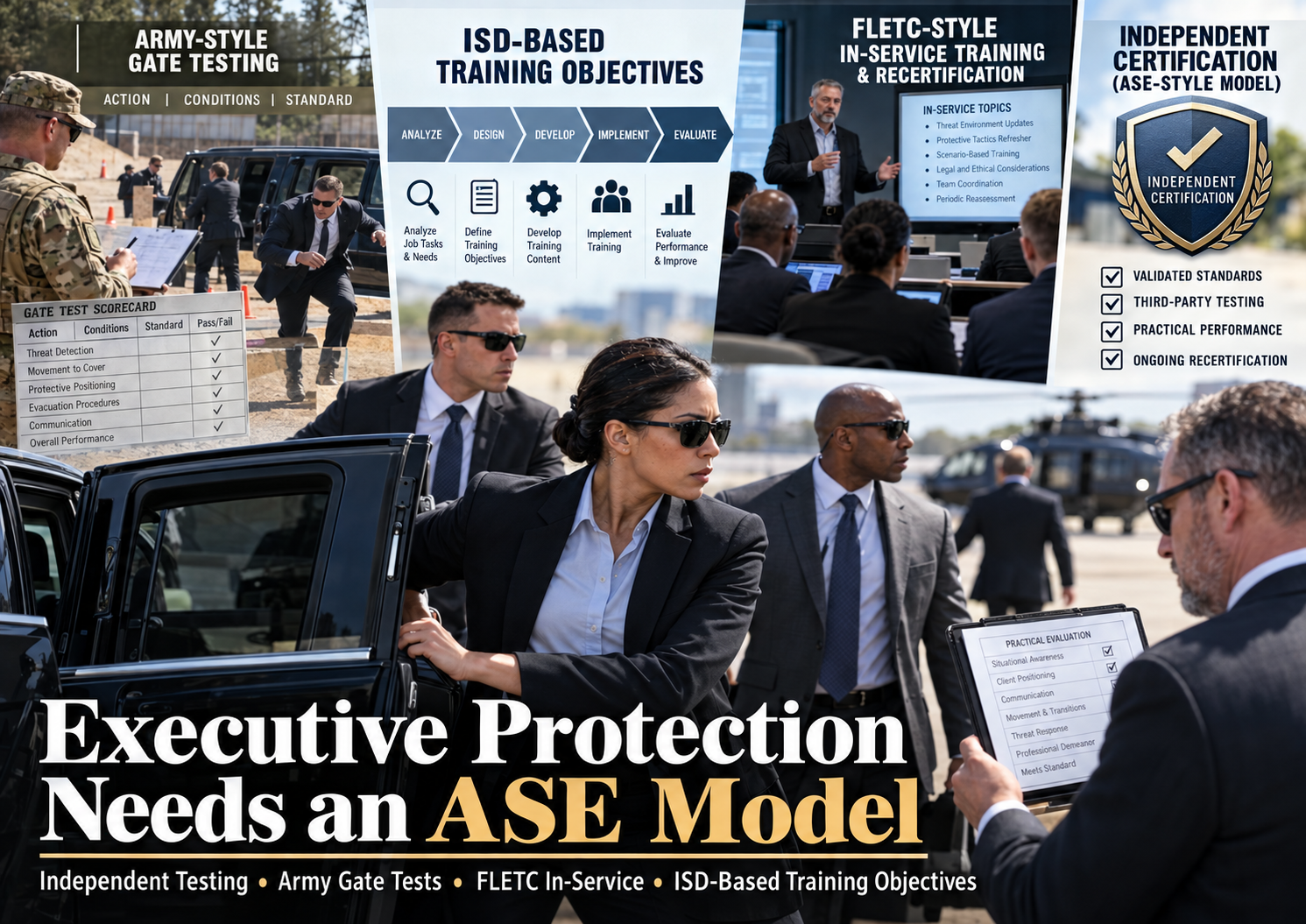
Executive Protection Certification: An ASE Model
Executive Protection Certification: From Paper to Proof — Article 6
A Voluntary National Certification System Combining Independent Examination, Practical Gate Testing and Continuing Professional Qualification
By Matthew C. Parker
Independent Security Advisors LLC (ISA) | EPTraining.us
Executive protection has standards. The next question is whether the individual can actually meet them. Matthew Parker revisits his 2020 proposal for an ASE-style independent certification system based on knowledge, demonstrated skills, relevant experience, and recertification.
Abstract
I believe the civilian executive protection industry should establish a voluntary national certification program modeled on the National Institute for Automotive Service Excellence (ASE). The program would separate professional certification from the organizations providing training, incorporate U.S. Military methods for independently evaluating practical skills, and use the continuing-training principles I experienced at the Federal Law Enforcement Training Centers (FLETC) to maintain qualifications through in-service training and periodic recertification.
An independently governed organization would establish occupational competencies, administer examinations, evaluate practical performance, and verify relevant experience. Candidates could qualify through different legitimate training and professional pathways without being required to attend one designated school.
For voluntary certification to succeed, employers, private clients, protective-service contractors and insurance underwriters must also recognize its value. ASE provides an established example of professional certification becoming commercially meaningful through employer preferences, business recognition and acceptance by vehicle-service contract providers.
1. Executive Protection Needs an ASE Model
In January 2020, I proposed examining the National Institute for Automotive Service Excellence as a model for executive protection certification. After years of developing training requirements, working with state regulators and examining outside qualification systems, I had concluded that establishing one national executive protection curriculum was not necessarily the answer.
A better approach would be an independent certification program that allowed practitioners to qualify through different legitimate training and career paths while requiring them to meet common professional standards.
I would combine three established systems. ASE provides the organizational structure for separating training from independent professional certification. The U.S. Army provides a practical method for testing occupational competencies through established actions, conditions and performance standards. Federal law-enforcement in-service training provides a model for maintaining those competencies through continuing instruction and periodic reassessment.
Each serves a different purpose, but together they offer a foundation for a voluntary national executive protection certification system. The organization administering certification would establish the qualifications associated with each professional credential, determine how applicants demonstrate the required knowledge and practical skills, verify relevant experience and establish requirements for maintaining the credential.
Professional certification would remain separate from state licensing. Training schools would continue teaching their own legitimate curricula within applicable regulatory requirements. Experienced practitioners would have an opportunity to demonstrate qualifications acquired through military service, law enforcement, government protective assignments, corporate security and private-sector executive protection.
We already have substantial material to support this work. ASIS International published its Executive Protection Standard in September 2025, and the Board of Executive Protection Professionals (BEPP) received ANSI approval for EPS-2026 in June 2026. The University of Nebraska Public Policy Center also conducted occupational-competency research in 2020 that identified knowledge and skills practitioners considered important to executive protection.
Those efforts should contribute to developing independent certification requirements. We do not need another organization attempting to control every school or dictate how every instructor must teach. We need a credible professional certification system that can operate independently of those organizations.
2. How ISA Arrived at This Proposal
ISA began examining executive protection training standards in 2011, following a request from local law-enforcement personnel for close-protection training appropriate to protecting elected officials. We examined military and federal instructional systems, Virginia’s Personal Protection Specialist requirements, and existing private-sector training programs. Our immediate challenge was establishing the minimum knowledge and skills an executive protection agent needed before undertaking protective assignments.
Having spent years developing and managing military training programs, I approached that problem through the Instructional Systems Design (ISD) process. Before writing a curriculum, you must determine what the student needs to know and be able to do. ISD provides a systematic method for analyzing occupational duties, identifying the knowledge and skills required to perform them, and developing measurable training objectives. Those objectives become the foundation for the curriculum, lesson plans, instructional methods and student evaluations.
We applied that process to ISA’s executive protection program. Rather than simply assembling a list of subjects and assigning instructional hours, we examined the duties protective agents were expected to perform and established the objectives students would have to meet. For each required competency, we needed to identify what the student should know, what the student should be capable of demonstrating, and the standard by which successful performance would be evaluated. That allowed us to establish minimum training requirements supported by written examinations and practical assessments.
Once we had identified the required competencies and developed measurable training objectives, the next question became how those qualifications could be validated beyond ISA’s own examinations. We could demonstrate that our students met the requirements of our program, and outside agencies could evaluate our training against their established requirements. But a school-issued certificate remained a qualification awarded by the institution providing the instruction. It was not an independent professional certification recognized across different training providers and career pathways.
Our experience working with state regulatory systems and outside reviewers reinforced that distinction. In May 2015, ISA entered into a recognition agreement with Industry Qualifications Limited, a British awarding organization, while examining the United Kingdom’s close-protection qualification framework. That arrangement provided another example of training providers, qualification organizations and government licensing authorities performing separate responsibilities.
I published Executive Protection Training Standards: A National Priority? in November 2018. During that period, Dr. Richard W. Kobetz, founder of the Executive Protection Institute, and Tony Scotti contributed advice that encouraged me to consider how measurable training requirements could support independent professional qualifications rather than concentrate solely on establishing national training standards.
By January 2020, I had concluded that developing minimum training objectives was an essential foundation, but it was not the final objective. The next step was establishing an independent system capable of examining an individual’s knowledge, practical skills and relevant experience against common professional requirements. The January 30, 2020 update to our standards article introduced the National Institute for Automotive Service Excellence (ASE) as a possible model.
That remains the basis of my proposal. The ISD process helped us identify what executive protection agents needed to learn and how their performance could be measured. Those competencies, together with occupational research and established professional standards, could provide the foundation for independent certification requirements. Schools would remain responsible for preparing candidates through their own legitimate programs, while a separate certifying organization would determine whether individuals met the required professional qualifications.
The distinction is important. ISD provides the framework for developing measurable instruction. An ASE-type system provides the independent professional certification that can follow. The two processes complement one another without requiring every executive protection school to teach an identical curriculum.
3. ASE: Separating Training From Certification
The National Institute for Automotive Service Excellence was established in 1972 as an independent nonprofit organization serving the automotive industry. Its certification system recognizes that technicians acquire knowledge and experience through different schools, employers, manufacturers and career paths.
ASE does not require every applicant to attend one particular technical school. Candidates seeking professional certification must pass the appropriate examinations and meet applicable work-experience requirements. Certified technicians generally must renew their credentials through recertification examinations or other authorized renewal processes.
The separation between training and certification is important. A technical school may prepare the student, an employer may provide opportunities for practical experience, and ASE independently determines whether the technician has satisfied the requirements for the credential being sought.
That credential can then be recognized by other employers and businesses. It does not remain tied to the school that originally trained the individual.
I would establish the same separation for executive protection.
A practitioner might receive initial instruction at ISA, another private school, a government academy or an employer’s internal training program. An experienced police officer or military protective-services practitioner might have acquired relevant knowledge and skills through assignments that differ substantially from a civilian school program.
Those backgrounds should not automatically be considered equivalent, but neither should qualified people be forced to repeat training merely because they did not graduate from a particular private school.
The certification organization would establish the occupational requirements, and candidates would demonstrate whether they met them.
ASE also provides a useful example of recognizing different occupational specialties. Automotive technicians do not all perform identical work, and their certification requirements reflect those differences. Executive protection presents a similar need to distinguish between foundational protective duties, advanced operational responsibilities, specialized assignments and leadership.
For example, an entry-level protective agent should not receive a credential implying the same qualifications as a person certified to lead a complex protective detail. The required knowledge, experience and practical evaluations should correspond to the responsibilities associated with each professional level.
There is one important difference between ASE’s existing model and the system I propose. ASE professional certification generally relies on occupational examinations and verified work experience rather than a universal requirement for independently observed practical repair examinations.
Executive protection requires additional consideration because many protective responsibilities involve the physical performance of tasks and decisions made under changing circumstances.
For that reason, I would supplement the ASE structure with independently administered practical gate tests adapted from established military evaluation methods.
4. The Army Model: Demonstrating Practical Competence
During my Army career, I worked within an instructional system that evaluated required tasks through established actions, conditions and standards.
The action identifies what the individual must perform. The conditions describe the circumstances, available equipment and resources. The standard establishes what constitutes successful performance.
An evaluator observes the task and determines whether the required performance measures have been satisfied. The Army historically used Common Task Testing to evaluate individual soldier skills, and the principles of defined practical performance continue through Warrior Tasks and Battle Drills.
The results of individual task evaluations commonly use GO and NO-GO determinations. A soldier either meets the required performance measures or must correct the deficiencies and demonstrate the task again.
For an independent executive protection certification program, I would use the same general approach. Written examinations are appropriate for evaluating occupational knowledge. They can assess legal responsibilities, threat assessment, protective intelligence, communications, transportation planning, emergency procedures and other subjects that an agent must understand.
But some competencies require practical performance. An applicant may know the correct answer to a written question about protective advances and still fail to identify important vulnerabilities when examining an unfamiliar location.
That is why the certification organization should establish practical examinations for skills that cannot be adequately evaluated through written testing.
A Practical Gate Test for Protective Advance Work
Consider an applicant seeking certification in protective advance work.
The applicant would be assigned an unfamiliar location, a mock client assignment, an event schedule and information about available protective resources. The candidate would conduct the advance, identify relevant concerns, develop appropriate recommendations, prepare the required documentation and brief an evaluator or designated protective team.
The examination would be conducted under established conditions using a published performance standard. A qualified evaluator would observe the work, review the documentation and determine whether the candidate satisfied the required measures.
The assessment would examine whether the candidate identified vulnerabilities, evaluated access and movement requirements, considered emergency arrangements and produced a report that could be used by other protective personnel.
Critical errors would be identified in the assessment criteria. The evaluator would not coach the candidate through the examination because the purpose is to establish whether the applicant can independently perform the required task.
Different approved testing locations could use different facilities and scenarios, provided they applied equivalent performance standards. The certification organization would be responsible for validating the assessment procedures and ensuring that evaluators applied them consistently.
Comparable examinations could be developed for protective communications, transportation planning, emergency response, movement coordination and other occupational competencies requiring demonstrated performance.
The practical-testing requirements should also reflect certification levels. An experienced agent seeking advanced certification would be evaluated against more demanding requirements than an entry-level applicant. A detail-leader candidate would have to demonstrate appropriate planning, coordination, supervision and decision-making competencies in addition to the foundational skills expected of protective personnel.
This approach would allow the certification organization to determine whether candidates can perform the duties represented by their credentials without requiring every school to use identical teaching methods.
5. The FLETC Model: Maintaining Professional Certification
Initial certification should not represent a lifetime qualification. The skills and knowledge required for protective operations change, and a credential issued years earlier cannot establish that an individual remains competent without periodic reassessment.
During my career, I attended in-service programs at the Federal Law Enforcement Training Centers (FLETC). Those programs reinforced the importance of returning previously trained personnel for refresher instruction, practical exercises and evaluation. I would adapt that principle to civilian executive protection certification.
Under the proposed system, certified agents would complete annual in-service training addressing relevant changes in protective operations, medical response, technology, legal requirements and other competencies associated with their certification level.
Training from different qualified providers should be eligible for recognition. The certification organization would establish acceptable continuing-qualification requirements but would not require agents to purchase its own courses or attend one association’s conferences.
At established intervals, agents would undergo independent recertification. Written examinations could reassess knowledge, while practical gate tests would evaluate critical skills requiring demonstrated performance. Advanced and specialist credentials would carry additional requirements appropriate to their responsibilities.
The certification body would determine the renewal periods, assessment requirements and evidence needed to maintain each credential. The purpose is to ensure that professional certification represents current qualifications rather than successful completion of training many years earlier.
6. How the National Certification System Would Operate
The certification system would begin with established occupational competencies developed through a defensible job analysis. These requirements would identify what applicants must know, what they must demonstrate, and the experience appropriate to each certification level.
The University of Nebraska Public Policy Center’s 2020 Executive Protection Professionals Core Competencies Survey provides useful supporting research. That project collected 278 valid practitioner responses concerning knowledge and skills considered important for new executive protection professionals.
I would examine that research alongside published standards, state regulatory requirements, government protective-service practices and actual private-sector protective assignments. The objective would be to establish occupational requirements through the work performed by protective personnel, rather than adopt the curriculum of one school as the national qualification.
Eligibility and Qualifying Experience
Applicants could enter the certification process through legitimate private-sector, military, law-enforcement, government or employer-sponsored preparation.
Each certification level would have defined eligibility requirements. Entry-level applicants would need to satisfy the appropriate foundational requirements, while experienced-agent and leadership credentials would require additional qualifications.
I would distinguish carefully between general security employment and actual executive protection experience. A requirement for five years of security experience tells us relatively little unless the qualifying duties are defined. Military service, law enforcement and private security cover numerous assignments that may or may not involve protective operations.
Applicants seeking an advanced executive protection credential should document experience relevant to the responsibilities represented by that certification. That might include conducting protective advances, planning movements, coordinating with other protective personnel, evaluating vulnerabilities, conducting protective operations or supervising details.
The certification organization would determine what evidence is acceptable, how experience is verified and whether particular types of prior service satisfy the requirements for the credential being sought. Experienced practitioners should have an opportunity to demonstrate their qualifications through the same independent examinations as other candidates without being required to purchase unnecessary introductory courses.
Independent Examinations and Practical Evaluations
Professional examination specialists would work with qualified executive protection subject-matter experts to develop written examinations tied to the approved competencies. Practical evaluations would be developed for occupational tasks requiring observed performance. The certification organization would establish testing conditions, assessment criteria, critical performance measures and the qualifications expected of evaluators.
The evaluators themselves would require appropriate preparation and periodic review to ensure that examination results remain consistent across locations and candidates. Examination security, candidate identification, accommodations, recordkeeping and appeals procedures would form part of the certification system.
The same professional standard should apply to all applicants seeking a particular credential, regardless of whether they prepared through ISA, another school, a government academy or relevant employment experience.
Certification Levels and Advancement
I would initially establish a manageable number of certification levels representing clearly distinguishable responsibilities.
The final categories would be determined through the occupational analysis, but the program should distinguish foundational protective skills from advanced operational duties and protective-detail leadership. Additional specialty credentials could be developed where the occupational requirements justify separate examinations and experience standards.
Candidates would receive certification only after meeting all applicable requirements. Their credentials would identify the professional level achieved, the effective certification period and any additional specialties. A verification system would allow employers and clients to confirm the status of a credential.
Advancement to higher certification levels would require satisfying the additional knowledge, performance and experience requirements associated with those qualifications. Annual continuing-qualification requirements and periodic recertification would maintain the integrity of the system.
7. Who Would Administer the System?
I propose establishing an independent nonprofit organization responsible specifically for professional executive protection certification. The organization should not be controlled by ISA, any other private training company, one membership association or a single standards publisher.
Its governing body should include qualified protective practitioners, professional examination specialists, experienced training representatives, corporate security executives, protective-service employers and other appropriate participants. I would also include representatives familiar with private-client requirements and the insurance industry. Insurance underwriters, brokers and corporate risk managers could help determine which professional qualifications might be relevant when evaluating protective-service risks.
Those interests should have an appropriate voice in developing the program without controlling individual examination results or compromising the independence of certification decisions. The organization would be responsible for developing competency requirements, commissioning or administering examinations, qualifying evaluators, verifying experience and maintaining certification records.
It would also establish procedures for recertification, appeals, complaints and disciplinary matters affecting credential status.
Independent Accreditation
I would expect the certifying organization to pursue recognized accreditation under ISO/IEC 17024:2026, the international standard addressing organizations that certify individuals. The ANSI National Accreditation Board offers personnel-certification accreditation under the applicable framework.
This should not be confused with ANSI approval of an executive protection operating standard. Approval of a professional standard and accreditation of an organization certifying individuals are different functions.
A properly accredited certification organization would provide employers and clients with another basis for evaluating the integrity of its examinations and certification decisions. The organization would need to protect the independence of testing from the training providers whose graduates seek certification.
A candidate should not be required to purchase training from the certifying organization or one approved commercial school merely to become eligible. The objective is to certify qualified individuals through an independent process, not establish another exclusive training market.
Certification and State Licensing
National certification would remain voluntary and separate from the legal authority required to provide protective services.
State regulators would continue establishing licensing, registration and other requirements within their jurisdictions. A nationally recognized professional credential would not authorize an individual to perform regulated services where state law requires a separate license.
The certification would instead establish that the credential holder had met defined professional requirements independent of those legal authorizations.
8. Training Providers and Professional Standards
A national executive protection certification should establish what individuals must know and demonstrate, not dictate how every school must teach.
ISA and other legitimate training providers should remain responsible for their curricula, instructional methods and compliance with applicable state regulations. My experience developing and supervising military instruction and working with state-regulated training programs has reinforced the importance of that distinction.
A certification organization would establish common competency requirements, examinations and practical performance standards. Different schools, government programs and employers could prepare candidates through their own appropriate methods. Existing professional standards would provide important material for developing those certification requirements.
The 2020 University of Nebraska competency survey, the ASIS Executive Protection Standard and ANSI/BEPP EPS-2026 all offer material that should be examined during the certification job analysis.
BEPP’s work with Prometric in developing a professional examination is also relevant. Professional test development is an essential part of independent certification, although I would add practical gate tests and ensure that experience requirements correspond to the credential being sought.
BEPP’s standards-development effort involved substantial volunteer participation, a contribution Mr. Kevin Dye, formerly of BEEP, emphasized in his response to Article 2 online. That work deserves recognition, but no existing organization needs to control the resulting national certification system.
BEPP is also developing a separate training-provider standard. Such standards may provide useful guidance, but certifying individual agents and establishing requirements for training schools are different responsibilities. A provider standard should not become an unnecessary exclusive route to individual certification.
I would involve ASIS, BEPP, IPSB, qualified practitioners, employers and training organizations in developing the competency requirements while keeping final certification decisions with an independently governed body. The objective is a nationally recognized professional credential available to qualified individuals through different legitimate educational and occupational pathways.
9. Why the System Would Benefit the Profession
A voluntary certification program will not succeed simply because an organization establishes examinations and begins issuing credentials. It must become valuable to individuals and organizations outside the certifying body. ASE demonstrates how that recognition can develop.
Automotive employers identify ASE certification in job requirements and preferred qualifications. Repair businesses use ASE qualifications when demonstrating the professional credentials of their personnel, and vehicle-service contract providers may recognize ASE-certified repair facilities when establishing where covered repairs can be performed.
Those arrangements create commercial incentives for technicians to become certified and for employers to hire and retain certified personnel. The same principle could make a voluntary executive protection certification valuable without compulsory government licensing.
ASE Recognition in Hiring and Commercial Services
ASE’s Blue Seal of Excellence program recognizes qualifying businesses employing ASE-certified personnel. For repair businesses, at least 75 percent of technicians performing diagnosis and repairs must be ASE certified, with appropriate certification coverage for the services offered. That recognition gives participating businesses another way to demonstrate the qualifications of their personnel to prospective customers.
Vehicle-service contract providers also provide an example of third-party recognition. CarShield’s published customer guidance identifies ASE-certified repair shops that accept its contracts as facilities customers may use for covered repairs. ASE certification is also recognized in employment. Group 1 Automotive, a major dealership operator, it identifies ASE credentials among preferred qualifications in automotive technician job postings.
These are practical examples of a voluntary credential influencing hiring, business recognition and service-provider selection. I believe executive protection certification could develop comparable recognition if the program provides professional qualifications that employers and clients consider valuable.
Benefits to Executive Protection Agents
Independent certification would allow agents to demonstrate professional qualifications beyond attendance at a particular school. An agent could present a credential supported by established examinations, practical evaluations, verified experience and continuing requirements. That credential could become a preferred qualification for corporate protective assignments or employment with professional security contractors.
Experienced practitioners would also have a means of seeking recognition for knowledge and abilities developed through legitimate occupational experience without unnecessarily repeating entry-level courses. Certification would not guarantee employment or automatically qualify someone for every protective assignment, but it could provide a recognized professional distinction when employers evaluate applicants.
Benefits to Training Providers and Protective-Service Companies
Schools could continue offering their own curricula while preparing candidates for common certification requirements. Their reputations could increasingly reflect how well graduates perform on independent examinations rather than relying exclusively on descriptions of course content or instructor experience.
Executive protection companies employing certified agents could document those qualifications when submitting proposals, competing for contracts or demonstrating professional staffing practices. A contractor would still be responsible for recruitment, background investigations, supervision and operational performance. Certification would provide an additional independent qualification that clients could consider when assessing personnel assigned to protective duties.
Benefits to Corporate and Private Clients
Corporate security departments could identify professional certification as a preferred qualification when recruiting protective personnel or evaluating contractors. Private clients and family offices could consider the credential when selecting agents or comparing protective-service providers. A recognized certification would provide a consistent explanation of the knowledge, practical skills and relevant experience required of the credential holder.
That does not eliminate the need to verify an individual’s background, professional history or suitability for a particular assignment. It provides another means of evaluating qualifications against established requirements. Clients should also be able to verify whether an agent’s credential remains current and whether the certification represents entry-level, advanced or leadership responsibilities.
Insurance Recognition and Potential Liability Benefits
Insurance companies, brokers and underwriters could become particularly important participants in the development and recognition of a voluntary certification system.
A protective-service company employing independently certified agents would be able to document that those individuals met established knowledge, practical performance, experience and continuing-qualification requirements. That information could be useful to insurance professionals evaluating a contractor’s operations or an organization’s protective program.
If insurers determine that certified personnel contribute to better risk management, they may eventually recognize those qualifications in underwriting decisions. Such recognition could potentially support more favorable terms or lower premiums for qualifying protective programs. It could also encourage employers and contractors to maintain a higher proportion of independently certified personnel.
But these outcomes cannot simply be assumed. Certification does not automatically eliminate liability, prevent incidents or guarantee insurance savings. Insurers would need evidence that the certification requirements are meaningful and that their use contributes to improved risk management or measurable outcomes.
That is why I would involve insurance brokers, underwriters, corporate risk managers and protective-service employers in developing the certification system rather than approach them only after the program had been established. Their participation could help determine what evidence would be necessary for certification to influence hiring, contracting and underwriting decisions.
Making Voluntary Certification Commercially Valuable
ASE certification has gained recognition because organizations outside ASE have chosen to use it in their business decisions. Employers value it when recruiting. Repair businesses use it to demonstrate professional staffing. Vehicle-service contract providers recognize it when directing customers to repair facilities. A voluntary executive protection certification could follow a similar path.
Corporate employers could list certification as a preferred hiring qualification. Private clients could request certified agents. Protective-service companies could demonstrate that their personnel hold recognized credentials. Insurance underwriters might eventually consider certification when assessing professional risk.
Those decisions would create incentives for agents to qualify, employers to recruit certified personnel and training providers to prepare candidates for independent assessment. The commercial value of the credential must come from recognition of the qualifications it represents, rather than the fact that an organization has issued another certificate.
10. Establishing the Certification Program
I would begin by organizing a working group representing the interests necessary to establish a credible and commercially recognized program.
That group should include experienced protective practitioners, assessment specialists, corporate security directors, protective-service employers, qualified training representatives, private-client advisers, insurance professionals and appropriate state regulatory advisers.
ASIS, BEPP, IPSB and other organizations with relevant occupational research or standards-development experience should be invited to contribute.
The purpose would not be to select one organization’s existing curriculum or professional standard as the entire certification requirement. It would be to establish occupational competencies through a defensible job analysis that draws on available research, professional practice and actual protective duties.
Developing the Certification Requirements
The working group would examine the 2020 University of Nebraska competency research, current professional standards, state regulatory requirements, government protective-service practices and requirements established by employers.
From that work, it would identify appropriate foundational, advanced, specialty and leadership competencies.
The certification body would determine which competencies can be measured through written examinations, which require independently observed practical performance and what experience applicants must document.
Professional examination specialists would develop examination plans, testing procedures and methods for validating the assessments. The certification organization would also establish its governance, eligibility rules, candidate procedures and requirements for maintaining the credential.
Pilot Examinations and Practical Testing
Before introducing national certification, I would pilot the examinations with candidates representing different training and professional backgrounds. The written and practical examinations should be administered through more than one legitimate testing environment.
We would examine whether the assessments measure relevant occupational competencies, whether independent evaluators reach consistent decisions and whether applicants from different educational pathways have a fair opportunity to demonstrate their qualifications.
The pilot should identify weaknesses in examination instructions, practical testing conditions, evaluator procedures and the requirements established for each certification level. Those findings should be used to improve the system before the organization asks employers and clients to recognize the credentials.
Employer, Client and Insurance Participation
The certification-development process should include a separate effort to establish prospective recognition by employers, clients and insurance professionals.
Corporate security directors and protective-service employers could examine the proposed credentials to determine whether they would use certification as a preferred qualification for appropriate positions and assignments.
Private-client representatives could evaluate how certification information should be presented so that families and other end users can understand what the credential represents.
Insurance brokers and underwriters could identify what evidence they would need before considering certification in risk assessment or underwriting decisions.
The certifying organization should gather appropriate examination, performance and outcome information over time so that professional and commercial claims can be evaluated rather than assumed.
This would allow the certification program to develop professional credibility and potential market recognition together.
National Introduction and Continuing Review
Once the organization had completed initial examination development and validation, it could introduce certification under its published requirements. Candidates would qualify through approved assessment procedures rather than attendance at one designated school. Employers and clients would be able to verify credentials, and certified personnel would maintain their qualifications through annual in-service requirements and periodic recertification.
The independent nonprofit should seek appropriate accreditation and periodically review its examinations, practical assessments and occupational competency requirements.
The system would have to evolve as protective assignments, technologies and professional responsibilities change.
I would judge the program through two principal measures: whether it reliably establishes the professional qualifications represented by its credentials, and whether employers, clients and insurers find those qualifications useful enough to recognize voluntarily. Both are necessary for a successful national certification program.
Conclusion: Establishing a Certification Worth Recognizing
ISA began examining executive protection training standards in 2011 because we needed measurable objectives for preparing protective personnel. Our use of ISD, state regulatory requirements and outside reviews helped establish what agents needed to learn and how their performance could be evaluated.
By January 2020, that work had led me to a larger conclusion. We did not need every protective professional to attend the same school or complete one prescribed curriculum. We needed an independent method of establishing whether individuals coming through different legitimate training and career paths met common professional requirements.
ASE provides the organizational model. The Army provides established methods for practical gate testing. The continuing-training principles I experienced at FLETC provide a model for maintaining professional qualifications.
An independent nonprofit could combine those elements into a voluntary certification program that recognizes occupational knowledge, demonstrated skills, relevant experience and continuing competence.
Schools would remain responsible for their lawful instruction. State regulators would retain their authority over licensing and registration. The certification organization would independently evaluate candidates against the requirements associated with their professional credentials.
But establishing technically sound examinations would not be sufficient by itself. For the program to succeed, the credential must acquire value among the organizations employing protective personnel, purchasing protective services and evaluating the risks associated with those operations.
ASE demonstrates how voluntary professional certification can gain recognition through employer preferences and commercial decisions. Executive protection could benefit from similar recognition by corporations, private clients, protective-service contractors and, eventually, insurance underwriters.
I do not propose another compulsory national license or an organization that controls every executive protection school. I propose an independent, voluntary professional certification system that agents have reason to pursue and that employers, clients and insurers have reason to recognize.
That is the ASE–Army–FLETC model I advocated examining in 2020, and it remains the approach I believe the civilian executive protection industry should pursue.
Frequently Asked Questions
What is an ASE-style executive protection certification?
It is a voluntary professional certification administered independently of the schools and employers preparing candidates. Individuals would qualify by meeting established knowledge, practical performance and relevant experience requirements, with continuing training and periodic recertification.
How would the Army and FLETC models fit into the system?
Army-style practical gate testing would provide a method for independently evaluating occupational skills against established performance measures. The FLETC model would contribute the principle of continuing professional training and reassessment after initial qualification.
Would executive protection schools have to use an identical curriculum?
No. Schools would remain responsible for developing and delivering instruction within applicable regulations. The independent certification organization would establish the competencies candidates must demonstrate.
Could experienced agents qualify without attending another basic course?
The system should provide an appropriate route for experienced applicants who can document relevant work and pass the required written and practical examinations. The certification body would determine the experience and assessment requirements for each credential.
Would certification replace state licensing?
No. State licensing and registration requirements would continue to apply wherever required. Independent national certification would be a separate, voluntary professional qualification.
Who would administer the certification?
A separately governed nonprofit organization responsible for establishing certification requirements, administering independent examinations, verifying experience, qualifying evaluators and maintaining credentials. The organization should pursue appropriate personnel-certification accreditation.
How could a voluntary executive protection certification become nationally recognized?
The certification would have to demonstrate value to employers, clients and other organizations making protective-security decisions. Corporate employers could identify certification as a preferred hiring qualification, private clients could consider it when evaluating service providers, and insurance professionals could examine whether documented qualifications provide useful evidence for risk assessments.
Recognition would develop through the credibility of the certification requirements and the decisions of participating organizations rather than compulsory government licensing.
Could certification reduce insurance premiums or liability?
Independently verified qualifications could provide insurers and corporate risk managers with useful information about protective personnel. If those qualifications were shown to contribute to reduced risk, insurers might eventually consider them when establishing underwriting terms or premiums. Certification would not automatically reduce legal liability or guarantee insurance savings.
About the Author
Matthew C. Parker is Chief Executive Officer of Independent Security Advisors LLC (ISA) and Director of Training for EPTraining.us. His professional experience spans more than three decades of military service, executive and dignitary protection operations and training, international security advising, and protective program development.
Before retiring from the U.S. Army in 2011, Parker conducted protective operations involving senior U.S. military leaders, trained U.S. and Iraqi protective-security personnel, managed military instructional programs and taught military science at Virginia Tech.
Since establishing ISA in 2011, he has directed executive protection operations in the United States for international government officials and trade delegations, provided protective services for corporate and private clients, and developed protective programs for financial institutions, insurance companies and private families.
His international experience includes security-advisory and protective assignments in Ukraine, training for Ukrainian police and Judicial Protection Service personnel, and advisory work concerning international commerce, diplomatic protection and democracy-support initiatives.
Independent Security Advisors LLC | EPTraining.us
From Paper to Proof — Article 6
Sources and Related Reading
ASE Certification and Commercial Recognition
National Institute for Automotive Service Excellence — About ASE
ASE — Work Experience Requirements
ASE — Blue Seal of Excellence Program
CarShield — Vehicle Protection 101
Group 1 Automotive — BMW ASE Certified Technician Job Posting
ISA History and Competency Research
ISA — Executive Protection Training Standards: A National Priority?
ISA — Executive Protection Training Standards and Program Evaluation
Virginia Department of Criminal Justice Services — Personal Protection Specialist
UK Security Industry Authority — Licence-Linked Qualifications
Standards, Certification and Accreditation
ASIS International — Executive Protection Standard
BEPP — Standards and Certification Updates
BEPP — Professional Certification
BEPP — Training-Provider Standard Development
ANSI — Board of Standards Review
ANSI National Accreditation Board — Personnel Certification
Federal Law Enforcement Training Centers
Independent Security Advisors | EPTraining.us | ISA Executive Protection Standards Series — Article 6
Publisher: Independent Security Advisors LLC / EPTraining.us
Hashtags:
#ExecutiveProtection #ExecutiveProtectionCertification #ExecutiveProtectionStandards #ExecutiveProtectionTraining #ProtectiveServices #ProfessionalStandards #EPTraining #IndependentSecurityAdvisors