
 E-mail us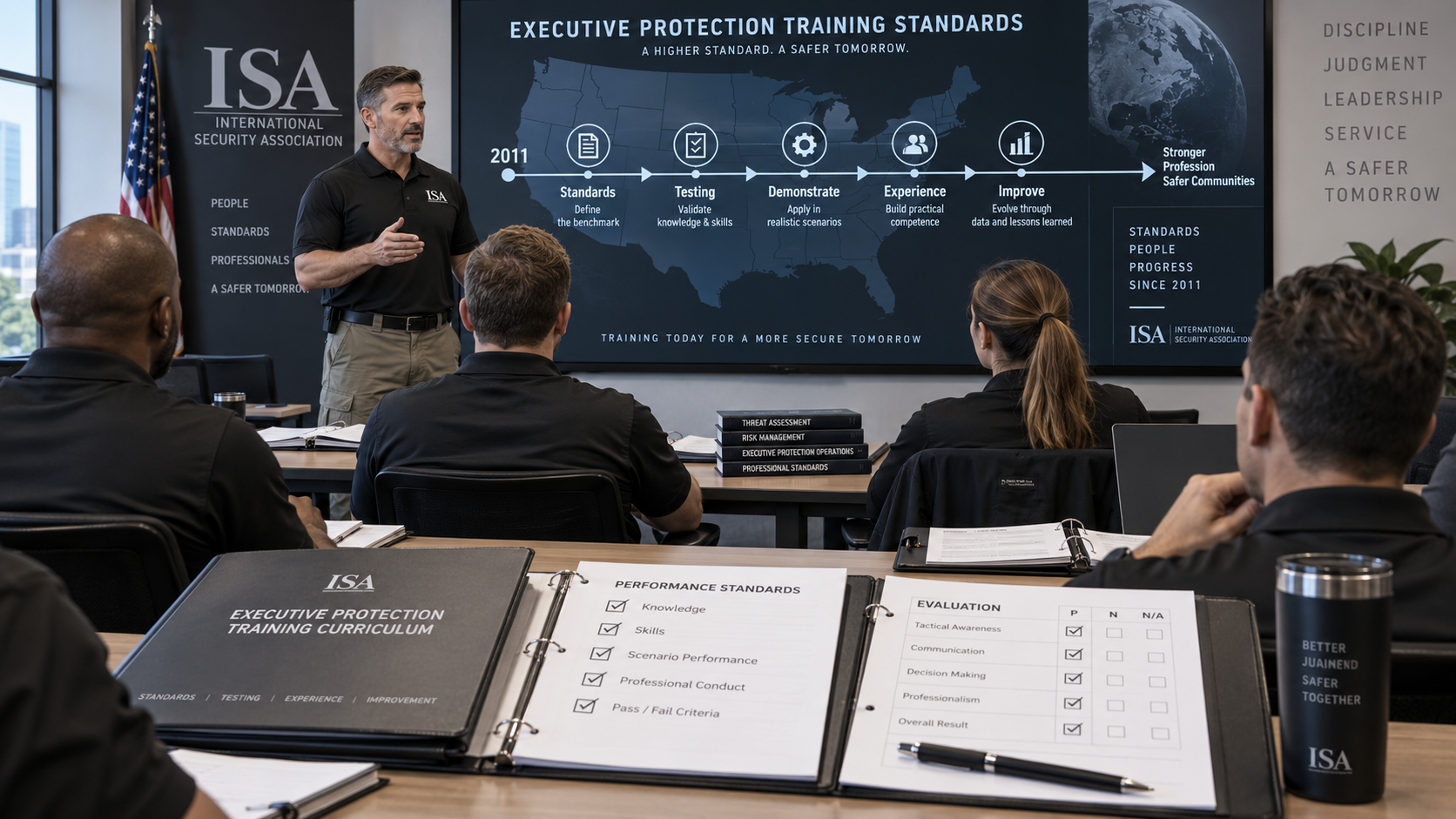
ISA Has Been Doing Standards Work for More Than a Decade
executive protection training standards
Why Independent Security Advisors Has Earned a Place in the Executive Protection Standards Conversation
By Matthew C. Parker
Independent Security Advisors | EPTraining.us
Independent Security Advisors has been working on measurable executive protection training standards since 2011, years before today’s ASIS, BEPP and ANSI debate. Matthew Parker traces ISA’s early standards work, outside regulatory review, state licensing relationships and continuing argument that professional training must be measurable, testable and relevant to the people who actually perform protective operations.
Executive protection is talking about standards again, and I think that is a good thing. What is easy to forget, especially when looking at the profession through the lens of the last year or two, is that standards were not always a popular subject in executive protection. Independent Security Advisors did not begin asking these questions because ASIS published an executive protection standard in 2025 or because BEPP’s privately developed consensus document received an ANSI designation in 2026. Our published record reaches back to 2011, when we were trying to solve a practical training problem for law-enforcement personnel assigned to support elected officials.
That history matters because it explains how we arrived at our present position. It also explains why I continue to ask some fairly basic questions whenever somebody tells the profession that a new standard, credential or certification is the answer. What exactly is the standard? What is it supposed to accomplish? Who recognizes it? How is performance measured against it? How does it interact with state regulation? Most importantly, does it make the person doing the job more capable? Those questions did not originate with the current standards debate. We have been asking variations of them for years.
The Problem We Encountered in 2011
Following the shooting of Representative Gabrielle Giffords in 2011, ISA was approached by local law-enforcement personnel seeking close-protection training that would help them support their own elected officials. The original course was relatively short and covered the fundamentals of physical and event security, advance work, movement and immediate-action procedures. While developing that training, however, we encountered a larger problem: we could not find a single, readily available, quantifiable training standard specifically designed for state and local law-enforcement personnel performing close-protection duties.
Our later article, Executive Protection Training Standards: A National Priority?, documented that search and our decision to look to Department of Defense and Federal Law Enforcement Training Centers material for guidance. The question driving the effort was practical rather than academic: if we were going to tell an officer that he or she had been trained to perform protective duties, trained to what standard?
That question pushed the program beyond the original course. We examined federal and military training models, reviewed private-sector executive protection practices, and conducted the instructional-systems-design work necessary to identify the critical skills a protective professional actually needed to perform. The program became longer and more demanding because the training problem was larger than the original syllabus.
We Were Talking About Standards When the Idea Was Not Popular
By 2012, according to our published history, ISA had begun taking the program through outside regulatory and accreditation processes rather than relying exclusively on our own opinion of whether the curriculum was good enough. Our 2018 retrospective records that the program received the first of what would become several state regulatory approvals and law-enforcement training recognitions during that period. The process was expensive and time consuming, but the purpose was straightforward: if students and employers were going to place value on the training, somebody outside ISA should be able to examine what we were teaching and determine whether it satisfied requirements we did not write for ourselves.
By 2014 we were publicly pushing the issue much further. In announcing an educational partnership that year, we wrote that we hoped it would become “the first step in establishing a recognized national standard in executive protection training and accreditation.” That language is worth remembering because it was written in 2014, not after executive protection standards became a major industry topic. We were looking for broader professional recognition, common expectations and measurable training at a time when the private sector did not have a single framework we could simply adopt.
The response was not universal applause. Our later retrospective records that some people in the profession questioned whether the effort represented the beginning of a federal takeover of private executive protection training. Most of the private sector did something less dramatic: very little. We continued anyway, and later in 2014 the International Foundation for Protection Officers endorsed ISA’s dignitary protection training program. Our announcement tied education and certification to the development and maintenance of professional training and ethical standards, while also extending scholarships and reduced tuition because accessibility was part of the discussion even then.
That period still influences how I look at standards today. There was no obvious commercial advantage in being the company talking about them. There was no new executive protection credential to market against and no large standards movement to join. We were trying to persuade people that measurable, externally recognizable training standards deserved serious attention in the first place.
Curriculum and Standards Were Never the Same Thing
In 2017, I addressed the issue again in Executive Protection Training Programs: New EP Instructors Beware, It’s Not Easy. I wrote that specialized training providers have “two critical core concerns, curriculum development and standards of training.” I still believe that distinction is fundamental. A curriculum tells us what subjects are going to be taught; a standard tells us what acceptable performance looks like.
A school can teach advances, walking formations, motorcades, threat assessment, protective intelligence, surveillance detection, communications, medical response and firearms. That tells us what appeared on the schedule, but it does not necessarily tell a student, employer or regulator what level of performance was required before graduation. That is why ISA began working with measurable learning objectives, instructional-systems-design principles, practical exercises and evaluation standards rather than treating a list of topics as proof that learning occurred.
The 2017 article made the argument more directly than much of our earlier writing. Programs should identify the objective, identify the tasks and skills required to accomplish it, define the conditions under which those tasks will be performed, and establish quantifiable and achievable standards for graduation. I also warned against building standards around war stories or an instructor’s personal recollection of how something was done on a particular deployment. Experience matters tremendously, but experience is not a substitute for instructional design. The instructor’s job is to convert relevant experience, doctrine, research and current operational requirements into training that another person can learn, practice and demonstrate.
If the student simply watches the instructor perform, we have demonstrated the instructor’s competence. We have not demonstrated the student’s.
By 2018, We Were Still Asking Why This Had Not Been Solved
Our November 2018 article, Executive Protection Training Standards: A National Priority?, revisited the history beginning in 2011. It documented the original law-enforcement request, the search for external training models, the state regulatory work, the 2014 effort to gain broader educational recognition and the industry’s mixed reaction to standardization. By then, other professionals were also beginning to write more openly about the lack of consistent curricula, evaluations and certifications across executive protection training.
For ISA, the discussion felt familiar because we had already spent years working through many of the same issues. The record is not one article written after standards became fashionable. It is a continuous body of work that began in 2011, when we first encountered the problem while developing close-protection training for law enforcement. From there, we moved the program through outside regulatory and accreditation processes, and by 2014 we were publicly arguing for a recognized executive protection training standard even though that position drew criticism from parts of the industry. We continued the discussion in the years that followed, writing about the relationship between curriculum and measurable standards, revisiting why the profession still lacked a consistent approach, and evaluating our own program against the same questions we were asking others. By 2024, we were still making the same basic point: listing training topics is not enough if there is no clear way to measure whether a student can actually perform to a defined standard.
We did not come to this discussion because standards suddenly became popular. We had been working on the problem for years, and we had already learned that writing a standard is the easy part. Making it useful, measurable and relevant to the people doing the work is considerably harder.
We Were Also Willing to Apply the Questions to Ourselves
One of the most important pieces of ISA’s standards history came from our 2019 program-evaluation work. In Executive Protection Training Standards & Program Evaluation, we used questions raised by longtime security-driving and training professional Tony Scotti to examine our own program. Three of those questions went directly to the point: “What is the standard that I will be trained? How will I be measured to that standard? Where is the standard documented?”
Those remain good questions for a prospective student to ask any training provider, including ISA. Our evaluation examined the standards behind the curriculum, the qualifications of instructors, the relevance of the material, how students were evaluated and whether the program continued to meet the commitments we had made when it was developed. The review also described our use of FLETC protective-service training as an important model and the incorporation of state regulatory requirements into the program.
That kind of self-examination is not a weakness in a standards system; it is one of the things that makes the system credible. If I am going to ask another organization when it last reviewed its standard, how it measures results or whether its documentation is current, ISA has to accept the same questions.
In fact, while reviewing our material for this series, we found something that needs to be updated. Our current published Executive Protection Training Syllabus still references the 2020 edition of the FLETA Procedures and Standards Manual. FLETA has since published a 2025 edition. ISA does not claim FLETA accreditation; we use applicable FLETA procedures and standards as a voluntary quality-assurance reference. If we are going to cite that framework, however, the reference should be current, and we will update it.
External Scrutiny Still Matters
ISA has always believed there is a meaningful difference between declaring your own program excellent and placing that program into an environment where another organization has requirements you must satisfy. Virginia provides a current example. The Virginia Department of Criminal Justice Services currently lists Independent Security Advisors for 32E Personal Protection Specialist Entry-Level and 32I Personal Protection Specialist In-Service online training.
North Carolina provides another. The North Carolina Private Protective Services Board currently lists ISA NC PPSB Fundamentals of Personal Protection and the ISA Dignitary Protection Studies Program among the courses pre-approved for Close Personal Protection licensing purposes. The Board’s current continuing-education list also identifies ISA’s Private Security EP Operations course as a 12-hour approved program through December 20, 2026.
The South Carolina Criminal Justice Academy’s 2026 Institutional Provider Catalog lists ISA’s Dignitary and Executive Protection Specialist program as lesson plan 5365, with 70.5 hours of training. None of these facts means ISA is automatically right about every question involving executive protection. State approval is not sainthood, and regulatory compliance is not the end of professional development. What these examples do establish is that our standards philosophy has operated in environments where somebody outside our company gets a vote. I value that.
State Requirements Matter, but a Minimum Is Still a Minimum
Our early use of the phrase national standard also deserves some explanation because my thinking has become more precise over time. I support common professional expectations, measurable standards and independent competency testing, but I also believe the states have a legitimate regulatory role that should not be casually displaced by a private organization or by the appearance of a national label.
Our 2018 standards article was updated in 2020 to address concerns about federal regulation. We acknowledged the cost, state-authority and regulatory objections to federalizing executive protection training and concluded that federalization was not a realistic answer. The article instead argued for a private-sector effort that could raise professional standards while existing state regulatory systems continued to perform their legal role. That is much closer to how I would describe the objective today.
A state establishes the legal requirements for work within its jurisdiction. A professional standard can provide additional consistency. A training organization can prepare people to meet those requirements and go beyond them. An employer can establish mission-specific qualifications, and an independent certification system can test whether an individual actually possesses defined knowledge and skills. Those functions do not have to compete with one another, and they certainly should not be deliberately blurred.
ISA has also never argued that a state’s minimum training requirement represents the maximum level of professional competence. Our article Executive Protection Training Standards: The Minimums made that argument directly. Minimum requirements matter because they establish a legal floor, but a serious professional should understand that the floor is where development begins, not where it ends.
A Standard Has to Survive Contact With Reality
After all these years, my view of standards is probably simpler than it was when we started. I am less interested in how impressive a document looks than I am in what happens after somebody reads it. Can an instructor convert it into training? Can the objectives be measured? Can two qualified instructors evaluate the same performance and reach reasonably consistent conclusions? Does a student know what he or she must demonstrate? Does an employer know what a certificate actually represents? Does a regulator understand how the training relates to the law? Does somebody independently determine whether the practitioner can perform?
Those questions matter because eventually the meeting ends, the instructor leaves and the professional has to do the job. I have seen that reality in very different environments over the course of my career. Whether training soldiers, law-enforcement officers, protective personnel or security organizations overseas, the principle has remained remarkably consistent: a system is not successful simply because instruction was delivered. The people who remain have to be capable of performing the mission.
That is where standards become useful. A document sitting on a shelf does not make executive protection better; a standard that improves training, testing, organizational performance and professional judgment can. There is a substantial difference between the two.
We Were Still Making the Same Argument in 2024
ISA’s later standards work did not abandon those earlier principles. In Executive Protection Training Standards, published in 2024, we again argued that simply adding topics to a course is not enough. The learning objective has to state what the student is expected to learn, understand, evaluate, discuss or demonstrate, and the program needs a standard against which that performance can be judged.
The article put the point plainly: “Without these standards to grade or evaluate a student’s ability to do the job of an agent there is no purpose or reason to attend training.” The language is blunt, but the principle is the same one that has guided this work from the beginning. Training is not successful because the instructor completed the presentation or because the student received a certificate. Training is successful when the student can demonstrate the required knowledge, skill and judgment to the defined standard.
Now the Profession Has New Documents to Evaluate
The standards environment is unquestionably different today. ASIS International published its Executive Protection Standard in 2025. BEPP developed its own executive protection consensus document, and according to BEPP’s published project updates, ANSI approved ANSI/BEPP EPS-2026 on June 8, 2026.
Those developments deserve examination, but the terminology needs to remain precise. ANSI explains that it is a private nonprofit organization, not part of the federal government, and that it does not itself develop standards. ANSI accredits the procedures of standards developers and approves qualifying documents for designation as American National Standards when its due-process requirements have been met. ANSI also makes clear that voluntary consensus standards are not law unless an authority later incorporates them into a binding requirement.
That distinction matters. An American National Standard designation does not mean Congress enacted the document, a federal agency imposed it, the fifty states adopted it, or the executive protection profession collectively accepted it as the nation’s governing standard. The designation tells us something important about the process used to develop the document; it does not answer every other question a practitioner, employer or regulator should ask.
Does a state recognize it? Does it satisfy a licensing requirement? Can employers implement it? Can training providers teach against it? Can practitioners reasonably access it? Does it establish individual competence? Who tests that competence? What professional result follows from obtaining the document? Those are not hostile questions. They are the kinds of questions standards are supposed to survive.
Standards Should Serve the Profession
ISA’s position today is built on more than a decade of working through this problem. We support meaningful professional standards, state regulatory authority, measurable training, continuing professional development and independent assessment of competence. We believe training organizations should be able to explain what they teach, why they teach it, what standard applies and how they know a student met that standard.
What I do not believe is that publishing a document should make any private organization synonymous with the profession itself. Standards organizations have a role. State regulators have a role. Training providers have a role. Employers have a role. Certification organizations can have a role. The professional has perhaps the most important role of all: continuing to learn, gaining meaningful experience and demonstrating the ability to perform.
We were asking these questions when standards were not particularly popular in executive protection. We were asking them when some people thought the entire idea was unnecessary, and we kept asking them as our own program changed. We should keep asking them now.
Standards should serve the profession—not become the profession.
Frequently Asked Questions
How long has ISA been working on executive protection training standards?
Independent Security Advisors traces this work to 2011, when the organization was developing close-protection training for law-enforcement personnel supporting elected officials. ISA subsequently pursued outside regulatory review and publicly advocated broader executive protection training standards years before the current ASIS and BEPP standards debate.
What does ISA mean by an executive protection training standard?
ISA uses the term to describe defined expectations against which training and student performance can be measured. A curriculum identifies what will be taught; a meaningful training standard helps establish what the student is expected to know or perform and how that performance will be evaluated.
Does ISA believe state licensing requirements are enough?
State requirements establish important legal and regulatory minimums, but ISA does not consider a regulatory minimum to be the limit of professional development. A practitioner may need substantially more education, practical training and experience depending on the protective mission, client, threat environment and applicable law.
Is an ANSI American National Standard a federal executive protection standard?
No. ANSI is a private nonprofit organization, and an American National Standard is a voluntary consensus standard approved through ANSI’s process. The designation does not by itself make the document federal law, a state licensing requirement or evidence that the entire executive protection profession has adopted it.
Does completing an executive protection course prove professional competence?
Not necessarily. Course completion establishes that a student completed the requirements of that particular program. ISA’s broader standards position is that training, testing, demonstrated performance, experience and continuing professional development are different parts of professional competence and should not be confused with one another.
Why is ISA discussing executive protection standards again in 2026?
Because the profession now has additional standards frameworks to evaluate, creating legitimate questions about purpose, implementation, accessibility, relationship to state regulation and the difference between a standards document and demonstrated individual competence. ISA approaches those questions from more than a decade of documented standards and curriculum work.
Related ISA Resources
- Executive Protection Training Standards: A National Priority?
- Executive Protection Training Programs: New EP Instructors Beware, It’s Not Easy
- Executive Protection Training Standards & Program Evaluation
- Executive Protection Training Standards: The Minimums
- ISA Executive Protection Training Standards
- Executive Protection Training Curriculum
- Executive Protection Training Syllabus
- Dignitary and Executive Protection Specialist Course
- Matthew C. Parker – Instructor and Professional Profile
- About Independent Security Advisors
About the Author
Matthew C. Parker is CEO of Independent Security Advisors LLC and Director of Training for EPTraining.us. A retired U.S. Army Senior Non-Commissioned Officer, combat veteran, protective-services practitioner and senior instructor, Parker has more than three decades of military, security, training and advisory experience in the United States and internationally.
His work has included executive and dignitary protection, national-level government and security advising, development and training of government protective personnel, law-enforcement training, and standards-based training programs in the United States, Iraq and Ukraine. His international experience includes advisory work involving the Government of Iraq and the Kurdistan Regional Government and later military, police and judicial-security organizations in Ukraine. Parker received the Iraqi Commitment Medal from the Government of Iraq for his contributions to Iraqi national security, becoming one of only three Americans to receive the distinction. Additional background is available on his ISA professional profile.